Introduction
Welcome to The ContraMind Code.
The ContraMind Code provides you with a system of principles, signals, and ideas to aid you in your pursuit of excellence.
The newsletter shares the source code through quick snapshots for a systems thinking approach to be the best in what you do.
The Code helps you reboot and reimagine your thinking by learning from the best and enables you to draw a blueprint on what it takes to get extraordinary things done. Please share your valuable thoughts and comments and start a conversation here.
Take a journey to www.contraminds.com. Listen and watch some great minds talking to us about their journey of discovery of what went into making them craftsmen of their profession to drive peak performance.
The Myth of ‘I’m Bad at Math’.
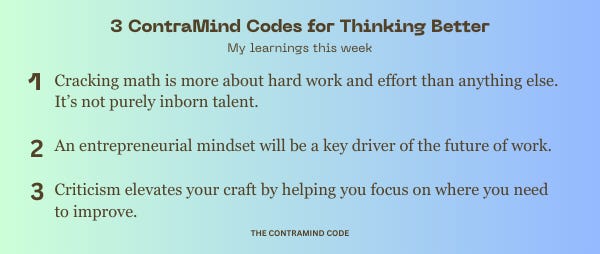
Many of us carry this perception that we are bad at math. And would like to stay away from anything to do that is close to it. The question to ask ‘Is being good in math genetic or can it be worked on?’ This article by Miles Kimball, Noah Smith, and Quartz answers the question very well - persistence, hard work and effort is vital:
‘East Asian countries focus more on hard work than on inborn talent.’
“When they do badly at something, [Japanese, Koreans, etc.] respond by working harder at it.”
“Persistence in the face of failure is very much part of the Asian tradition of self-improvement. And [people in those countries] are accustomed to criticism in the service of self-improvement in situations where Westerners avoid it or resent it.”
The article urges Americans to learn from East Asians (India is not included in this list) when studying math, and it offers many resources and links that can provide valuable insights.
Read the entire article here.
12 Questions Heading into 2026.
As we head into 2026, we will grapple with how to stay relevant in the face of technological change, and judgment will matter more than information. We need to purge our minds of old mental models and adopt new ones that make us relevant and ready to handle uncertainty. We need to develop our ability to learn how to learn, think clearly in the age of AI, make responsible decisions, and keep asking better questions as the world continues to change.
This recap episode from Contraminds will help you prepare for this change and set the ball rolling.
You can also listen to this episode on: Apple Podcast | Amazon Music | YouTube
AI in 2026: Reid Hoffman’s Predictions on Agents, Work, and Creation
Dan Shipper, Co-Founder and CEO of Every, is in conversation with Reid Hoffman, discussing his predictions for where AI will go, over the next 12 months.
Top predictions Reid Hoffman makes, which are worth thinking about:
Future of work will need an entrepreneurial mindset.
People need to learn how to create rather than just do or manage in the age of AI.
There will be significant use of AI to amplify meetings and coordinate workflows within enterprises in 2026.
Biological Therapeutics is a category to watch, as AI will have a huge impact there in 2026.
How Prepared Are You To Handle Criticism?
Increasingly, many countries around the world are becoming societies unable to handle criticism. This gets reflected directly in its people, culture, behaviour, and as responses in their personal life and at the workplace, too.
A good way to analyse this phenomenon is to ask ourselves where does it all begin.
In the modern age, it starts quite early at home and in schools, where ‘hyper-sensitive’ parents transfer their anxiety to children. They find it hard and can’t accept when their children face difficulties, get rejected and fail. Unable to handle even a small criticism of their ward, they begin to ill-prepare their children for the harsh world outside. Schools and colleges, too, have chickened out in the face of backlash and grade- or score-obsession! Imagine a whole decade and a half in which children are prepared in such a manner and then unleashed into an ‘unsympathetic and ruthless’ world of work.
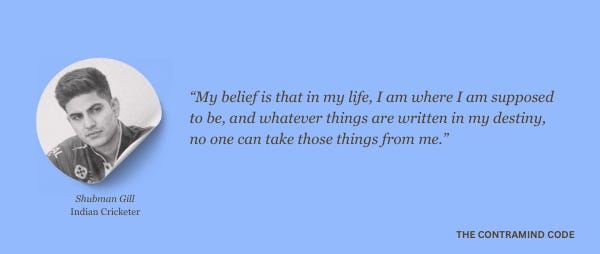
Let’s take the example of one of India’s leading cricketer and a rising star, Shubman Gill. Recently, he was brutally axed from the Cricket World Cup T-20 squad. Just think for a minute, he was the leading run scorer in the 2023 IPL season, with a whopping 890 runs, including 3 centuries, and in IPL 2025, he amassed 650 runs! This is after an incredible run in tests in England, where he scored 754 runs in five tests. There were severe criticisms about his performance and technique for the T-20 format! What was Gill’s response? “My belief is that in my life, I am where I am supposed to be, and whatever things are written in my destiny, no one can take those things from me.”
When you look back at research studies done by psychologists David Dunning and Justin Kruger, who first described this in 1999, they called it the Dunning-Kruger Effect.
Dunning-Kruger Effect is a cognitive bias where people with low ability in a specific area overestimate their competence, while highly skilled individuals often underestimate theirs.'
Therefore, low performers, overestimate their skills because they don’t know enough to recognize their own incompetence. And high performers underestimate their skills, assuming that tasks that are easy for them are also easy for others.
The question is - how do you communicate or have a conversation about this with the people? It’s today packaged in positive words like “feedback” and “review,” and its impact and resulting outcomes are lost until the person discovers hard truths themselves. By then, it is too late.
Preparing for criticism early is a great way to overcome this huge challenge.
It is worth remembering that praise makes you feel good. Criticism makes you better.
First, it starts with appreciating that not all criticisms are bad. You must develop the maturity to filter criticism, but be open to it coming at you in full force. Then, the next question is, how will you respond to the criticism?
With criticism, you begin to see what you cannot see. Criticism creates a lot of friction, which is true. But this friction helps you develop ‘desirable difficulty’—where it prepares you for more effort and hard work, pushes you to practice more, significantly slows down your learning and growth in the short term, but dramatically improves retention and skill transfer. Also, struggle-induced learning and practice lead to superior long-term mastery.
Criticism also improves your psychological resilience. It also allows you to seek out and engage in authentic conversations. There is a lot of literature and articles on authenticity and authentic leadership, but if there is no ability to engage in direct and authentic conversations, then these remain mere theory and reading! Criticism allows you to focus intensively on your most potent weakness, prevents you from plateauing, and helps you convert effort into measurable progress.
You must start responding to it by delineating your identity from performance. You can start treating criticism as input rather than a judgment. You have to develop the ability to accept that criticism is a core ingredient of deliberate practice, a method that underlies elite performance in sports, music, medicine, and leadership.
Criticism helps you build your character, accountability and improve your personal standards. Criticism allows you to put more effort and hard work into fixing chinks in your armour. It also acts as a foundation for ownership of outcomes. If you want to be an effective leader, it helps you develop trust and influence.
Criticism helps you recalibrate and elevate your craft.