Introduction
Welcome to The ContraMind Code.
The ContraMind Code provides you with a system of principles, signals, and ideas to aid you in your pursuit of excellence. The newsletter shares the source code through quick snapshots for a systems thinking approach to be the best in what you do. The ContraMind Code helps you reboot and reimagine your thinking by learning from the best, and enables you to draw a blueprint on what it takes to get extraordinary things done. Please share your thoughts and comments to start a conversation here.
Take a journey to www.contramindslabs.com. Discover a complete system for ambitious professionals who refuse to plateau, and also a place where you can listen and watch some great minds talk to us about their journey of discovery of what went into making them craftsmen of their profession, to pursue excellence and drive peak performance.
When Data Is Right, But Decisions Go Wrong.
In their column in Founding Fuel, Debleena Majumdar, an entrepreneur, business leader, and author and Arjo Basu, a systems thinker, technologist, and entrepreneur, elucidate that one of the biggest challenges companies face, especially after doing all the hard work and heavy lifting of data, is that decisions still go wrong!
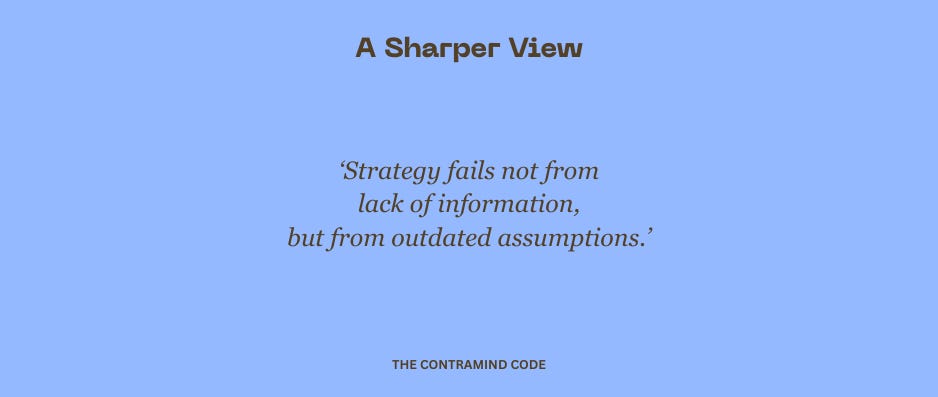
They summarise this challenge and outcome very well - ‘Strategy fails not from lack of information, but from outdated assumptions.’
Here are some interesting takeaways or quotes from the article:
The need may not be for more data, but for a change in how existing data is interpreted.
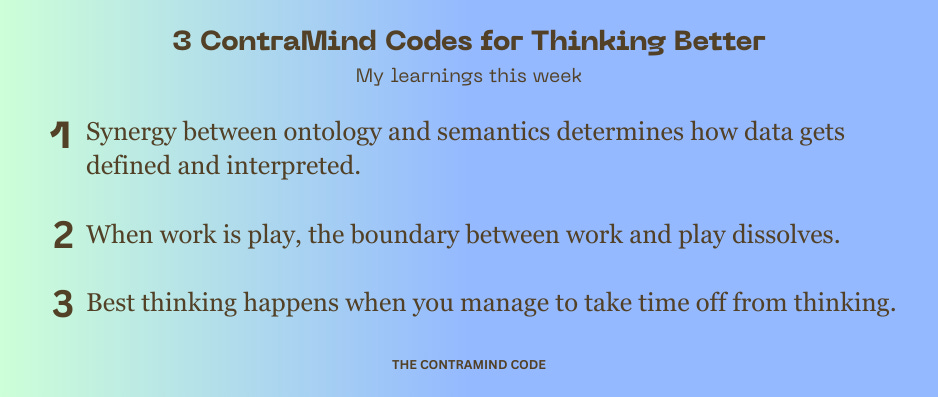
There is a need to understand the data's ontology and semantics in depth. Ontology is how data exists in the organisation, and semantics concerns what this data means in practice.
The financial crisis of 2008 is a great example of the mismatch between ontology and semantics. AAA ratings, over time, meant safety across contexts: regulatory safety, capital efficiency, systemic resilience. Capital continued to flow under an outdated interpretation of risk. The ontology did not change overnight. What changed was the meaning attached to the rating.
“In an AI-shaped world, truth may reside in the numbers. Advantage will belong to organisations that can update meaning faster than they update data.”
Read the entire article here.
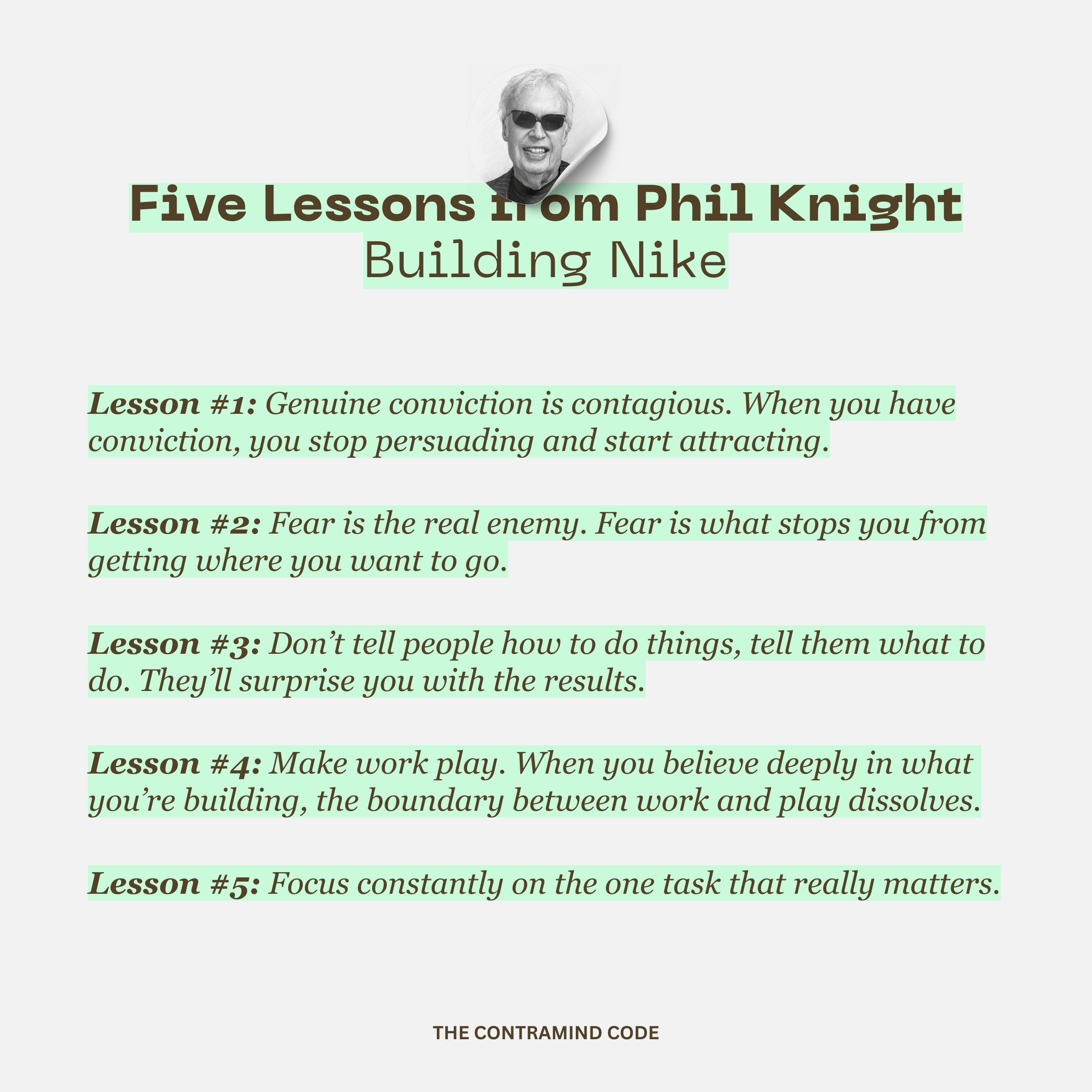
The Obsession That Built Nike |Phil Knight.
The Outliers episode of The Knowledge Project Podcast explores, through a powerful storytelling method, the beliefs, trust, fear, and the price of growth experienced by Nike’s Founder, Phil Knight.
There are some great lessons that can be learnt from Phil Knight’s story of building Nike:
Why More Classroom Technology Is Making Students Learn Less.
Anna Stokke, Professor, Department of Mathematics & Statistics
University of Winnipeg is in conversation with Jared Cooney Horvath, Cognitive Neuroscientist, educator and author, on a topic that’s so important and relevant today - ‘Does technology really help students learn better?’ - Jared talks about screens, multitasking, attention, and what technology does to memory.
Jared goes on to explain, using data, decades of research findings, and powerful insights, why classroom technology is, in fact, making students learn less! There are some very pertinent points he makes about this during this conversation:
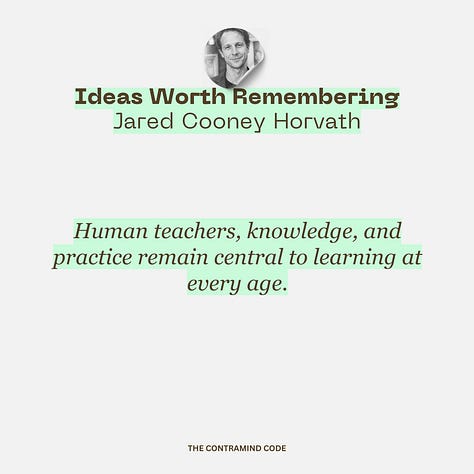
He reiterates that human teachers, knowledge, and practice remain central to learning at every age.
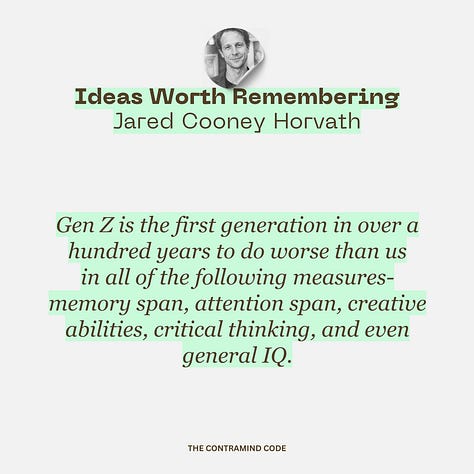
Gen Z is the first generation in over a hundred years to do worse than us
in all of the following measures- memory span, attention span, creative abilities, critical thinking, and even general IQ.
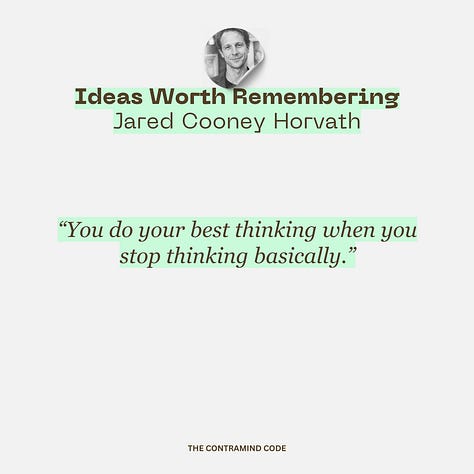
“You do your best thinking when you stop thinking basically.”
“Your creativity will always be limited by your knowledge, by what you know, not what you can access, not what you can have a machine do, what you have embedded within your biological system.”
“Human beings are very bad at knowing what’s good for learning. We know it feels good. It’s called the illusion of fluency. When something feels good to us, we assume we understand it better, and we’re learning more from it. And it’s the complete opposite.”
“The only way to make memories deeper is to recall them.”
“When you offload knowledge to a device, which is what most devices do, you will form a memory for how to find it, but you’ll never form a memory for what the thing actually is.”
“Generally, taking notes by hand is better, reading a physical book is better, and doing your assignments on paper is better. Get a printer. You’re never going to go wrong if you do it analog.”
“If you have a garden and you bring a new beetle into that garden, you don’t just have your garden plus a new beetle. You will have a whole new garden. The entire food chain has to change. The nutrients now have to change. It’s an ecological shift. Everything has to adapt. Tools are the same way.”
Ideas Worth Remembering


Learn To Enable People ‘What-To-Do’ Rather Than ‘How-To-Do-It’.
If you are working on something or have a team of people working alongside you, it is vital that you understand the critical difference between directing people ‘How-to-do-it’ and asking them ‘What-to-do’ for a specific problem.
When you ask a question ‘What-to-do’, it helps build people who are thinkers, versus when you tell people ‘How-to-do-it’, it builds people who are executors.
To understand this more deeply, you need to understand how learning or high-quality performance outcomes happen.
Imagine you're solving a business problem that needs a solution. If your boss tells you ‘How-to-do-it’, they are merely sharing a methodology or process for getting it done. It may appear as if the problem or solution has been found for now, but if the problem reappears later, the boss needs to intervene and explain how to do it again. The reasons are as follows:
With a ‘How-To’ approach, the mental difficulty of finding a solution to the problem and the associated pain decrease in the short term.
Also, only ‘surface learning’ occurs, as the way to do it is dictated by the team leader or boss.
Working memory load is reduced significantly. It’s like storing the data in the RAM vs the hard disk! When you shut off the computer, it is erased.
It looks like execution speed and compliance improve dramatically, and the error rate drops significantly, but the individual’s learning to think and solve the same or a similar problem becomes really narrow.
It tends to reduce creativity, judgement and ownership.
Also, what it does to people is that they feel they are being managed or controlled, they develop a fear of deviation, they optimize for correctness, and their inner drive to innovate is virtually shut down.
Here’s what “What-to-do’ question does to people:
It builds adaptability and resilience to handle diverse situations when answers are unknown or there is no prior experience in such problems.
People start to collect facts and analyze the various aspects, which leads to insights, and they begin to develop strategic judgement.
Learning improves as individuals face greater difficulty in thinking and finding an appropriate solution.
This actually leads to better transferability and retention of skills, unlike when they are just told what to do. There is ‘deeper learning’ that begins to happen without the individual realizing it.
Individuals begin to develop confidence through discovery, feel empowered and trusted and tend to show higher levels of ownership.
In an increasingly AI-augmented work environment in the future, you will need to strategically shift your capability from How to What, which means a lot more focus on helping people frame the problem rather than only managing a process, think differentiation rather than work within templates and not optimize only for execution, but leverage AI for judgement support.
What this really means to you, if you are leading a team, especially when there is widespread use and adoption of technology, digital tools and AI, is that when you move the needle from ‘How-to-do it’ to ‘What-to-do’ :
You stop being a bottleneck.
You scale ‘thinking capability’ rather than ‘execution capability’ of either yourself or individuals in your team.
The intelligence of an enterprise moves away from ‘you’ to ‘others’ as they effectively go through an intellectually demanding yet productive capability, built around a ‘deep learning’ layer of the do, learn, store, restore, retrieve cycle, which accelerates learning and commitment, over time.
For professionals of tomorrow, the competitive advantage is moving upward, which means it is more about the ability to define the ‘what’. There will be a dramatic increase in their ability to understand and appreciate the clarity of the expected or needed outcomes.
When you apply the ‘What-to-do’ principle with individuals and teams you work with, you will be able to build professionals, not mere employees.