Welcome to The ContraMind Code.
The ContraMind Code provides you with a system of principles, signals, and ideas to aid you in your pursuit of excellence. The newsletter shares the source code through quick snapshots for a systems thinking approach to be the best in what you do. The ContraMind Code helps you reboot and reimagine your thinking by learning from the best, and enables you to draw a blueprint on what it takes to get extraordinary things done. Please share your thoughts and comments to start a conversation here.
Take a journey through www.contramindslabs.com. Discover a complete system for ambitious professionals who refuse to plateau, and also a place where you can listen and watch some great minds talk to us about their journey of discovery of what went into making them craftsmen of their profession, to pursue excellence and drive peak performance.
What’s Your Chronotype? How Brain Science Can Boost Performance.
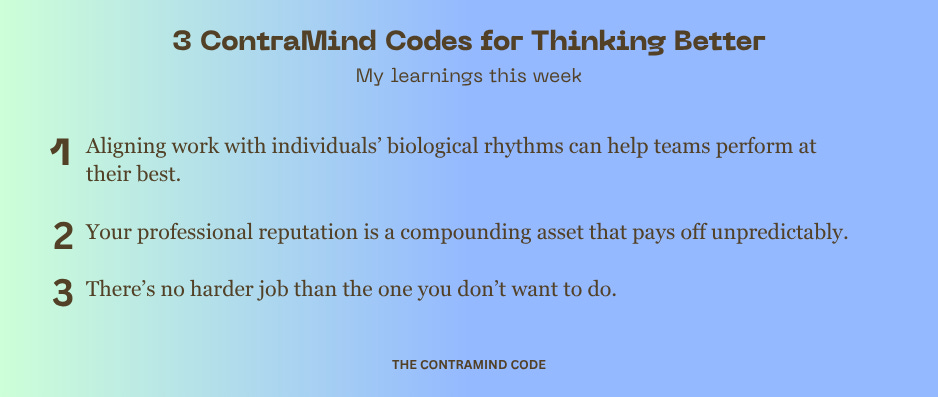
This KnowledgeAtWharton article, written in collaboration between The Wharton Neuroscience Initiative and Slalom, a global business and technology consulting firm, explores how aligning work with individuals’ biological rhythms can help teams perform at their best.
The article asks a very controversial, but interesting question: “Across the world, organisations by and large subscribe to the typical 9-to-5 workday. But what if that formula for work is creating an environment of decreased efficiencies, lowered innovation, and a creativity deficit?”
The contributing authors, Michael Platt, Elizabeth Johnson, Sophia Feldman, Elizabeth Beard (Wharton Neuroscience Initiative), Natalie Richardson, Rene Putz, Ryan McCreedy, Emily Foy, and Kevin Nunley (Slalom), go on to say that biological timing may be one of the most overlooked drivers of workplace performance.
Here are some very powerful insights that can make you think more about this topic in the context of yourself and your workplace:
Chronotype, an individual’s natural timing system for sleep and alertness, is not the same for everyone. It varies differently between people.
‘When teams understand each other’s chronotypes, it opens the door to more thoughtful and effective collaboration.’
“High-performing organizations recognize that timing is a cognitive variable. Aligning work with neural readiness isn’t a perk, it’s a performance strategy.”
“The next frontier is optimizing for the human brain. When we align work with how our brains actually function, adaptability becomes a structural advantage, not just a cultural aspiration.”
Scaling Uber with Thuan Pham (Uber’s first CTO)
Gergely Orosz, author of The Pragmatic Engineer, is in conversation with Thuan Pham, Uber’s first CTO. What makes this conversation really insightful is the work-life stories, his work-related values, beliefs and incredible experiences that Thuan shares during the chat.
Here is a select set of thoughts that Thuan shared, which are very valuable and can make a big difference in the way you shape your career:
A career is a long marathon. Don’t have a shortsighted view of some of the decisions you take. There is no value you can pay for the reputation you will be building over the two or three decades that you will be working - “Your professional reputation is a compounding asset that pays off unpredictably.”
Hiring is a hard job. It’s not about filling an open position or role. Don’t take it lightly. Invest disproportionate time when you are hiring - “Travis Kalanick spent 30+ hours interviewing Thuan.”
A CTO’s job is to look ahead to what is needed, and the person must have a strong ability to spot what’s coming or what could disrupt the company in the near future - “Your team handles the six-month problems, while you figure out what the organization needs to look like two years from now.”
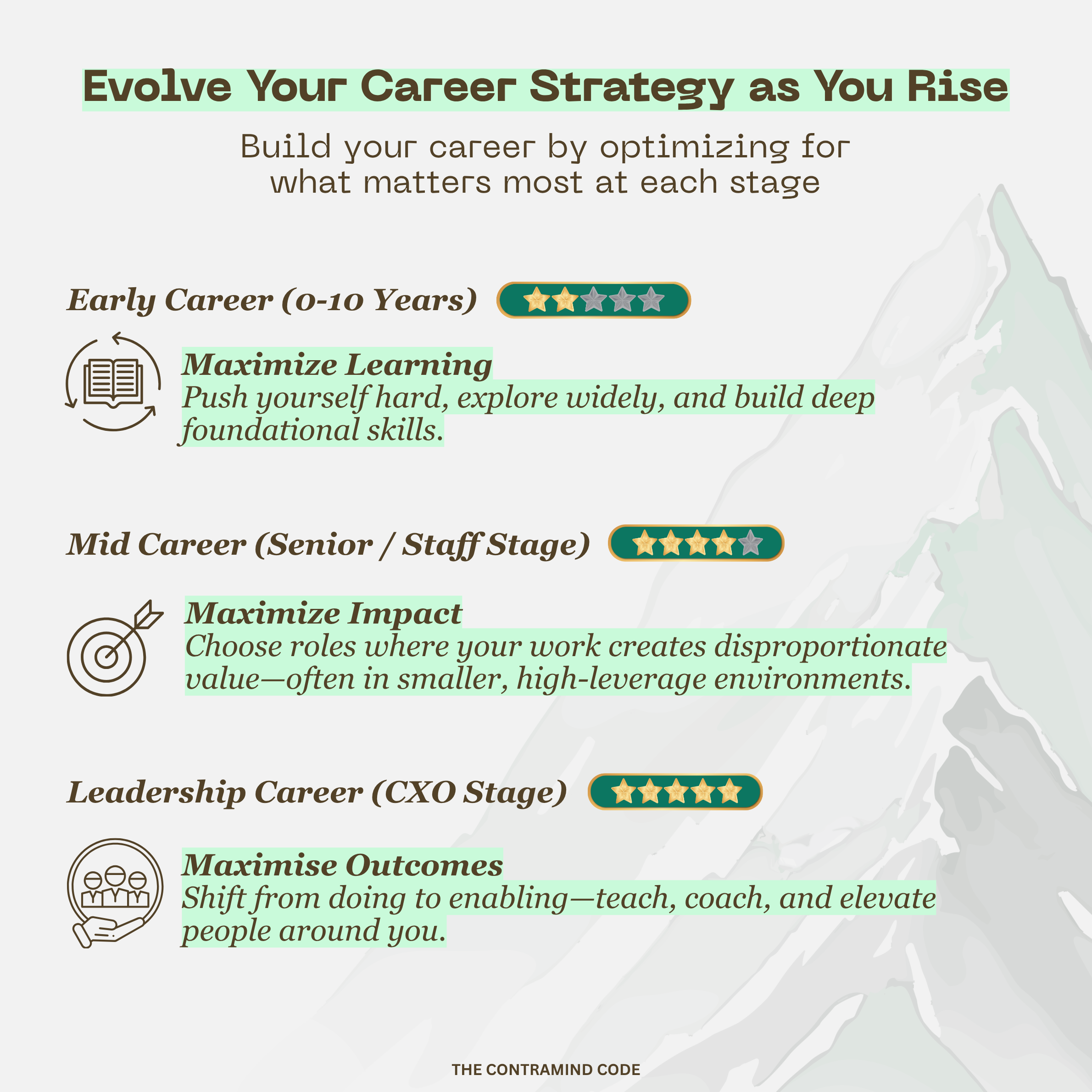
Thuan’s career advice is to think of it in parts or phases:
First 5–10 years: Seek maximum learning and push yourself hard.
Mid-career as a senior/staff engineer: Seek roles to make an outsized impact in, perhaps at a smaller company.
In leadership roles: Teach and coach others, and bring them along with you.
How Coca-Cola Stays Bold, Relevant: James Quincey, CEO, Coca-Cola.
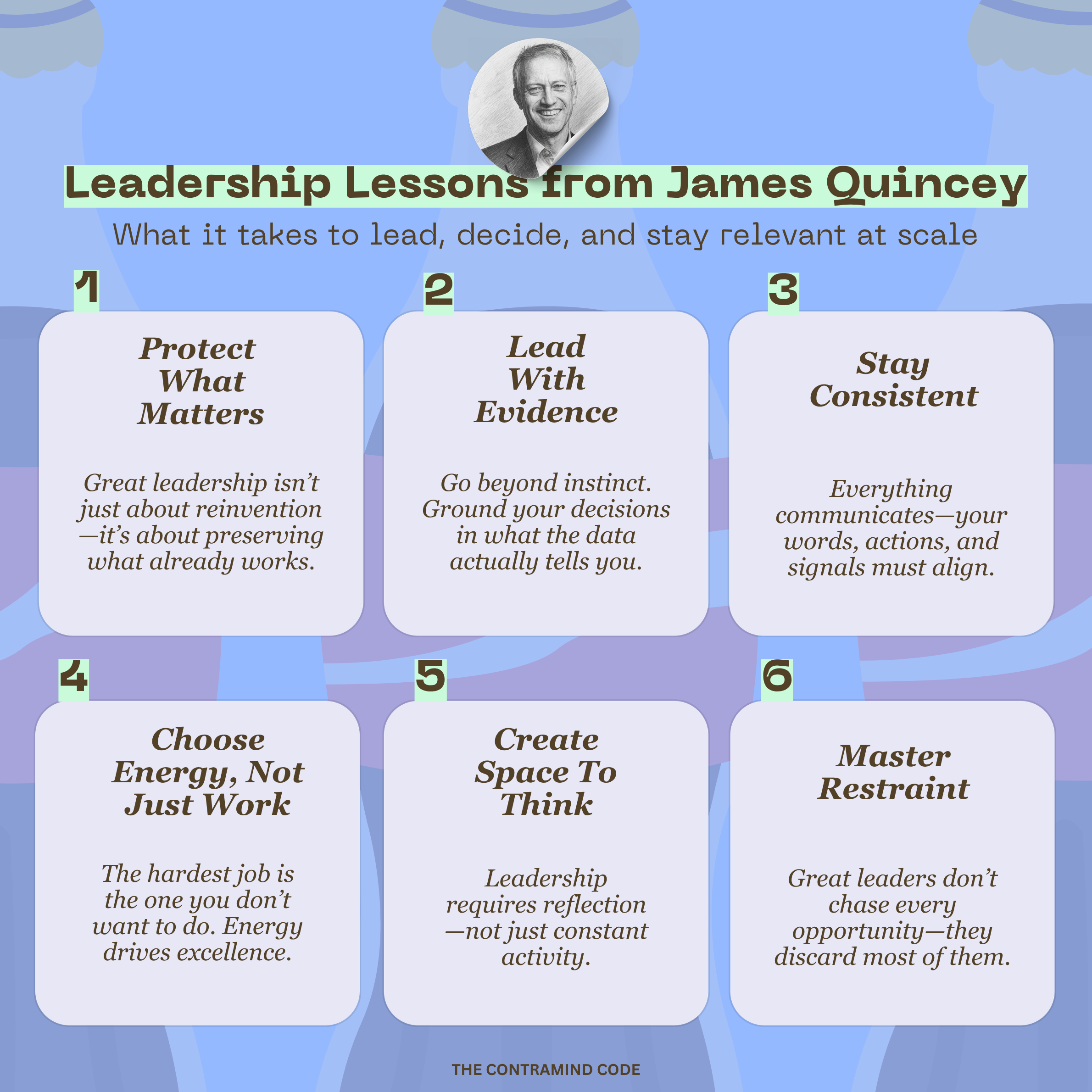
In this video, Coca-Cola’s CEO, James Quincey, is at London Business School and shares his candid insights with LBS students on Coca-Cola's biggest growth bets, balancing consumer convenience with environmental responsibility, leadership traits, and some of his thoughts can serve as a challenge to how you think about growth, culture and reinvention.
The leadership challenge that is there for a brand like Coca-Cola is
deciding what not to change.
“I think it’s always key as a leader to get down into the data. What does the data say?”
As a leader, you need to be aware of the fact that “Discipline is important. Understanding that everything communicates and staying on message.”
“Do something that gets you out of bed in the morning. There’s no harder job than the one you don’t want to do.”
As a leader in the top management of my company, “I don’t fill my day with
meetings.”
As a leader, “Most of the time I’m discarding the opportunity to act.”
Understand The Compounding Effect Of Your Professional Reputation.
Thun Pham, ex-CTO of Uber, spoke about a concept called “The compounding effect of professional reputation” and how it had helped him over the years in many roles he took on later in his life.
When you start your career, you really don’t think too much about this term called ‘Professional Reputation’. After all, you believe it’s just a job, and you are doing a job that’s been given to you. If you get that job done well, you tend to believe you have effectively satisfied the reason you have been hired for. For the job that you are doing, you may feel good or fine about what you are doing and how the company recognizes you. At the opposite end, you may feel you have not been rewarded enough in the subsequent year, or not compensated adequately or are not being promoted based on your performance, etc., etc. You may decide to leave for a better opportunity, join another company, and subsequently move on to many other companies over many years of your working career. With every job or role you take up or do, you are building an ‘unwritten or invisible code’ in people's minds, which is something called your ‘Professional Reputation.’
So, what is professional reputation?
Professional reputation is a shared perception within a professional network of an individual, based on observed behaviour, demonstrated competence, and information transmitted over time. The three key words to focus on are
Competence
Behaviour
Over time
The critical distinction is -'Reputation lives in others' minds, not your own.’ It is the delta between who you are and what the market believes about you.
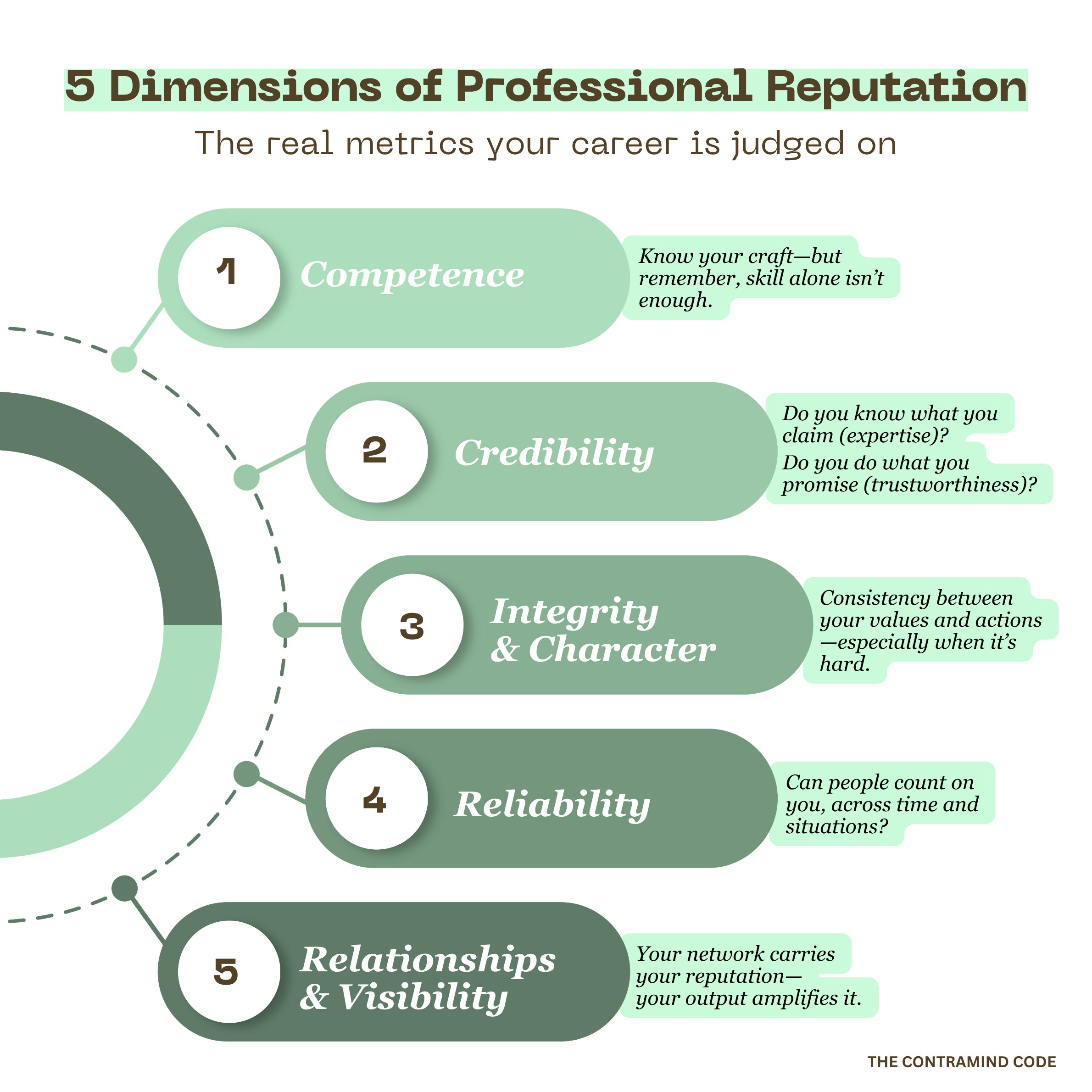
‘Professional Reputation’ has as many as five dimensions that you need to understand a lot more deeply and work on:
Competence: For ‘Professional Reputation’, competence is a necessary condition but not a sufficient condition.
Credibility: Credibility has two vectors that build your reputation over time, not in the short term, but over the long term, and it catches up over time with your name.
Expertise - ‘Do you know what you say you know?’
Trustworthiness - ‘Do you do what you say you will do?’
Integrity and Character: This is a measure of your consistency between stated values and observable behaviour — especially when it is costly. For example,
‘Did you join on the day you promised to join?’
‘Did you give enough time and transition what you do when you resigned well?’
‘Are you available to solve problems when it mattered most?’
“Do you keep up to your commitments?”
Reliability: This is more of a measure of the correlation between your output and your behaviour over time and across contexts. Remember, a career is a marathon that spans three to four decades.
‘Can I really count on this individual?’
Professional Relationships - The quality and reach of your professional relationships. Remember, your reputation travels through this network and connects irrationally with other networks.
Visibility and Signalling - This is like the distribution effect - the degree to which your reputation is known beyond your immediate circle. This is the primary reason why publishing, speaking, writing, and public output matter structurally — not just for ego, but for signal propagation.
Now, look back and think about how many job descriptions or roles that you have come across cover these dimensions of building a ‘Professional Reputation’? Building a ‘Professional Reputation’ is your moat for the future, not the company’s requirement, as they want to get a job done. Therefore, you have to work on building your own ‘Professional Reputation’.
The best analogy for ‘Professional Reputation’ in sports terminology is:
Capability reputation is like your batting average
Character reputation is like your batting style
You need both in a fair measure to build your ‘Professional reputation.’
Also, remember, ‘Professional Reputation’ does not get built overnight. It compounds over time. It will be a result of your previous efforts, across these five dimensions, compounded exponentially over time.
‘Professional Reputation’ follows one universal law: Purpose over opportunism. consistency over intensity. Duration over magnitude. Signal over noise.
The professionals who understand this begin early without looking for immediate results, seize opportunities as they come, work on success in a different time zone and learn to operate on an entirely different career trajectory than those who do not.