State of Curiosity Report 2026: Research On What’s Cultivating And Crushing Innovation in Workplaces.
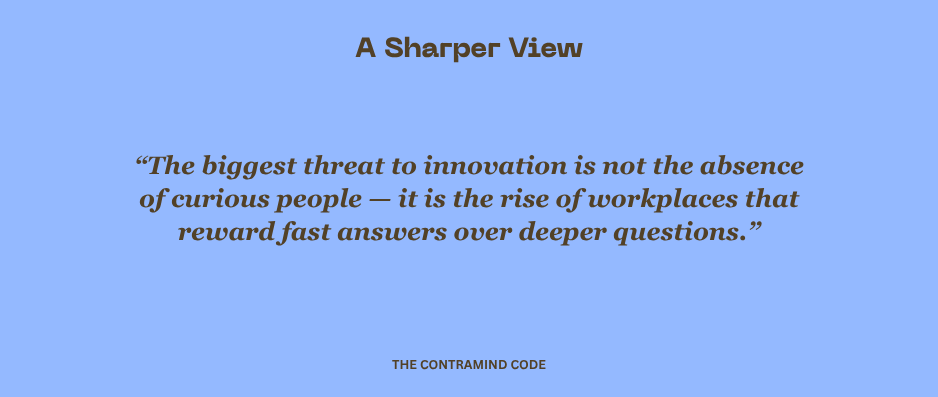
A report recently released by SurveyMonkey shows that organisations are not short of curious people — they are short of cultures that let curiosity survive.
Here are some key insights from this report:
Curiosity is often defined in academic literature as the intrinsic pull to close an information gap.
“Once you get an answer from AI, it feels as if it’s complete and there’s nothing more to know.” Jack Soll is a distinguished Professor of Management and Organisations at Duke’s Fuqua School of Business.
What is Curiosity capacity? It’s the practiced ability to stay open, ask sharper questions, and keep learning alongside AI.
The three forces draining curiosity capacity are: the AI middleman, the scroll reflex (accept whatever the model produces as-is, or do a quick check and move on), and the efficiency squeeze (the time curiosity needs to notice what’s missing, find someone who might know, come back with a better question — has been engineered out of the workday)
Read the entire report here.
Overconfidence And The Art Of Knowing Yourself.
In this podcast, Brené Brown, research professor at the University of Houston, is in conversation with Adam Grant, Professor, Organisational Psychologist, and Author, in The Curiosity Workshop Podcast. The discussion provides a powerful perspective on the meaning and value of metacognition and how it affects the way you think, behave, and act.
Here are some key points from the conversation:
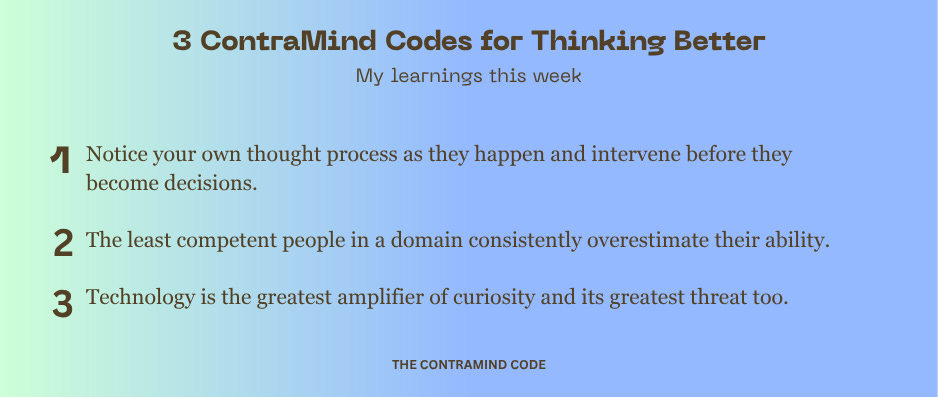
Metacognition is thinking about your thinking. It’s the ability to notice your own thought processes as they happen and intervene before they become decisions.
The Dunning-Kruger effect is not just about ignorance. The research also found that the least competent people in a domain consistently overestimate their ability.
When competence gets miscalibrated, it has compounding consequences. And the conversation tries to answer an important question: “What happens when your confidence outruns your competence?”
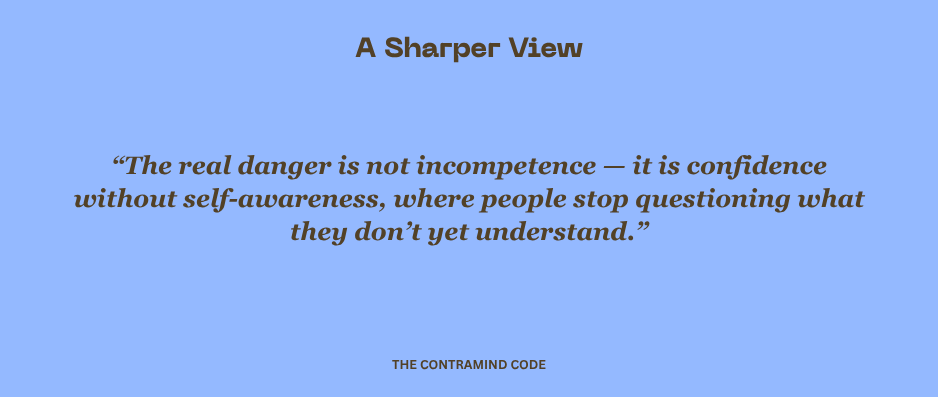
One key and most important takeaway from this conversation is that the most dangerous person in the room is the one who doesn’t know what they don’t know — and has never learned to ask. When you adopt and embrace the process of metacognition, it helps you discover and realise more about what you know and what you don’t know.
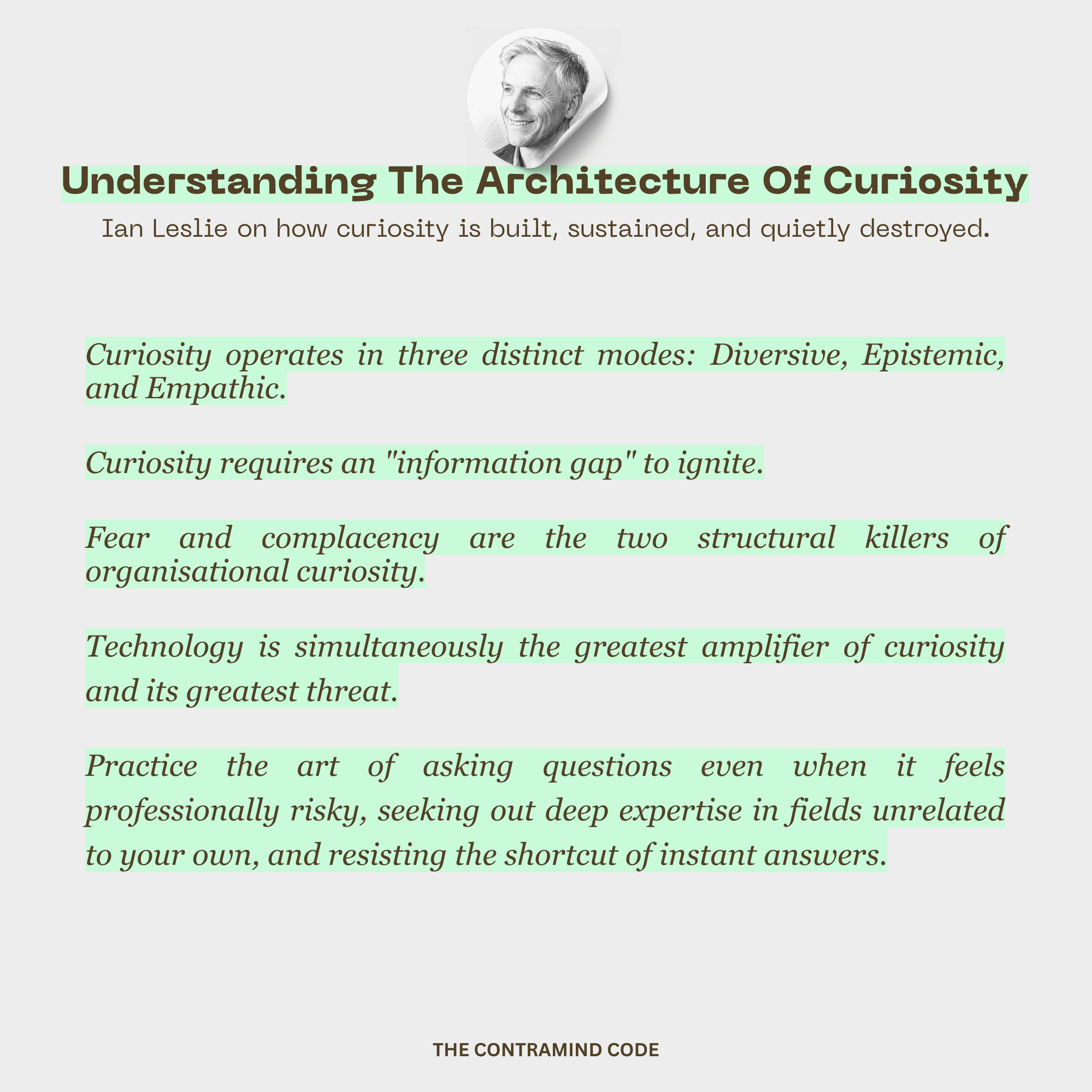
Ian Leslie - Understanding Curiosity
In this conversation, NYT bestselling author, Substacker, and cultural adviser Ian Leslie talks to Steve Berg, host of the Intangibles Podcast, about curiosity. Ian Leslie highlights how curiosity is correlated with intelligence and how we can learn to be more curious.
Here are some lovely takeaways from this conversation:
Why The Moat Of The Next Decade Is Not Artificial Intelligence.
It’s the ‘how’ and ‘what’ that’s built on top of it.
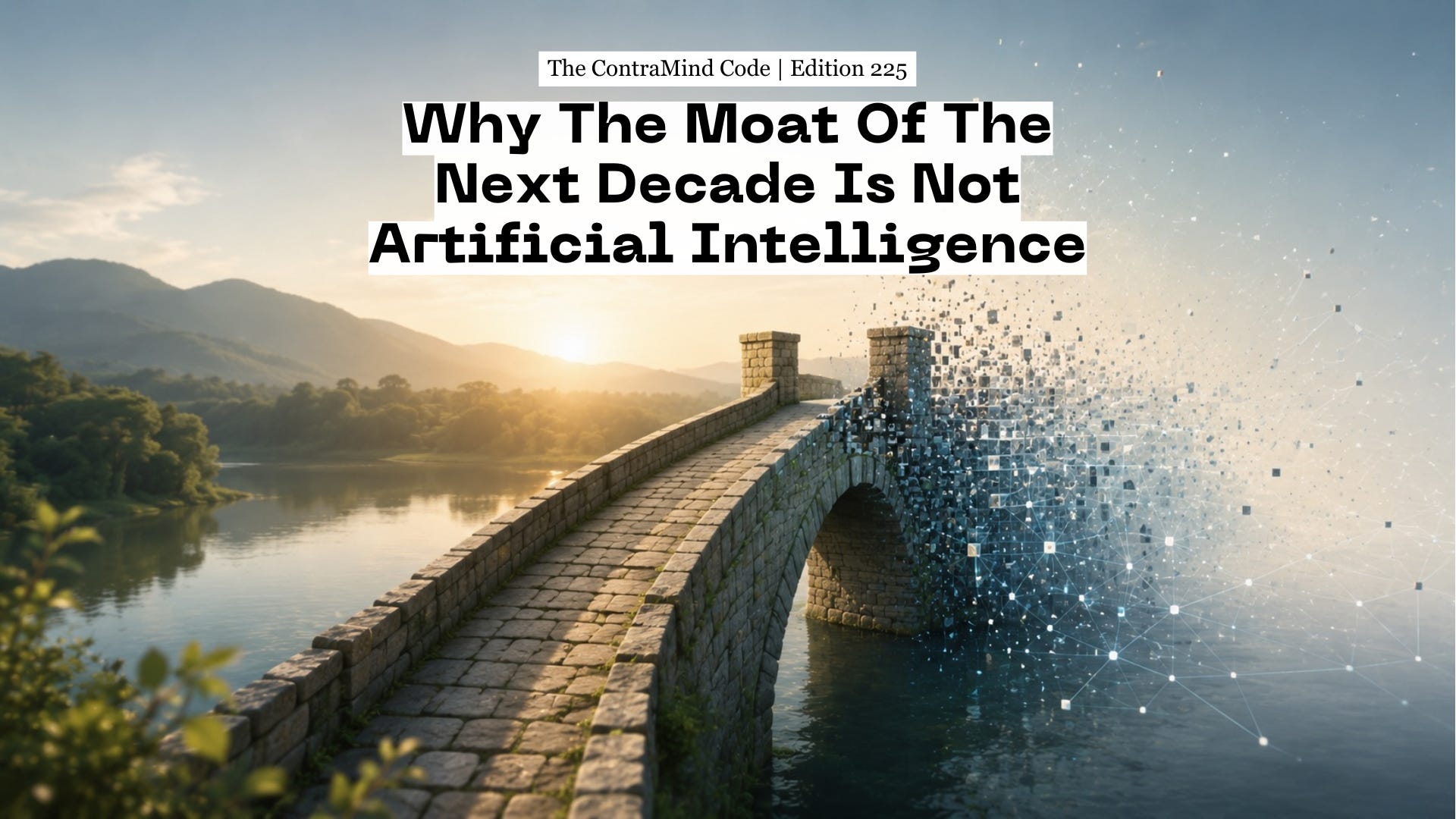
The moat of the next decade is not going to be AI — it is going to be organisations or firms populated with curious professionals. A curiosity culture emerges when professionals understand that they know little and sense there is more. The problem with AI is that it gives professionals instant top-line answers without ever building the underlying deeper knowledge. History has taught us these lessons, and it’s worthwhile to look back and learn from them.
How patterns repeat every 40 years. And we are in that moment now.
In 1913, Ford’s moving assembly line was one such mass-manufacturing idea, and soon competitors started copying the model. Ford’s moat was not the moving conveyor belt but the operating philosophy that made it a leader in the automotive industry at the time. The steam engine became standard. The moat moved to the assembly system.
In 1994, Amazon launched with the same internet technology available to every other retailer, but it was its logistics architecture, customer data flywheel, and management operating system that turned information into decisions faster than incumbents could respond. The internet became standard. The moat moved to the logistics and data flywheel.
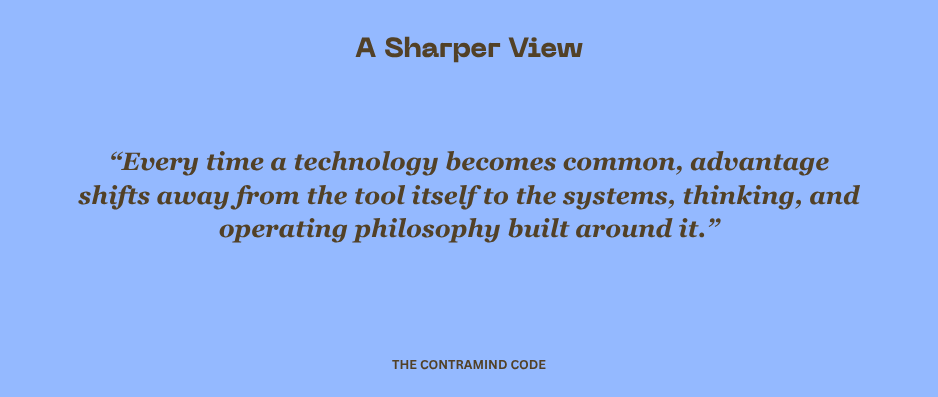
Now, AI is becoming standard. The moat will migrate again. Harvard Professor Clayton Christensen identified the mechanism precisely - once a technology matures and standardises, competitive advantage migrates downstream — to whoever controls the performance-defining subsystem. It’s only the organisations and professionals who build explicit processes to convert their tacit knowledge into institutional or professional knowledge who will develop competitive advantages that tools cannot replicate.
Why AI cannot be the moat?
Sure, AI creates value across every domain and business function, but when you apply the lens of whether there are no alternatives, the answer is no because there are multiple models and they will multiply every quarter. Can clones or imitations be built? Again, the answer is a clear yes, as DeepSeek was replicated cheaply. Therefore, any AI technology or platform becomes substitutable. Electricity became the standard, and the moat moved to many industries, where many products or services were created using the standard innovatively and productively.
Why Curious Professionals will be the moat?
AI synthesizes from existing knowledge. AI is, in fact, accelerating the curiosity deficit rather than solving it. However, curious professionals will operate at the boundary, generating questions that push it further. This will become the primary source of competitive differentiation in an AI-enabled world. They build curiosity through the deliberate practice of asking questions and considering previously unimagined applications, which helps foster innovation atop existing AI models. This cannot be transferred or created when you hire a new team or license a new platform.
Therefore, organisations that will succeed through the 2030s are not those that buy or use the best AI models, but those that foster a curiosity culture.
How should organisations build a curiosity culture?
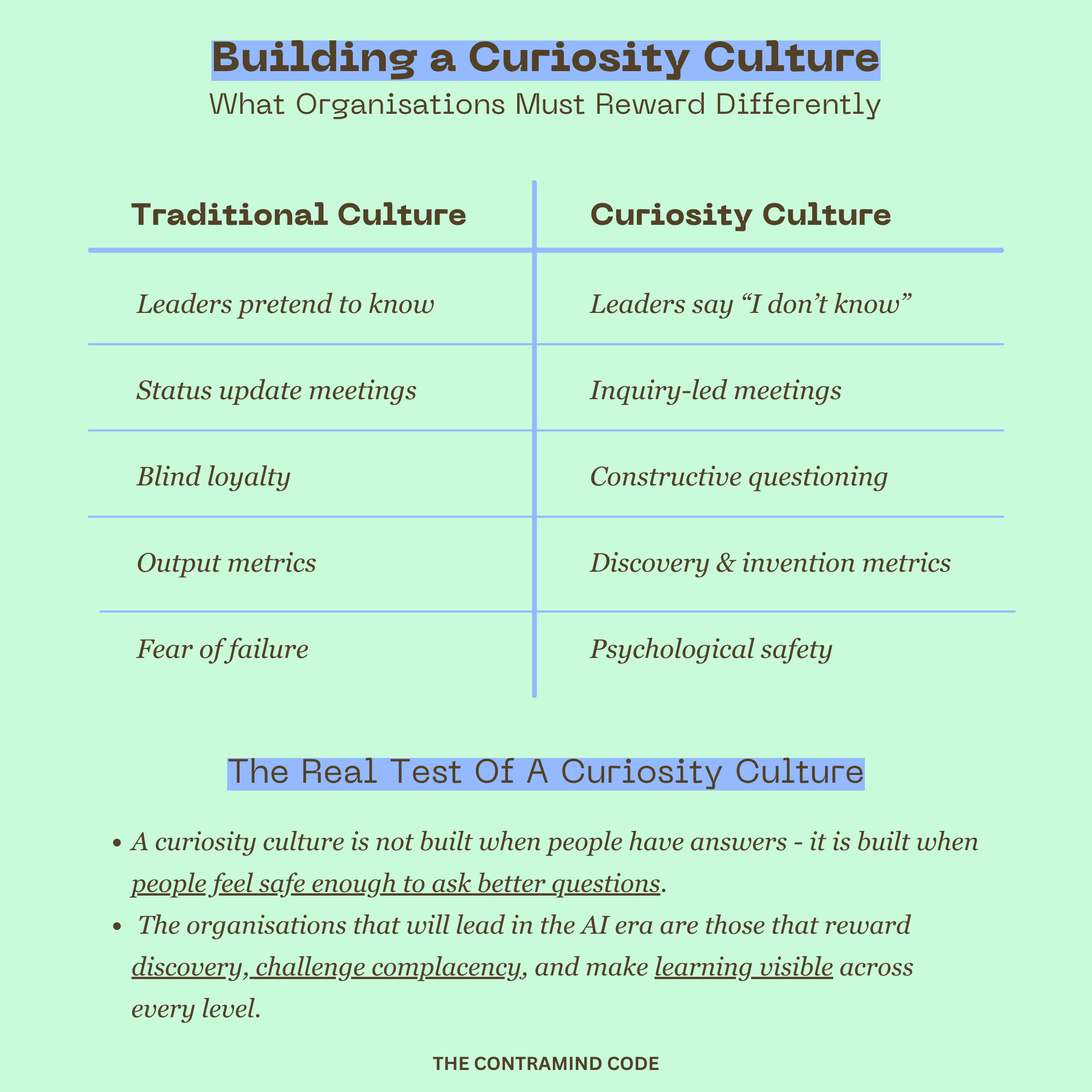
A culture of curiosity encourages people working there to be comfortable saying, “I don’t know.” CXOs must be comfortable with accepting their own not-knowing in public - in meetings, in townhalls, with team members. However, most organisations encourage leaders and managers who project confidence as if they know it all, when in reality the opposite is true. Today’s culture rarely pulls people up for complacency, which sets in across levels over time, but rewards them for not asking questions, for blind loyalty, and for working within a leader’s norms. A culture of curiosity must disincentivise people with a complacent attitude and remove the fear of not knowing or of failure. A curiosity culture will have to start not only measuring what was produced but also what was discovered or invented. Also, there must be a fair mix of status update meetings and more inquiry-led meetings, where curiosity-led thinking comes into play with people and teams in organisations.
How do you develop to become a curious professional?
It is not enough if organisations create an environment for a curiosity culture. It's the people who work there who need to change, too. Too often, professionals in companies equate effort or output with high competence and demand rewards for it every year, while in reality, there is ‘competence decay’ as they grow.
Competence and the ability to assess your own competence are two separate skills. You must build the feedback loop deliberately, because it will not form on its own. You must build an honest signal about the gap between your self-assessment of your competence and reality.
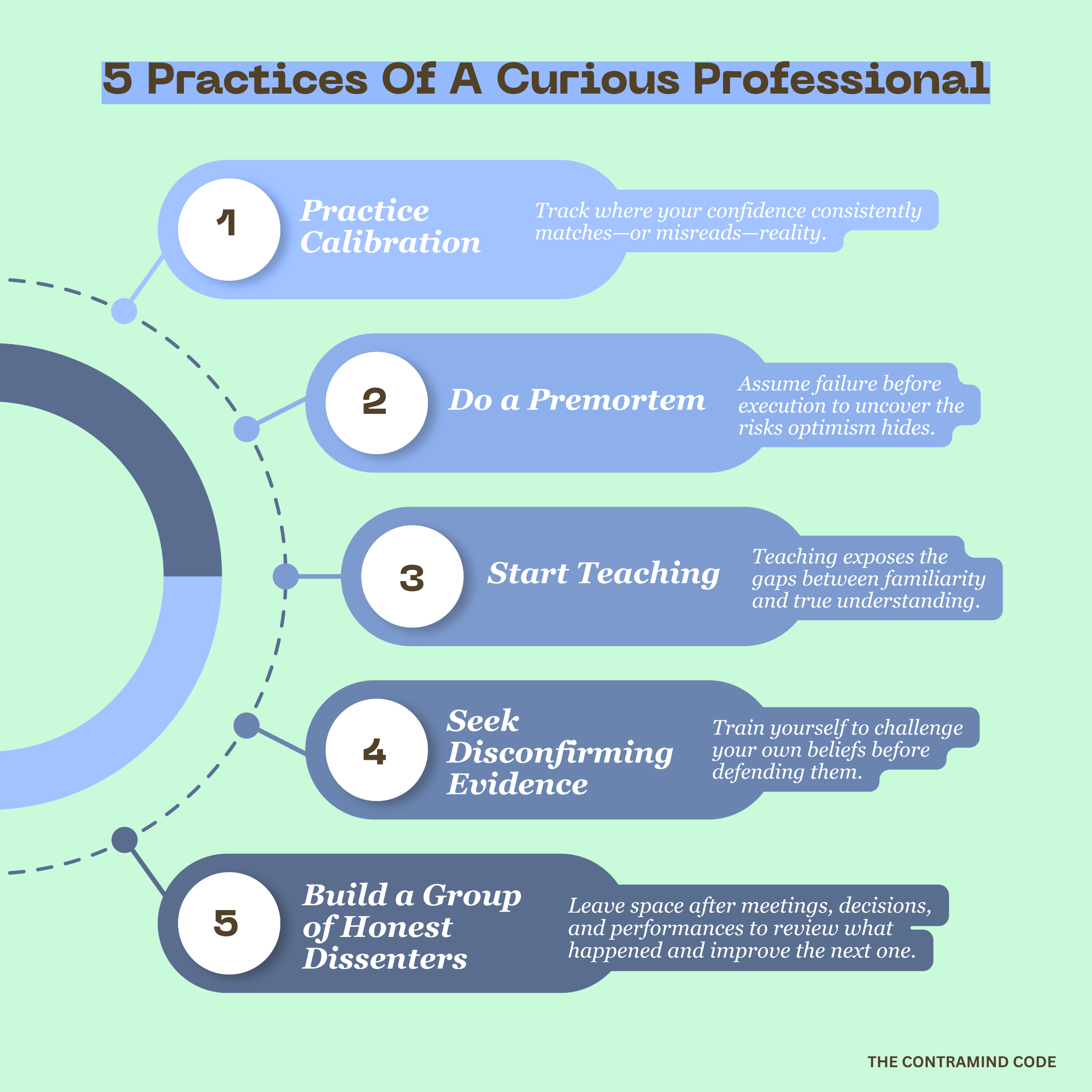
Practice Calibration: Before any project or decision, write down your confidence level as a percentage. Then track outcomes. Over time, patterns emerge — domains where you are reliably overconfident, domains where you are weak or undersell yourself.
Do a Premortem: You are always used to doing post-mortems once something succeeds or fails. Try to do pre-mortems before doing any work or solving a problem that has been assigned to you: ask yourself one question —assume this project or work has already failed—what killed it? This forces your brain out of planning mode into diagnostic mode. It surfaces the risks that optimism suppresses.
Start Teaching: You cannot teach what you do not understand. The moment you attempt to explain a concept to someone unfamiliar with it, every gap in your knowledge becomes visible.
Seek disconfirming evidence as a discipline: Normally, your default thinking mode is to seek information that confirms your current belief. Ask yourself one uncomfortable question: "Why am I right?"
Build a group of honest dissenters: Create a small group of people whose explicit role is to tell you what others won't. They are a group of people who can share with you uncomfortable truths about your strategies, skills, execution, and decisions.
Organisations will need to structurally incentivise a curiosity-driven culture to build their moat, rather than assuming it will arrive with platforms or tools they will license, or from the talent they have or will hire.
As AI becomes the standard, curiosity will increasingly become a strategic capability, specifically one that will distinguish the best professionals and organisations from the average.