The YouTube Revolution In Knowledge Transfer.
Samo Burja, a sociologist and the founder of Bismarck, a firm that analyses institutions, from governments to companies, offers a very interesting perspective on tacit knowledge. In this article, he writes that YouTube may be the largest platform for transferring tacit knowledge at scale. He analyses the reasons why tacit knowledge transfer through YouTube is revolutionary, due to the availability and access to cheap digital cameras, mass broadband, search engines, and portable screens.
Here are some powerful thoughts that Samo Burja has shared in this article:
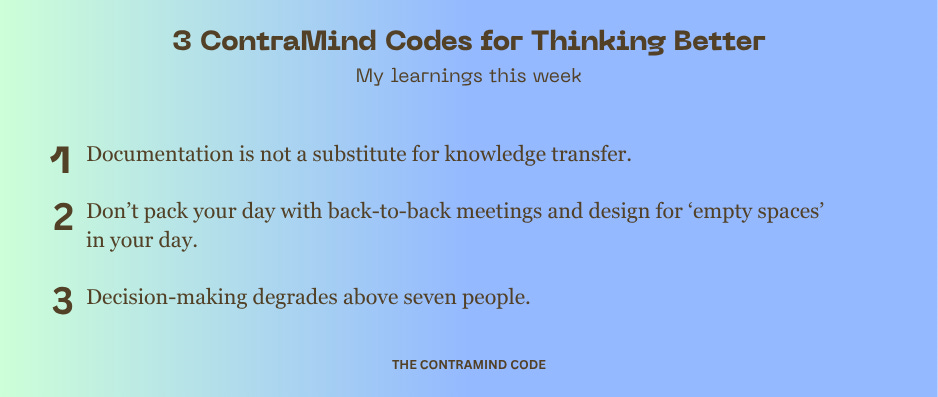
"If a master woodworker fails to transmit his tacit knowledge to the few apprentices in his shop, the knowledge is lost forever, even if he's written books about it." Documentation is not a substitute for transmission.
"Through these videos, learners can now partially replicate the master-apprentice relationship, opening up skill domains and economic niches that were previously cordoned off by personal access."
"Who today would argue that YouTube will one day be evaluated in the same category as the printing press or the telegraph? It is quite possible it will be."
You can read the entire article here.
Regain Control of Your Focus And Attention with Researcher Gloria Mark.
Gloria Mark is a professor of informatics at the University of California, Irvine and a visiting researcher at Microsoft, and the author of the new book Attention Span: A Groundbreaking Way to Restore Balance, Happiness and Productivity. She offers research-backed tips on how to regain control of your attention and help your teams do the same.
Here’s the summary of some ideas she suggests to regain focus and attention:
Raise your meta-awareness and ask yourself, “Do I need to think, behave and act the way I did right now?”
Practice forethought - Imagining how current actions affect future state.
Design your day - Don’t pack your day with back-to-back meetings and design for ‘empty spaces’ in your day.
Organisation can create ‘quiet time points’ during the day.
Understanding Complexity | Dave Snowden
Dave Snowden, founder and Chief Scientific Officer of The Cynefin Company, is in conversation with Garin & Dani from Distinction Consulting. He argues that in complex systems — which all organisations are — the instinct to plan, control, and cascade goals is not just ineffective but structurally wrong!
Here are some very interesting contrarian viewpoints that he puts forth in this chat:
Complex and complicated are not synonyms — and treating one as the other is the root cause of most organisational failure.
A leader's job is not to determine outcomes but to change the conditions in which interactions happen, then observe and amplify what emerges.
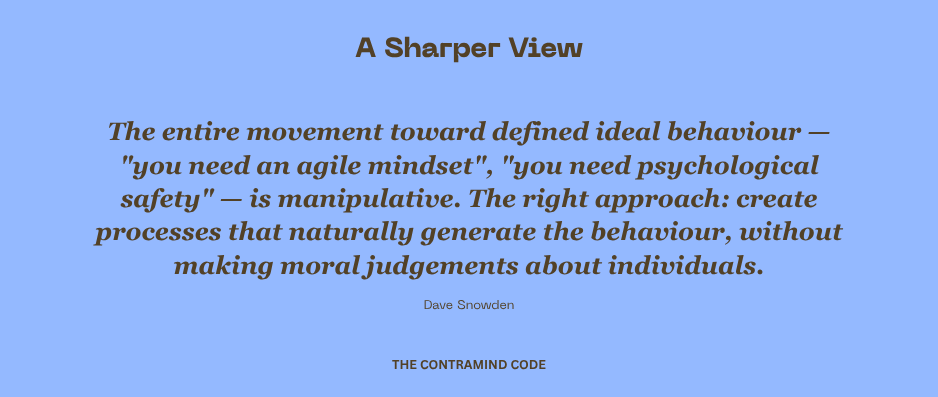
Dave says that the entire movement toward defined ideal behaviour — "you need an agile mindset", "you need psychological safety" — is manipulative. The right approach: create processes that naturally generate the behaviour, without making moral judgements about individuals.
Dave also makes a very powerful and provocative statement which is worth thinking about and reflecting on: “AI is reducing human intelligence to text. You can write down less than 10% of what you know anyway. Focus on text and tokens is problematic.”
Decision-making degrades above seven people!
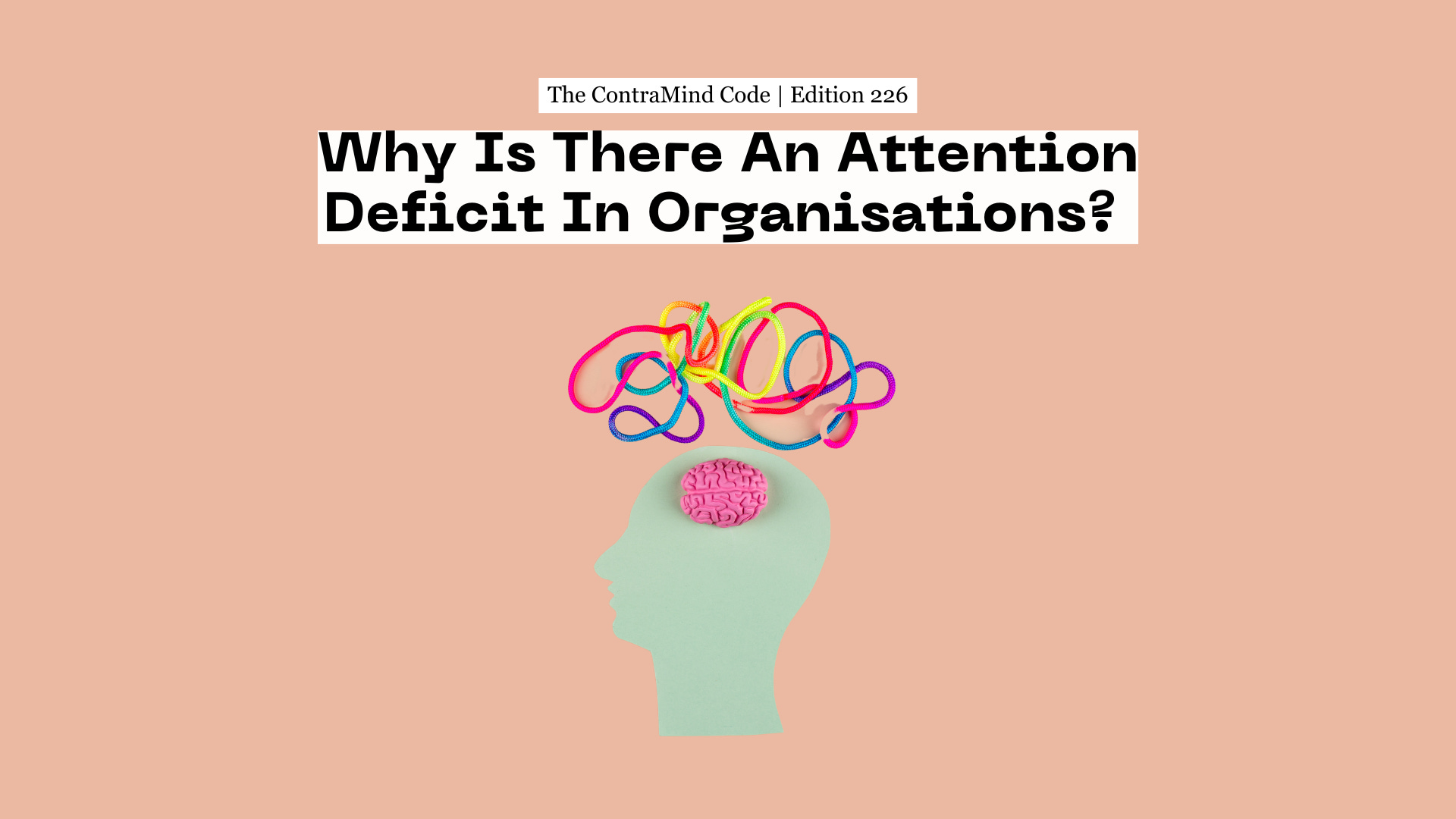
Why Is There An Attention Deficit In Organisations?
It is not uncommon for people to ignore an email, pay insufficient attention to the communication they receive, or forget the key points discussed in a meeting. You expect a response, but it never comes back. What’s surprising is that it is not just junior or middle-management folks who display this behaviour, even senior management folks behave similarly. Some information and responses are ignored consciously. The majority of others are missed till they are reminded. Sometimes, it is couched under the label of immediate priorities, not having enough time, being busy, paucity of resources, not having enough data or plans, etc., but the real truth is that enough attention was not paid to them.
How can you spot poor attention?
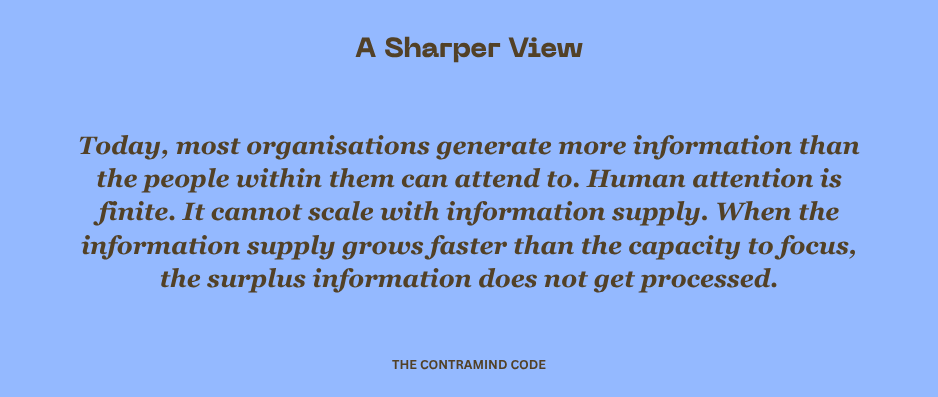
Today, most organisations generate more information than their people can attend to. Human attention is finite. It cannot scale with the supply of information. When the information supply grows faster than the capacity to focus, the surplus information does not get processed. How, then, do people decide which information to pay attention to?
Some people decide what they must read and what they must skip, and this is not based on strategic importance but on what arrives first, what is loudest, and what comes from people with authority.
Some people feign attention. These people sit in the meeting, open the details, browse through the dashboards, notes, or presentations, and retain almost none of it. It’s their appearance of being informed that substitutes for the reality. This is the most dangerous and a clear signal for failure, as this behaviour is virtually undetectable. In your eyes, everyone looks engaged, but nobody is integrating and processing information from the many sources they may be receiving.
There is a virtual breakdown of signal-to-noise ratio. It is not rare to see that attention, when fragmented across many pieces of information, produces even less understanding than when the focus and concentration were on two. An organisation with, say, twenty reports or dashboards is less informed than one with two - not because the data is worse, but because no single person has the attentional bandwidth to read, collate, integrate and process it.
The best way to understand this is with an example. It’s like a library with 10 million books. This is not useful to a person with ten thousand books — if the person is a reader who has one lifetime, no index, and no librarian. Adding books beyond the reader's capacity to find and read them does not increase knowledge. Today’s organisation generates a lot of internal information, much like a large library built with the lowest probability that people will access the relevant books and the most uninterested readers!
How do you overcome attention deficit in your organisation?
It begins by understanding, appreciating, and acknowledging that human attention is the scarcest resource. Most organisations are optimised for responsiveness and treat availability as a proxy for productivity. The professional who is always responsive, even if their output is shallow and frequent, appears more present. Over time, communication has been made frictionless in organisations and relatively cost-free - what started with email is now extended to Slack, WhatsApp, Teams, Zoom, etc. The cost of all this has been shifted to the receiver, who has to manage context switching, multitasking, and sudden interruptions. This is the primary structural cause of attention deficit at organisational scale.
If you are heading an organisation, or even running a team, or a group of team members, department, or function, you must find ways to determine how information, decisions, or discussions are surfaced to whom, at what frequency, in what form, and what will not bubble up to them.
Here are some steps and processes to reduce attention deficit:
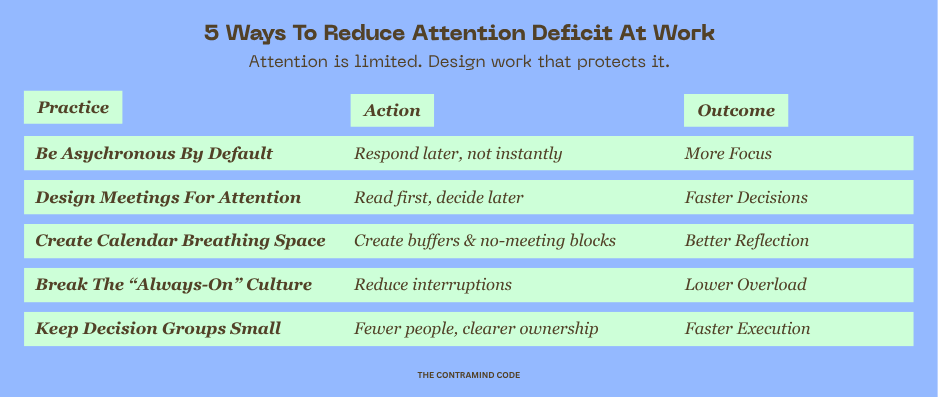
Learn to leverage the power of asynchronous and synchronous ways of working: The asynchronous way of working respects that not all communication between people or teams requires an immediate response or a meeting. Responses can wait for an agreed number of hours - say 8 hrs, for instance. It saves time and increases the depth of attention and productivity of people working on their planned work. It allows them to plan in advance and think ahead before responding to communications or meeting requests. There is no anxiety syndrome that they have not responded, even if it’s a person of authority or seniority. The culture is one of asynchronous response by default and synchronous response by exception.
Make meetings attention-designed: It’s well known that Jeff Bezos hated PowerPoint presentations. Amazon started the practice of a six-page narrative memo read in silence at the start of every meeting. The memo forced the person to think through the problem completely before the meeting. The silent reading forced the meeting's constituents to focus on the problem under discussion. Hence, these became decision-making meetings rather than just information-sharing sessions.
Redesign and Reprogram Calendars: Nobody stopped calendars from having fifteen-minute or half-hour breaks after meetings rather than back-to-back meetings. You can program calendars with half-hour meetings with a 15-minute break, or 1-hour meetings with a half-hour break before the next meeting. It allows people to think and reflect on next action points. Also, block off some parts of the weekdays- say, 1 hour on Wednesdays or Thursdays in the calendar as no-meeting hours for everybody. It puts pressure on people to think rather than blame the system. It improves attention span multi-fold.
Resist your urge to be an ‘always-on’ or ‘meet now’ leader, manager, or employee: If you send or respond to messages at unearthly hours, it signals to the people around you to be hyper-responsive, in the hope that they will be rewarded. Think before you respond or send messages, whether it is critical or can wait a few hours or until the next day. Similarly, many leaders are known to call for unscheduled or unplanned meetings. It puts the people working with them in a tizzy, as they drop what they are doing to attend this meeting. Think again before you call for these meetings. Unless critical, try to avoid it. Be ruthless about others' non-responsiveness, too, when you create this attention-intense ecosystem within the organisation. This often gets missed and not handled firmly, as people assume late response as an unwritten licence or policy.
Practice the art of small-group meeting invites or communication: One of the biggest attention-deficit catalysts in organisations is seeing meeting invites or communication to a very large number of people. Every other person assumes they will not attend that meeting or respond when they see such an invitation or communication, because they can get a debrief from someone else. Also, no decisions are made when there are a large number of people in these meetings or communications. It is a huge distraction to be CC’d on every email thread or meeting request. Communicate or meet with people who only matter. Let information sharing happen asynchronously. Tightly delegate the authority to decide to a very small number of people. It drives accountability and attention to get things done.
To improve attention deficit in organisations or in your teams, move from rewarding visible effort to rewarding demonstrated impact. Be comfortable playing with unfilled yet purposeful calendar space rather than seemingly productive, squeezed calendar slots. Be ready to transform into a professional who explicitly values ‘deep and intentional’ work rather than encouraging responsiveness as a marker for performance.