Trapped in Your Business
Andrea Chiarelli, Software Engineer, Technical Author, Identity Practitioner, writes his review of the book The Trapped Operator by Peter S. Bergeron and his takeaways on why small-business founders burn out while running their companies are brilliant. There are some very powerful insights and observations that he makes from the book:
Here are some takeaways that will make you think and reflect on the points he makes:
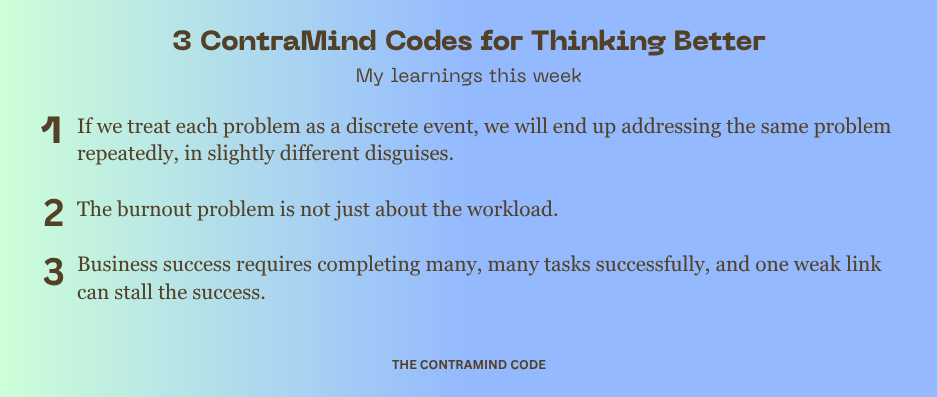
“If we treat each problem as a discrete event, we end up addressing the same problem repeatedly, in slightly different disguises. A cash crunch is solved with a new line of credit. Several months later, the same crunch returns, this time magnified by the debt accumulated from the last one.”
“Stop asking “What caused this?” and start asking “Which underlying system is failing to contain the pressure that is producing this?” The two questions sound similar, but they produce entirely different conversations.”
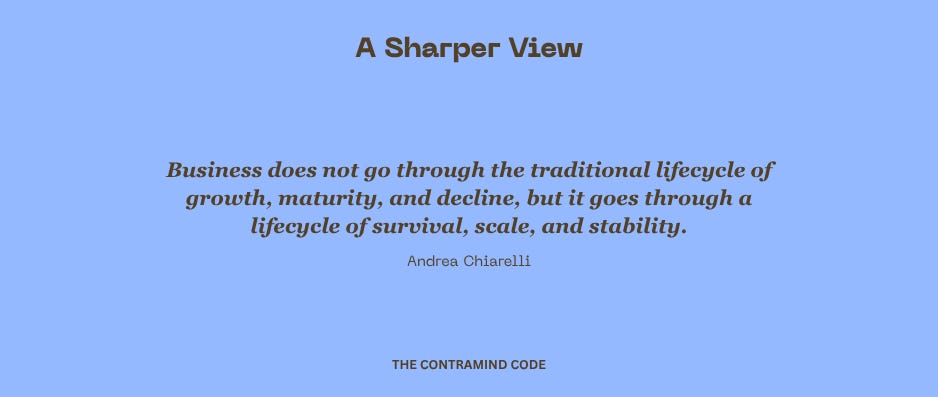
Business does not go through the traditional lifecycle of growth, maturity, and decline, but it goes through a lifecycle of survival, scale, and stability.
You can read his article here.
Why High Performers Burnout, And How To Stop It.
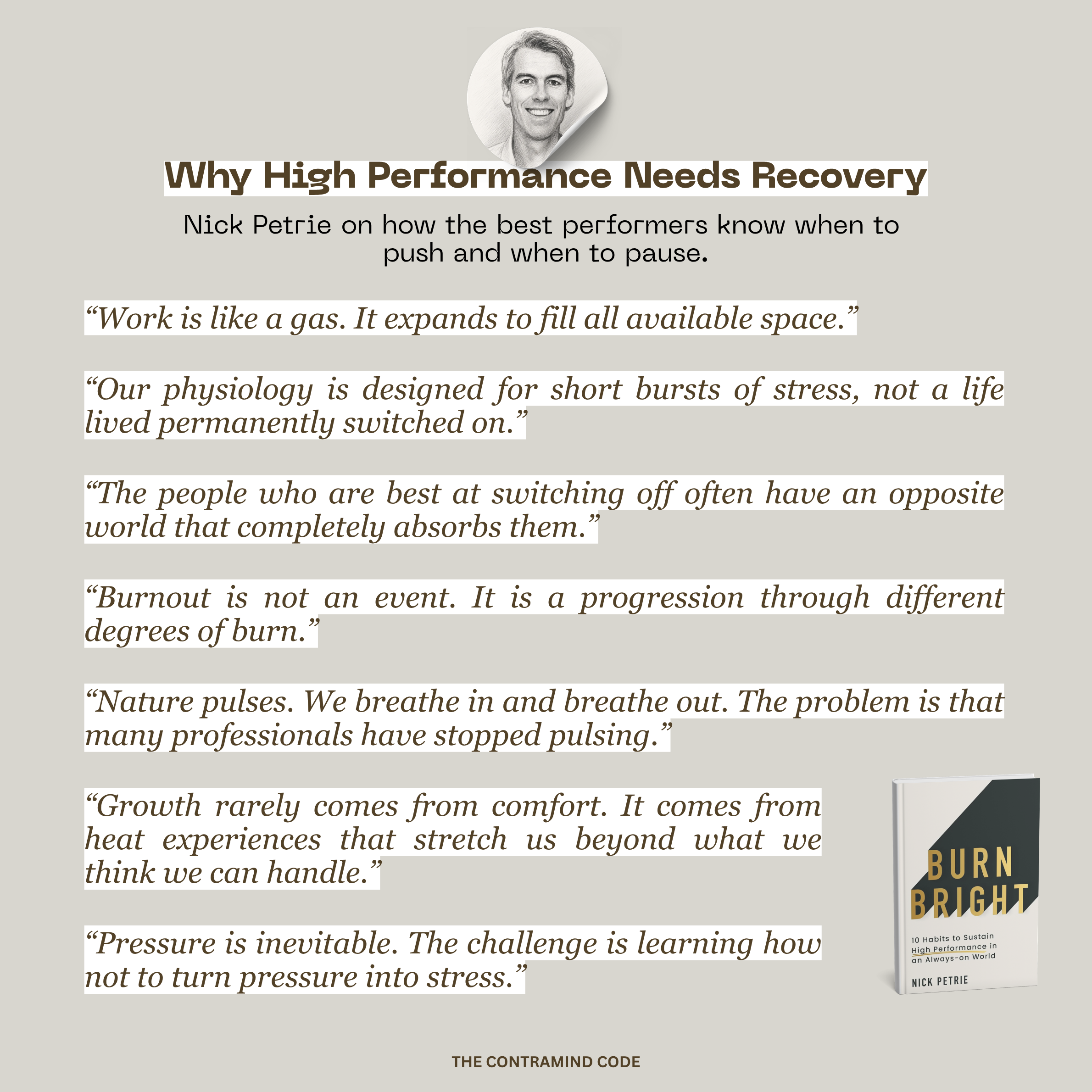
In this conversation on the ContraMinds Labs Podcast with Nick Petrie, a renowned researcher and speaker on leadership, resilience and burnout prevention, he brings out salient points about burnout based on his 3-year longitudinal research study and his recently published book ‘Burn Right’.
Here are some key takeaways from this chat:
Most people don’t suddenly burn out. They move through different degrees of burn—from temporary stress to chronic overload to complete exhaustion.
The best performers don’t work at maximum intensity all the time. They “pulse” between focus and recovery, effort and renewal, just as nature operates in rhythms.
The experiences that develop leaders the most are often the uncomfortable ones. Stretch assignments, uncertainty, and first-time challenges build capability and resilience.
Pressure is inevitable. Stress often occurs when we repeatedly replay negative stories in our minds. Reflection helps us learn; rumination keeps us trapped.
People don’t burn out only because they work too much. Many burn out because they spend years doing work that conflicts with what they truly value.
You can click on the above link and listen to the entire episode.
"A.I. and Our Economic Future," Professor Chad Jones
Professor Charles "Chad" Jones explores the transformative impact of artificial intelligence on our economic future. He makes some very compelling arguments by studying the impact of transformative technologies over the last 100- 150 years. He puts forth the idea of ‘weak links’ that will act as a bottleneck for high growth and widespread job losses or disruption in the next five years. Prof. Charles Jones reinforces his argument with a simulation model that accounts for GDP growth. Labour’s contribution to GDP growth and Return on Capital contribution to GDP growth over the next 75 years. He builds his hypothesis around two key statements that he applies to the simulated model:
Scenario 1: AI dramatically accelerates economic growth.
Scenario 2: AI is just a normal technology. AI is business as usual.
He tries to answer the question: “Does growth and change happen in three years or five years, or does it happen in 25 years?”
Prof. Charles Jones makes an emphatic point that even though the steam engine, electricity, and the internet were wildly transformative, growth rates were still 2%.
It’s complementary innovations on top of these disruptive technologies that drove this growth; else growth would have slowed - semiconductors, electric motors, internal combustion engines, spreadsheets, computers, etc. These complementary innovations need to be integrated and reorganised into the production process.
He then brings forth the concept of ‘weak links’ - Business success requires completing many, many tasks successfully, and one weak link can stall the success. “Chain is only as strong as its weakest links.”
He also makes a point - “Computers are getting less of GDP, not more of GDP, even though there are 100 million times more transistors in your pocket.” “Software is about 2% of GDP.
“We have more radiologists today than we did in 2016, and they’re paid more than they were in 2016.” This is because of the weak links.
The weak-link view suggests that things take much longer than you think.
You can click on the above link and watch this video.
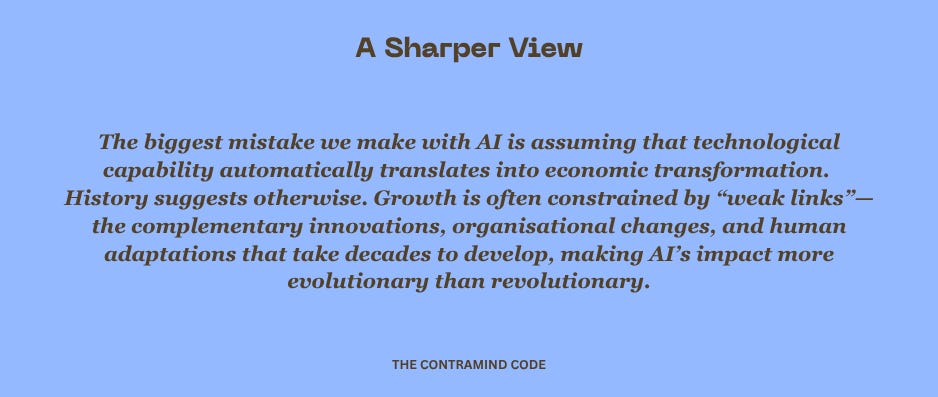
A Named Problem Is Not The Problem. It’s Merely A Signal.
One sentence from Andrea Chiarelli's article that sounded very powerful but true was the one about “A named problem is not the problem. It’s merely a signal.”
What’s interesting about this statement is that it applies to both organisations and individuals.
We often see this in many organisations: it’s always the problems they can see or surface that are assumed to need attention, which are solved. However, it’s the underlying structural condition that keeps coming back as a new version of the same symptom. The problem they see explicitly is merely a signal, and solving it does not eliminate the problem completely, since only the signal is addressed. People can blame it on the system, management, or a person and hide behind the symptom, creating the problem. At any time, organisations can hire external consultants to address the symptoms.
However, for you as an individual, there is no such escape. You are both the doctor and the patient. You are the system that’s simultaneously generating the symptoms. Also, you are the observer trying to read them, and if there’s somebody who has the most to lose, it will be you, assuming your diagnosis is inaccurate. Also, remember, there is a total conflict of interest. Hence, individual misreading of signals is widespread and often more damaging than organisational misreading.
Robert Kegan and Lisa Lahey at Harvard conducted in-depth research on this topic, and their findings are quite interesting. They concluded that individuals have “hidden competing commitments” - where their stated goals contradict their unconscious goals! As individuals, it is very hard for them to see competing commitments because seeing them would require confronting a "big assumption" about themselves.
Differentiating the signal, the problem and the symptom.
Here is a day-to-day example that may happen at your workplace for you to think and understand this a little more deeply:
You may have identified a problem like: "My problem is that I need to speak up more in leadership meetings."
You have identified the problem correctly. You may also be taking action on it by reading books, attending some training programs, etc.
But lying beneath could be another goal: "I am committed to never appearing incompetent in front of senior leaders." And this may be primarily driven by the assumption that"If I am seen as incompetent, I am fundamentally unsafe — professionally and personally."
This underlying primary assumption operates at full swing in every leadership meeting inside you. It produces your lack of willingness to speak in leadership meetings. Not speaking up is the signal, but fear of being seen as incompetent is the symptom.
"I don't speak up enough" is the named problem, but "What if I am seen as incompetent?" is the actual symptom. If you address the fear of incompetence, your ability to speak will improve.
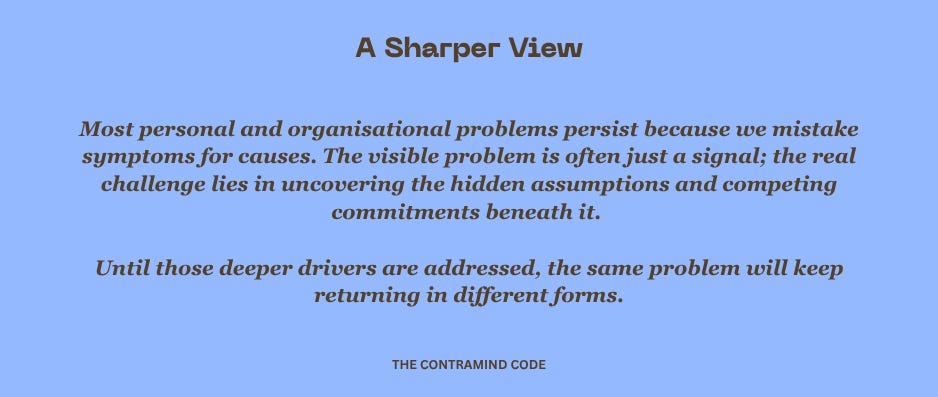
Carl Jung, Swiss psychiatrist, psychotherapist, and psychologist, defined this problem extremely well: “The qualities individuals most strongly and quickly criticise in others are often the qualities they most forcefully deny in themselves.” The projection is the signal. Carl Jung’s insight was very insightful: “What you cannot see in yourself, you will see in others.”
As an individual, how do you misread the signals?
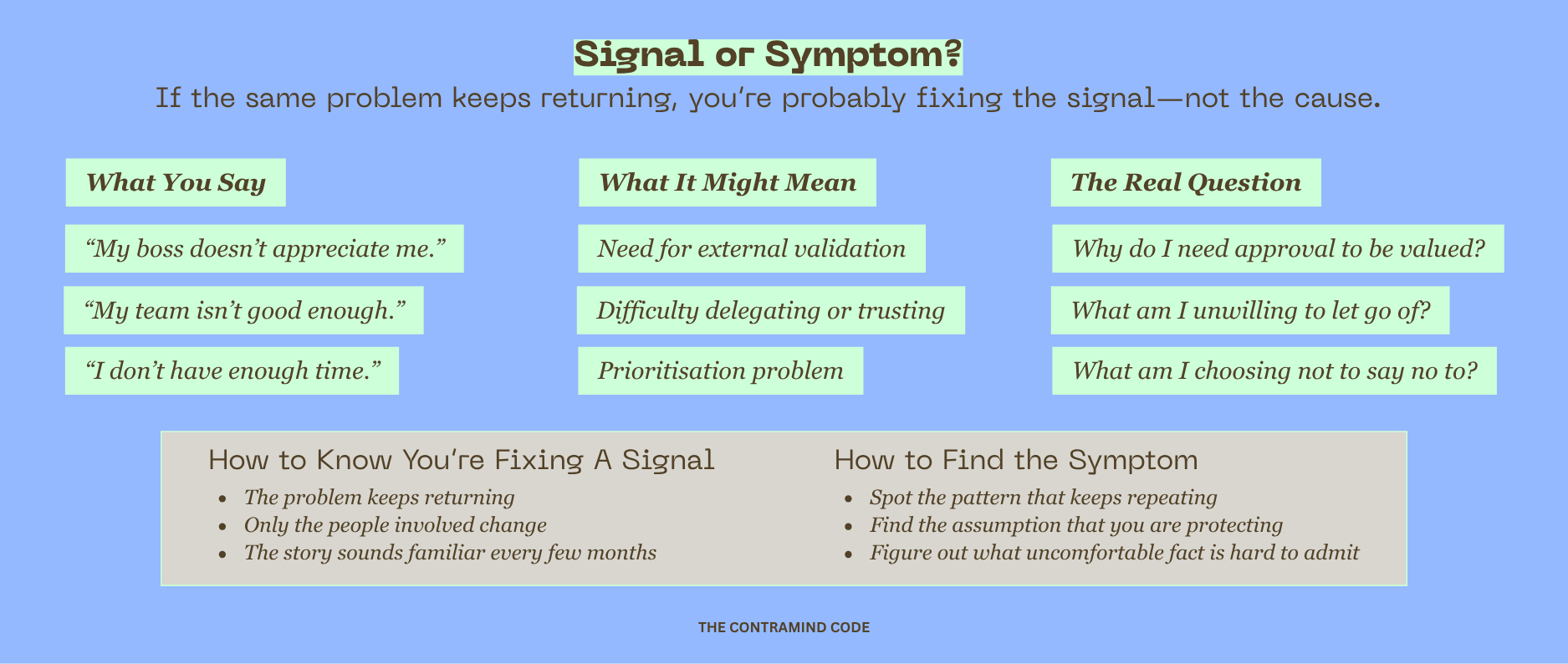
Seeing it as someone else’s fault:
"My organisation doesn't value strategic thinking."
“ He is a difficult person to work with.”
“My team is not good enough”
“My boss does not appreciate me.”
Naming the recent cause, not the underlying condition:
"I'm burned out because this quarter was too intense"
“The project got delayed because the client changed the requirements last minute.”
Naming the symptom that's visible, not the one that's actionable.
"I don't have enough time"
“Too many changes in priorities and changes to work on.”
“Don’t have enough resources or bandwidth”
How do you learn to address the symptom and not the signal?
If the problem keeps recurring, you can rest assured that you're addressing the signal, not the symptom.
Here are some simple tips and suggestions that you can consider:
Treat your recurring criticisms of others as diagnostic data about yourself: If you are consistently emotionally charged and criticising others in a specific domain, it is worth interrogating yourself.
Treat the problem as a hypothesis and seek evidence: When you see or identify a problem, don’t come to a conclusion immediately. Try to generate two or three alternative explanations and consider the evidence that explains the closest reasons as to why the problem is happening. Actively look for the evidence to confirm your problem definition.
Practice time-delayed reflection: Maintain a diary in which you record the problems you identify and when you solved them. Revisit this once a quarter or in six months and see if you are addressing a similar problem with a new variation. Then it tells you that you have not solved the symptom, but only the apparent signal.
Remember, when organisations misname problems and address the apparent signals, they try to protect power structures. An organisation can be restructured. However, when individuals misname problems and constantly focus on the apparent signals, they tend to protect their self-image. This mistake can be existential and can hamper their growth. This therefore needs to be examined and questioned voluntarily.
It’s also time for you to think about this a bit.