Introduction
Welcome to The ContraMind Code.
The ContraMind Code provides you with a system of principles, signals, and ideas to aid you in your pursuit of excellence. The newsletter shares the source code through quick snapshots for a systems thinking approach to be the best in what you do. The ContraMind Code helps you reboot and reimagine your thinking by learning from the best, and enables you to draw a blueprint on what it takes to get extraordinary things done. Please share your thoughts and comments to start a conversation here.
Take a journey to www.contraminds.com. Listen and watch some great minds talk to us about their journey of discovery of what went into making them craftsmen of their profession to drive peak performance.
In this brilliant article, Saras D. Sarasvathy, Paul M. Hammaker Professor of Business Administration and Jamuna Raghavan Chair Professor in Entrepreneurship at the Indian Institute of Management, Bangalore, writes that her research shows that a founder’s ability to ask is the core competency that makes everything else possible. She adds that novice entrepreneurs struggle with asking.
Here are some radical views that she shares in the article about entrepreneurs:
“They often focus on building pitch decks and writing business plans because business schools emphasize those methods.”
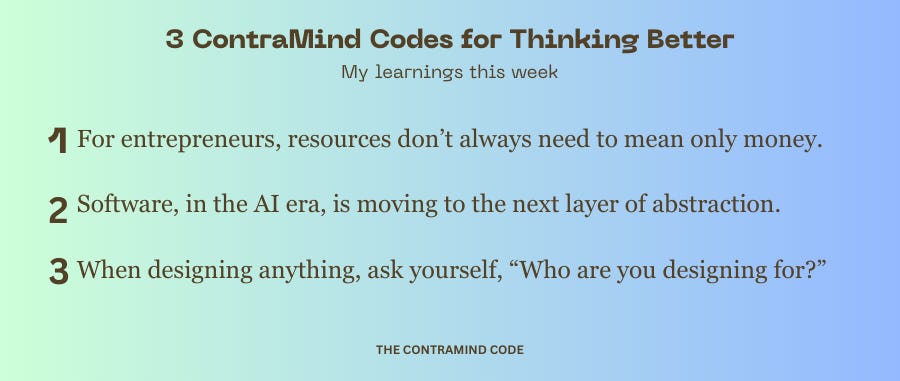
“When aspiring entrepreneurs think about resources, they typically jump straight to money. But this narrow focus can paralyze progress. Before you've validated your concept, built relationships with potential customers, or understood your market, obsessing over funding makes little sense.”
What to Ask For:
“Transactional resources with low commitment, which include advice, information and feedback.”
Ongoing support without major commitment, which encompasses mentorship, coaching and regular guidance.”
“Transactional resources with high commitment, which include formal investments, grants and subsidies.”
“Ongoing relationships with high commitment, which represent the ultimate goal: paying customers, reliable suppliers, co-founders, and long-term partners.”
Read the entire article here.
Grady Booch, is an American software engineer, best known for developing the Unified Modeling Language(UML) with Ivar Jacobson and James Rumbaugh. He is recognized internationally for his innovative work in software architecture, software engineering, and collaborative development environments.
In this podcast, Grady Booch speaks with Gergely Orosz, host of The Pragmatic Engineer podcast and newsletter, the #1 technology newsletter on Substack.
Grady unpacks his deep knowledge of the history of the software engineering industry and explains in a compelling manner how young this industry is, which is not more than 70-80 years old. He also explains, in a very simple and lucid manner, how the software industry has pivoted with each new technology disruption over the last few decades and how he is confident it will transform in the new AI era, too. Grady also explains what skills will be needed to succeed in the third golden age of software engineering.
Professor Kirti Trivedi, Design Educationist and Education Mentor at the Centre for Design Studies, is in conversation with Bapu Kaladhar to discuss key issues on what it will take to make India a design power in the future.
Here are key thoughts from this conversation:
Ask yourself a question: “Who are you designing for?”
Indian products were once the envy of the world in the 18th century!
“Japanese merged Japanese sensitivity with high technology, and we forgot both.”
“We are still creative in textile tradition and jewellery. But, product design, graphic design and architecture, we are totally killed.”
“One misconception is that India was a village economy, it was very urban.”
Click on the above link to watch the video.
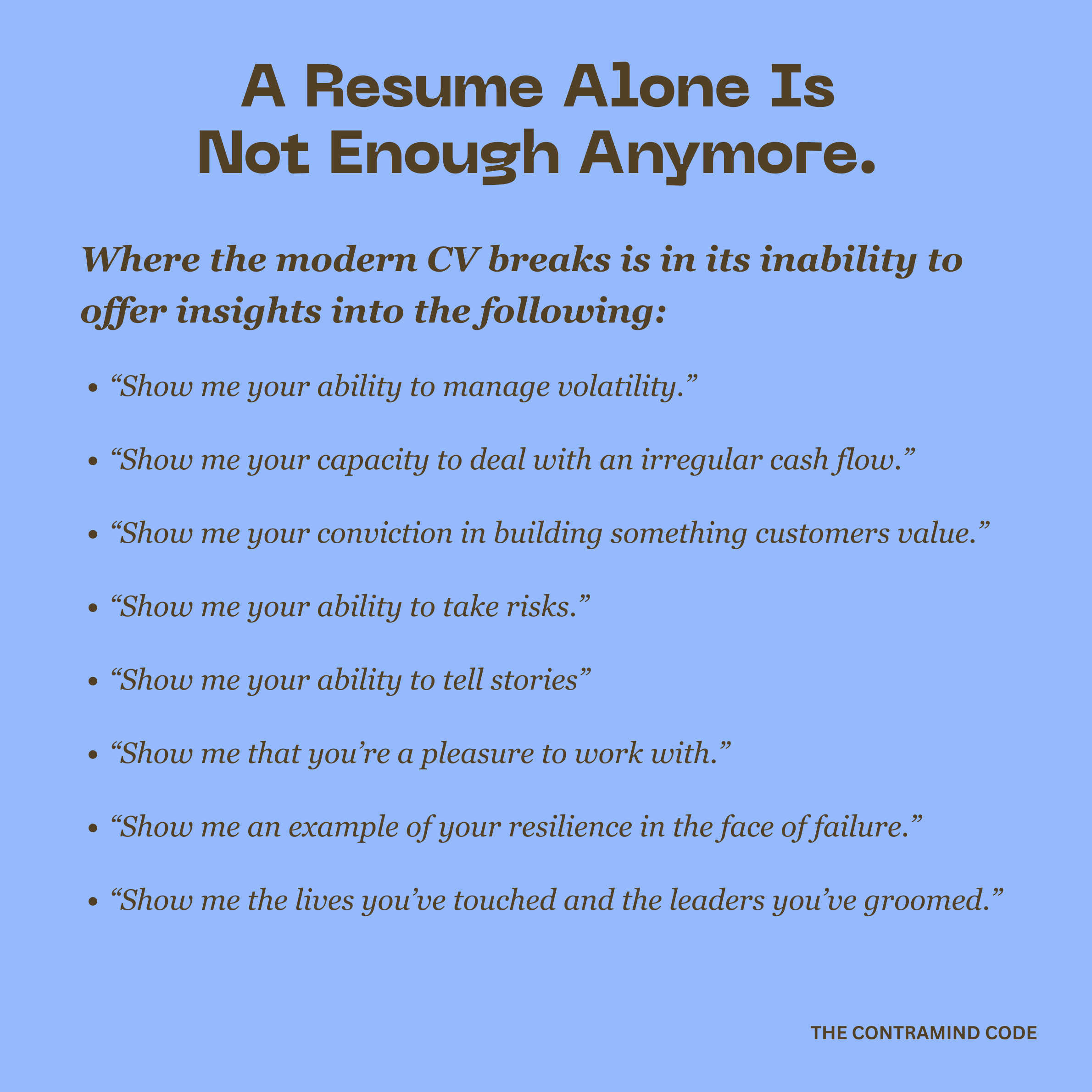
We are now transitioning to the age where we judge people not by their CVs but by their body of work. Nobody judges Michelangelo by looking at his CV. We always judged him by looking at his body of work. What has been historically true of artists, musicians and sportspeople is now coming to the world of professionals. You will be loved, respected and compensated by your body of work. Where the modern CV breaks is in its inability to offer insights into the following:
“Show me your ability to manage volatility.”
“Show me your capacity to deal with an irregular cash flow.”
“Show me your conviction in building something customers value.”
“Show me your ability to take risks.”
“Show me your ability to tell stories”
“Show me that you’re a pleasure to work with.”
“Show me an example of your resilience in the face of failure.”
“Show me the lives you’ve touched and the leaders you’ve groomed.”
Here is mine. So, what does all this mean to you?
In a 30-35-year career span, you are bound to go through a lot of disruptions and pivots in your industry as well as your profession. Some disruptions and pivots are incremental, while some are foundational shifts. Some, in their life, go through an ‘incremental era’ of change, while others go through a ‘foundational era’ of change. Most of us are now going through a ‘foundational era’ of change in the nature of work and employment. To better understand this, we must examine the history of work and employment, which will help us see what it takes to build career-transforming skills, continuous learning capability, resilience and adaptability in this new era.
For most of human history, people did not work for large organisations or corporations in the modern sense. The idea of millions of people being salaried employees of firms was largely a product of the industrial age. Most people were self-employed in the pre-industrial age. Skills were passed on through apprenticeships. Most of the work was based on personal, local, and skill-based factors. There were no HR departments, no corporate ladders, and no salaried jobs before the 1750s. Most people were independent producers or creators.
Compare this to the medical profession now. The organised medical profession is 4000-5000 years old! Imagine you are a doctor today. The number of advances and developments in medicine over the last 50 years has forced doctors to adapt to new prescriptions, diagnostic tools, devices, and treatments. Since doctors are individual practitioners, they are either hired as consultants by hospitals or run their own practices. If they don’t earn the trust of their patients through their expertise and knowledge, patients don’t go to them. This forces them to learn and adapt to survive. Grady Booch, the well-known American software engineer, traces the profession of software engineering back to only 70-80 years in this podcast. Therefore, it is a relatively young profession compared to many others.
It is critical to accept that we are undergoing a fundamental shift in work and employment structures. This requires new ways to build a body of work, knowledge and expertise, career resilience and adaptability.
In the pre-industrial age, work and employment were all about “I am what I make” as work identity and economic value that was created from that. Therefore, autonomy, slow diffusion of innovation, unstable income and scalability were limited in this era.
In the Industrial era, work and employment centred on “I work for this company” as a work identity, and this became the basis for economic value creation. There was earning stability, job security, mass production and scale was possible. However, skill fragmentation, lack of autonomy, hierarchical organisations, and standardized roles were the downsides of this era.
In the AI era, work and employment will be about “I build, create and collaborate across systems,” as a work identity and economic value will be shaped by how people network and leverage ecosystems across geographies. Therefore, people need to learn to ‘orchestrate’ across humans, AI systems and platforms. There will be an exponential rise in productivity, resulting in jobless GDP growth, uncertainty, and income volatility. There will be a need for constant reinvention and learning. Work will turn into a portfolio career - multiple clients, multiple roles, non-linear, project-based, skill or expertise-based, job security will be more about being self-created rather than employer-provided for life, and learning will be continuous and self-directed. It will lead to the decline of the ‘job-for-life’ or ‘job-to-job switch’ model, which was predominant in the industrial era.
If you want to be an impactful, powerful modern professional of the AI-era, you will need to learn to combine all three - be a craftsperson in your skills, an excellent manager in execution and an accomplished orchestrator of strategy. You need to be a collaborator and co-creator. You must learn to work and be productive in hybrid workplaces - remote and physical. You must develop multi-disciplinary and adaptive skills. You have to build your personal brand, network and a portfolio of your capabilities and assets.
In the near future, your reputation will be built on your capability and expertise, not on your education credentials or your employer.