Introduction
Welcome to The ContraMind Code.
The ContraMind Code provides you with a system of principles, signals, and ideas to aid you in your pursuit of excellence. The newsletter shares the source code through quick snapshots for a systems thinking approach to be the best in what you do. The ContraMind Code helps you reboot and reimagine your thinking by learning from the best, and enables you to draw a blueprint on what it takes to get extraordinary things done. Please share your thoughts and comments to start a conversation here.
Take a journey to www.contramindslabs.com. Discover a complete system for ambitious professionals who refuse to plateau, and also a place where you can listen and watch some great minds talk to us about their journey of discovery of what went into making them craftsmen of their profession, to pursue excellence and drive peak performance.
The Age Of Agency.
As the traditional corporate 9-to-5 is questioned, creative leaders have an opportunity to redefine career success.
Rachel Gogel, an independent creative executive and educator, writes in her column in Design Observer that the traditional 9-to-5 job model is being questioned as more of us choose self-employment over typical corporate roles. While she highlights more about the benefits of such opportunities for women, you need to understand that we are slowly moving as a society into an era of ‘fractional leadership’ and ‘flexible workforce’.
Here are some interesting thoughts from her article:
Self-employed knowledge workers now comprise 35–40% of the global workforce.
‘This versatile model provides immense value both ways: companies gain executive-level expertise without the commitment of full-time compensation packages (including benefits and equity), while we gain diversity in projects and clients, autonomy to pursue personal interests, and the space to continually grow.’
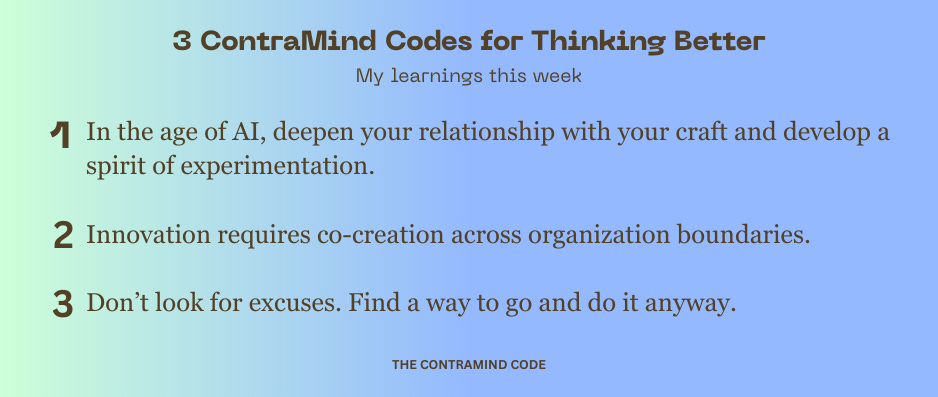
‘The solo journey deepens our relationship with our craft and rekindles the spirit of experimentation.’
‘You may have to turn down opportunities that don’t align with your vision.’
‘Success isn’t necessarily about scaling up, nor does growth always mean expansion’
‘As ‘jobs for life’ fade into history, companies discover they can no longer attract top talent with standard employment packages alone.’
‘We’re building our own rooms with a focus on personal and professional fulfilment.’
Read the entire article here.
The New Leadership Structures That Block Innovation.
Linda Hill, Professor at Harvard Business School, discusses misconceptions about innovation and what it takes to build a culture of continuous innovation.
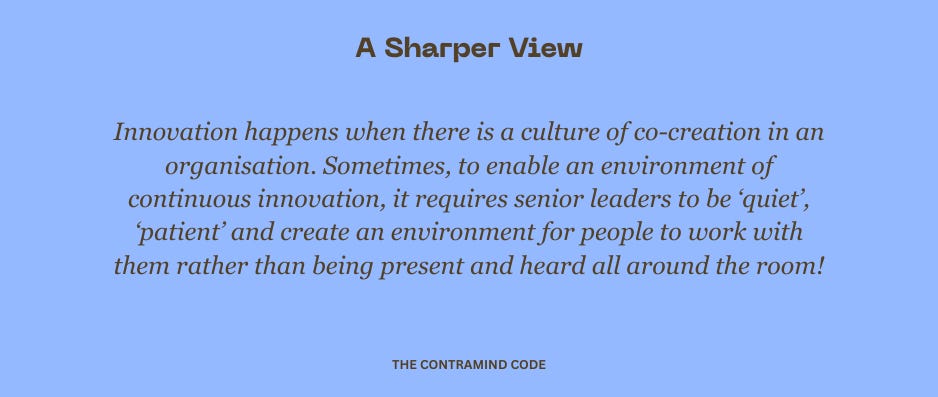
Prof. Linda Hill emphasizes that innovation happens when there is a culture of co-creation in an organisation. Sometimes, to enable an environment of continuous innovation, it requires senior leaders to be ‘quiet’, ‘patient’ and create an environment for people to work with them rather than being present and heard all around the room! Leaders have to learn to leverage the ‘slice of genius’ of the people around them
How do you get people to share their ideas with you as a leader or with the organisation? One of the most important factors in getting people to share their ideas is to create a sense of purpose and make the work they do feel meaningful to them. Trust, feeling valued, and the ability to influence the leader they work with play a key role in people's willingness to innovate. Leadership is an emotional connection, and this helps people experiment without fear and speak honestly to the leader. Decisiveness is extremely key to innovation. Innovation also requires co-creation across organisational boundaries, and, if needed, beyond the organisation to leverage talent and capabilities from outside. In today’s environment, we need leaders to be wayfinders, not pathfinders, as we work in ambiguity, with new technologies and people with new professional skills, etc.
What’s Your Excuse? Do It Anyway.
Many of us hide behind excuses as to why we can’t do something, and the reasons are many:
“I don’t have the time.”
“ I don’t have the bandwidth.”
“I don’t know how to do it.”
“ It’s too hard, it’s too difficult to keep doing them consistently.”
“I just don’t have the motivation to do it.”
Casey Owen Neistat, vlogger, filmmaker, and founder of the multimedia company Beme, just dispels the myth that excuses don’t make sense. He just shows you, with an inspiring example, that it’s all in your mind, and if you want to make the change, it’s all about your intent and intensity. He urges you to do it anyway.
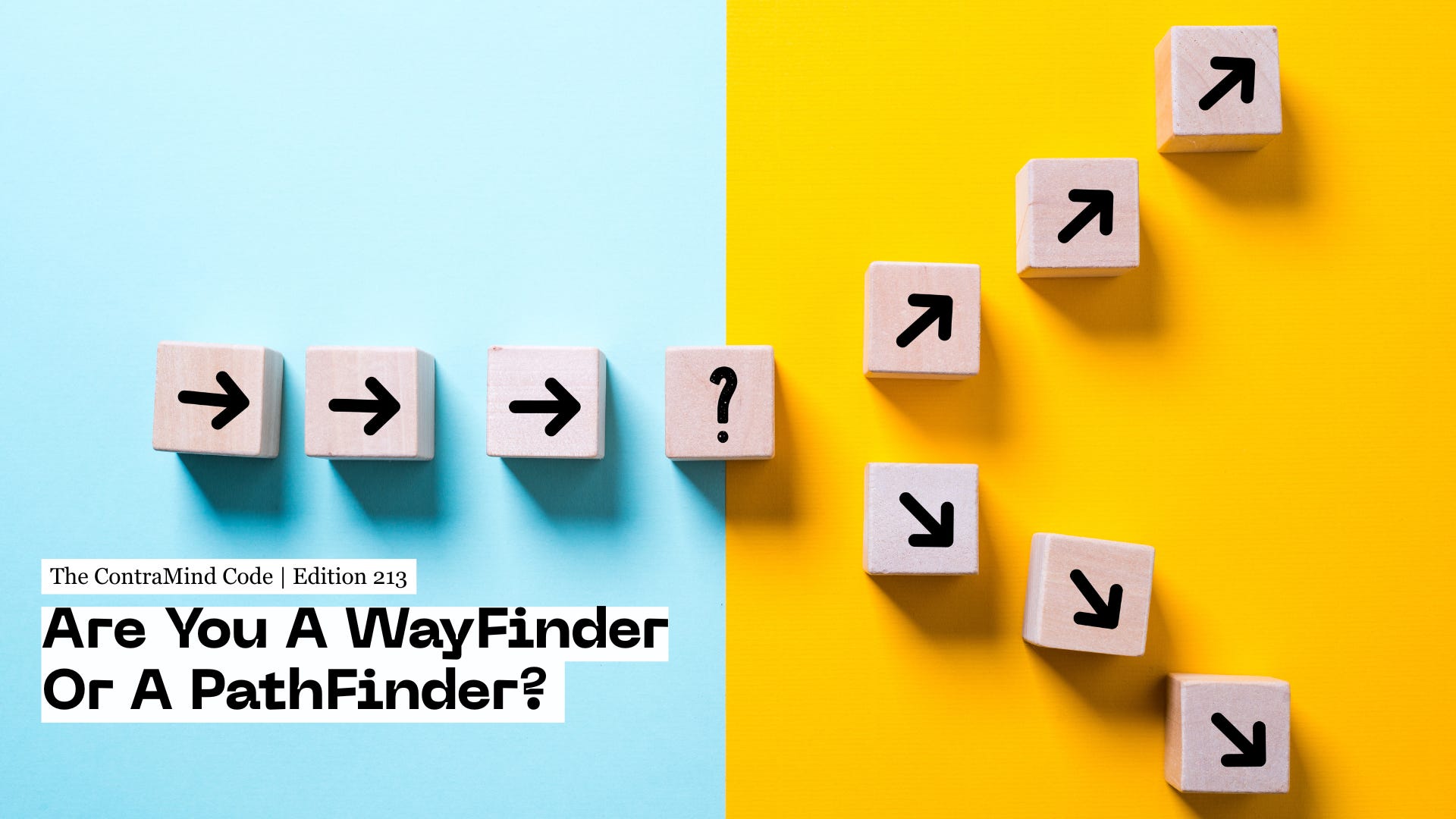
Are You A WayFinder Or A PathFinder?
Linda Hill, Professor at Harvard Business School, articulates brilliantly the leadership or professional capability opportunity or problem - leaders or professionals of today need to be more like wayfinders than pathfinders. Many of us may or may not be aware that we have this capability challenge, and there is also an urgent need for us to intensely work on it.
To make a difference and be the best at anything you do, especially in today’s uncertain or rapidly changing environment, being a wayfinder rather than a pathfinder is vital.
As a professional, how do you know you are either a ‘WayFinder’ or a ‘PathFinder’?
If you are a ‘PathFinder’ kind of leader or professional, you thrive in a stable, predictable environment, and your mindset is defined by a predefined path or way of doing things. Your decision-making style will be heavily reliant on planning. The tools that you will put to use when you do something are looking at best practices, benchmarking processes, you will intuitively use a lot of rules that you have seen work or heard work, and you will be mostly comfortable with ‘linear execution’ and a ‘command and control’ leadership or team culture.
However, if you are a ‘WayFinder’, your mindset is one of an approach where you will be extremely comfortable with discovering the path as you move along. You have a vague or, let’s call it, a ‘blurred’ view of where you need to reach, and you thrive in situations that are complex and uncertain. You have the ability to ‘continuously recalibrate’ because you are extremely aware that the path you are taking has not been taken by many before. Therefore, you have an ‘adaptive sensing’ capability because you know, many of the things you are dealing with may be new to the world in terms of new technology, people and their mindsets, which are totally unpredictable, not solved before, etc. Therefore, the tools you use will be unspoken signals, patterns, and feedback that allow leeway for a ‘flexible execution’. Mostly, the management or working style you will follow is to spend a lot of time on ‘context creation’ with your teams.
Think for a few minutes, and write down which of the above you do more than others. That will give you an awareness of where you fall in the spectrum between a ‘PathFinder and a WayFinder’.
A ‘PathFinder’ mindset worked well in a post-industrial era, when many industries and workplaces began to slowly ‘mature’ in terms of what needed to be done and how it needed to be done. It works well when the destination and path are well-known. However, today we live in an era where careers are shorter, technology cycles, industry lifecycles, innovation waves, and disruptions happen faster than strategy planning or execution cycles. Just think for a moment, the internet took 25 years for diffusion, mobile took 15 years, and AI has taken less than 5 years for diffusion. It is only natural for professionals and leaders to navigate this onslaught of competition, technological shifts, and industry disruptions, as these are unforeseen tsunamis. Many professionals are forced to work in environments and with people that they have never worked with before.
It therefore requires you to be more of a ‘WayFinder’ to understand and absorb the new business or professional language and ways of working, while also infusing your ideas, experience and context into their minds to achieve what was previously thought impossible together. As you do it, you will begin to realize and see that small changes bring non-linear outcomes. In these times of change, when tectonic shifts are happening around you, it is crucial not to follow existing industry or professional growth maps but to learn to navigate unknown terrains rather than protect legacy paths. You must get comfortable with experimentation and iteration rather than getting stuck with static strategic roadmaps. You need to find a way of creating a terrain rather than following what’s already laid out or in front of you.
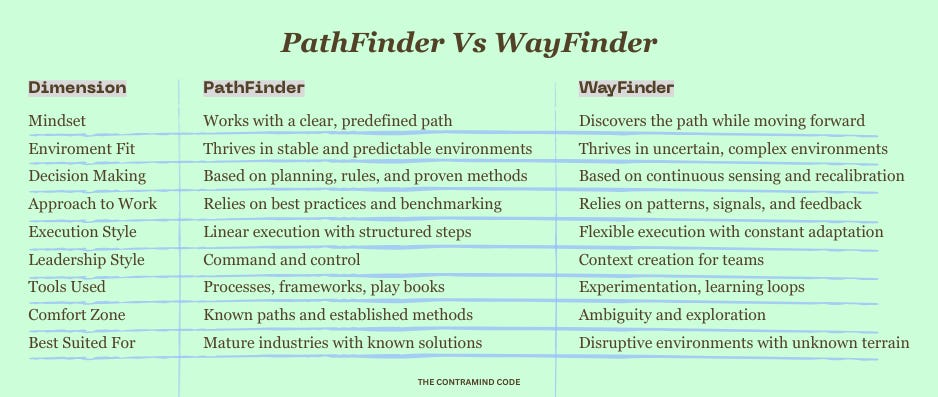
PathFinders work well with maps, while WayFinders work well with a compass.