
Take a moment to think about the last piece of work you handed over.
You finished your part, sent it and moved to the next task. Someone else took it to the next step, and then someone else took it to a customer or a client. Then, someone else had to find out whether it worked. If it failed, you would never know or hear why.
Most of us were trained to work this way. We were hired into a function, measured on our part of the work and promoted for doing it well. But today, many parts of the work are getting redundant or cheaper every year. In fact, the work that is becoming scarce is the one that brings ‘many parts’ of the work together.
What is ‘whole-loop’ work?
If you carefully observe the work you do, you will find that every piece of work runs in a loop with four parts:
One person understands or identifies the need.
One person does the work.
One person supervises or checks whether it is right.
One person answers for the result or the outcome - takes accountability for the outcome, analyses what happened and carries the learnings into the next round.
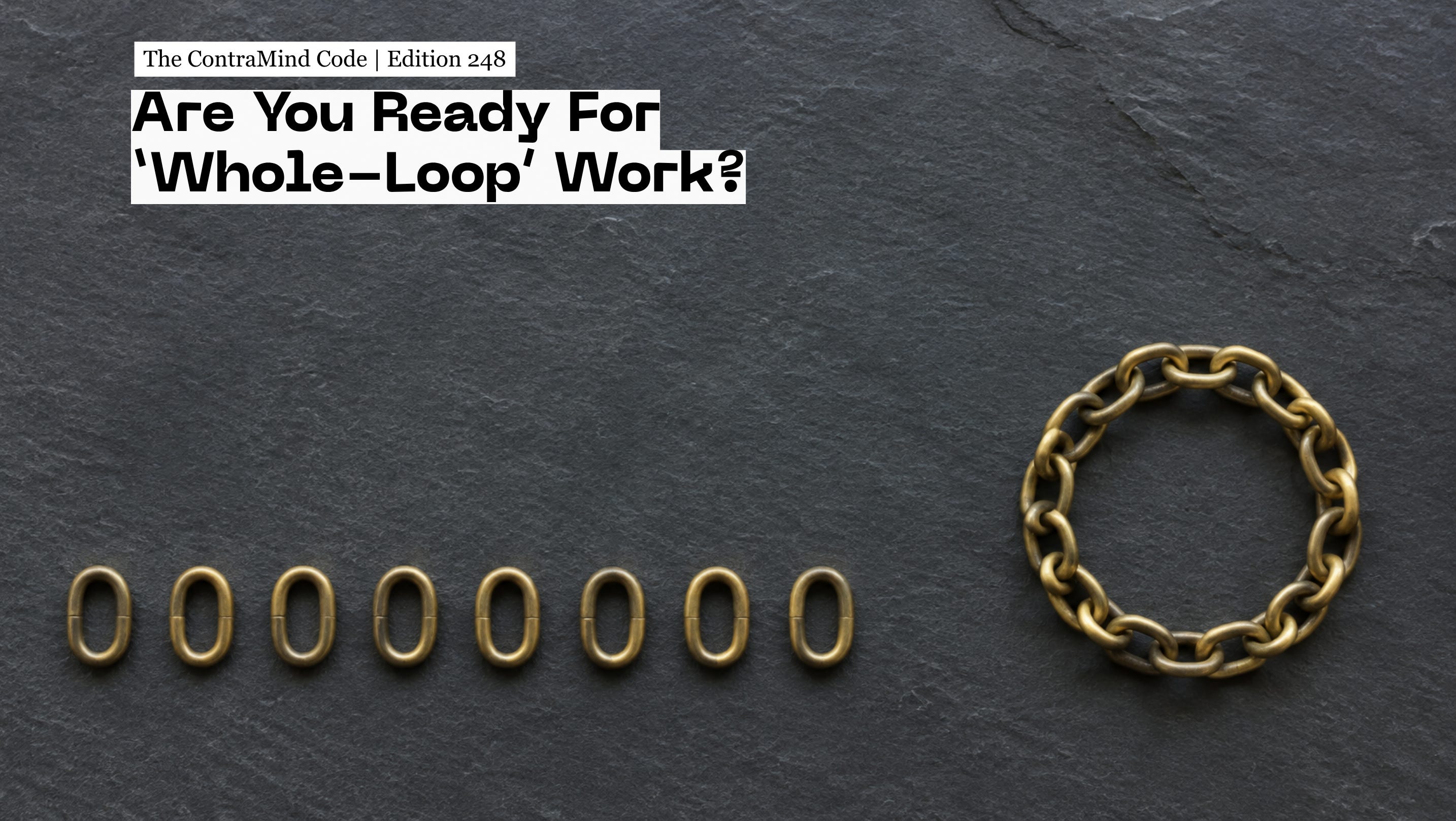
I call it 'whole-loop’ work.
‘Whole-loop’ happens when one person, or one small team, holds all four parts together. The opposite of this is 'sliced work', which is how work was done for many decades. You do one part, hand it over and never get to see the rest.
Increasingly, hiring data trends will start to show more of what’s seen below:
In July 2026, researchers at ShanghaiTech University, led by Chief Data Scientist Chen Qin, drew insights from more than 700 million raw Chinese recruitment records. The largest source of new hiring growth was what they call 'composite closed-loop positions'. ‘Composite closed-loop positions’ are roles that require humans to work alongside AI to complete a full operational cycle rather than letting AI replace the role entirely. These roles are defined by task complexity, where a human oversees, refines, and executes the final output of an AI's initial work. The person acts as the critical final link in the operational ‘loop.’
What is the difference between ‘human-in-the-loop’ and ‘composite closed-loop '?
Human-in-the-loop means the system owns the loop and the human is one step inside it. A composite closed-loop means the human owns the loop, and the machine may be a step inside it. What this really means is that even though AI can do much of the execution, the person decides what's needed, judges whether the output is right, and gives it their stamp of approval.
We are slowly transitioning to a new way of working - finding ‘meaning’ and ‘value’ in the work that is being done rather than just completing tasks.
Psychologists saw the value of this half a century ago. In 1976, Prof. Richard Hackman at Yale University and Prof. Greg Oldham at the University of Illinois studied 658 employees in 62 jobs. They found three psychological states had a positive effect on the work people did:
Experienced Meaningfulness of the work, defined by skill variety, task identity, and task significance.
Experienced responsibility for the outcomes of the work they do - Autonomy
Knowledge of the actual results of the work they did - Feedback
How did the ‘division of labour’ shape the way we think?
More than a two-century-old method of ‘division of labour’ which created ‘sliced work’ largely took meaning and value away from work.
For 250 years, we got ahead by ‘dividing’ work. It produced productivity, efficiency and scale. Take a look at these examples:
In 1776, Adam Smith described a pin factory where making a pin was split into ‘about eighteen distinct operations’ so that ten people could make upwards of 48,000 pins a day!
In 1911, Frederick Taylor moved ‘planning’ of work away from the people ‘doing’ it. At Henry Ford's Highland Park plant in 1913 and 1914, the moving assembly line cut the time to build Model T from about 12½ hours to 93 minutes.
Adam Smith saw the decay coming. He had warned that a man whose life is spent "performing a few simple operations" will have "no occasion to exert his understanding".
The deeper cost of ‘division of labour’ was the gradual decay in the way we think at work.
Deborah Dougherty, a Professor at the University of Missouri, Columbia, studied product innovation in large firms in 1992, and the challenges she identified remain to date.
She found that technical, field, manufacturing, and planning staff lived in separate 'thought worlds'. Their different ways of making sense of the same product kept innovators at bay from ‘synthesising their expertise’.
She found that specialisation did not make people narrow-minded. It made them see things differently. Therefore, silos formed inside the firm as there was no alignment, integration, or translation between functions or departments.
In 1967, Harvard Business School’s Paul Lawrence and Jay Lorsch found that the best-performing firms achieved both ‘dividing work’ (which they called differentiation) and ‘joining’ them up(which they called integration) very well.
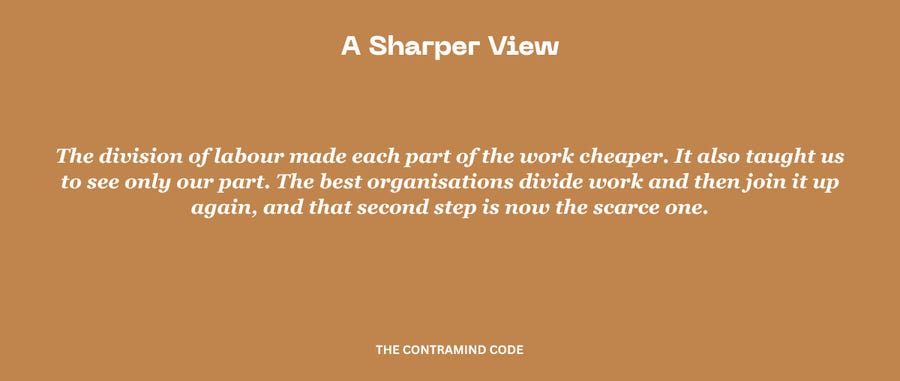
For most of the last century, work was perfected mainly through division, while integration was mostly neglected.
Why does the ‘whole loop’ matter more now?
Let’s look at some of the things we carry, use and drive today.
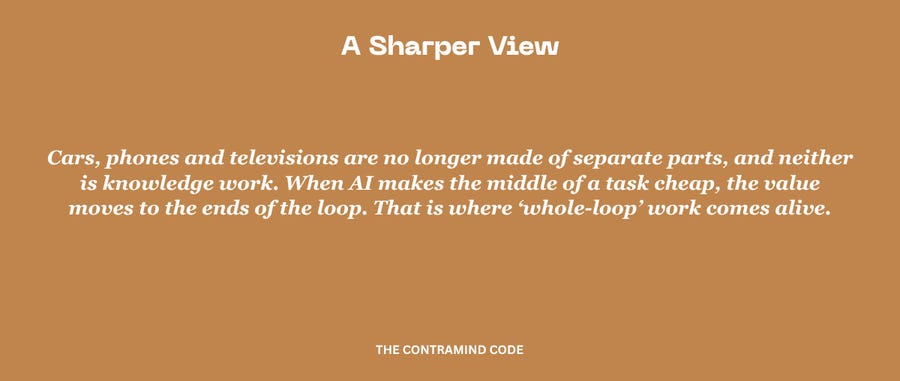
A phone, a television and a car are no longer hardware with some software added on. They're embedded together, and they fail or succeed at the joins. At its core, it’s ‘integration of labour’ thinking.
The recent Boeing 737 MAX incident reinforces this point. International regulators who reviewed the Boeing 737 MAX after two fatal crashes found that, in the certification documents, its flight-control software, MCAS, "was not evaluated as a complete and integrated function". Information about it had been passed on "to disconnected groups within the process". Each process or part of the work had an owner. The whole function had no single owner!
Well-known Stanford University economist Paul David showed that electricity took about four decades to lift factory productivity. The gains came only once factories were rebuilt around the new power source. AI's gains are expected to go to the people and firms that rebuild their work around the ‘whole-loop '. History shows this requires the need for patience and rebuilding skills.
So, will we not need specialists anymore? Not really. Engines, chips and code still need deep specialists. Also, ‘whole-loop’ work does not mean doing everything yourself. It does not mean trading depth for breadth. It means keeping your depth, including an outcome you need an answer for, and agreeing when the loop is closed.
What does ‘integration of labour’ look like in your function?
Under ‘division of labour’, each function owned a ‘slice’ of an activity and handled the output independently. Under ‘integration of labour’, each professional owns an outcome across the ‘whole-loop’ and follows through across the various intersections the functions touch. The perspective changes from "Did I finish my part of the work?" to "Did the thing we set out to do actually happen?"
Let me illustrate this with a few examples:
If it’s an HR function, ‘division of labour’ thinking focuses on one ‘slice of work ’- filling a vacancy and closing the requirement once the offer is accepted. ‘Integration of labour’ thinking focuses on owning the hire until the person can deliver the outcome they were hired for. It includes understanding what the team really needs, checking in every 3-6 months whether the hire is making the intended impact, and learning from feedback how to better define and screen the role.
If it is an IT function, the ‘division of labour’ thinking focuses on one ‘slice of work’, such as closing the ticket or shipping the system to specification. ‘Integration of labour’ thinking focuses on owning the business process the system was built for - measuring whether business value was visible, whether people use it, and whether it helped improve how work got done.
So the specialist doesn't stop being a specialist. What the ‘integration of labour’-driven ‘whole-loop’ thinking does is seek answers that cross the boundaries of their function. AI tools are simply accelerating this need, as it has become easier and more cost-effective to connect functions that once couldn't be connected.
So, what does it take to develop ‘Whole-loop Thinking ‘?
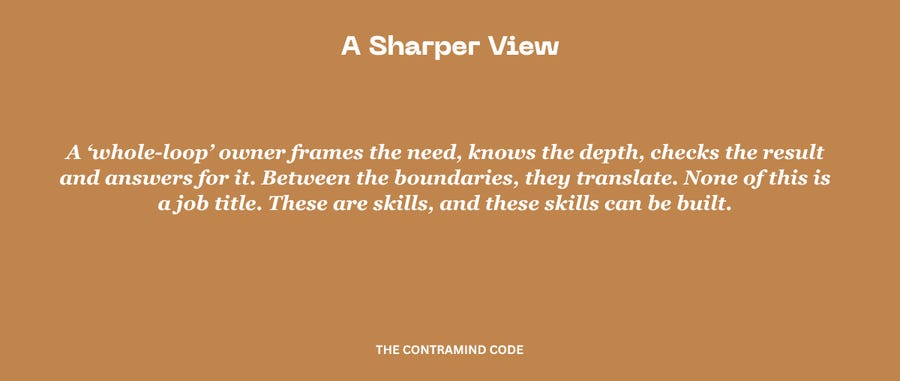
Research points to six capabilities. One for each part of the loop and two for joining the intersection between the parts of this loop.
The first is ‘framing the need’. Before you solve the problem you are given, make sure it is a problem worth solving, described in the words of the person who has it.
The second is ‘knowing the depth and creating the guardrails.’ Wharton’s Prof. Hamsa Bastani found that using generative AI improves student performance, but also makes it harder for students to learn and acquire new skills. As Prof. Hamsa Bastani puts it, “If we are thinking of this tool as an assistant and doing the higher-level tasks, checking its outputs and so on, it can be a huge benefit.” Similarly, in July 2026, India’s industry body NASSCOM found that young engineers were proficient in AI, but only 23% were ‘AI-natives.’ The gaps between proficient and natives were in orchestrating AI and in technical grounding.
The third is ‘knowing when the output is wrong.’ In a study of 758 BCG consultants along with Harvard Business School researchers, it was found that consultants who used AI on a task beyond its abilities were less likely to reach the right answer than those who worked without it. Only someone who can see the ‘whole loop’ notices when a part of the work or loop has gone wrong.
The fourth is ‘answering questions in a way that sharpens judgement.’ Prof. Jennifer Lerner, Professor of Public Policy, Decision Science, and Management and Prof. Philip Tetlock, Wharton School, found that being accountable improves thinking because you don’t commit to an answer. When you work with AI, the answer it throws looks ‘almost right’, but when you push back and ask harder questions, it shows more facts, lets you evaluate them in detail, and builds your conviction. Otherwise, you end up defending what you have already decided.
The fifth is ‘knowing how to bridge knowledge or information and translate.’ Paul Carlile, Prof. of Management & Information Systems at Boston University, identifies three kinds of boundaries that specialists or functional experts need to bridge - different words, different meanings, and different interests. Each requires a different bridge- first, having a shared vocabulary, second, building the ability to find shared meaning while working together; and third, being open to negotiating interests.
The sixth is ‘learning to apply solutions across fields’. Prof. Mary Gick and Keith Holyoak found that people rarely apply a solution from one field to another. To practice this, they found it important to develop the skill of mapping processes between two unrelated systems and detecting similar relations in both. They reiterated the finding that keenly observing the systems and carrying lessons across domains is vital.
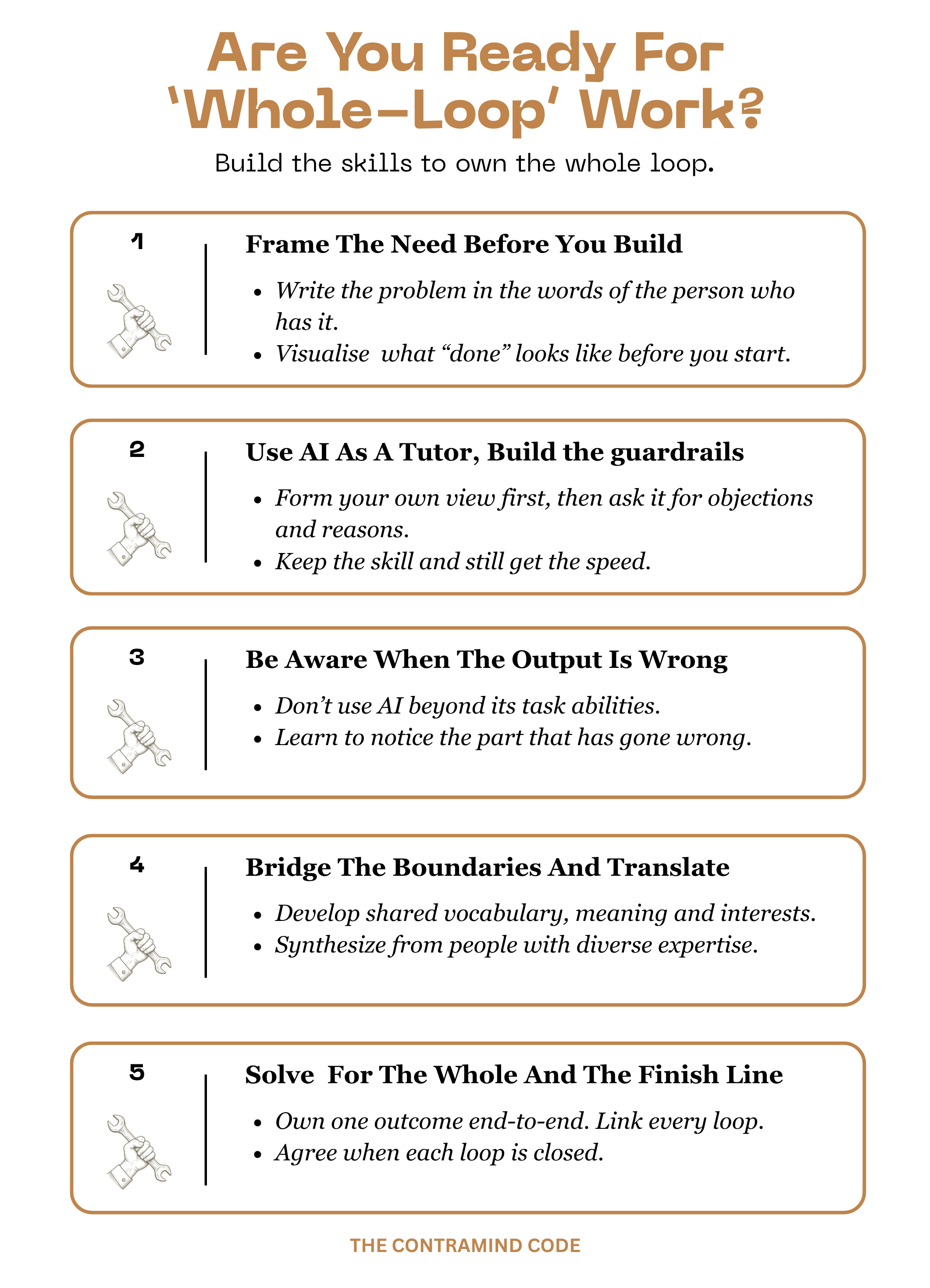
Finally, think back to the family doctor who knew you for years. She was not the best specialist in any one field. But she saw your health holistically, knew which specialist to send you to and noticed when the pieces did not add up. That is the role the ‘integration of labour’ now asks out of every professional. The ‘division of labour’ method only asked you to perfect just your part of the work.
The work that lies ahead will demand someone who can find answers for the whole. Start building the skills of 'whole-loop’ work now, so that you can become the go-to professional in your company or in your function.