
You have probably met this person, or, for all I might know, you may be this person.
The finance head who glances at a spreadsheet and says, “Something is off in row forty.” The leader who gets a sense that assumptions made about a strategy and resulting outcomes are not seeming right. The senior engineer who reads a block of code and senses the bug before reviewing the entire piece of code. The doctor who looks at a patient walking in and orders one more test. None of them can fully explain it. They are usually right.
That ‘feeling’ is the most valuable thing years of work have given you. It is also the part of your skill that you are now most likely handing over to a machine without noticing.
Think back for a minute. Today you ask AI for the first draft, the first summary, the first read of a contract, the first piece of code. It is fast, and often good. But think about what you did just a couple of years ago. You used to ‘notice’ the missing gaps or assumptions that you failed to consider at every stage. And every time you noticed or caught the gap, you were quietly sharpening the instinct that made you valuable in the first place.
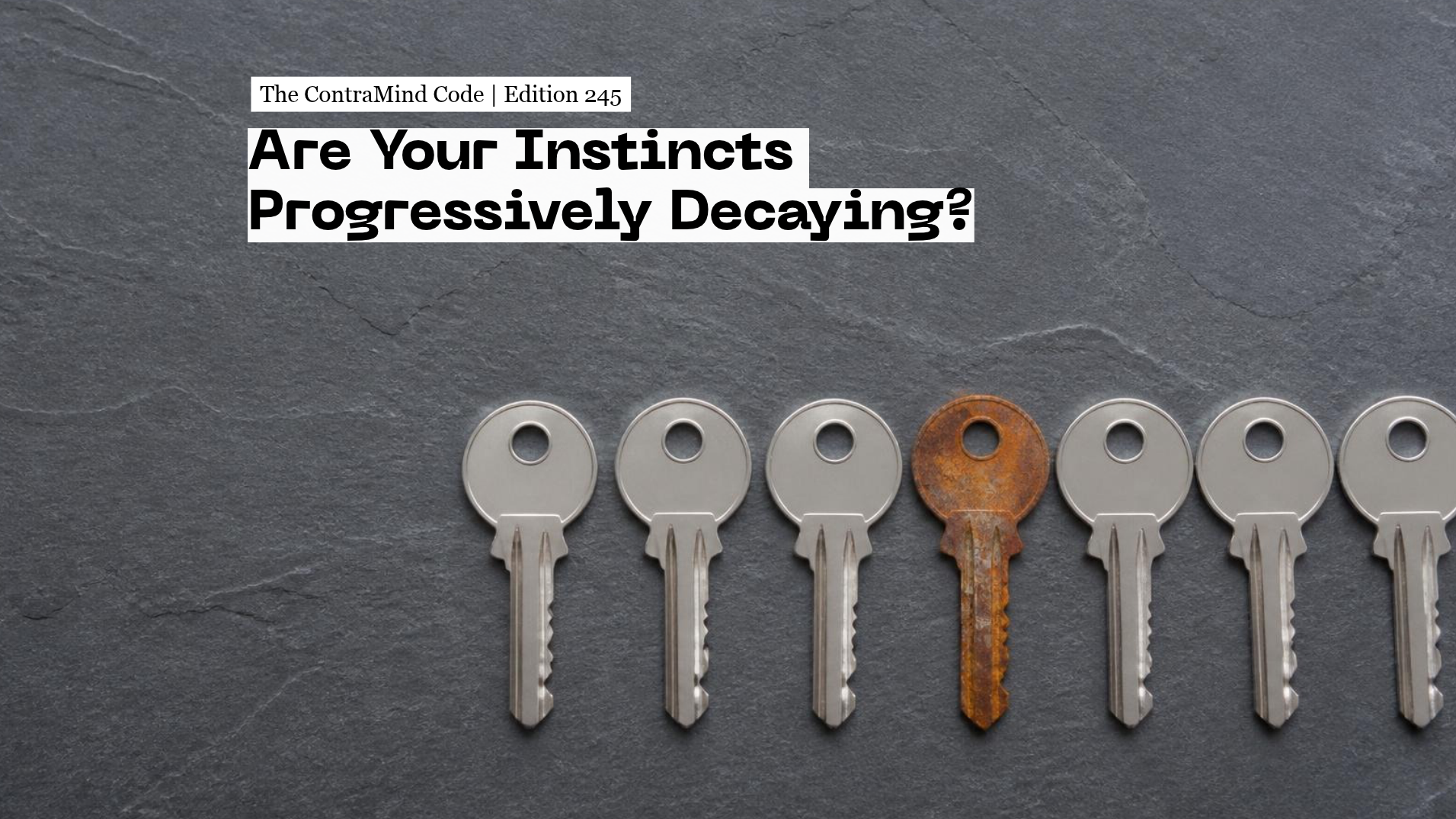
What happens to that instinct when you stop using it? I call this ‘Intuition Rust’.
What is ‘Intuition Rust’?
A couple of months ago, I wrote about the firefighter who walks into a burning building and senses, before he can explain why, that the floor is about to give way. His brain has matched what he sees and hears against a pattern built from fighting real fires.
The economist and psychologist Herbert Simon, who won the Nobel Prize in 1978, explained this better than anyone. In a 1992 paper in Psychological Science, he wrote: “The situation has provided a cue. This cue has given the expert access to information stored in memory, and the information provides the answer. Intuition is nothing more and nothing less than recognition.”
Recognition. It’s not magic, not a gift. It’s a library of patterns, built one case at a time.
How does that library get built?
In 2009, Daniel Kahneman and Gary Klein, two psychologists who had spent decades on opposite sides of the argument about expert judgement, wrote a paper together in American Psychologist. They agreed that ‘intuition can be trusted only when the environment is regular enough to learn from, and when the person has had “prolonged practice and feedback that is both rapid and unequivocal”.
Intuition needs constant practice and feedback. That is the whole recipe for making it recognize patterns successfully.
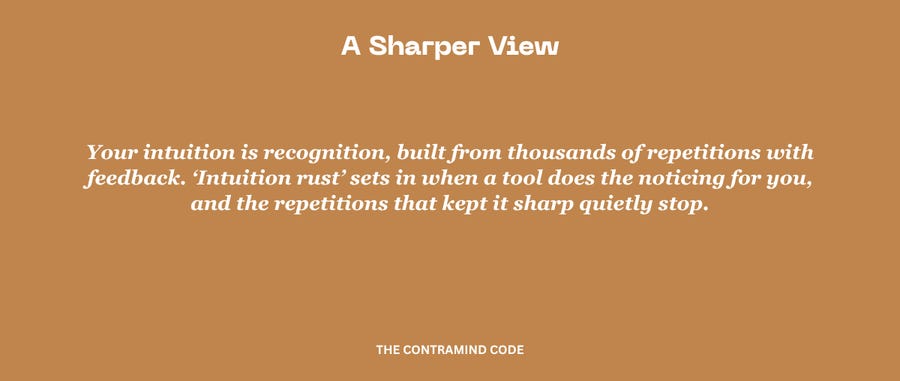
‘Intuition Rust’ sets in when the practice and the feedback loop stop. Every missing gap and assumption you missed led to feedback loop that you fixed and each time you did that, your intuition was getting sharpened. Such patterns which you built, over time, do not vanish overnight. They fade, slowly and silently, because what you are doing today is not forcing you to use them. You still feel like an expert. You are simply noticing less than you used to.
What are the factors leading to your ‘Intuition Rust’?
It happens in three stages, and none of them makes you feel like you're losing while it happens in the background.
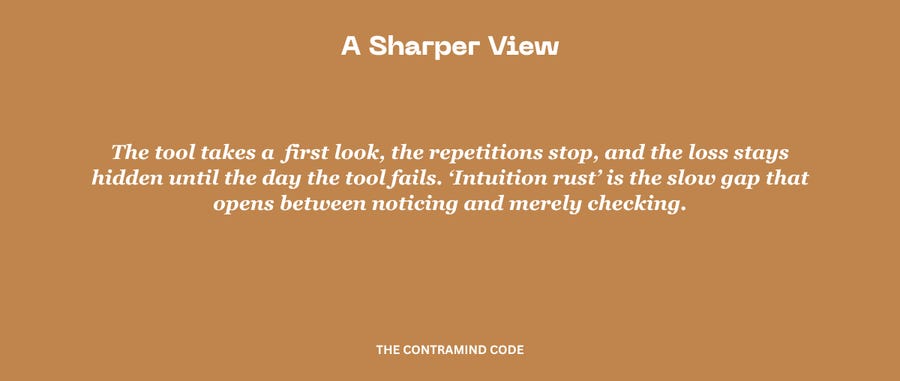
In the first stage, the tool takes a first shot at processing what you need and offering potential alternatives.
You soon stop forming your own view and start reviewing the tool's view. Take a pause to notice the subtle difference between the two activities that look alike from the outside. ‘Noticing’ is when you read the ‘situation yourself’ and form a ‘judgement.’ ‘Checking’ is when you read someone else's judgement and decide whether it looks right. Many of us now spend more of the day ‘checking than noticing.’
In the second stage, repetitions, rework, and feedback dry up.
Research predicted this problem long before AI. In 1983, Lisanne Bainbridge, a psychologist at University College London, published a short paper called ‘Ironies of Automation’ in the journal Automatica. She pointed out that the operator's knowledge of a process "develops only through use and feedback about its effectiveness". When it is taken away or put to rare use, the knowledge stops growing. Her most provocative finding and insight was "a formerly experienced operator who has been monitoring an automated process may now be an inexperienced one."
Therefore, checking a good answer is not the same as producing one through repetition. The psychologists Elizabeth and Robert Bjork at the University of California, Los Angeles have shown for years that we learn more from ‘generating an answer’ than from being shown it. What this really means is that whenever you look up an answer that you could have not worked out yourself, “You rob yourself of a powerful learning opportunity.”
In the third stage, the rust isn't visible until the tool fails or isn't available.
With the tool, your work looks fine, maybe even looks better than before. The loss shows up only when the tool is missing, wrong, or isn’t working. And the part that rusts first is the part you value most - ‘noticing the patterns’. In an interesting 2014 flight simulator study of 16 Boeing 747 pilots, Stephen Casner and colleagues found that pilots’ hand-flying skills were mostly intact. It was their thinking skills, like keeping track of where they were and recognising failures, that had slipped.
Your hands remember. Your instincts forget.
Do you still know the way without the map?
Think of London’s black-cab drivers.
To get a licence, these cab drivers must learn and accumulate ‘The Knowledge of the streets’ - some 25,000 streets of London- and how to get between any two points without a map. This takes years. Neuroscientist Eleanor Maguire at University College London scanned the brains of London black-cab drivers. In a 2000 study, she found that the rear part of the hippocampus, a region involved in spatial memory, was larger in taxi drivers than in other people, and the longer they had driven, the larger it was!
Now consider the rest of us, with a phone on the dashboard or using something like Google or Apple Maps. In 2020, Louisa Dahmani and Véronique Bohbot at McGill University reported in Scientific Reports that people who used GPS more showed a steeper decline in their spatial memory over the following years!
The irony is that a cab driver and a GPS user may reach the same address. Only one of them is still building the map in their heads. When the phone is stolen or runs out of charge, you will know who struggles more to reach the same address faster, because GPS users have lost the habit of noticing, identifying, and storing landmarks or direction signs, as well as the intuition for where traffic is heavier or lighter.
Toyota reached a similar conclusion on the factory floor.
By 2014, Mitsuru Kawai, a veteran of about fifty years at the company, was leading a move to bring manual work back beside its robots. At its oldest plant, workers learnt to forge crankshafts by hand, so they would understand the process well enough to improve the machines. He said, “When I was a novice, experienced masters used to be called gods, and they could make anything.”
Mitsuru Kawai concluded, “To be the master of the machine, you have to have the knowledge and the skills to teach the machine.”
The situation is no different at work today. AI is your copilot. Ask yourself whether you are still using your hands to build the map and the knowledge.
What do the recent research findings about AI show us?
AI research is still young, but it's already producing some interesting insights fast.
In October 2026, researchers from the University of California, Berkeley, Carnegie Mellon, Oxford, MIT, and UCLA released findings on how quickly people’s focus and persistence plummeted with AI use.
In the first experiment, one group solved 15 basic fraction problems without help, while another had ChatGPT open on the side to use for assistance, even to ask for the answer. The group with AI access started off more accurate than the group without it. After 12 problems, researchers removed the AI tool. Almost immediately, that group stopped solving questions accurately!
A similar pattern emerged in a second but larger group. They found that the AI users got answers wrong or gave up entirely when the AI assistance was withdrawn, while the group without AI stuck with the task and was more successful in the end.
Their research findings make an important point: Persistence is “foundational to skill acquisition”. Persistence and retention increases when things are done by hand, by making mistakes and by correcting and learning from them, without help.
Earlier this year, Judy Hanwen Shen and Alex Tamkin at Anthropic ran a trial with 52 software developers learning an unfamiliar programming library. Those who used AI scored 50% on a follow-up quiz, compared with 67% for those who coded by hand. The biggest gap was in debugging, which is exactly the ‘skill of noticing’ that something is wrong.
Frontier AI companies have acknowledged that offloading tasks to agents can reduce a person’s baseline understanding and mastery of a subject.
The more you trust the tool, the less you think for yourself.
How do you protect yourself from developing ‘Intuition Rust’?
Here are some ways to keep your instincts sharp while you use AI every day:
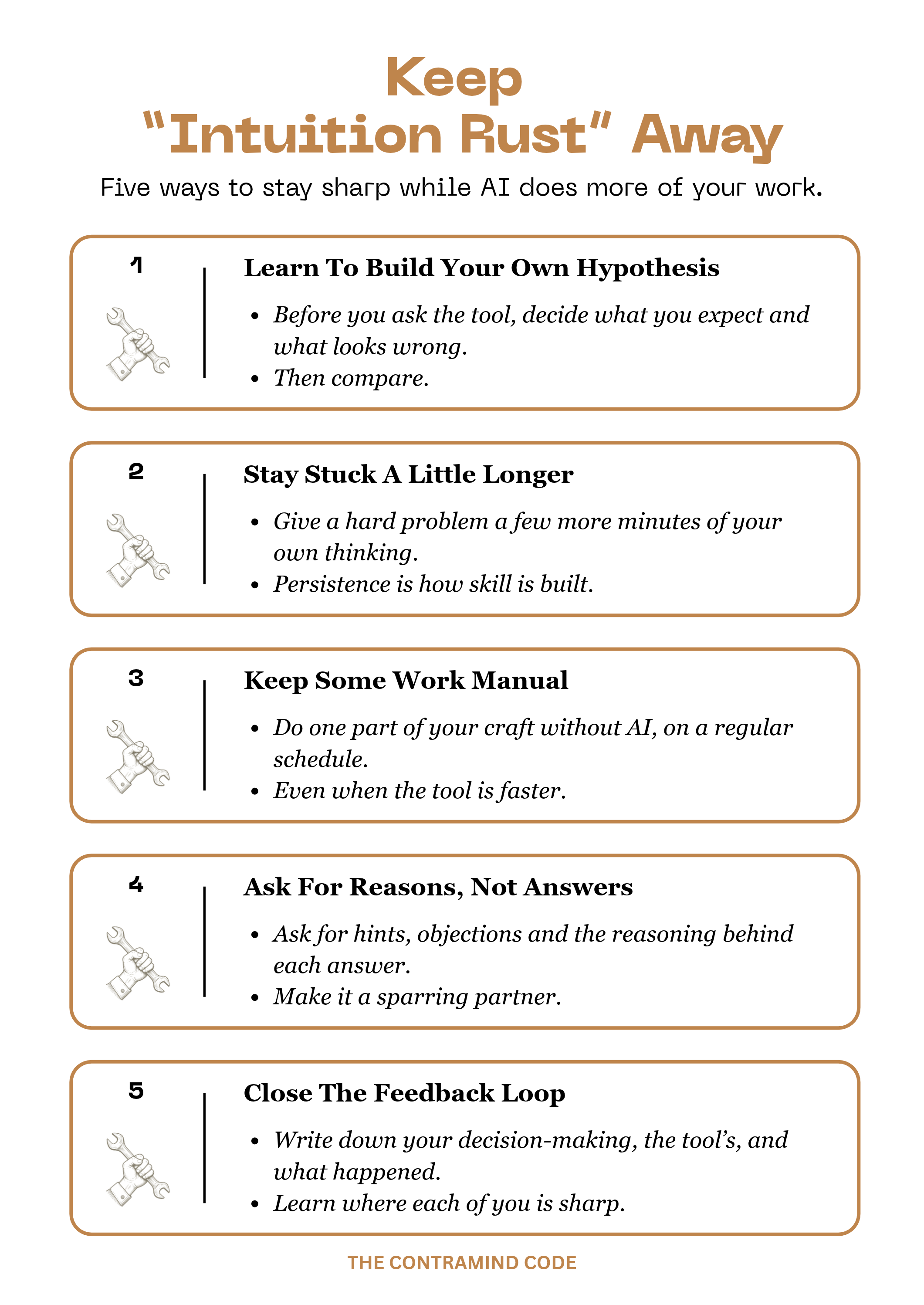
Learn to build your own hypothesis: Before you ask the tool, spend a lot more time forming your own view and leveraging on your experience. Write down notes and your assumptions. What do you expect the answer to be? Look at what looks wrong? Then compare. It’s the repetition and rethinking that keeps your pattern library alive.
Stay stuck a little longer: Give a hard problem a few more minutes of your own struggle before you ask for help. The urge to reach for the tool at the first sign of difficulty is the sign of rust setting in. Persistence is how skill is built. Learning to live with the struggle and inability for some time to solve the problem helps builds your intuition.
Keep some work manual: Pilots fly by hand on purpose. Toyota forged crankshafts by hand on purpose. Choose one part of your craft and do it without AI, regularly, even when the tool would be faster.
Ask for reasons, not answers: The developers who asked AI to explain concepts learnt far more than those who handed over the task. Ask the tool for hints, objections, and the reasoning behind its answer. Make it a sparring partner, not a substitute.
Close the feedback loop: Intuition needs rapid, clear feedback. Write down your decision making process, the tool's decision making process, and observe what actually happens in the interim. Over a few months, you will learn where your instinct is sharp, where the tool is sharper, and where both are wrong.
AI will help you finish tasks faster. Whether it leaves you sharper is up to you. Your intuition was never a gift. It was a library you built, one case at a time, by noticing for yourself. Keep noticing, and keep growing this library. That is how you keep ‘Intuition Rust’ away.