

There has been a lot of discussion and articles about how people like us have to upskill ourselves in the age of AI. However, it may be worthwhile to understand what the impact of people’s skills has been in earlier eras - be it the industrial era or the internet era that has gone by. That will give you a context for the invisible skill decay you or others have gone through, whether you are starting, in the middle, or in the late stage of your career now. This will help you prepare better to handle the scale of change happening around you with AI.
Before we explore how AI will deskill you, let’s spend a minute on the phenomenon of expertise and its inflexibility paradox.
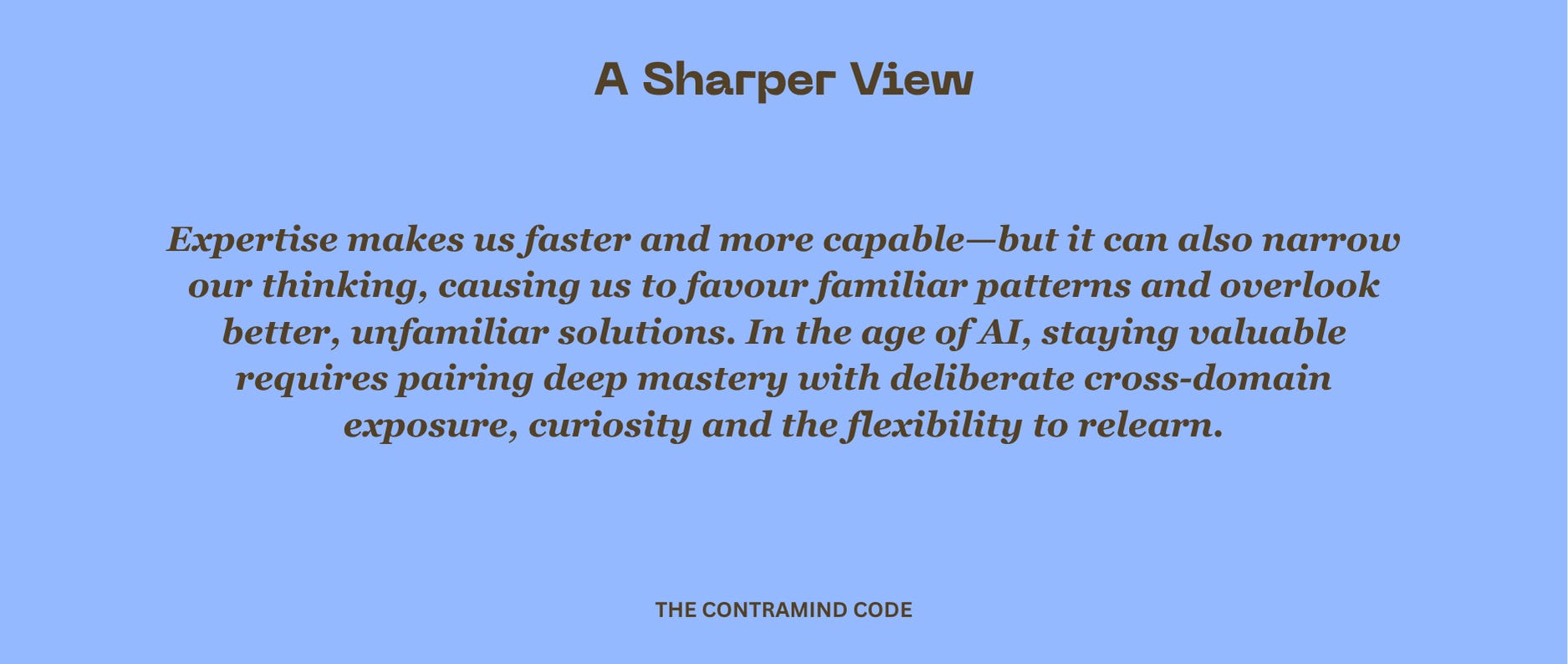
Many of us spent a lot of time and effort building our expertise in our chosen area of profession or function- accounting, sales, marketing, manufacturing, HR, supply chain, IT, etc. But the paradox is that our path to building expertise also simultaneously leads us to a zone of inflexibility. It is important to be cognizant of this problem and work towards not getting there, especially with the rapid proliferation of AI in every job.
Let’s examine why this happens.
According to research, an expert sees too much of what they already know, creating blind spots for themselves. What is funny but stunning is that the same expert sometimes reaches a point where they cannot see what a novice sees more precisely! According to the findings of Erik Dane, a professor at Washington University who led this research, it was found that as expertise grows, the brain becomes dense and forms efficient schema networks for the specific domain. Problems are pattern-matched to existing frameworks. Any problem thrown at this kind of brain system results in a fast, reliable response within the domain. Hence, this creates the following challenges as you develop your expertise:
Any novel or new information gets processed through existing, often-used frameworks rather than being processed afresh.
An expert tends to zero in on less optimal but familiar solutions over optimal but unfamiliar ones.
Their ability to transfer this expertise across other domains begins to degrade.
Therefore, when experts build deep domain mastery and lack deliberate cross-domain exposure, they become professionals who are highly capable within a narrow corridor and get progressively blind to what lies outside their domain.
What’s the performance impact?
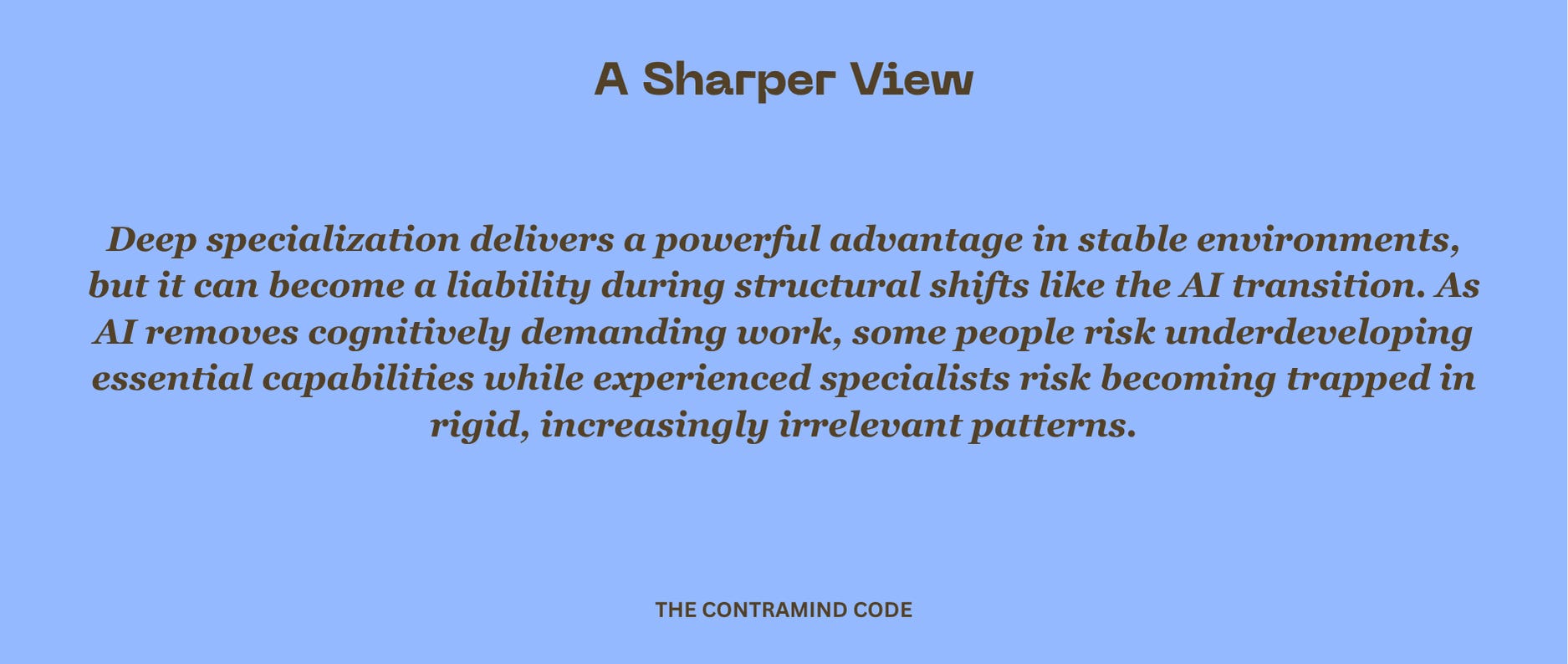
If you are such an expert and you are operating in a stable environment, you will have a huge performance advantage. You are quick off the block, can pick up existing patterns in your brain, and solve problems faster than others. However, if you are in an environment of rapid structural change or disruption, which is what the AI transition currently represents, it is a liability. A phenomenon called ‘cognitive stunting’, which was invisible in a stable environment, becomes catastrophic during such a disruptive time.
Beware of ‘cognitive stunting’ and understand how it can affect you.
‘Cognitive stunting ’ is a widely used term in developmental psychology. When applied to organisational work environments, ‘cognitive stunting’ happens when cognitively demanding portions of work are removed from systematic work-related processes or methods, leaving the human with only the routine, repetitive part of that work. Over time, the capability for human beings to perform the demanding work atrophies, not due to laziness but due to lack of use.
The industrial era of the past, which widely adopted Fredrick Taylor’s method of scientific management, systematically deskilled workers’ skills or a craft that they were good at, by decomposing complex, holistic tasks into simple, repetitive blocks of tasks, disconnected from one another. Some of the people then became ‘super specialists’ and many of them became ‘mere operators’. The management layer of the company handled the conceptual and supervisory part of the work. The knowledge era also followed some of these principles, where different teams built different modules of software or hardware. A case in point is the story of secrecy at Apple, which is well known and written about.
In a stable economic environment, all these ‘Isolated ways of working’ worked successfully, while they were actually creating massive ‘cognitive stunting’ of work-related skills and their capabilities in that era. Professionals could still thrive and grow as they were deeply focussed on what they were asked or told to do. They were blissfully unaware of their own ‘Cognitive Stunting.’ This is why you will find people unable to ‘connect the dots’ as they grew up in such an environment, because they looked at a problem or solution only through their lens or scope, yet companies rewarded them handsomely, as that’s how work was organised in the past. So, they had no reason to question or doubt their capabilities or status as experts or operators who could execute well what was assigned to them.
This is really where Erik Dane’s research findings are valuable. ‘Cognitive Stunting’ has created two problems, and this is going to deepen further in the AI-driven world:
There will be a group of people who will fail to develop capability due to insufficient challenge. AI will take over many of their cognitive tasks.
There will be another group of people who have spent decades over-developing specific work patterns or brain schemas to a point of inflexibility - they are experts or specialists or operators in specific areas. They will now become increasingly irrelevant due to their inflexibility in a new boundary of work if they don’t change.
If machines deskilled people in the past, how will AI deskill you?
In a study released by Microsoft and Carnegie Mellon University in 2025 on the Impact of Generative AI on Critical Thinking, the findings revealed that ‘the more workers trusted AI's capabilities, the less they engaged in critical thinking about its outputs.’ Also, AI users tended to produce a less diverse set of outcomes for the same task than those without AI, leading to suppression of originality and converging towards median-level thinking and solutions. In another study, across mathematical reasoning and reading comprehension tasks, the most disturbing finding was that using AI improved short-term task performance, but when AI was removed, performance dropped significantly, and people gave up sooner too. While AI expedited the answers, it removed the productive struggle that builds both capability and persistence in people.
To summarise, in a company, every workflow where AI handles the hard cognitive step, it will end up actively reducing the capability of the human in that workflow. It will have a direct impact on how you will get deskilled rapidly, in any function or department you are working in.
What are the deskilling signals you need to watch out for?
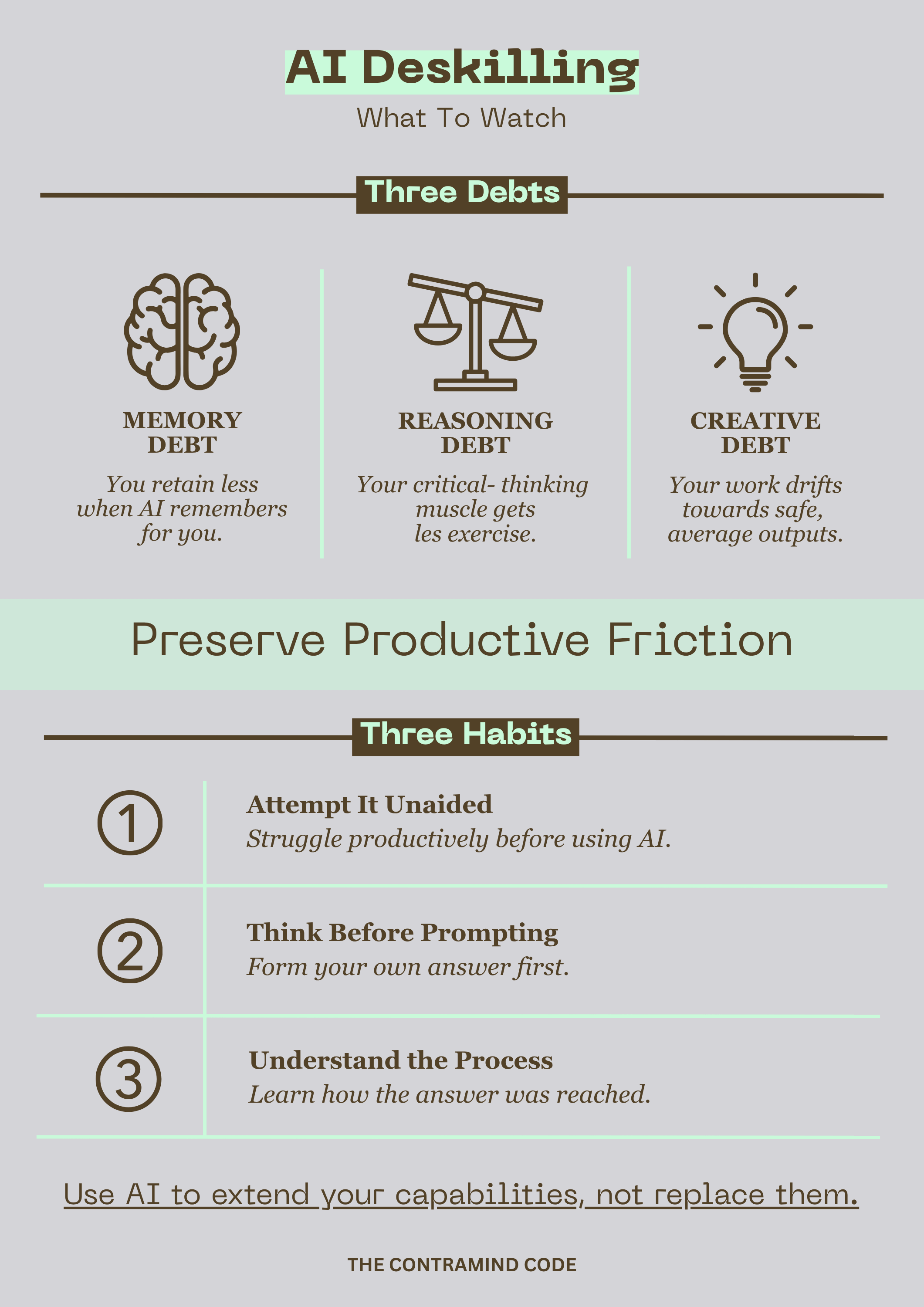
You will accumulate three kinds of debt:
Memory Debt: Before the advent of mobile phones, we remembered a large bunch of phone numbers. Can you even remember a bunch of them today? The same will happen with AI. You will forget a lot faster. You will begin to encode problems in a shallow manner. The reason is that your brain now builds fewer and weaker memory structures for the content.
Reasoning debt: A majority of the reasoning steps will begin to get handled by AI, and you will only handle the prompts and approval. Your critical thinking muscle, the ability to reason through an unfamiliar problem without any scaffolding, atrophies from lack of use.
Creative debt: Using AI tools does not expand your creative capability, it actually compresses it. However, originality requires the cognitive friction that AI eliminates. You will need to get a deep sense of your work and identify areas where you veer towards central tendency and median outputs.
How can you protect yourself from deskilling?
Improve your persistence: Don’t settle for the first output you get from AI tools. Develop the willingness to keep trying to search for answers and not accept the ones that come immediately. Ask hard questions. Work through difficulty and look at the problems from different angles to eventually find a breakthrough.
Learn to encode the friction: Any AI that produces less friction and makes the work easier makes you weaker. The professionals who will win in the next decade are those who will use AI to remove the wrong friction, not all friction. This one singular act helps reduce your ‘cognitive stunting.’
Reduce your C-R-M Debt: Work continuously towards improving your Creative, Reasoning and Memory Debt. Friction helps improve your creative faculties, persistence multiplies your reasoning capabilities to find the right answers without giving up easily and trying harder, and moving away from habit-led execution to involved cognitive engagement in anything you do improves your memory capabilities.
So what new ways of working can you adopt?
Attempt any problem unaided first. Then use the tool to check, extend, or improve it. This preserves the productive struggle phase, the phase where your capability gets actually built.
Before using the tool, articulate your own answer to any problem. Even if it is incomplete, or even if it is wrong. The act of attempting it, wrestling with it, is the cognitive event or effort that builds your capability.
Try to understand the mechanism and don’t just consume the output. Any tool, when used without understanding its mechanism, creates dependency. Using a tool with an understanding of its mechanism builds your capability.
If you want to protect yourself from deskilling, whether in the current AI era or in the future, refrain from allowing capability to accumulate in any of the tools you use. Remember, capability accumulates where more cognitive effort is spent. Ask yourself one question: “Does this capability still reside in me, or has it migrated from me?”