Welcome to The ContraMind Code.
The ContraMind Code provides you with a system of principles, signals, and ideas to aid you in your pursuit of excellence. The newsletter shares the source code through quick snapshots for a systems thinking approach to be the best in what you do. The ContraMind Code helps you reboot and reimagine your thinking by learning from the best, and enables you to draw a blueprint on what it takes to get extraordinary things done. Please share your thoughts and comments to start a conversation here.
Take a journey through www.contramindslabs.com. Discover a complete system for ambitious professionals who refuse to plateau, and also a place where you can listen and watch some great minds talk to us about their journey of discovery of what went into making them craftsmen of their profession, to pursue excellence and drive peak performance.
When Your Ambition Starts To Exhaust You.
Harvard Business Review’s article on Ambition versus Exhaustion provides some lovely perspectives on some of the questions many people keep asking themselves - ‘Why am I feeling overwhelmed at my work despite my burning ambition to achieve ?’
The author of this HBR article, Rebecca Knight, is a journalist who writes about the changing nature of careers and the workplace. She points to some interesting triggers to think about whether you or somebody else you know well is going through this problem:
Is it the engine problem or the fuel problem? What this means is that you need to diagnose whether it’s the body that’s getting tired, or the feeling about what you're doing that makes you tired.
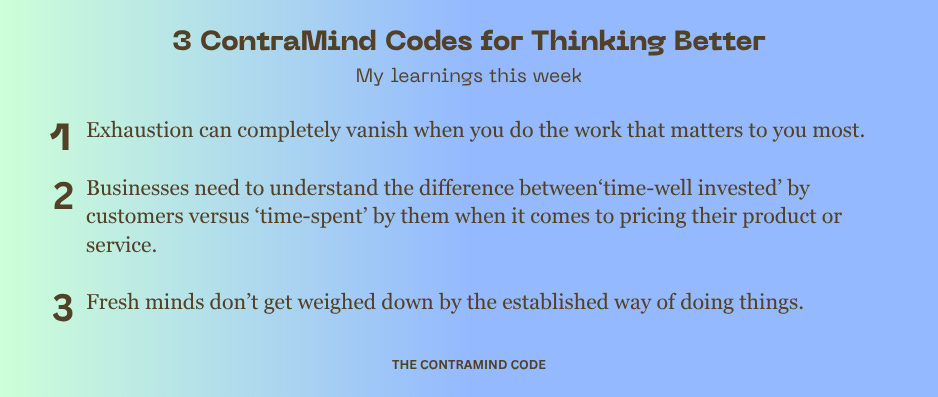
Am I chasing the next achievement, or doing work that matters to me? This is an important question that requires deep thought and analysis. Not often do many people spend time reflecting on this. Some see what they do as a job, a financial exchange, or an advancement or promotion, but only a few do the work because it is their inherent calling. This can clearly explain why there is exhaustion or not.
Whose standards am I living by? This is, again, a problem in which extrinsic recognition conflicts with your intrinsic motivation or needs. It starts to show up over time as you get a little older and mature, or as you stay longer doing what you don't enjoy.
There are two more questions for you to think about and answer, and you can read the entire article here.
Don’t Serve Your Customers, Transform Them.
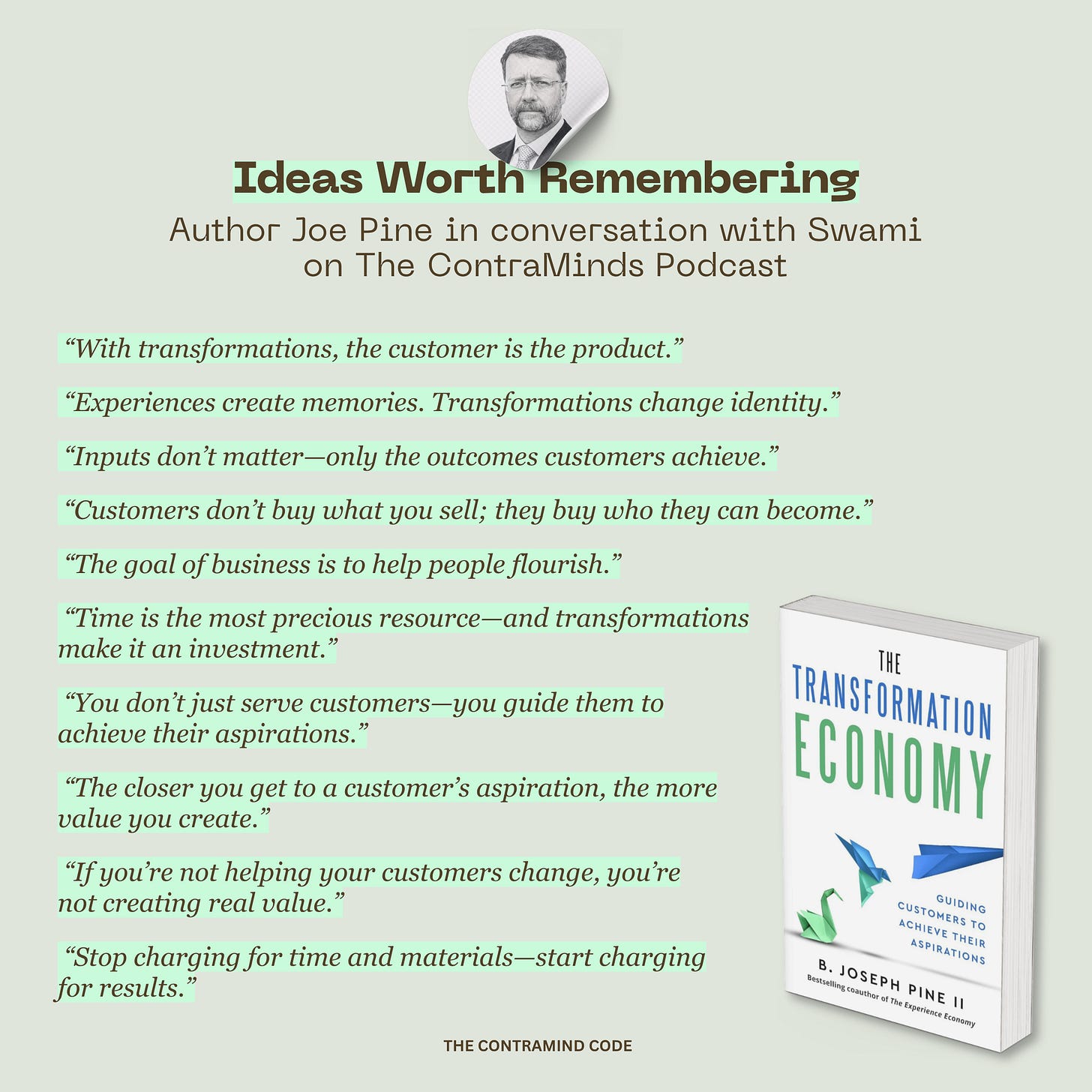
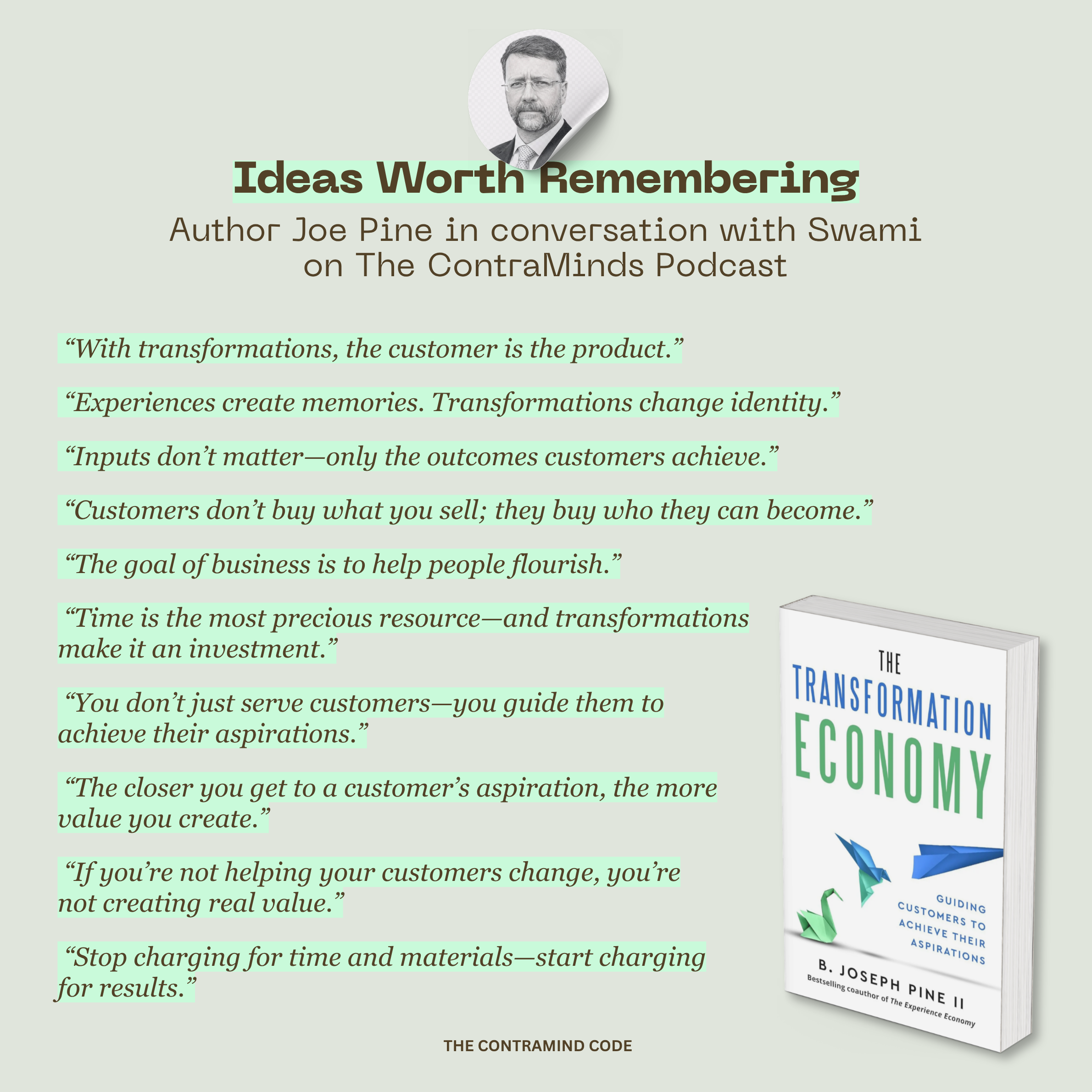
In this conversation on the ContraMinds Podcast, Joe Pine explains why businesses must rethink how they create and capture value. This includes moving from charging for time and effort to charging for outcomes. Also, understanding “time well invested” as the highest form of value, and embracing a deeper responsibility: helping customers flourish.
Here are 5 key takeaways from the conversation:
The Customer Is the Product: Real value is created not in what you deliver, but in who your Customer becomes.
From Experience to Transformation: Experiences create memories, but transformations create lasting identity change.
Aspiration Drives Value: Customers buy to move from their current state to a desired future version of themselves.
Charge for Outcomes, Not Effort: The future of pricing lies in what results customers achieve—not the time or inputs you invest.
Time Well Invested Is the Highest Value: The best businesses don’t just save or spend time—they help customers invest it in becoming better.
Jon McNeill: The Musk School Of Management.
So, what does it take for people to work with Elon Musk? His audacious and ambitious vision of nearly building things hitherto believed to be impossible should require a different DNA to work with him. Jon McNeill has worked up close and personal with Elon Musk. He was the former president of Tesla, and he shares his experience in this video. He is in conversation with Tim Higgins of WSJ. Jon has just published his new book, Algorithm.
“Musk hires orthogonally. He doesn’t hire people from the industry because he wants fresh thinking that is not weighed down by old constructs.”
Musk’s Five-Step operating system:
#1: Question every requirement
#2: Radically simplify the process
#3: Do not automate till you trial the process manually, because it's really hard to change automation after you start.
#4: Add Speed
#5: Then, add automation
Weekly management meetings were a reflection of mistakes made.
Finally, “There are a myriad of leadership styles at work. You've got to run yours as a leader. You cannot run somebody else’s and try to mimic it because it just is inauthentic.”
Break Away From Old Constructs.
As you listen to and watch Joe Pine and Jon McNeill share their learnings and experiences, one common thread that emerges is the need for you to break away from old constructs.
Let’s explore more about the definition and meaning of old constructs.
“An old construct is a deep-rooted belief that forms the bedrock of how you think, behave, and decide on things. However, the founding conditions on which they are based are decoupled or changed from reality today.”
The key points for you to focus on here are:
The facts and outcomes which formed the basis of this belief were accurate in the past, but not now.
It’s a behaviour built on the above assumption.
It continues to dominate your thinking, behaviour and actions even though it may be irrelevant.
It’s defended vehemently because there’s an emotion attached to it.
The person cannot see the gap, but outsiders can see it clearly.
The real challenge with old constructs is that letting go of them feels like a loss for you. This is almost like the ‘calcification’ of how you break down a problem, find solutions, and implement them because that’s what you have done in the past, and you have succeeded. So, you have no reason to question them.
Let’s take some old construct thinking that was demolished in the automotive or space industry by Elon Musk when he built Tesla:
Traditionally, the automotive industry optimised the ‘feature to cost’ ratio to arrive at an acceptable price for a passenger vehicle. However, when Tesla launched its electric vehicle, it questioned the old construct. It positioned the car's features as a software platform that can be switched on or off as needed and by the driver. It was a fully loaded model, akin to software subscription pricing! The same was true of the price of Lithium-ion batteries, which were extremely expensive and were then brought down significantly.
SpaceX questioned the fundamental assumption as to why rockets should be so expensive. They looked at every possible component and cost, and started to unpeel the hidden costs of materials and overheads in each of them. Thereby, dramatically reducing the cost of rockets themselves. The other thing that was questioned - which was an old construct - was around the why rockets cannot be reused!
How do you systematically break old construct thinking?
Begin by asking a foundational question - “What do I believe and why do I believe so?” This helps you distinguish your observed reality from deep-rooted assumptions that you make when a problem is posed to you.
Practice Inversion Thinking. Don’t start your questions from the familiar end. Try to move it to the opposite end. For example, don’t ask “How do I succeed?” but you can begin by asking “What guarantees failure and how can I avoid it?”
Think adjacent possibilities. Try to live or think one step outside current reality. Try to connect unconnected possibilities that have hitherto not been attempted due to technological, regulatory, and consumer behaviour changes. Brian Chesky, Founder of Airbnb, reimagined hospitality by connecting smartphones + payments + fragmented living infrastructure + changing vacation behaviour.
Demolish dogmas - Seek evidence to prove something, even if it is widely accepted, believed or practiced. Be comfortable in asking an uncomfortable question like “What evidence would prove this wrong?” Elon Musk asked, “Tell me, why should rockets be so expensive?”
Break free from the dominant paradigm. Everyone, or every industry or company, operates within a dominant paradigm. Most of the thinking and behaviour is controlled to remain rational. That’s the reason disruption comes from outsiders and rarely from incumbents. Apple asked, “Why should a watch just display only the time?” This one question disrupted the entire watch industry and created a smartwatch category.
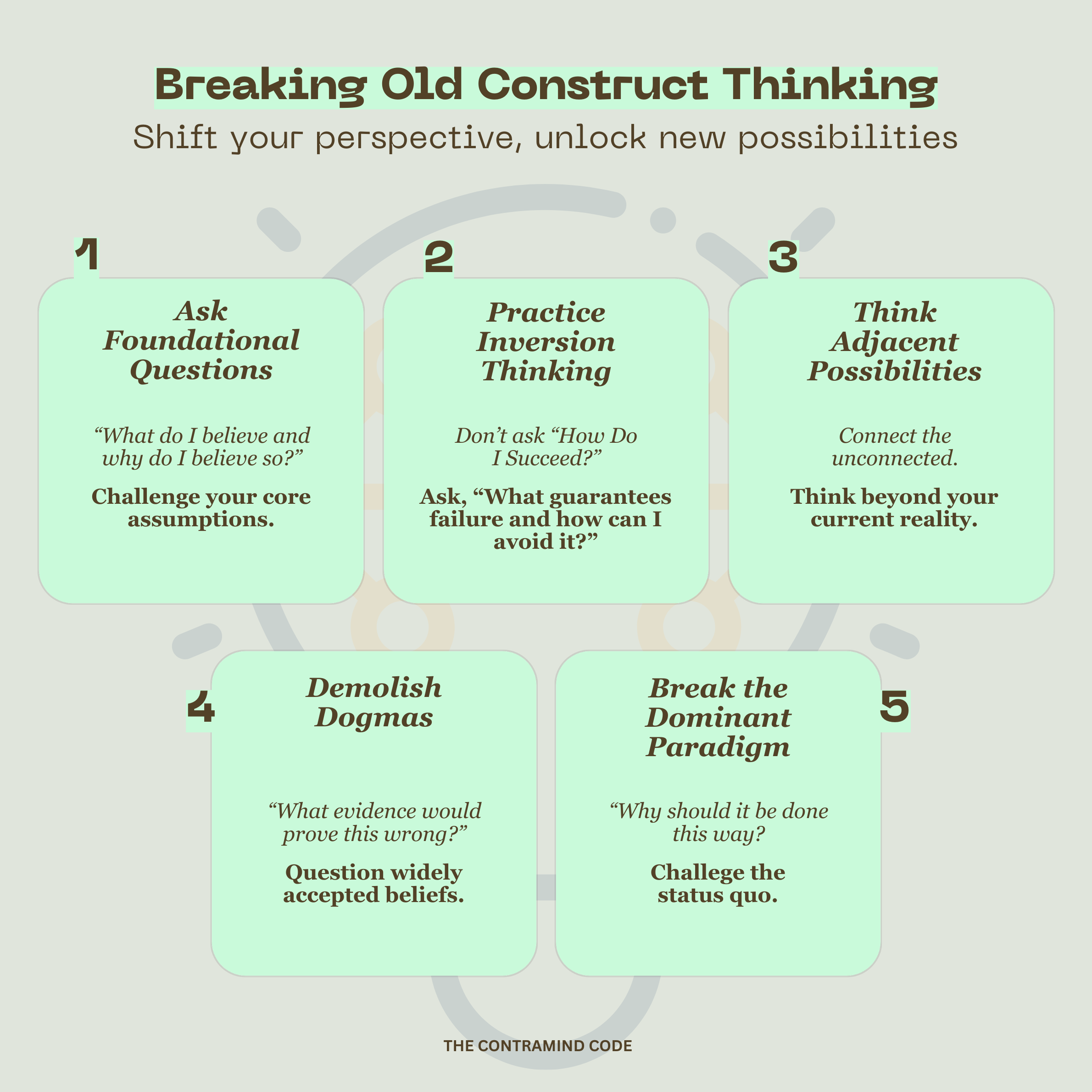
To break from old constructs, deliberately borrow frameworks from unrelated fields. Create artificial constraints to force original thinking.