Introduction
The ContraMind Code is published by ContraMinds Labs, which runs a successful podcast that explores thoughts and conversations around the DNA of purposeful minds. It helps you explore and discover what it takes to achieve personal excellence and professional fulfillment. It tries to decode what really goes behind the minds of people with a purpose, what are their motivations and inspirations, and attempts to understand the why behind what they do and how they successfully accomplish what they set out to do. It helps provide a mental framework, markers and a mind map for each one of us to learn and discover from their life purpose, their cultural ecosystem and their experiences. These conversations and thoughts will hopefully open your mind and help you put some of these thoughts to practice both in your life and career.
Subscribe to get full access to the newsletter and visit our ContraMinds website, which has a treasure trove of podcasts from leading thinkers, successful entrepreneurs and practitioners.
I Think India Can Do It.
A lot of people doubt that India can develop. I’ll take the other side of that bet.
In this article, Noah Smith, Founder and Writer of Noahpinion, writes about his perspective on why he bets on India and its growth into one of the top global economies of the world.
He cites some good counterpoints, as against many who don’t think so, and explains why he believes this will happen:
“Economic development creates political support for further development. Once the people of a country realize that rapid economic growth is possible, they may get used to the idea of their living standards increasing noticeably every year.”
“India needs to reform its financial system in order to help its companies scale up. The country currently has a very high cost of capital, meaning it’s hard for companies to borrow and grow. Fixing bond markets is one idea here, but most countries that experience economic growth “miracles” rely heavily on bank finance instead of on bond markets.”
“I’m bullish on India because there’s still a huge amount of room for manufacturing to grow. Right now, despite being the world’s fifth-largest manufacturer, India is still a service-intensive economy — manufacturing is only 13% of the country’s GDP.”
“Linguistic fragmentation is certainly a challenge for India. But the country’s regions show no inclination to break away. And federalism can be a strength, too.”
“India is now about as rich a country as Japan was in 1962. The task is not insurmountable.”
Read the entire article here.
Why Is It So Hard To Delegate - And How To Improve.
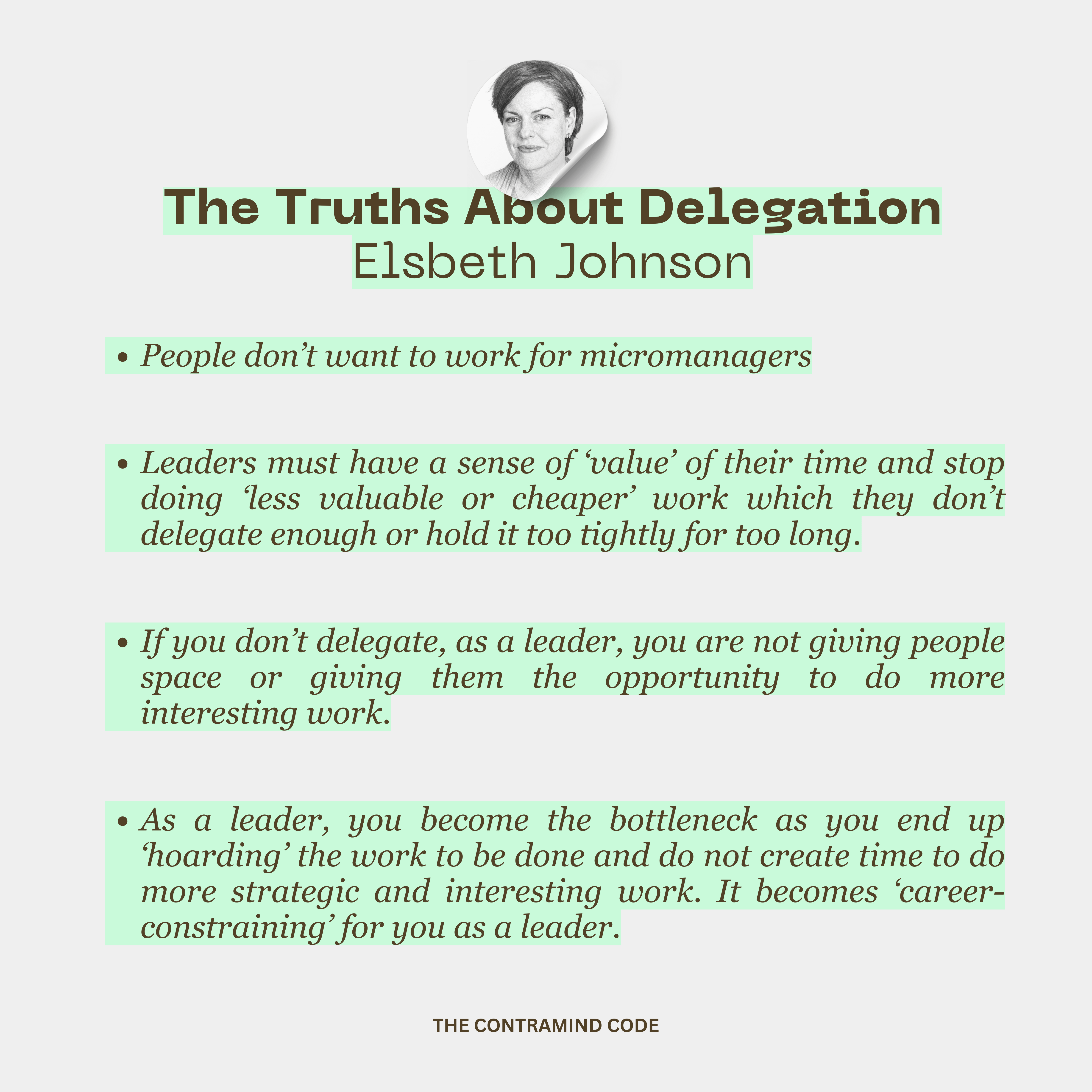
In this HBR Ideacast Podcast, Elsbeth Johnson, a senior lecturer at the MIT Sloan School of Management and Alison Beard, Executive Editor, HBR, discuss one of the most prominent challenges leaders face: Delegation.
Having been a performer and one who has done it all by yourself, if you get into a leadership position, the most difficult habit that you must give up is ensuring you don’t stand in the way of others! Yet, you will want them to do or get things done the way you do it or want them done!
This conversation will help unlock some of the concepts and ideas on the art of delegation. Here are some truths that this conversation throws up:
You can listen to the entire episode on: Spotify | Amazon Music | HBR
India UnInc: Management Lessons From Streets Of India.
This video by Capt. Raghuraman provides a revealing insight into what lessons we can learn from India’s unorganised sector. Often, we rely too much on US case studies, examples from professors who teach at Ivy League schools, and the Big 4 consulting companies that churn out research and insights. Yet, we often forget to learn from the people who run businesses on the street or in small neighbourhood shops in any country.
Here are some statistics and insights that can force you to rethink new avenues or areas you can learn your management lessons from:
50% of India’s GDP comes from the unorganised sector.
The unorganised sector employed 90% of India’s workforce.
The lessons and examples here on empowerment, the fluidity of the business-product mix, supply chain management, entrepreneurship, persistence, pricing, discounts, CSR, leadership, etc., are excellent.
Delegation Is Not ‘Task Dumping’.
Most of us find it hard to delegate. Delegation is far more nuanced than it appears. It’s not just a mere ‘transfer’ of the tasks that you are doing, or just ‘managing’ what is being done. You still retain responsibility for direction and standards.
Delegation forces you to pivot yourself at two levels:
At one level, you need to move from ‘doing’ to ‘thinking’.
At another level, you need to shift from ‘doing’ to ‘guiding’.
Why is it hard to shift from ‘doing’ to ‘thinking’?
One question that is bound to come to you is, "Am I not thinking when I am doing?” Of course, you are. But you are doing something that somebody else has thought of and planned. Therefore, you get busy ‘doing’ things for most parts of your career. Companies are structured to reward people who ‘do’ things. But, when you are promoted to a senior leadership role, you are expected to ‘think’ overnight! You, therefore, end up confusing ‘doing’ with ‘thinking’.
Doing is breaking down what needs to get done, by when, by whom, by mitigating risks, planning the execution and delivery. There is thinking involved here, but it is much more ‘behavioural’ and purely outcome-focused, deadline-driven, as you can see.
‘Thinking’ takes a lot more of your ‘cognitive’ load, while ‘doing’ takes a lot more of your ‘behavioural’ load. ‘Thinking’ explores possibility while ‘doing’ confronts reality. Thinking requires contemplation, judgement, and it is a lot more ‘internal’ rather than an ‘external’ process. Thinking leads you to an insight. And coming up with an insight is a lot more complex than working purely for a deadline or an outcome. As you have to weigh different perspectives, assess multiple data points, think through abstract issues, and find solutions.
Many people find it difficult to pivot to this level. As delegation suddenly creates time and space, because you move away from being ‘busy’ to having time to ‘focus’. Busy fills time while ‘focus’ compounds value.
Making the Shift from ‘Doing’ to ‘Guiding’
When you do things over time, you develop an ‘intuitive’ sense of the various subtasks, how much time they will take, the bottlenecks you may face, and how to plan for them. You would have either already done it in the past, or it may be similar to a lot of things that you would have done. Therefore, you would be comfortable getting it done in the quality and time it requires.
However, when you delegate, the other person initially lacks the experience or the understanding. Hence, in the early stages, delegation consumes much more of your time than you assume, requiring a greater investment of your effort on the person. You have to factor for multiple rounds of discussions, reviews, and changes till the person gets it. Sometimes, this effort forces you to do it yourself or dump the task and abandon the person. You also must start getting conscious that the quality of the output may not be as good, initially, if you had done it yourself. You need to allow for the person to ‘discover’ the quality of doing things, as it cannot be just taught but also be ‘felt’ by the other person. You must be comfortable with ‘imperfect execution’ and allow the person to observe how you handle challenges or solve problems as they arise. You have to learn the art of ‘not doing but showing.’ This is precisely why some great players don’t make good coaches, and why some great coaches don’t make great players. Therefore, guiding is:
Not jumping in to give the answers too early.
Creating clarity without dependency.
Providing the direction without overwhelming.
Getting comfortable with seeing the struggle but not abandoning them.
Exercising ‘loose’ control and balancing ‘acceptable’ risks.
Most leaders confuse ‘managing’ with guiding. You are just managing, not guiding, if the answers to these three questions are ‘No’.
‘Is the person clearer, not just compliant?’
‘Is the person more confident, not just reassured?’
‘Could the person make a similar decision alone next time?’
Hence, ‘guiding’ is all about not proving but growing someone else’s intelligence and judgement. In the end, it must leave them more confident than when they started. It’s also about letting the system build confidence in the person without letting them down in front of others.
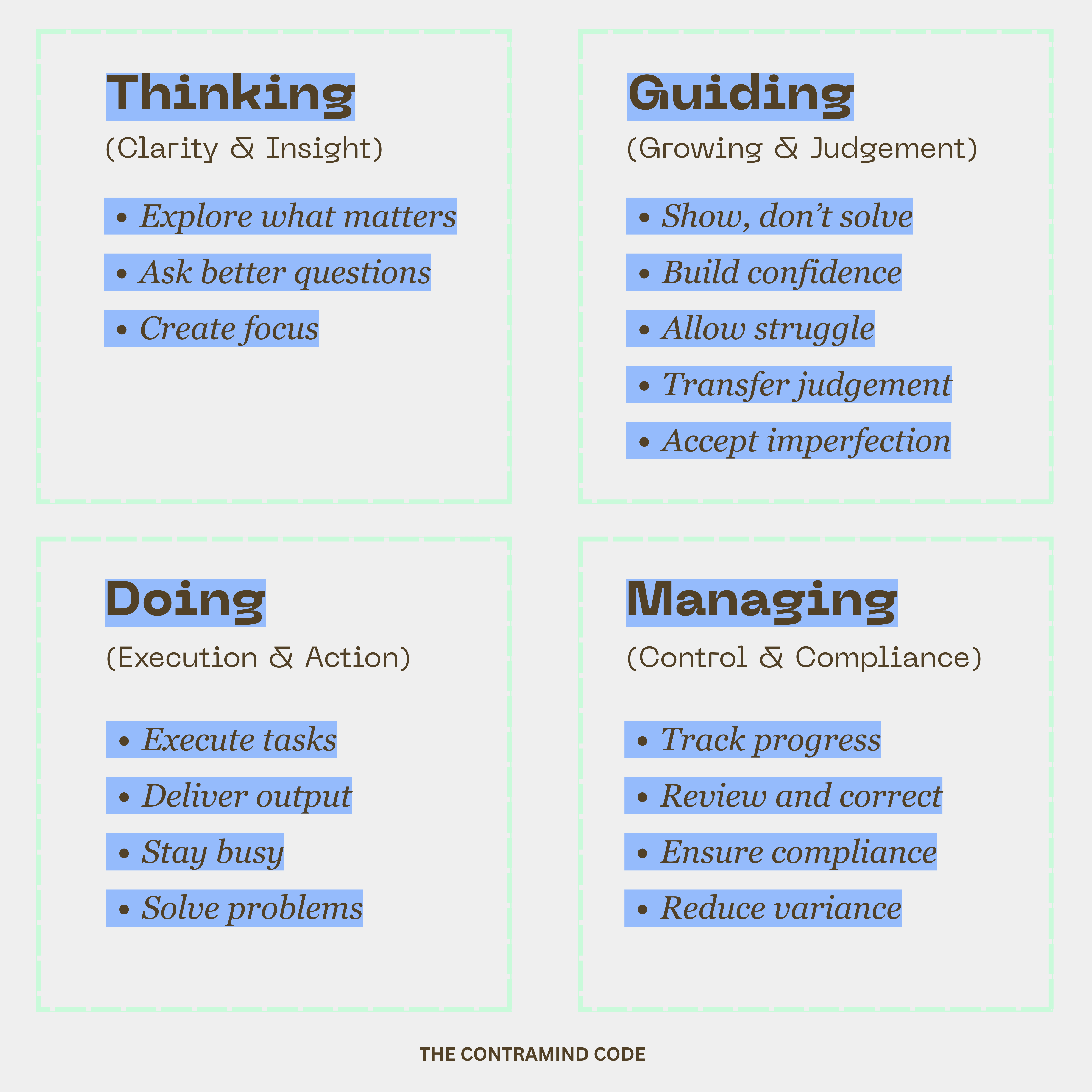
Therefore, delegation is not ‘task dumping’. It’s moving up a layer, personally, from ‘doing’ to ‘thinking’ and also developing the skill to ‘guide’ and not just ‘manage.’