Domain Expertise Has Always Been The Real Moat.
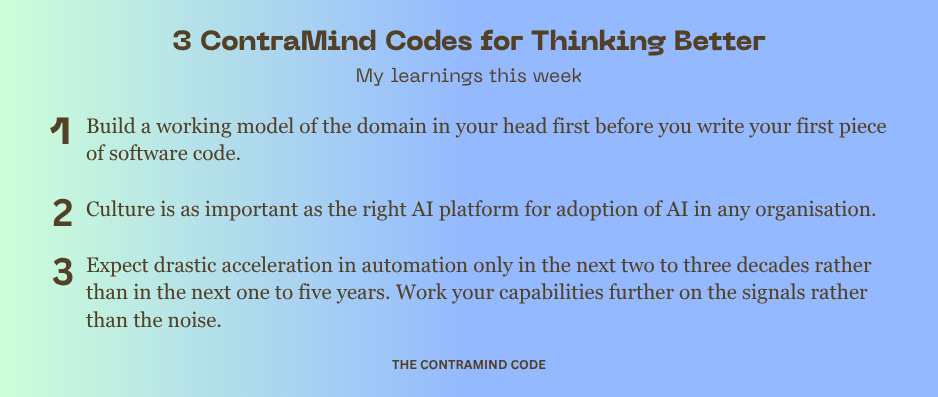
Aaron Brethorst writes in this article, “The hard part of writing software has never been the writing. It was building a working model of the domain in your head first.”
This is the cardinal truth that has always been spoken and understood by many people. If you do a root cause analysis of software projects as to why they succeeded or failed, or were delivered on time or delayed, or had near-zero bugs or continuous fixing, a good balance of domain knowledge and coding expertise would be one key difference that will keep coming up over and over again.
However, AI has bridged the gap in code development, and it is now up to developers to assess whether the code is right. And this requires a different level of judgement, not just code-writing skills. And this transformation is changing the profession itself.
Aaron highlights some key points to accentuate this transformation and who are the ones who are poised to succeed:
“The first is a domain expert with no real software background. Hand them an agent, and they are startlingly effective, because the thing they’re missing, the ability to produce code, is exactly the thing the agent supplies. What they bring is the thing the agent can’t: the ground truth.”
“The second is a strong generalist engineer who has never worked in the domain. They can architect anything, they know reliability and testing and how to keep a system from falling over at 2am. They can verify that the software is well-built. They cannot verify that it’s correct, because correctness here is defined entirely by a domain they don’t hold in their head.”
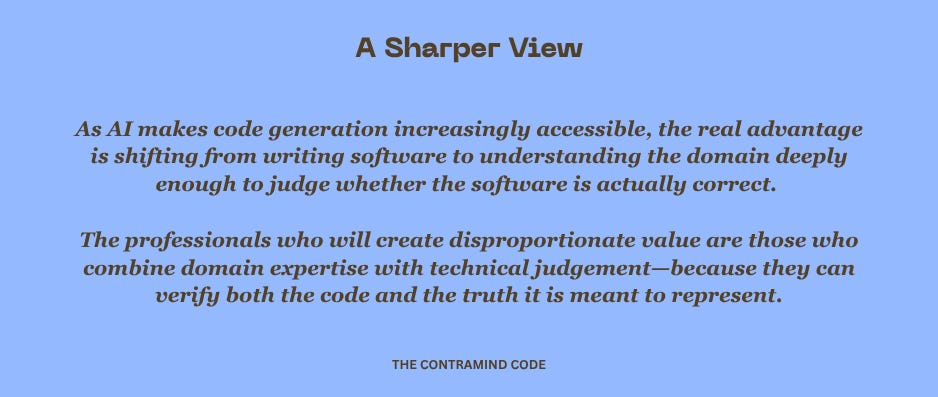
So the most valuable person in this new world will be the one who has both skills because they can verify at both layers. They know the generated code is sound and they know the answers it produces are true.
You can read the entire article here.
How To Build An AI-Ready Culture: A Practical Guide.
In this AI Daily Brief podcast, Nufar Gaspar, Head of Research, Superintelligent, discusses how culture is critical to AI adoption in any enterprise. She presents a CHANGE framework for building an AI culture.
What are the individual components of the CHANGE Framework?
C- Communication
H - Human Oversight
A - Attitude
N - Network
G- Governance
E- Enablement
Nufar explains the various aspects of this framework extremely well and how to put it to work in a company.
You can click on the above link and listen to this conversation.
Stanford Leadership Forum 2026: Rewiring The Workforce In The Age of AI.
At the Stanford Leadership Forum 2026, Paul Oyer, Tamay Besiroglu, Susan Athey, and Nela Richardson share their perspectives on how AI is reshaping and rewiring the workforce of the future.
Here are some interesting insights from these conversations:
Tamay: “I think I don’t expect a very drastic amount of acceleration in automation over the next one to five years. I expect that in the next one to three decades, we’ll probably have very widespread automation.”
Susan: “We can have great technological improvement, but that improvement only translates into impact when it’s combined with an existing system or an existing organization.”
Nela: “Where the jobs are coming and where the tech is going is totally different. It's upskilling those young workers to more complex tasks.”
Susan: “If you have an idea about how to conceptualize and solve a problem and break it down and measure and test, then you have these tools that can make that idea a reality.”
Susan: “AI-powered products delivered to small business owners through their mobile phones.”
Nela: “AI is destroying knowledge work. We have to change our measurement of productivity, we have to change our measurement of engagement.”
Don’t Be An Economic Professional. Adapt To Become A Living Professional.
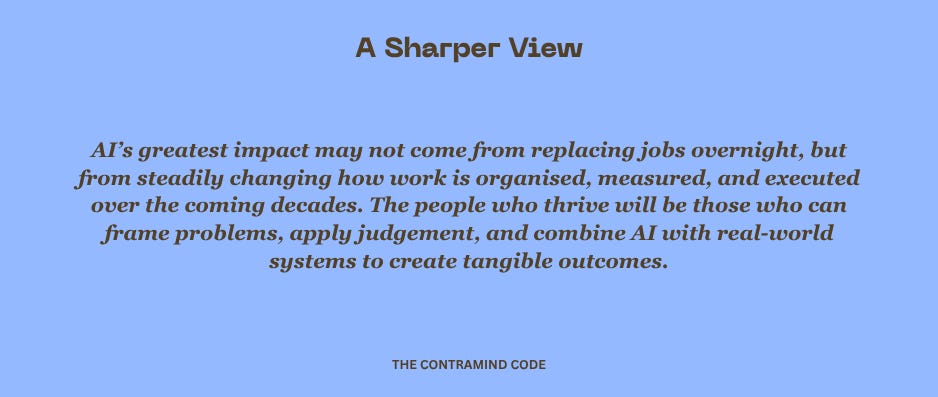
Thinking through ideas shared by Aaron Brethorst and Stanford Leadership Forum’s discussions on rewiring the workforce, and Nufar Gasper’s thoughts on building an AI-ready culture in companies, one common theme that comes through in all three is that it’s the professionals themselves who are experiencing this volatility and churn. Companies make their call on layoffs and downsizing when disruption or volatility hits their business. Some of these decisions are made in a couple of quarters.
It’s the people who work in these companies who are affected or caught by surprise. A great performer over many years is now not needed. The ones who were middle-of-the-curve performers, who stayed the course, assuming things would get better or kept chugging along, are the most affected. As things happen to them personally, it is a matter of their economic survival to be adaptable and stay relevant to take advantage of emerging opportunities amid these changes. If you are a professional working in such an environment, it is important to view the problem from a distance and work on a method to prepare yourself for these changes.
Today, professionals are managed as economic entities.
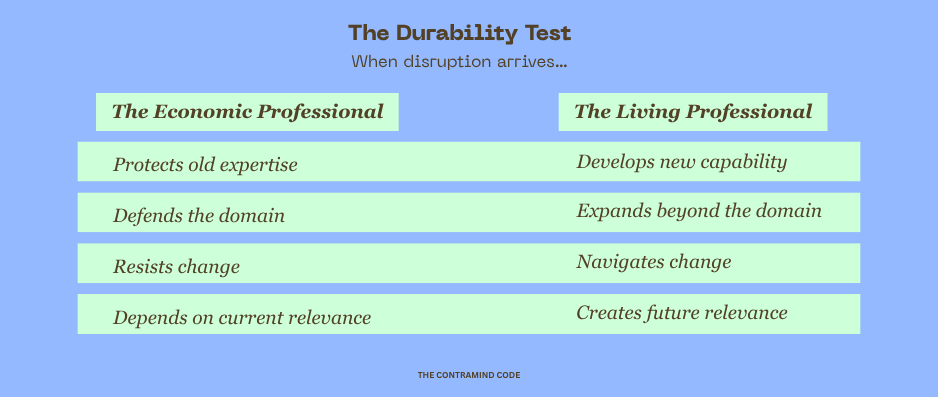
Most professionals are managed by employers as economic entities with a set of skill inventory, and their value is measured by the present market rate. The employer’s purpose is to maximise their revenue from their capabilities. When the market shifts, the economic professional is in crisis. Their identity is their role, and when that capability or role is disrupted, their need is threatened. Most professionals try to protect or extract the most possible from their old skills rather than acquire new ones. They defend their domain rather than expand beyond it.
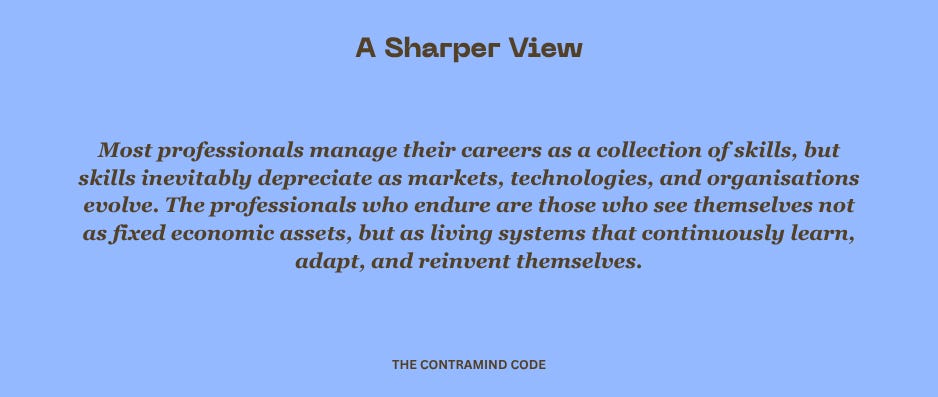
Organisations you work for may have missed opportunities to identify market or technology shifts in their industry. But the ones who bear the brunt of this disruption are the professionals working in these organisations. They are caught unawares by the speed of change required in how they operate or reskill, and suddenly their need and relevance are in question.
Most professionals decline in their careers that span decades because they forget that the true essence of success lies in believing in a learning system — not a skill inventory. The economic professional exists to deploy their skills - it’s a worker’s mindset: “I will do what I am told repetitively well. Period.” The living professional exists to continuously develop their potential.
It may be worthwhile for you to think more deeply about what type of professional you are today.
So, what differentiates the economic professional from a living professional?
The economic professional is overleveraged financially due to their lifestyle needs relative to their current income. They get trapped by their cost base. It’s pretty similar to companies stuck with high expenses or costs. The living professional maintains or creates sufficient financial runway to experiment, retrain, spend a year learning something adjacent, or walk away from a role that has become a dead end. It in no way indicates that frugality is a virtue for them. Rather, they place a greater emphasis on their freedom as a strategy.
The economic professionals are involved in or consumed by a constant stream of shallow, reactive tasks that deplete their higher cognitive potential, which decays over time, thereby reducing their ability to adapt. The living professionals do not spend all their deepest cognitive capacity on low-value work but find genuine reflective time and the slack to think about what is changing in their environment before it becomes a crisis.
The living professional tries to maintain a deliberate peripheral vision. They read systematically outside their domain. They maintain relationships with people in adjacent fields. They pay attention to what is becoming true before the data confirms it. The economic professional’s expertise is real but isolated. When their domain is disrupted, they have no adjacent capabilities and no social network to carry them across.
The economic professional identity is mostly in domain terms: "I am a software engineer." "I am a marketer." "I am a banker." This identity is contingent on the domain remaining valuable. When the domain shifts — and eventually every domain shifts — the identity is under threat, and the professional resists the change rather than navigating it. The living professional identity is mostly in terms of values: “I am a person who applies rigorous analytical thinking to complex, ambiguous problems.”, “I am someone who builds trust with people and translates that trust into coordinated action”, “I am a person who synthesises across fields to find non-obvious connections.” Their identities survive every industry disruption because they are not contingent on any industry or technology.
The economic professional treats their current skills as their core asset. Skills are the balance sheet. Income is the return on those assets. When skills become obsolete, the economic professional faces a write-down on the balance sheet. The living professional treats their capacity to learn as the core asset. Current skills are instruments of that capacity — means to an end, not the end itself.
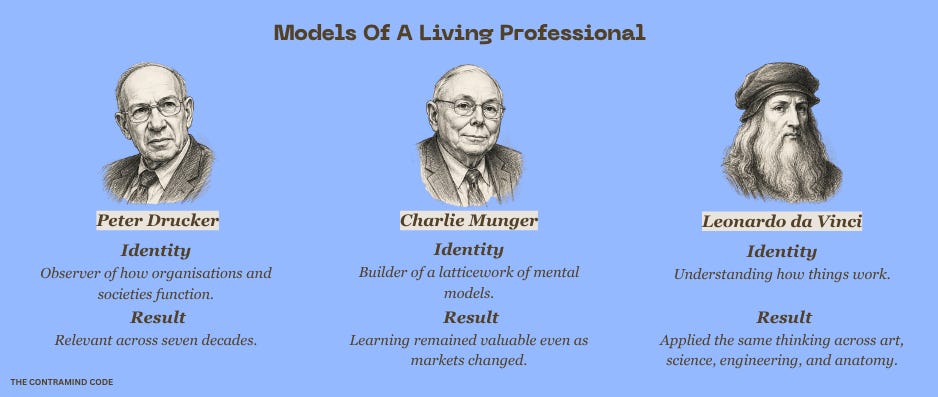
Living professionals and how they endured disruptions.
Peter Drucker: He never defined himself as a management consultant. He defined himself as "an observer who explains how organisations and societies actually function." This identity allowed him to remain compellingly relevant from the 1930s to his death in 2005. He wrote his last book at 93.
Charlie Munger: He never defined himself as an investor. He defined himself as "a learning machine that builds a latticework of mental models." This identity made him infinitely durable. This also defined his specific investment strategies and tactics.
Leonardo da Vinci: He never defined himself in one category. He defined himself as somebody with “rigorous observation and first-principles investigation of how things work.” He applied it to anatomy, engineering, botany, and art. The domain was always secondary.
So how do you begin your path to becoming a living professional?
Deliberately pursue margin activities like learning, reading, building, experimenting in areas adjacent to or outside your current domain. These will matter in five years, so you must begin developing them early. These may not give you immediate returns but will matter when your core domain gets disrupted.
Don’t build a rigid five-year career plan with a fixed mindset and growth trajectory bias. Just maintain directional clarity (your identity, your values, your methods) while allowing tactical flexibility in how these can be applied.
Ask yourself this one question: “If I had to restart in a completely different domain tomorrow, what would I bring that would still be valuable?”
Build a diverse network of connections: It’s not enough to have a network of people in your domain who validate your current expertise, but you will need a diverse community of thinkers and practitioners across domains whose intellectual curiosity keeps you energised, uncomfortable and on the edge.
Therefore, as a professional don’t optimize just for your current output. Work on capabilities that allow you to continue to grow across a forty-year career spanning multiple industry disruptions, multiple technological discontinuities, and multiple transformations of knowledge domains that markets will value.
Work to transform yourself into a living professional who compounds in value, judgment, and contribution rather than peaking at thirty-five and then defending the domain knowledge that you once had.