

Don't Obsess On Technology. Obsess On People.
There isn't a day that passes in companies today when technology isn't discussed in meetings, workshops, boardrooms, management meetings, and off-sites. Every day there is one or the other software tool or technology device that gets peddled as a productivity enhancer, customer experience maximiser, cost optimiser, better decision support system, etc. Of course, more recently, there is the discussion of AI and its impact on business disruption in every meeting. If a company had all the financial resources in its hands and bought all the best-in-class technology that was around, would it have made a difference to its market dominance, competitive advantage, innovation and growth? Let’s look at some examples and reasons, and it’s quite interesting what the answers reveal in reality.
Toyota had the same machines as Ford. Ford was founded in 1903 and Toyota in 1937. Yet, Toyota became a leader in the land where Ford was founded.
Nokia had all the technology. Nokia had a 20-year head start over Apple in mobile hardware. Yet, they failed.
Alibaba had an inferior infrastructure to Amazon for most of its first decade. Amazon was started in 1994 and Alibaba in 1999. However, Amazon had a 5-year head start, yet Alibaba dominated e-commerce in the world's most populous market - China.
Google published a paper on transformer architecture in 2017. OpenAI built GPT on Google's published architecture. It’s the architecture underlying Claude, Gemini, Llama and virtually every LLM today. Google invented the technology that eventually disrupted Google.
General Motors produced the first modern mass-produced EV, the EV1, in 1996. But only in 2008, when Tesla came out with the Roadster, did it have a runaway success that led to mass adoption, interest, and global growth of the EV industry.
What do these examples reveal to us?
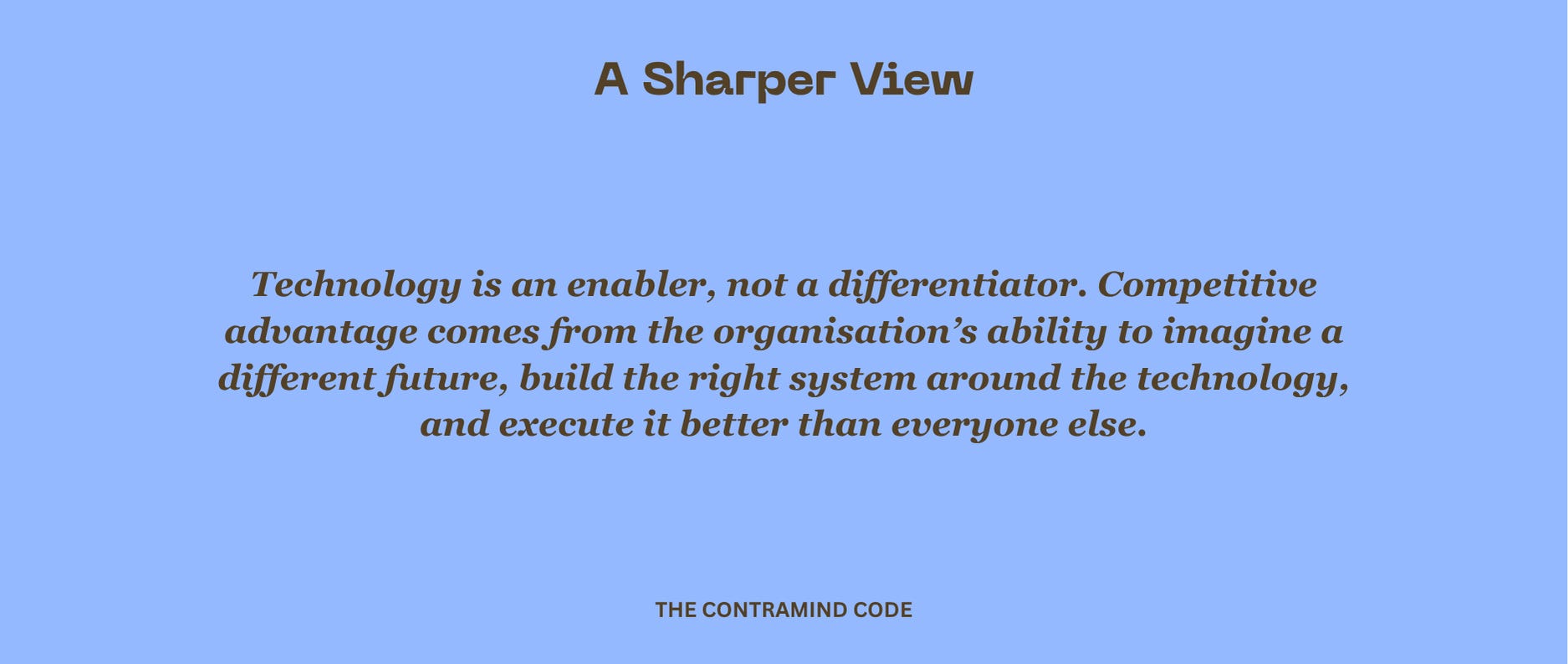
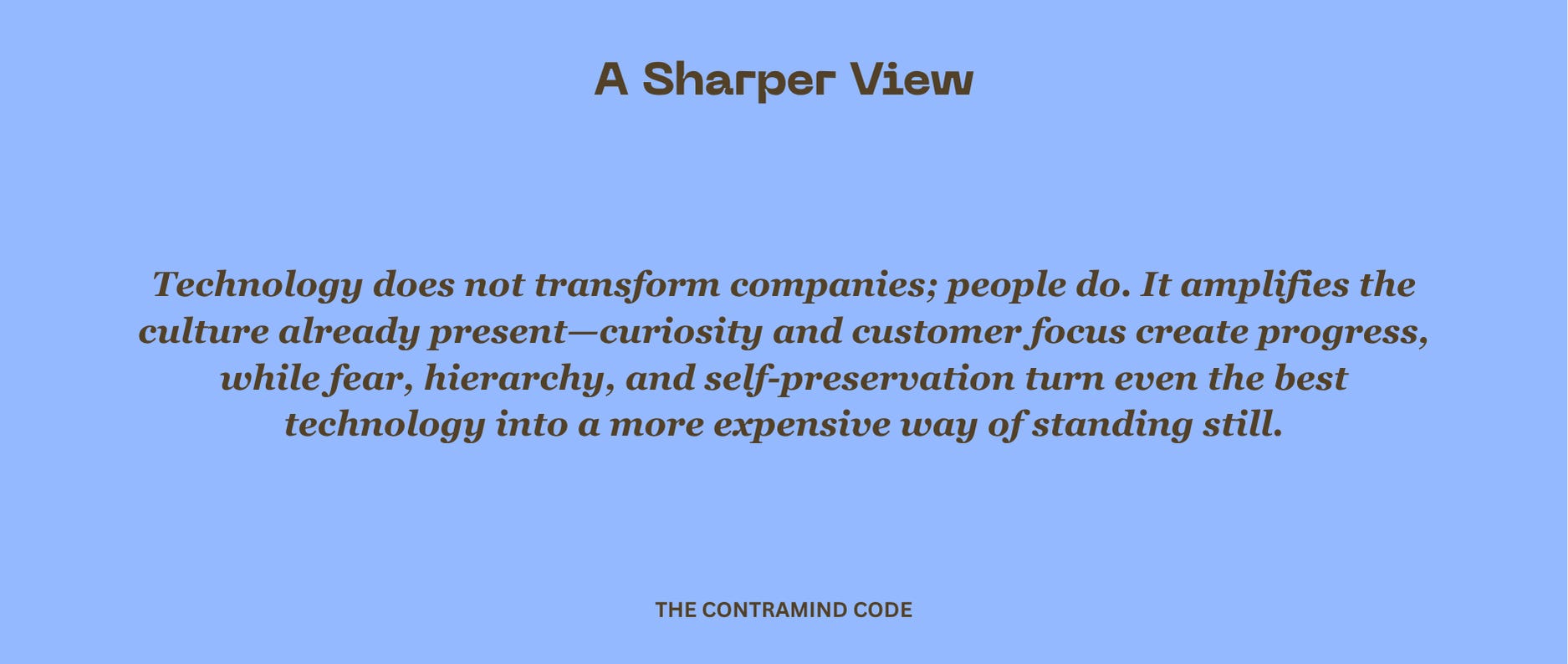
If a company’s culture rewards self-preservation over reality, then the technology they invented or just deployed will be used to protect careers, not serve customers. Technology is a mere amplifier, and its effect multiplies whenever people are ready. If a company has a bunch of curious people, technology makes them more curious. If they have a bunch of people who are fearful or insecure, technology makes them more fearful and protective, much to the chagrin of a company’s future and its market leadership.
Research studies done over two decades by MIT Sloan Management Review and McKinsey Global Institute show that 70–87% of digital transformation in companies fail to deliver expected business outcomes! In fact, MIT Sloan Management Review puts failure above 87%, and McKinsey puts success below 30%. The data consistently show that the failure rate has not improved over time. During this period, many new technologies have emerged and expanded, and many others have disappeared.
An MIT Sloan Management Review study offers an interesting insight. It finds that cultural resistance is the single most important reason for 90% of transformation failures. It’s not technical debt. It’s not integration complexity. It’s not vendor performance or the availability of the most sophisticated technology tools. All reasons point to the culture. Companies that invest in cultural change alongside technology see 5.3 times higher transformation success rates than those that invest in technology alone. In fact, this is the most under-reported ROI metric in enterprise transformation. Companies rarely budget for this right and often underestimate the pain and cost of this transition.
What really slowed down Google, again, was not a technology failure. In fact, Google has the research, the talent, the compute, and the data advantage. The single biggest factor that slowed them was organisational — the fear of cannibalising search revenue, internal alignment challenges, and the classic innovator's dilemma framework that famous Harvard Professor Clayton Christensen had written about decades before transformers existed.
Another widely known culture failure, rather than a technology failure, was Volkswagen’s attempt to develop one of the most ambitious automotive software transformations in history — building VW.OS, a unified software stack for 10 million vehicles per year. The hard truth was that the technology was credible. But the organisation was not ready. It led to cultural friction between legacy mechanical engineers and newly hired software specialists, which reached a breaking point. In 2024, technical engineers’ turnover hit 14%. The governance processes that worked for physical components, which needed to go through a hierarchy and took more than a week-long approval chain, led to a freeze of software development cycles entirely. It was not a software failure. It was a people-systems failure.
In most technology adoption and transformation programs, it is not rare to see technology budgets increase by 10–20× while the people development budget stays flat. Therefore, the outcome becomes predictable. Companies end up installing a very powerful engine into a vehicle, but the tyres, transmission, and driver remain unchanged. Technology companies don’t tell you this because it dramatically increases the cost of deployment and rollout. They would rather leave it to the company to figure it out, or blame internal company challenges once they get in.
So, what are the learnings, key actions and takeaways?
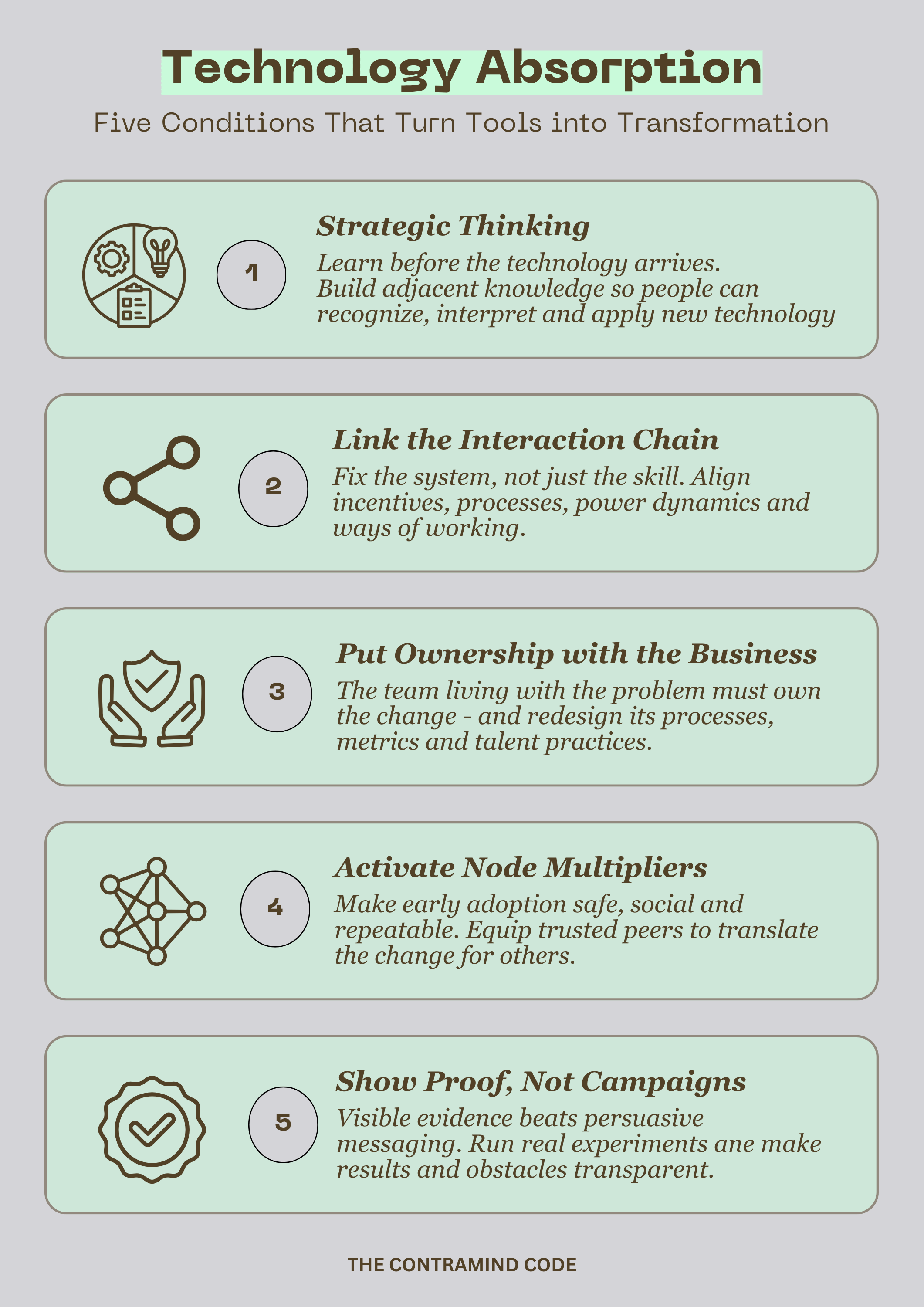
Build absorptive capacity: As an individual, you cannot absorb what you have no foundation for. So, is the case with any organisation too. It is ideal not to wait until the technology reaches your desk to start building adjacent knowledge. It is critical to read laterally across domains that are adjacent to your current work. If you are an individual who has built absorptive capacity, you can be pretty sure that you can adopt ahead of the rest and translate it for the system. Individuals who have not done this cannot, regardless of their openness and higher IQ. Hiring a few specialists and expecting the knowledge to diffuse is bound to fail. In any company, investment in absorptive capacity precedes the technology investment. No technology vendor will tell you that. Fancy words like TCO will be used, but they will never factor these costs in.
Link the interaction chain: It is not enough if individuals within a company are curious, open, and willing to adopt technology, the company still will not transform. It’s important to remember that a company is not a sum of individuals. Finally, a company is a system, and right system behaviour emerges out of the interactions between parts—incentive structures, power dynamics, formal processes, informal ways of working, and collective institutional memory—not just from the parts themselves. Hence, these have to be fixed or rejigged as much as the technology that is being adopted or deployed.
Define the ownership: Any transformation will succeed when the business unit that bears the cost of the status quo owns the change, not when a central function owns it on their behalf. Business unit ownership of technology initiatives — not technology department ownership — is a necessary structural condition for adoption. Without explicit business unit institutionalisation like new processes, new hiring criteria, new performance metrics, new onboarding practices, changes made by central functions dissolve under pressure. Also, you must treat any resistance or pushback as information. All these signals indicate conditions for adoption have not been met. Either complexity is too high, social proof is insufficient, or risk is unmanaged. Any business leader who treats resistance as an obstacle to be overcome misses the signal.
Identify the node multipliers: The individual who adopts and then makes it acceptable and low-risk for colleagues is a critical change agent. Any technology lives or dies with the early majority in a company, not the innovators. Individual change creates the demand for structural change. Structural change creates the conditions for collective change. Collective change then institutionalises the new state. Creating structural nodes between teams that will convert individual change and multiply peer adoption is vital. Remove any structural barriers that act as bottlenecks to collaboration across functions. If you skip any step, the system reverts to the old state. Building a coalition converts individual change into organisational momentum.
Show proof, don’t design campaigns: Too often, companies create campaigns or messages that claim an end state even before the technology has been implemented or deployed. There is a lot of focus on creating the message rather than doing the plumbing that is needed for the end-state to happen. Co-opt different teams and individuals and create experiments that show the proof. People need observable proof rather than promises. It is critical to make the results visible, known to others, and not circulate only within the team that is doing the work. Make the proof concrete and highlight the challenges that can impede technology adoption or success. Only visible proof creates organisation-wide momentum.
It’s vital to transform people first, or in parallel, before any company embarks on technology investments, if the company want to realise the full value of its technology deployment. It’s as important for any company to get its people strategy right as it forays into a new technology strategy or deployment. Culture will eat technology for breakfast.