Introduction
Welcome to The ContraMind Code.
The ContraMind Code provides you with a system of principles, signals, and ideas to aid you in your pursuit of excellence. The newsletter shares the source code through quick snapshots for a systems thinking approach to be the best in what you do. The ContraMind Code helps you reboot and reimagine your thinking by learning from the best, and enables you to draw a blueprint on what it takes to get extraordinary things done. Please share your thoughts and comments to start a conversation here.
Take a journey to www.contramindslabs.com. Discover a complete system for ambitious professionals who refuse to plateau, and also a place where you can listen and watch some great minds talk to us about their journey of discovery of what went into making them craftsmen of their profession, to pursue excellence and drive peak performance.
Why the World Still Runs On SAP.
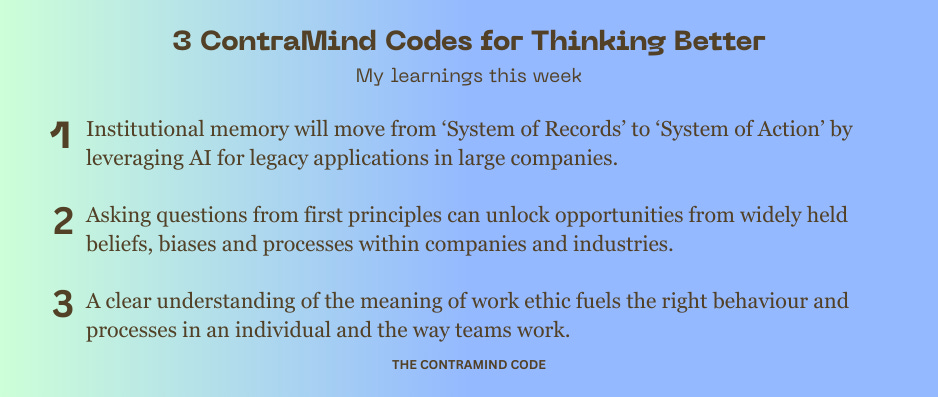
In an article in a16z newsletter, Eric Zhou and Seema Amble, Partners at Andreessen Horowitz, write about the behemoth software application SAP. They make this point, which is widely accepted as a statement in large companies, “SAP is Painful, and Yet We Still Use It.” However, they reiterate a very important insight ‘somehow using this backbone’ could be an opportunity waiting to be leveraged. They write:
‘They’re accumulated institutional memory expressed as tables, roles, approvals, posting logic, and exception handling.’
‘The challenge is that the same extensibility that makes them valuable also makes them brittle -each customization becomes a future upgrade landmine, each workflow a maze, each screen a tax on every human who has to use it.’
‘The process and pain here presents an opportunity for AI to change the way this software is implemented and used.’
‘The opportunity is for AI to wrap legacy systems with a friendlier, more capable “system of action.”’
‘The moat compounds from real usage: every successful workflow becomes a reusable intent, every exception becomes a guardrail, every migration artifact becomes living lineage, and every integration deepens the graph of how the enterprise actually runs.’
Read the entire article here.
How SpaceX Works.
In this episode of the Founders’ Podcast, David Senra decodes some of the reasons behind SpaceX’s success. He explores, by reflecting on an essay written by Max Olson, the reasons why SpaceX has become one of the most dominant companies on the planet, what makes them build rockets on an industrial scale, the company culture that differentiates it from the rest and why it is the most valuable private company in the world, among other things.
Here are some highlights from this episode:
Reframing questions from first principles - They discovered that the material costs of making the rocket were only 2%! Asking hard questions about where the rest of the 98% of costs go, led to the strategy of “minimizing the cost of getting things to space.”
SpaceX concluded that atoms are cheap and the process is expensive, and so pursued the idea of vertical integration - therefore building 80% of the hardware themselves.
In an age when most companies talk about outsourcing manufacturing and assembling parts, SpaceX believed vertical integration accelerated internal iteration.
Learning and adapting from the Ford T Model, SpaceX developed the economics of manufacturing through standardisation of rocket or satellite specs rather than customisation, as was done in the space industry then.
“You can’t think your way to perfect solutions for problems you don’t fully understand.”
“Failures are data, not disasters.”
Existing space players eliminated uncertainty by planning. SpaceX eliminated uncertainty by doing!
“Even an arbitrary deadline is better than no deadline because it forces decisions.”
“The cultural expectation is honesty about what’s not working and relentless effort to fix it.”
How To Improve Work Ethic.
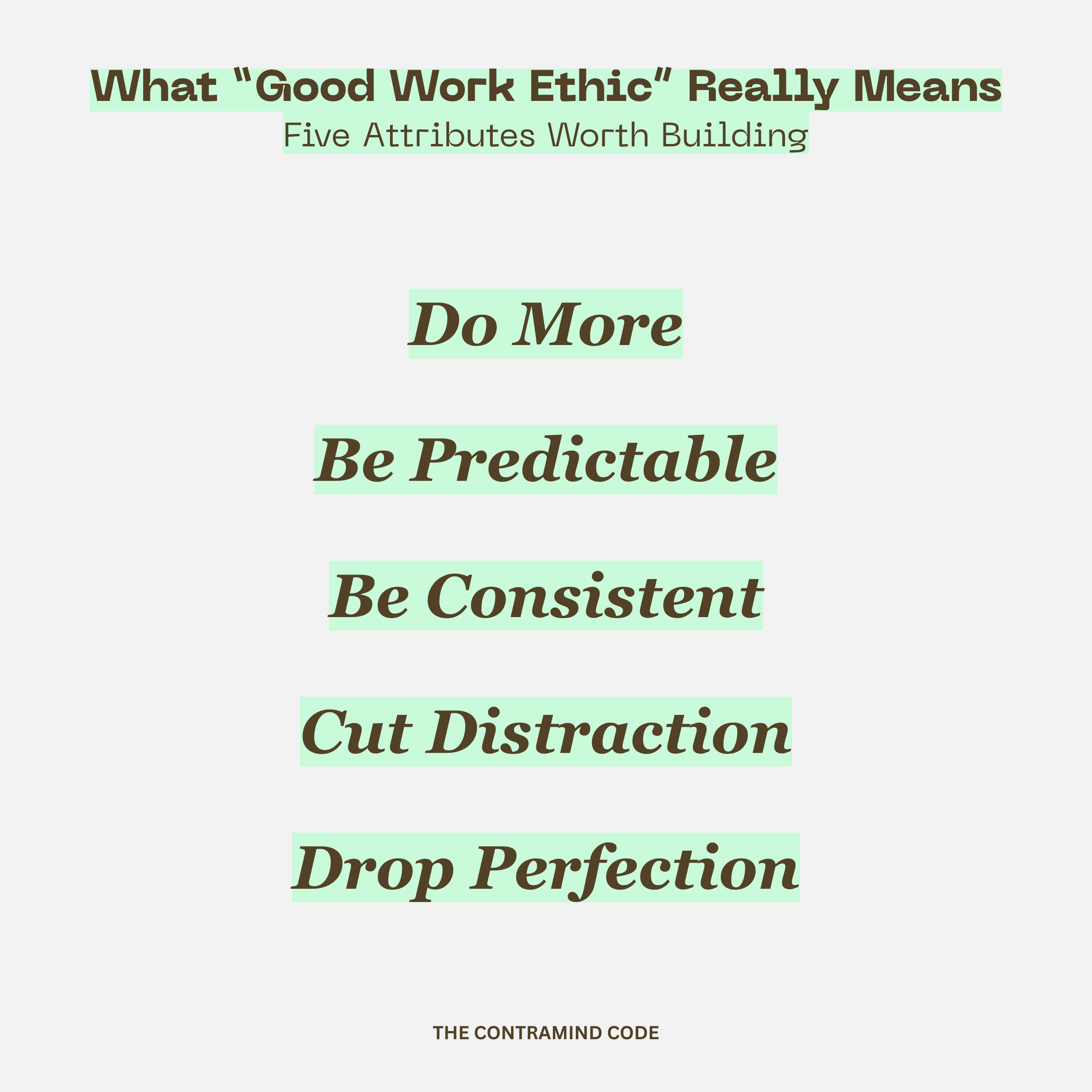
While there is a lot of drama and hype in this video, one thing that makes this video really valuable is the clear definition of the word that we use so often- ‘Work ethic.’ The meaning and definition of the word ‘Work Ethic’ provide clarity on how it drives beliefs, behaviour, and processes when one defines and understands its meaning in such a lucid and simple manner.
Also, what is outlined is a clear explanation of the key attributes for building a work ethic.
Eliminating Uncertainty By Doing, Not Planning.
The predictable, linear world is dead.
There is now enough data, information, and research to reinforce the point that we live in an uncertain world. If we are living in an uncertain world, we need to start asking ourselves - first principles questions - as to why we still do things the same way as we have always done when the world was stable and during times, when in the past, many of the external factors were pretty much known to us.
We have to understand and appreciate that planning works when things are predictable, variables are known, outcomes are known with a certain degree of deviation, and then we can fathom the cause-and-effect relationships. Also, for most people, planning creates an illusion of progress and a sense that things are moving, while in reality, things are at a standstill. It also creates a false narrative that teams are productive while they will be ‘busy being busy’ - spending time on brainstorming sessions, workshops, doing decks or presentations, working on forecasts and developing scenarios, etc. But, in reality, learning happens only when all these plans are put into action, especially when customers’ demands exceed expectations or when all hell breaks loose because a product fails or people are forced to pull back due to unforeseen situations or crises.
Why are we losing our ability to handle uncertainty?
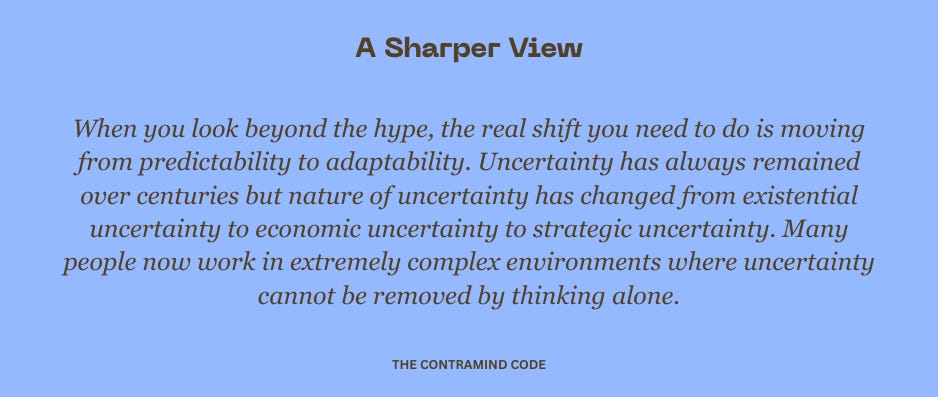
It’s not that uncertainty is new to human civilization. Uncertainty has remained a factor in people’s lives for several thousand years. Crops failed when there was famine or sudden rains or fire and floods, diseases had no cures, wars would wipe out several million people, etc. However, the industrial era reduced uncertainties to a large extent - factories provided lifelong employment, discoveries in medicine provided vaccines and cures to dreaded diseases, insurance provided contingencies in times of crisis, weather forecasting helped prepare for any catastrophe, etc. The development of science, technology and institutions in the last hundred years, to a large extent, removed many uncertainties in people’s lives and therefore industrial society became good at managing risks. For much of the 20th century and the early part of the 21st century, industries operated in relatively stable environments. Economic uncertainty, barring a few situations like COVID, has been significantly reduced or largely absent from people’s lives.
Therefore, our resilience in handling uncertainty has significantly depleted, as there are now several moats to fall back on.
However, we are now living in times of strategic uncertainty. There is technological acceleration, systems are complex and interconnected, interdependent, so much so that industries will need to transform every few years, not over decades. There is a real threat that many of them will vanish if they don’t adapt or change. In earlier centuries, people could not ‘perceive’ uncertainty instantly, but today the speed at which information travels across borders greatly amplifies uncertainty.
Hence, there is a need for a ‘behavioural shift’ from:
Long-term planning to experimentation
Slow or no iterations to rapid iterations
One-time learning to lifelong learning
Think-act-do to Do-act-think
Learning to operate with hard constraints, to learning to operate by confronting or challenging real-world constraints
Moving from structured or linear career paths to fragmented career paths
However, it is easier said than done because the ability to ‘process’ uncertainty in your mind is as important as ‘handling’ uncertainty. You must develop the ability to:
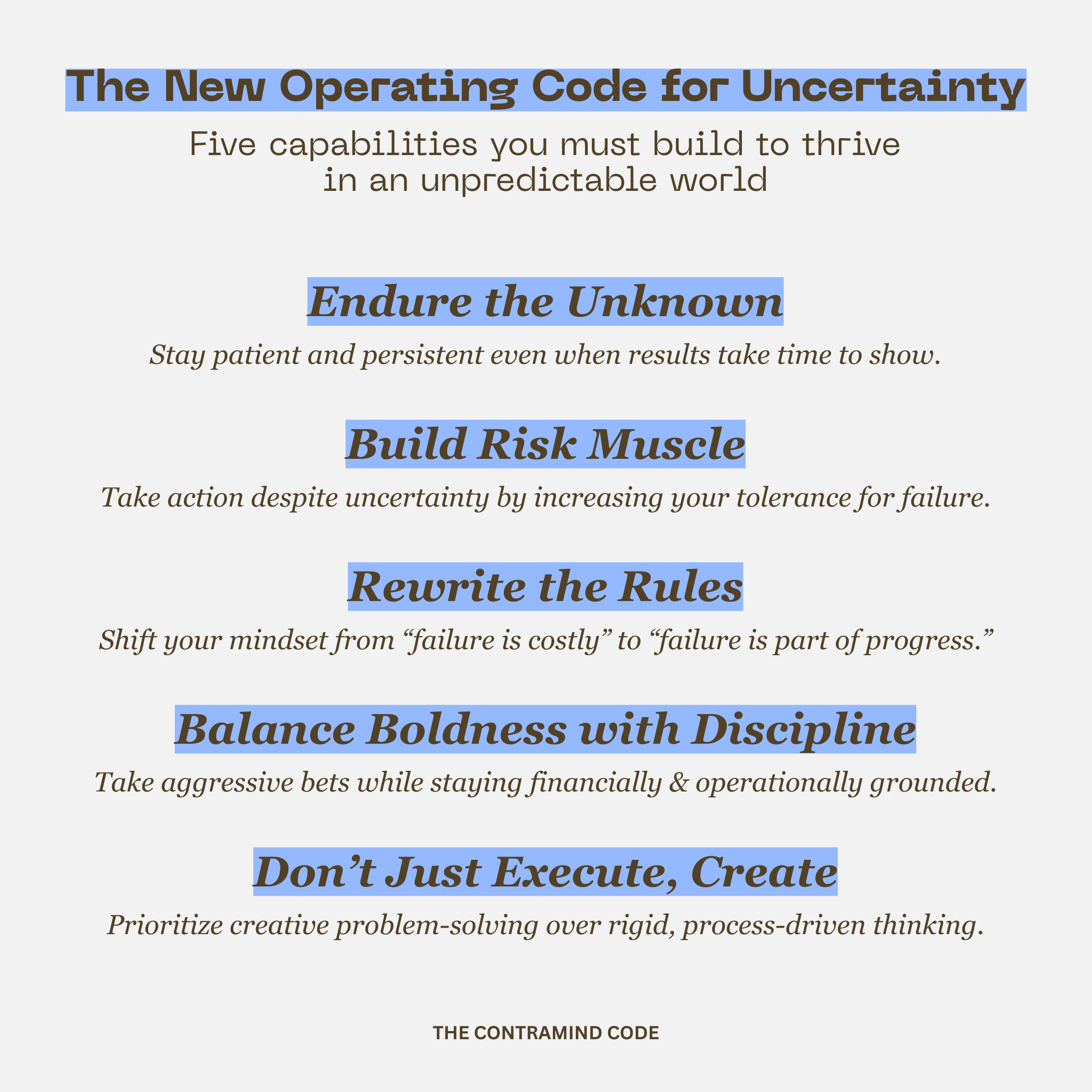
Persist through long periods of uncertainty before seeing results. This requires you to develop a high degree of patience and endurance, which was not needed in earlier decades. People who develop these attributes are likely to succeed or manage such an environment better than those with purely technical skills.
You must get comfortable taking risks, develop a greater tolerance for failure, and improve your psychological resilience. That’s when you will feel comfortable doing rather than just planning.
The economic or work environment of the past few decades was ‘capital was scarce, and therefore failure was costly’. However, the world today has changed to ‘capital being abundant, and therefore failure is not costly.’ You need new rules and methods to operate in such an environment.
With abundant capital, there is suddenly a need to focus on financial prudence and operational rigour, rather than on deploying capital and taking risks. The ability to balance ‘extreme risk and practice financial prudence’ is something that has never been taught or experienced by people in earlier decades. This is something that is to be learnt and understood better.
Thinking creatively about problems is becoming as important as deep operational rigour, which was vital in a stable economic environment, and will be essential for success in the future. You need to develop the ability to be ‘extremely creative while taking risks’, which is a new operating code that can define breakthrough innovation and ideas in this era.
The most successful professionals combine the best traits of the industrial era and the modern era, which are discipline, craft, adaptability and learning to endure and navigate uncertainty.