5 Questions To Help You Navigate Uncertainty.
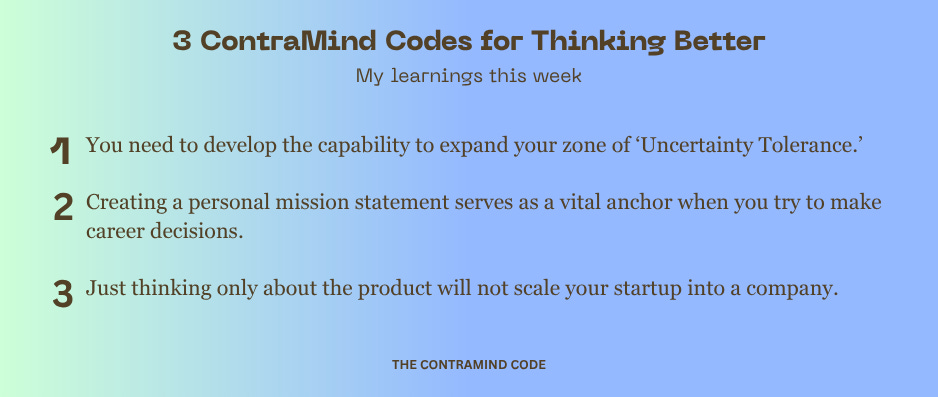
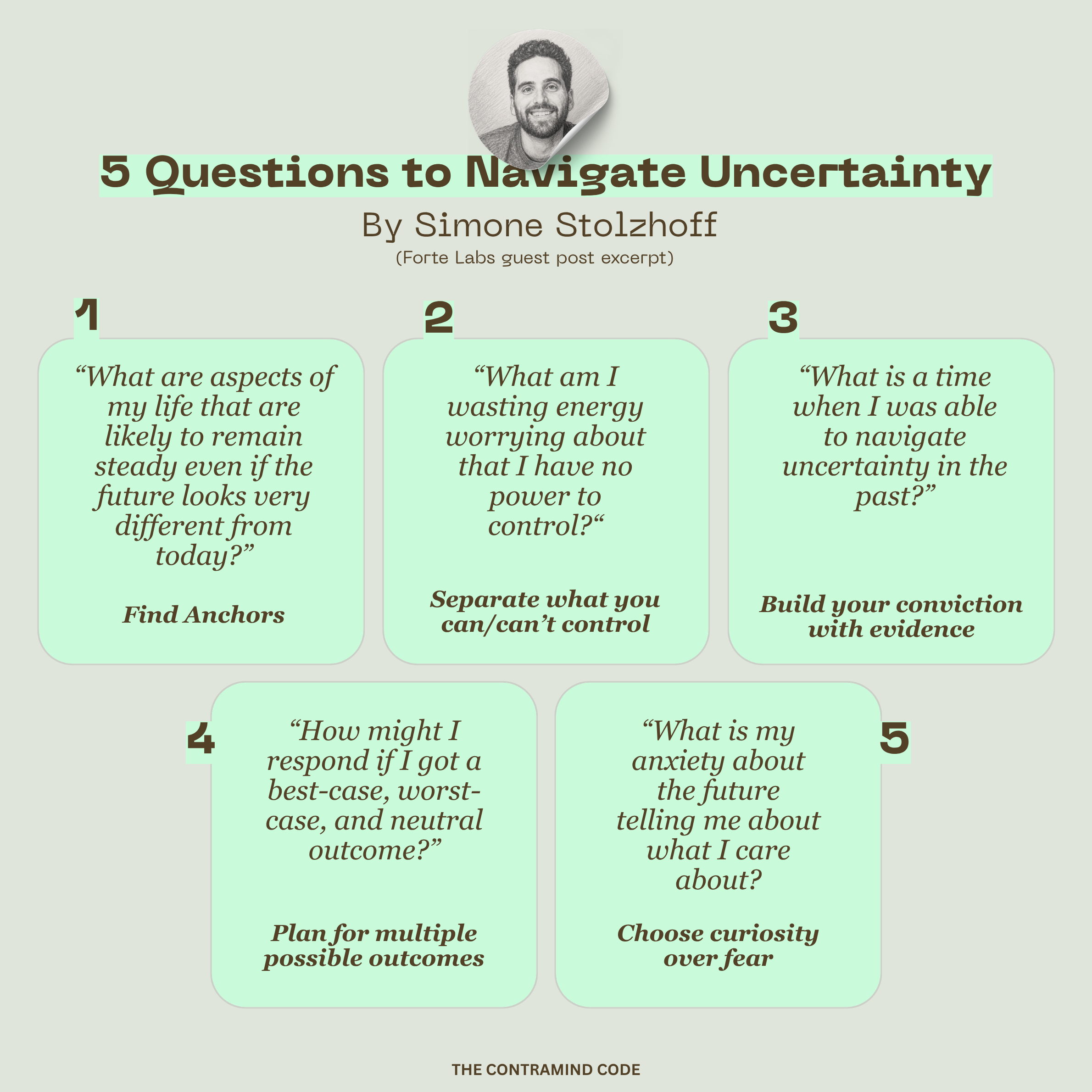
Simone Stolzhoff, in his guest post in Forte Labs, writes how it is important for leaders to develop ‘Uncertainty Tolerance.’ Simone writes that when you have a low threshold for ‘Uncertainty Tolerance’, you tend to get stuck with your strategy, relationships, business decisions, or a job, and you end up not operating at your optimal level of capability.
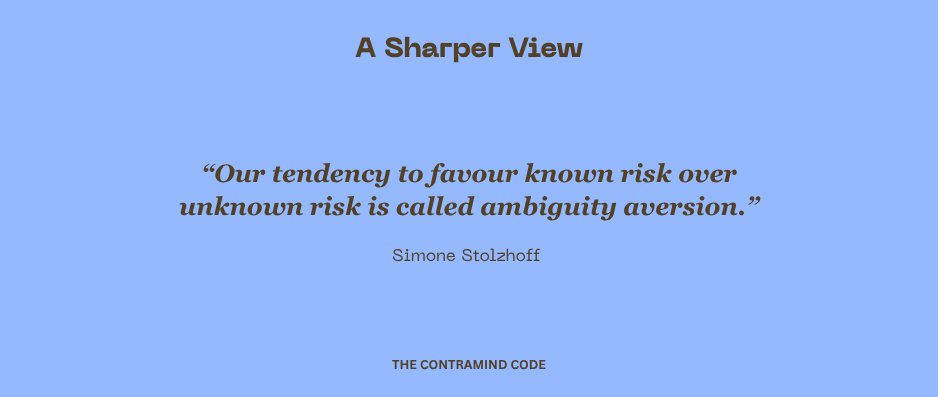
Here are some ideas or suggestions he offers to manage uncertainty:
The Secret To Making The Right Career Decisions With Patty StoneSifer.
Molly Graham is in conversation with Patty StoneSifer. founding CEO of the Bill & Melinda Gates Foundation. This conversation has one big idea, which is that not always the most prestigious job that you are thinking of, or that you get, is always the right career move.
Patty goes on to explain the importance of creating a personal mission statement and how it serves as a vital anchor when making career decisions. She goes on to say how we are enamoured to say “YES” instinctively to an offer by a company, whose founders or the CEOs, whom we admire, or the market reputation that the company carries, will drive us to join them, but that may not fit with our personal mission statement. She also demonstrates how to build your own personal mission statement during this conversation with Molly.
The Product-Company Gap.
In this Harvard Innovations Lab Video, Chris Gardner, partner at Underscore VC, highlights how just thinking about a product that you're building alone will not scale your startup into a company. He calls this the product-company gap, and this thinking, in most cases, acts as a bottleneck to transforming it into a company.
Chris shares some frameworks that you can use to see this challenge from a new lens, and the first 30 minutes of the talk are loaded with powerful insights and thought-provoking ideas for you to reflect on:
There is a 40/20/20 rule. For mature companies, 40% of revenue comes from marketing and sales, and 20% from product and research.
Chris introduces a 2x2 BLAC framework -Blatant, Latent, Aspirational and Critical. He explains how some products go through these transitions. It allows you to put your product in one of these segments and evaluate what strategies you may need to adopt to scale your product or startup idea into a company.
Chris talks about the concept of Minimum Viable Segment - “Of your grand market, find one segment that has consistent needs. Prove that your first idea either works or doesn’t for a minimum viable segment, before you try to blow it out and create something much, much bigger.”
Chris puts forth a very powerful framework articulated by Des Traynor, called a cluster of demand, which allows you to identify your Minimum Viable Segment at the intersection point.
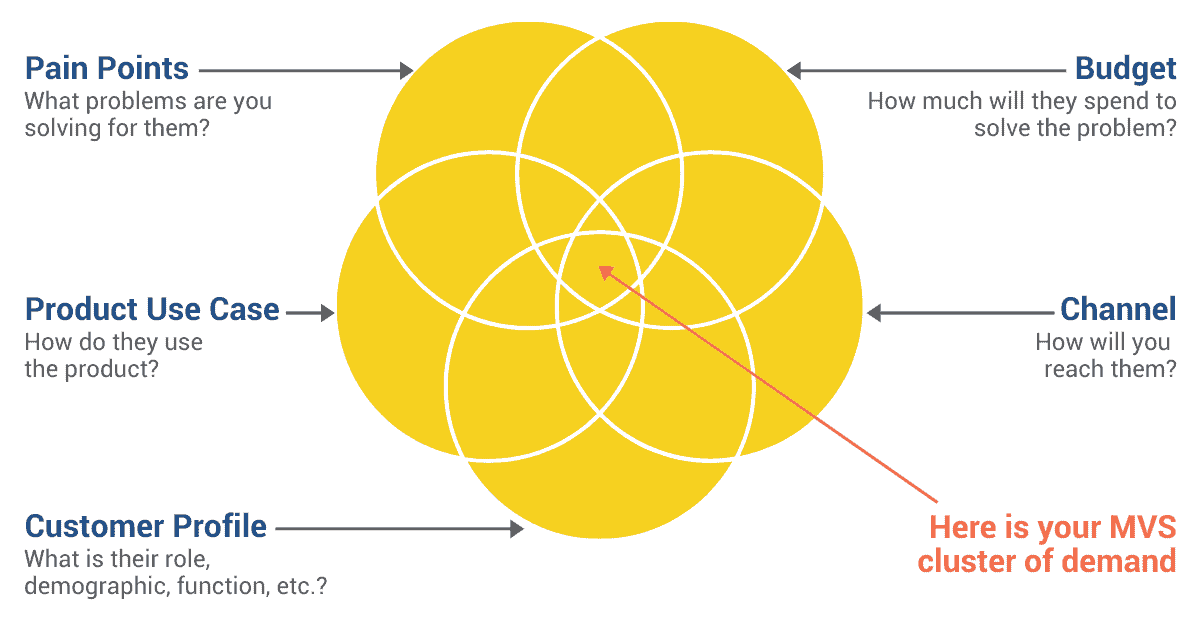
[Image courtesy -Harvard Innovation Labs YouTube Video “How to Build a Product that Scales into a Company”]
Grades And IQ Don’t Determine Your Long-Term Success. Character Does.
Listening to Patty Stonesifer, one key takeaway from that conversation was the importance of anchoring your decisions in line with your personal purpose, mission and values. Many times, when you make decisions that are not anchored around these, it soon starts to play havoc in your life, as there is a contradiction between what you're doing and what you believe in. During the course of your career, there will be many such opportunities that come your way where your skills & expertise seem like the best fit, but when filtered through the lens of your purpose, mission, and values, you may have to drop them.
Diving a little further into this, building your character is an important lever for success and for acting with discipline. It’s even higher in the order of ranking than your skill. Let’s explore why.
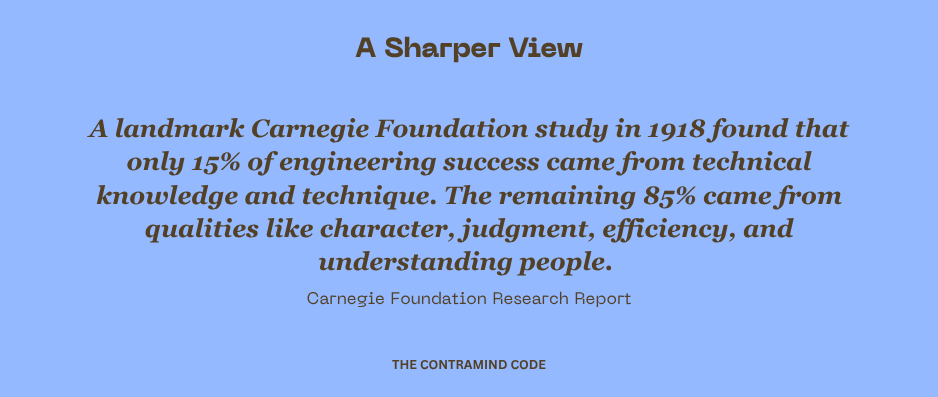
Carnegie Foundation, way back in 1918, released a research report, in a joint study commissioned by the National Engineering Societies in collaboration with Harvard University, and the Stanford Research Centre, found that character, which encompasses traits like judgment, focus, understanding of people, and, in addition, technical skill, in that order, is key for engineering success. Technical knowledge and technique scored 15% of the priority weight. The remaining 85% included judgment, efficiency, and EQ, which were all non-technical, character-rooted competencies. While this may be a study restricted to engineers, it reflects the overwhelming importance of character over skill.
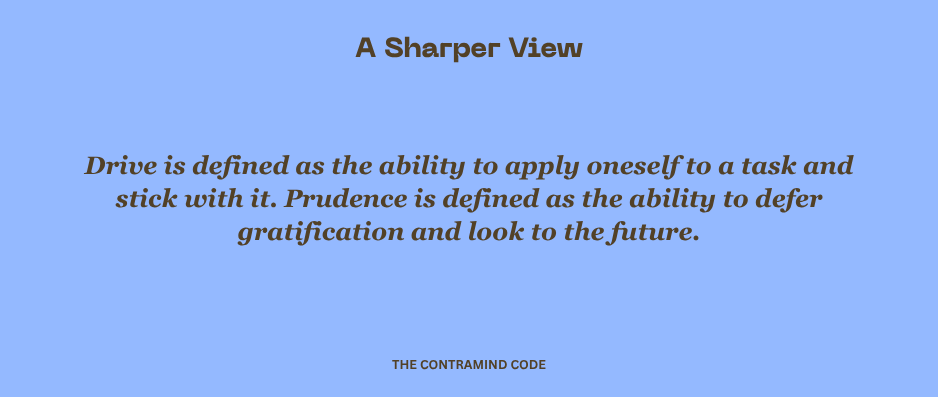
In another study by Leadership IQ, Mark Murphy highlights that attitude drove 89% of hiring failures, while technical skills accounted for only 11%. More recently, in 2014, Richard Reeves, Joanna Venator, and Kimberly Howard published a research report titled The character factor, identifying drive and prudence as the most important non-cognitive skills needed to do well in life.
Nobel Laureate James Heckman found through his research that achievement tests do not adequately capture character skills, and he went on to establish that character is a skill which can be developed through practice, adversity, and deliberate effort. The most interesting part of his finding is that character can be built with practice, intent and conviction. It can be built at any age.
Over the years, many studies have shown that grades and IQ are poor indicators of long-term success. Non-Cognitive skills, which form the basis of your character which includes traits like problem-solving, perseverance, grit, resilience, drive, prudence, focus, humility, self-discipline, integrity, empathy, accountability, courage, and collaboration, play an important role in achieving your goals and aspirations in life and career. Character is not a trait that you are born with, but it’s a skill that can be developed through consistent practice. The question is: are you willing to go through the hard grind of effort required to acquire and imbibe these traits?
So what are the steps to building your character?
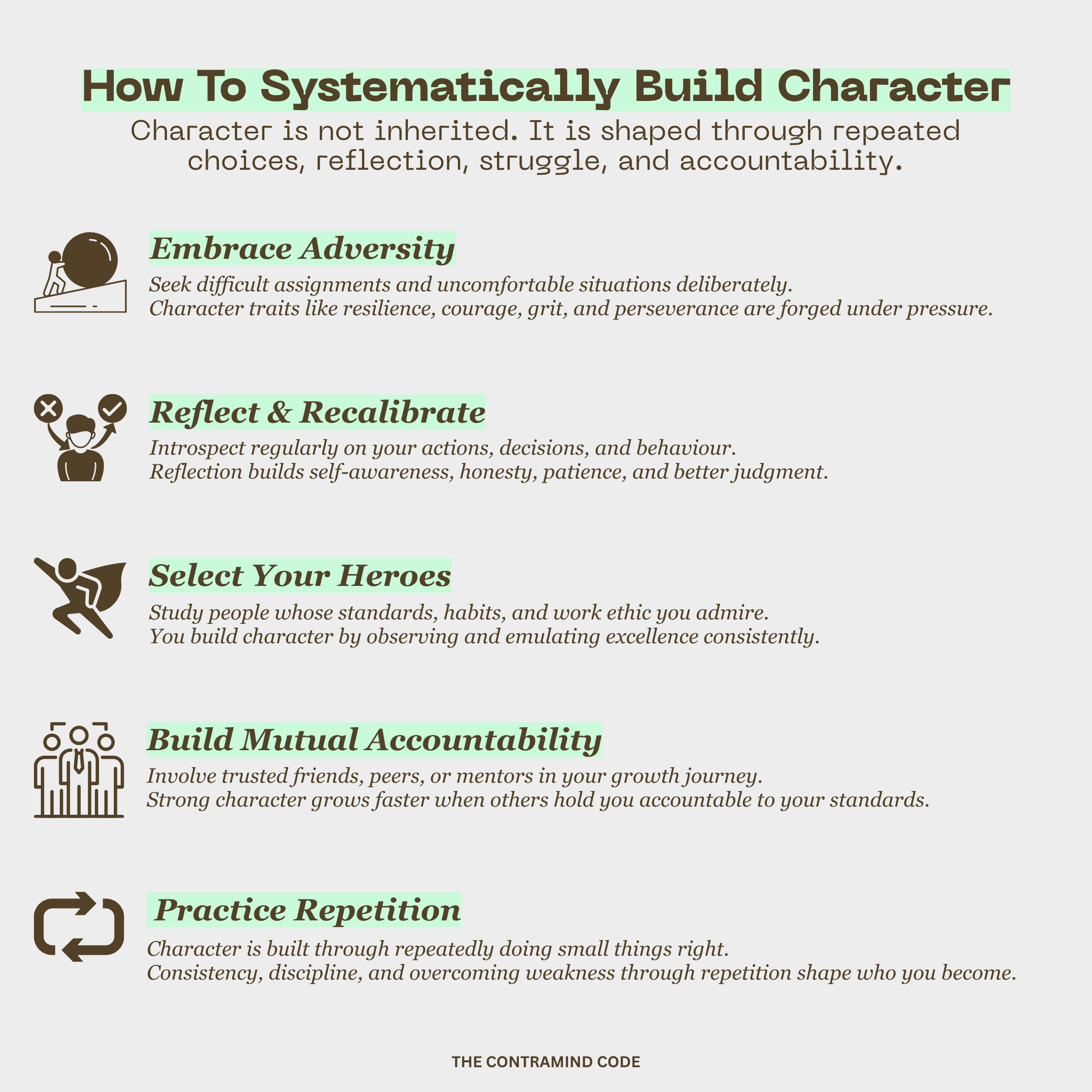
Embrace Adverse Situations: It’s always easy to work within your comfort zone. But when you take up assignments and opportunities that are tough and ones that can shake you up from your comfort zone, it helps you learn a lot. It teaches and puts you through tests of your character, such as perseverance, resilience, courage, and grit. If you go out and seek difficulty deliberately, you will be able to build your character systematically.
Reflect, Refine and Recalibrate: Most of the time, you set aside very little time to reflect on your day, a meeting, or an incident. When you introspect, you become more self-aware about your behaviour and actions every day. It could throw up a lot of insights around your bias, agility, lack of patience, jumping to conclusions, etc. You will develop a lot more honesty, authenticity, and prudence within. When you journal them, you gain a fresh perspective on how to approach similar situations or issues.
Select your heroes: When you pick up a hero or set of heroes, it provides an opportunity for you to study their life, their practices, work ethic, habits, etc. You will slowly begin to emulate them in your thinking, behaviour and actions. It’s akin to learning from a master craftsman who does not teach you through any lecture, but you learn through observing, being an apprentice, and arrive at benchmarks and standards you would like to achieve like that person.
Co-Opt For Mutual Accountability: Character never gets built in isolation. Co-opt your friends, colleagues, or well-wishers in your journey, and make your aspirations and process known to them. When you do that, it allows them to notice when you compromise and hold the standard, when you cannot hold it yourself. The best character-building environment is the one that creates social friction and provides a structure you can rely on.
Practice Repetition: Character is built by consistently doing the small things. Your neural pathways strengthen with repetition. It begins by setting realistic goals, breaking them into small, manageable steps, celebrating small victories, reflecting on failures and the lessons learned, and using setbacks to transform your journey. Character gets built through the struggle of overcoming your own weakness, and that can happen only through sustained repetition.
Finally, remember that your technical skills only open the door. But character determines how long you stay, what you build, and what legacy you leave behind in everything you do in life.