How To Maintain Strong Friendships As You Move Through Your Career.
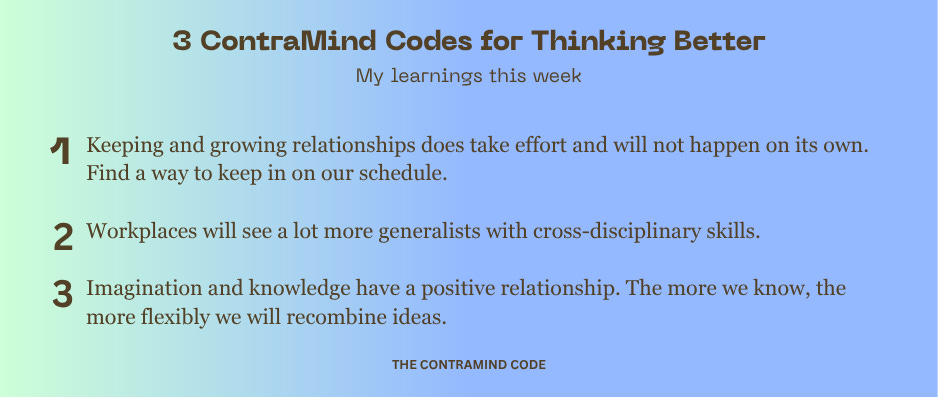
In the article in Kellogg Insights, Professor Neal Roese, a leading expert in the science of regret, writes about the importance of maintaining relationships throughout the course of your career. He writes that there will be location changes, organisational shifts and time constraints in your job as you grow, but keeping relationships does take effort and will not happen on its own. He provides some research-based recommendations, like:
Put In the Effort: “One of the simplest ways to preserve a close friendship is to make a point of keeping it on your schedule.” It may be worth noting that there is a gender difference in maintaining connections. Women are better at maintaining one-to-one connections, while men need a nudge!
Be Ambitious but Preserve What You Value: Taking time out with friends does not mean you have to limit your ambition or forgo opportunities. You have to go out of your way to preserve some friendships that you greatly value and want to maintain.
Reach Out for the Perspective You Need: You must try to keep nurturing your close friendships over time. Your friends can often help you see your strengths more clearly, and therefore, they can help you in finding new ways to succeed. They can act as a great sounding board for you, too.
Read the entire article here.
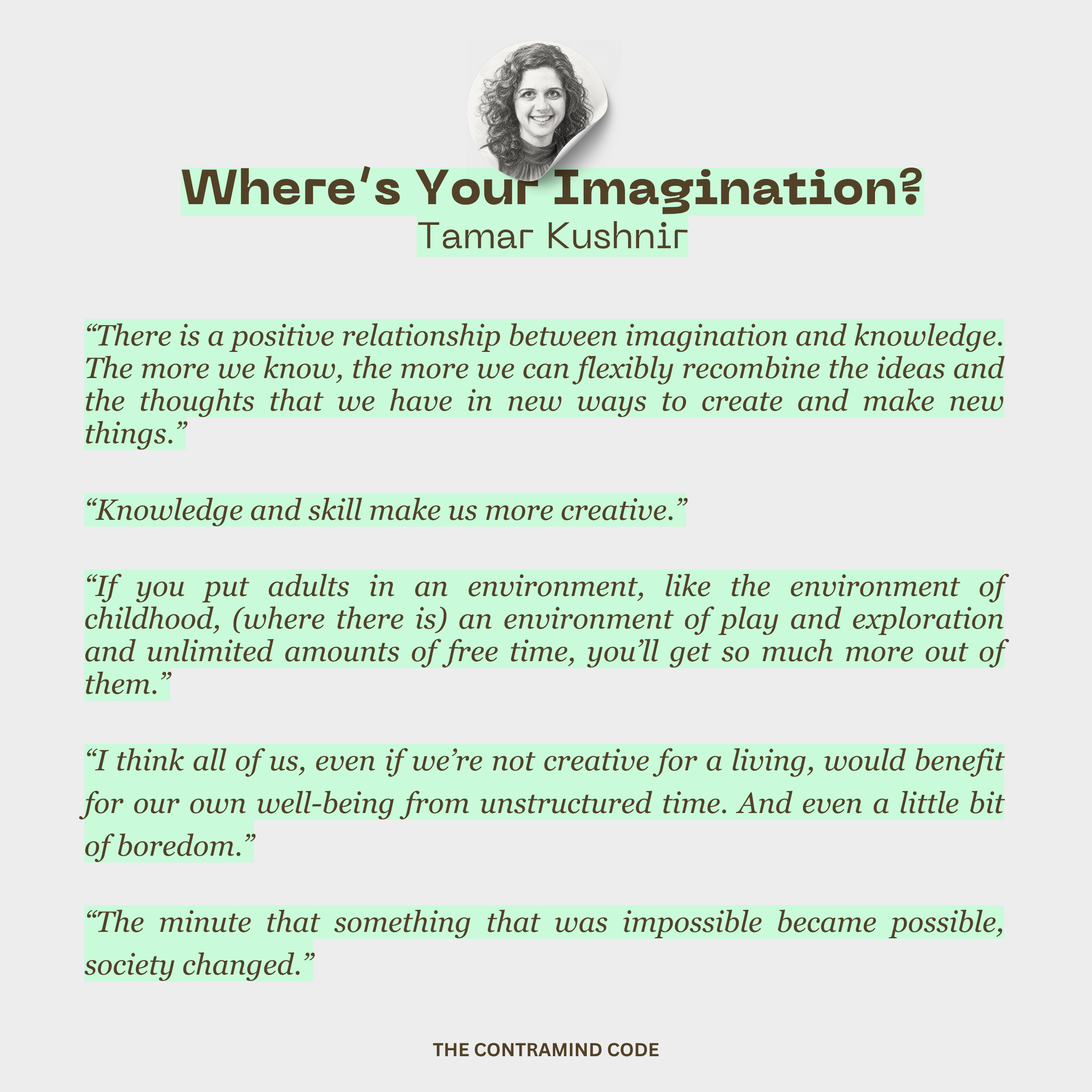
Tamar Kushnir: Power of Imagination.
Tamar Kushnir, Professor of Psychology and Neuroscience at Duke University, is in conversation on the Stanford Psychology Podcast, discussing her research on imagination and answering the question, ‘Does everyone have imagination?’
Here are some key thoughts from Prof. Tamar on this topic:
Why Coding Is Solved And What Comes Next.
Boris Cherny, who is considered the father of Claude Code at Anthropic, joins Sequoia partner Lauren Reeder to discuss the future of software coding.
Here are some thoughts he shares in this conversation:
What will teams look like in the future? “We’re going to start to see a lot more generalists who are cross-disciplinary….engineers who are really good at product engineering, but also really great at design, or really great at product and data science and engineering.”
What’s changing with coding? “One that gets less important is switching costs... another one that gets less important is processing power…network effects,
scale economies, cornered resources, things like that, these are not really
changing with AI.”
How will companies, competition and startups look like? “I think the number of startups in the next 10 years that are just going to disrupt everything is going to increase like 10x because right now, you can be a tiny startup, you could build a thing that’s as valuable as a large company, and you can actually compete head-to-head because the large company has to evolve their business process. They have to evolve the way they work. They have to retrain everyone to use technology. They’re going to face a lot
of internal resistance to that.”
How Imagination Can Become Your Competitive Advantage.
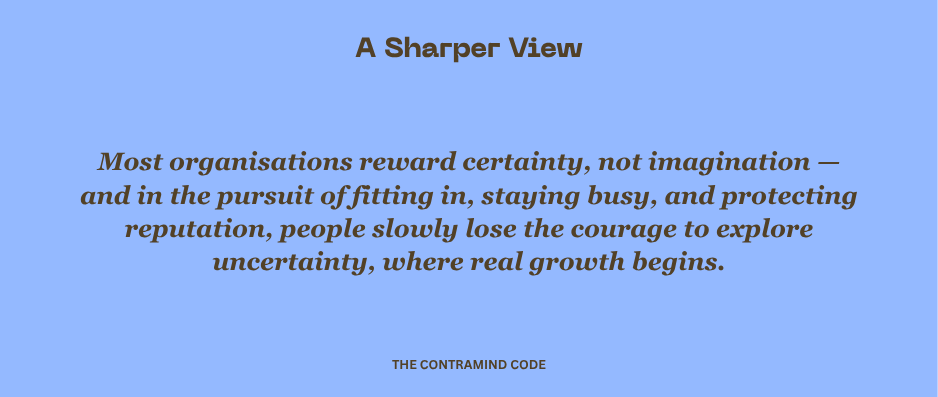
Imagination requires you to challenge established norms, look at alternatives, connect the unconnected and question fundamental assumptions.
Children freely challenge what they see around them. Children, by nature, are curious, test many hypotheses and are comfortable starting from ignorance and looking foolish with their questions. Adults turn the same process upside down, as they gain more knowledge, apply richer cross-domain analogies, and intuitively recognise patterns from experience. Hence, most adults fall into an ‘Adult Trap’, where they come to rely too heavily on established precedents.
The companies that people work for only further this cause. In a majority of organisations or companies, they put the brake on their imagination, as most people settle into a culture of ‘fitting in and ‘going along’, and this is a death-knell for imagination and hence growth. Most high performers fill up every available gap in their calendar with calls, emails, and meetings, leaving no space to imagine, experiment, and play. People have ideas. They do not voice them. The real underlying contradiction is that the companies most people work for reward them for certainty. A majority of people, therefore, end up resisting uncertainty in their lives. However, uncertainty and unstructuredness are integral to developing your imagination skills.
Therefore, as an adult, over time, you begin to constantly defend the need to maintain or protect your reputation, or strive very hard to grow your position, or rank, and get unduly worried about creating cracks in relationships. This leads you to become overly cautious or dismiss any new patterns you discover in what you're pursuing.
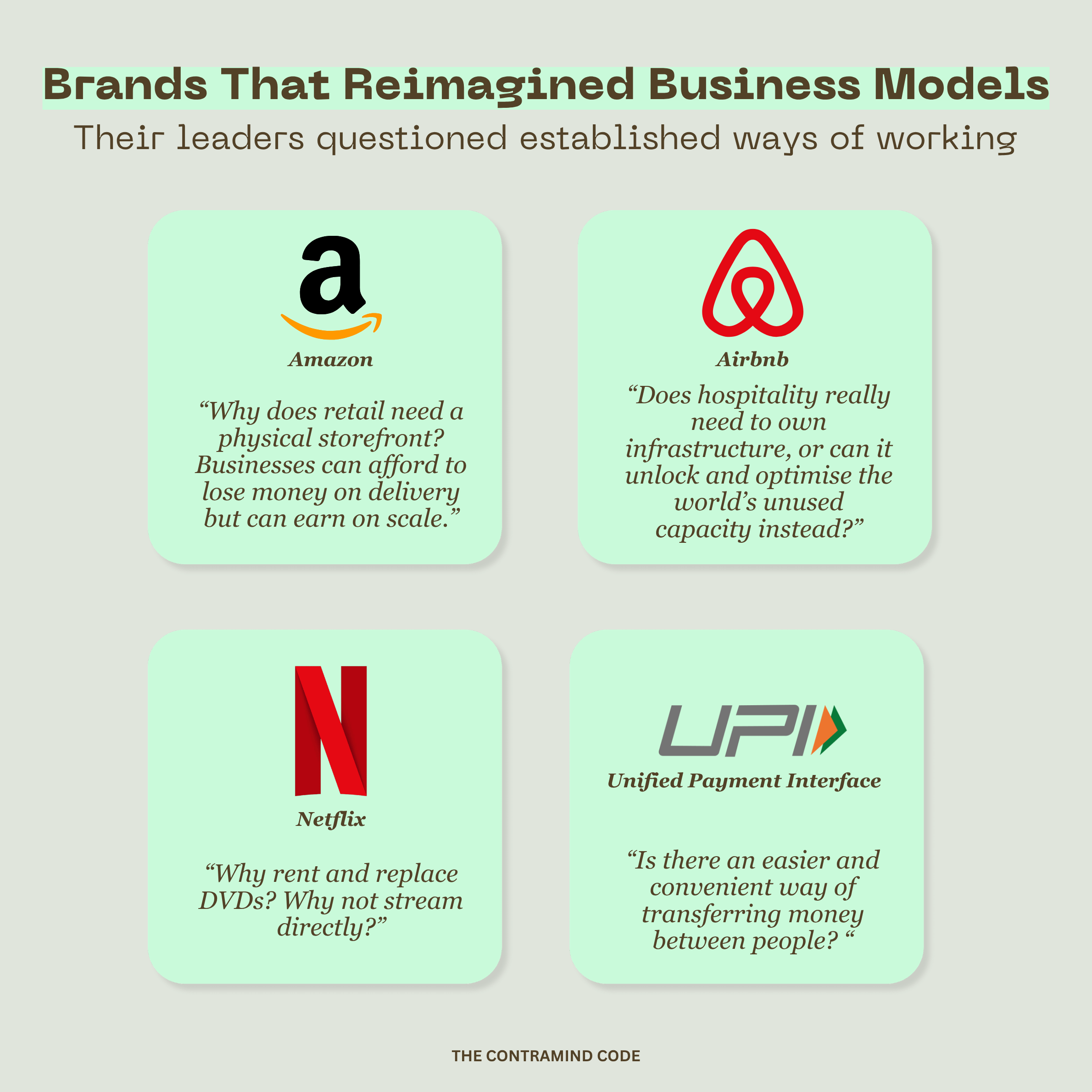
Here are examples of some business models that have disrupted traditional assumptions, as the leaders of these companies questioned established ways of working and reimagined them:
Amazon: Why does retail need a physical storefront? Businesses can afford to lose money on delivery but can earn on scale.
Airbnb: Is there a need for hotels to necessarily invest in physical infrastructure and overheads? Is there a better way to optimise available or unused capacity? The hospitality business does not need infrastructure, it can leverage existing capacity. There was a segment waiting to lap up this need.
Netflix: Why rent and replace DVDs? Why not stream directly?
UPI(Universal Payment Interface): Is there a more, easier, and convenient way of transferring money between people? Why have bank accounts created walled gardens for transferring money?
However, imagination, by its nature, requires the ability to work with ambiguity, to test hypotheses with limited data, and to allow for unstructured time and thinking. The natural instinct for many of us is to seek clarity before imagining. At work, you must have noticed that many strategic decisions are rarely made with all the facts in hand. You must develop the ability to gain meaningful insights from what little is known. This requires two important skills that you must build on:
Inductive Leap: Ability to jump from specific observations to broader, generalised conclusions. This is not simply blind guessing but rather exploration beyond what the data reveals, using pattern recognition, prior knowledge, and imagination.
Epistemic Courage: The intellectual courage to express or voice your opinion about beliefs that are true, after accurately ascertaining facts or patterns, despite social, personal and professional costs that may come with it.
Imagination triggers the creative tension between what is observed, what is normally done, and possible new ways of thinking and solving a problem that may or may not exist. That’s possibly the moment for you to take an inductive leap, with an idea, when there is not enough data, but you sense some patterns emerging. If you don’t develop epistemic courage, the idea you come up with is retracted, diluted, or never voiced due to the fear of social resistance.
In fact, imagination is becoming more important than ever in the age of AI. The WEF Future of Jobs Report 2025, based on research across more than 55 countries, 1,000 leading employers, and 14 million workers, highlights the importance of this skill. AI is great at finding optimal solutions within boundaries using convergent thinking, while humans excel in breaking boundaries and making unexpected connections between seemingly unrelated ideas. In another landmark 2026 study of 100,000 humans, the research found that while AI can beat average human creativity, the most imaginative minds are still unmistakably human.
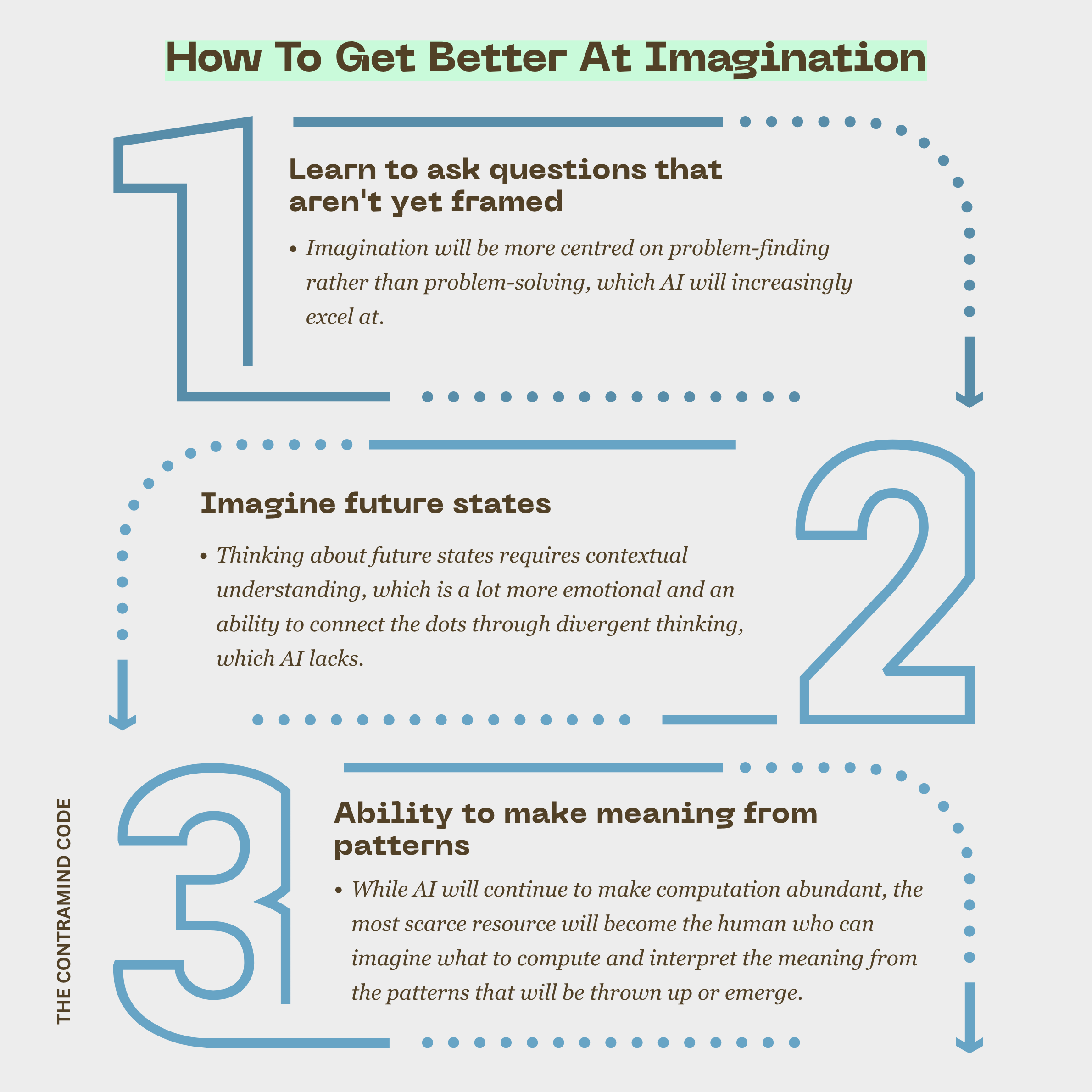
So, how do you work further and get better at imagination?
Learn to ask questions that aren't yet framed. Imagination will be more centred on problem-finding rather than problem-solving, which AI will increasingly excel at.
Imagine future states: Thinking about future states requires contextual understanding, which is a lot more emotional and an ability to connect the dots through divergent thinking, which AI lacks.
Ability to make meaning from patterns: While AI will continue to make computation abundant, the most scarce resource will become the human who can imagine what to compute and interpret the meaning from the patterns that will be thrown up or emerge.
If you, as a professional, want to shape what comes next, you must deliberately cultivate imagination through uncertainty tolerance, set unstructured time for exploration, epistemic courage, and inductive leaps.