Introduction
Welcome to The ContraMind Code.
The ContraMind Code provides you with a system of principles, signals, and ideas to aid you in your pursuit of excellence. The newsletter shares the source code through quick snapshots for a systems thinking approach to be the best in what you do. The ContraMind Code helps you reboot and reimagine your thinking by learning from the best, and enables you to draw a blueprint on what it takes to get extraordinary things done. Please share your thoughts and comments to start a conversation here.
Take a journey to www.contramindslabs.com. Discover a complete system for ambitious professionals who refuse to plateau, and also a place where you can listen and watch some great minds talk to us about their journey of discovery of what went into making them craftsmen of their profession, to pursue excellence and drive peak performance.
The Expert Beginner Problem.
In this article, James Stainer writes about a familiar problem that most of you face, especially when you are changing jobs and joining a new company.
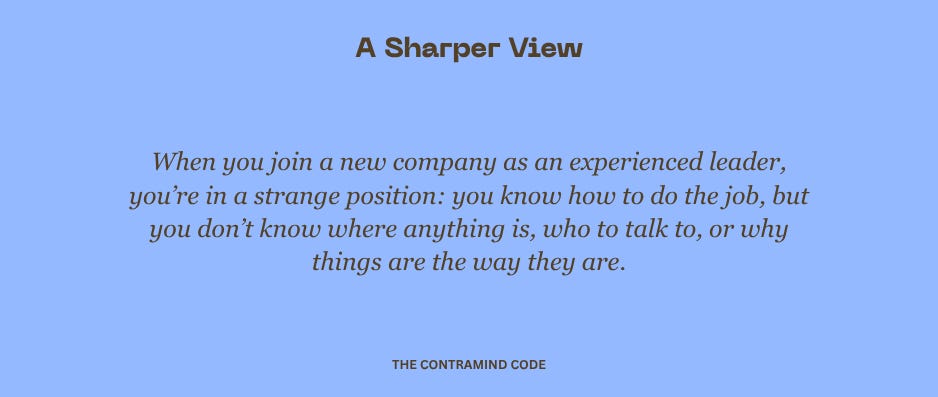
James writes, “When you join a new company as an experienced leader, you’re in a strange position: you know how to do the job, but you don’t know where anything is, who to talk to, or why things are the way they are.”
It is important to approach such situations with openness and curiosity. He suggests a couple of ideas on how to approach this situation:
Days 1-30: See things clearly.
Days 30-60: Pick your battles.
Days 60-90: Land the results.
James makes a very important point about how you must balance the principles you are familiar with and the prescriptions you may know but need to leave them behind.
Read the entire article here. (Some part of this article is behind a pay wall)
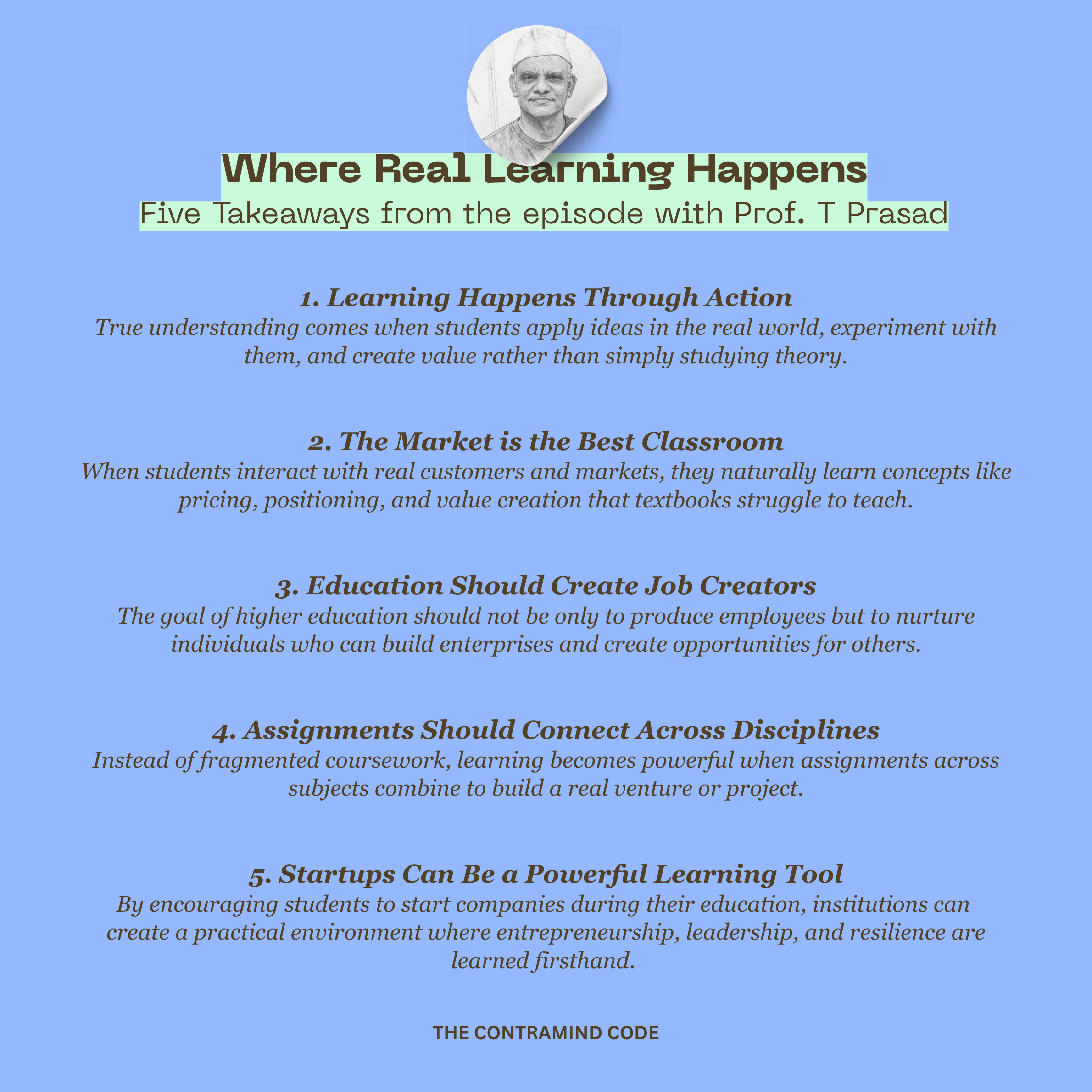
Markets Make The Best Classrooms.
What if the real problem with education is not what students learn, but how they learn?
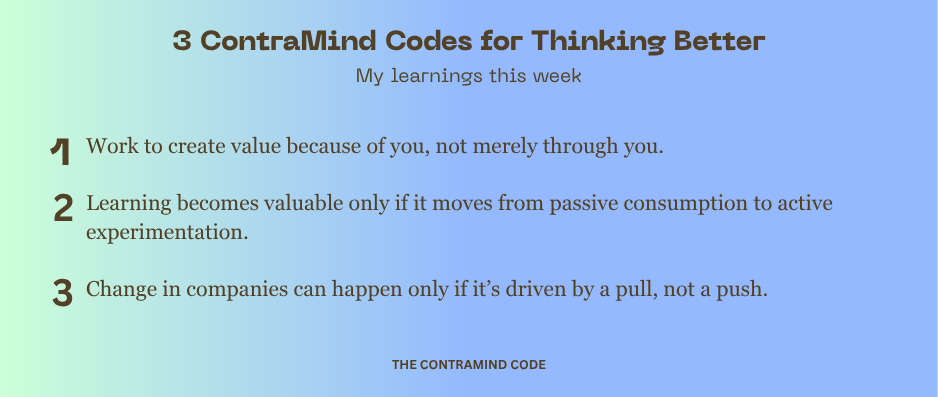
In this episode, Professor T Prasad, IIM Bombay, questions the dominant model of higher education that prioritizes lectures, exams, and placements, arguing that these methods often disconnect learning from real-world value creation. He proposes a radically different approach—one where students engage with markets, customers, and problems early, transforming learning from passive consumption into active experimentation.
Leaders At All Levels: Kraft Heinz’s 5X Speed Secret.
In this MIT Sloan Management Review video, Kraft Heinz's global head of agile transformation, Carolina Wosiack, shares her experience with Michele Zanini, Co-Founder, M Lab, Co-Author, Humanocracy and Prof. Kate Issacs on how transformation in companies is possible by sharing responsibility for decisions, limiting the project pipeline, and building ownership amongst teams instead of compliance.
Here are some key points that are made by Carolina in an extremely succinct and powerful way, if you want transformation to happen at speed in a company:
Let teams pull change - not push it.
Replace compliance with ownership.
Leadership often means getting out of the way.
In a successful transformation, there is a moment when teams start to outpace the system, that’s when company must be ready to fix the system.
How To Prepare To Become Irreplaceable In The Age Of AI.
There is a lot of hype surrounding how AI will replace jobs and many occupations. As a professional, you must now be worried about the future and how it could affect your job, career, and growth. There is, without doubt, truth in that. But, what may be missing in all the “top-of-the-heap” discussions, research, bad news amplification, etc., is about getting a lot deeper into the reasons and also starting to analyze, for yourself, what are the competitive disadvantages that AI comes with and what you can do to take advantage of AI’s strengths and its own weaknesses. You have to start thinking about it in the context of the professional expertise you are trying to build and your current job function, industry, or the company you work for.
First things first, you need to recognize that bad news spreads faster and gains a lot of attention. You have to accept and appreciate that every industry goes through such disruptions every few years or decades. Take, for example, the telecommunications industry, which moved from landline phones to mobile phones or from copper pipes to fibre-optic pipes, or industrial robots replacing human workers in factories. Some disruptions have a larger-scale impact, while a few others have a vertical impact in one industry or department. AI is one such thing like the internet or mobile communications.
Therefore, some of the most important questions that you have to answer yourself are:
"If my company's name were removed from my work tomorrow, would the outcome or value still be traced back to me?"
“Imagine you are an independent contractor or a consultant, would your company today still hire you for your expertise and service and pay you as much, if not more?”
“What is it that you bring to discussions or problems that others are not able to see due to the sheer nature of accumulated knowledge and capability that you have been able to build over the years?”
Answering questions like these helps you prepare better for any future changes. Today it's AI, but a few years later, it may be something else.
The question really is, what must you do to prepare yourself to be irreplaceable?
Let’s take the example of a surgeon, a lawyer, or an architect. It’s years of expertise built diligently by proactively taking up patients, cases, and projects that helped them build skills they never had or were lying untapped or unused. Their earnings are non-linear, which increases disproportionately over the years. If you can sense a large gap between your used and unused skills or expertise, and you are working to continuously improve them, then there is a safe moat that protects you against disruptions like AI.
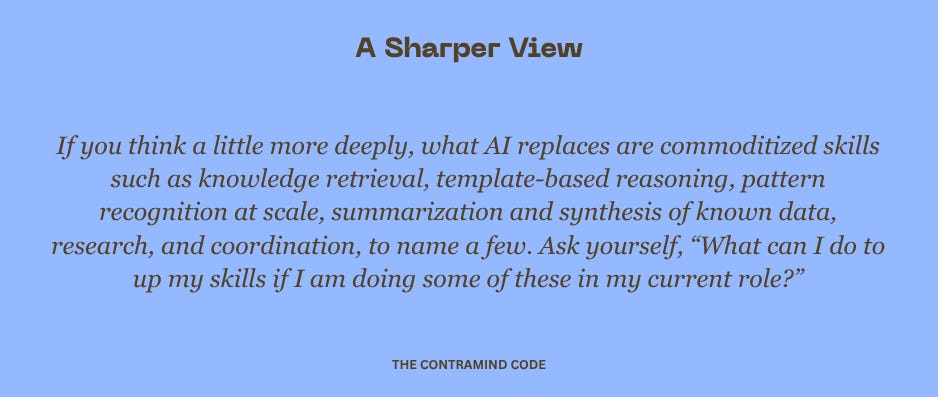
The other important thing you need to get comfortable with is working on and practicing some skills that your current role, job or company may not require immediately. You are often too accustomed to ‘trading your available skills’ for ‘maximum value’. You need to move away from that mentality to remain relevant and valuable.
What are the skills that allow you to make a difference personally to any job or work that gets done, and it gets attributed to your contribution and value?
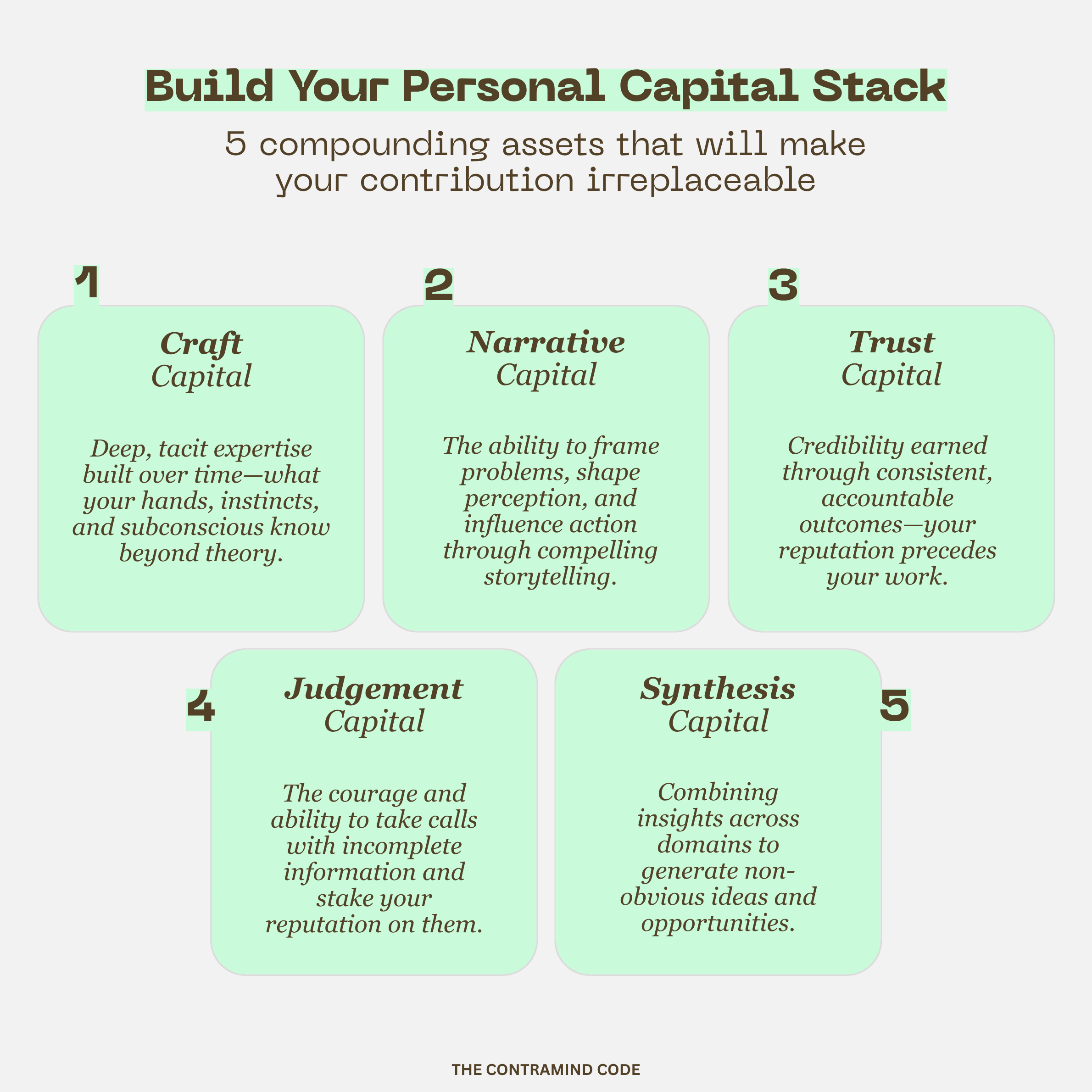
Work towards improving your craft capital: It’s the expertise that accumulates over time in your subconscious and in your body, which you need to work diligently on. It’s akin to a surgeon's hands, a jazz musician's improvisation, and an investor's gut to read the founder in a room beyond the numbers. It’s this ‘tacit knowledge’ that can give you a competitive advantage against AI.
Develop the ability to construct narrative capital: It’s the ability to frame a situation, build a case, and move people to action. It’s all about building structural intelligence to shape opinions about how a problem is perceived and outlining the action it requires. Outcomes are achieved by influencing and building a story architecture with people. AI can write, but cannot persuade. It can only push. To improve in this skill, write, talk, teach, and debate in your own name.
Strive to build your trust capital: AI cannot automate earning trust. The patient requests a doctor, a client reaches out to a trustworthy lawyer, a client seeks a reputed architect, etc. Your name must bring a sense of trust to the project or a transaction. Trust accumulates through accountable outcomes that are personally attributable to you over time. It is the compounding asset that AI cannot replicate.
Work on your judgement capital: You must develop the ability to make decisions under ambiguity, incomplete information, and where high stakes are involved. How prepared are you to put your reputation on the line? The more willing you are to do it, the better your judgement capital will grow, as you will win some and lose some. That is when your judgement improves through deliberate exposure, and it lives in no database.
Get better at your synthesis capital: You must build your skills and knowledge across domains. You must cultivate intellectual curiosity to build cross-domain knowledge, balance depth with breadth, and develop the capability to transfer knowledge across domains so you can connect them intuitively when opportunities or problems arise. You must develop the ability to synthesize and fuse ideas across domains to generate non-obvious insights. You can develop this skill by deliberately reading outside your domain.
In the past, the firm was your scaffolding, proxy of trust for your credentials and reputation. To become irreplaceable, you must strive to build your value beyond the institution you work for. Your canvas of growth and recognition must become industry recognition, not just a firm or a company’s recognition.