Welcome to The ContraMind Code.
The ContraMind Code provides you with a system of principles, signals, and ideas to aid you in your pursuit of excellence. The newsletter shares the source code through quick snapshots for a systems thinking approach to be the best in what you do. The ContraMind Code helps you reboot and reimagine your thinking by learning from the best, and enables you to draw a blueprint on what it takes to get extraordinary things done. Please share your thoughts and comments to start a conversation here.
Take a journey through www.contramindslabs.com. Discover a complete system for ambitious professionals who refuse to plateau, and also a place where you can listen and watch some great minds talk to us about their journey of discovery of what went into making them craftsmen of their profession, to pursue excellence and drive peak performance.
7 Rules to Actually Make AI Work Inside Your Organization.
Mike Taylor, who is the head of tech consulting at Every and a co-author of the O’Reilly-published book "Prompt Engineering for Generative AI,” has written this extremely insightful and valuable article.
It’s useful for anyone working with or leading a team at a company undergoing an AI transformation or transition. The reason is that it looks beyond the hype around AI and succinctly outlines what it takes to make AI work in a company. Here are some rules that he recommends:
1. Buy the Model, Not the Tool: Go direct to model providers—more flexibility, better performance, lower cost.
2. Raise the Ceiling, Not the Floor: Empower early adopters instead of forcing everyone—momentum beats mandates.
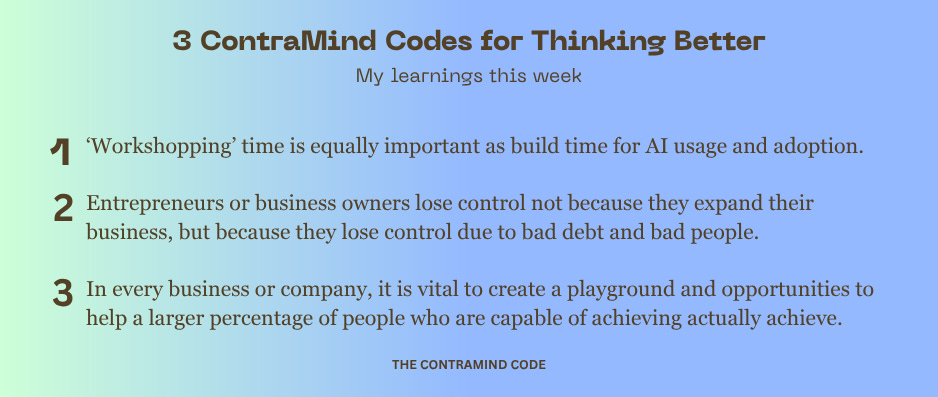
3. Learn by Building, Not Watching: Workshops should prioritize hands-on creation over passive learning.
4. Assign What Feels Impossible: Stretch goals force AI adoption by making manual work impractical.
5. Capture Everything, Use It Everywhere: Turn meetings into structured, reusable intelligence with AI note-taking.
6. Automate Relentlessly, Task by Task: Map workflows and eliminate repetition—no task should be done thrice.
7. Turn Employees into AI Managers: Train people to guide, evaluate, and orchestrate AI agents effectively.
Read the entire article here.
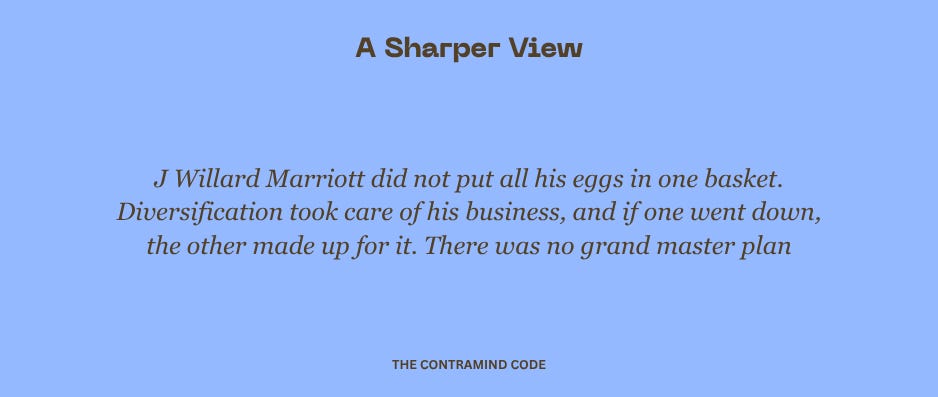
J.W. Marriott: Building an Empire Without A Master Plan.
In The Knowledge Project Podcast, Shane Parrish shares the life story of J Willard Marriott, the man who built the world's largest hotel company.
When success stories about individuals are written and celebrated, it can be very inspiring to listen to and learn about the minds and psyches of the people who achieved them. They, in fact, come out as ordinary people who go through their own confusion and tribulations. In this case, what’s interesting about J Willard Marriott (Bill as he was called) was that he didn’t open his first hotel until he was in his mid-50s, a man who was afraid of hotels, and he fought against opening one till then!
Here are some key takeaways:
Preparations begin far ahead of their achievements - Bill’s father would tell him what he wanted him to do, but never told him how to do it. He picked up the nuances and knowledge that he could handle whatever got thrown at him, like when his father put him in charge of shipping 3000 sheep to San Francisco for the Panama Pacific Exposition alone on a freight train, nearly 1000 miles to a city he had never seen.
Learnings at a young age that stay embedded for life - Having seen the life of farmers where he lived his early life and that of his own father, who was also a farmer, he resolved never to build a life that depended on forces he couldn't influence. He built a simple yet extremely tight financial management system where he tracked the business's success as one that was taking in more than it spent!
Work patterns and philosophy that stay consistent over life - Bill would never stop when he saw a rule in a contract, he would find a way to have a conversation and make a case to change it. Any obstacle he encountered was never a reason to stop. He would refuse to let other people control his money, even as his business expanded. The life lesson that ‘owners lost control not because they expanded but lost control because of bad debt and bad people’ stayed in any business that he did all his life. His eye for detail defined his business's culture and the way it was built. Being extremely cost-conscious and taking care of his people before his customers, long before compliance required him to do it, became the hallmark of how the business scaled. His ability to spot opportunities long before anyone else could made a big difference in how he grew the business, such as Marriott becoming the largest airline food provider in the world in the 1960s. The one question he kept asking himself all his life ‘Where are people now and what do they need?’ Finally, when they expanded to the hotel business, the father provided the brake, but Bill’s son provided the engine. The 15 guideposts he wrote for running a business serve as an anchor for anyone running a business. Finally, he taught one key principle that he practised every day - ‘Where there is no discipline, there is no character.’
Outliers: Why Some People Succeed, And Some Don’t.
In this video, one of the concepts- capitalization rate and human success, which is introduced by Malcom Gladwell during the launch of his book, Outliers, has a lot of underlying power and thought on what it takes humans to achieve their potential.
According to Malcom Gladwell, who has liberally borrowed the concept from psychometrician James Flynn (discoverer of the Flynn Effect — rising global IQ scores generation over generation), defines capitalization rate as "the rate at which a given community capitalizes on the human potential — what percentage of those who are capable of achieving something actually achieve it."
Malcom Gladwell talks of three constraints that affect capitalization rate:
Constraint 1 — Poverty
Constraint 2 — Stupidity (Arbitrary System Rules)
Constraint 3 — Culture (Attitudinal)
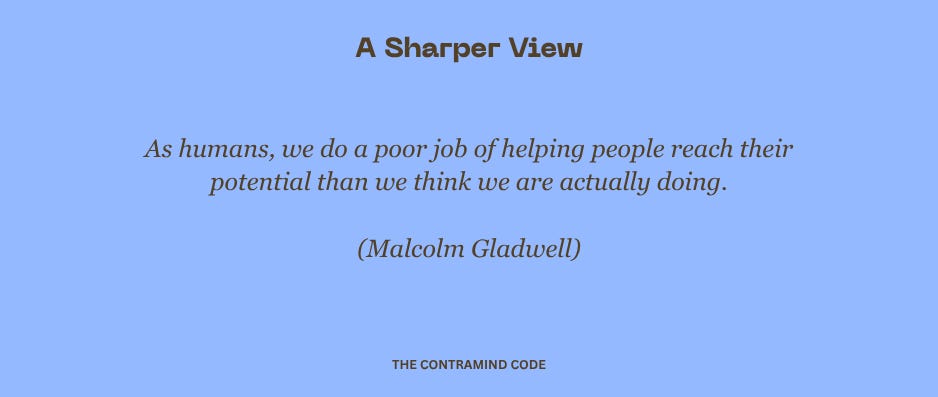
How To Stop Companies From Supressing The Very Talent They Hire: Measure Capitalization Rate.
Malcom Gladwell’s idea of “Capitalization Rate” - “What percentage of those who are capable of achieving something actually achieve it.” can be applied creatively to companies in the context of the time, investment of money, resources and effort they take to hire, train and grow top-notch talent.
The interesting question to ask in the context of a company is, “ What percentage of the great talent we hire end up achieving what we envisaged them to achieve in our company?” This could be defined as the “capitalization rate” of the company. Normally, most companies track retention rates, attrition rates, employee satisfaction or engagement scores, etc., but measuring ‘capitalization rate’ could be a valuable KPI worth tracking and understanding more.
Why would this be important in the context of a company?
In the ‘war for talent’, most companies within an industry - say, for example, banking, software, insurance, engineering, automotive, etc. end up competing hard to hire the best talent available in the market from each other or from outside. It would be extremely valuable to measure and analyze, what percentage of them ended or did not end up achieving what they wanted to achieve when they initially joined the company or even finding out if they achieved what they wanted in another company.
Most people come with a dream, an inner drive, motivation and an aspiration to make a difference and create an impact in their role and position at whatever level they join a company. But what stopped them from achieving what they wanted, or the barriers that kept them from living up to their own potential within the company, will be a useful insight and a measure to consider. This is beyond the retention and attrition rates, which are standard measures, but truly does not give the picture of ‘talent squeeze’ and therefore ‘talent erosion or flight.’
The gap and opportunity - Putting it in perspective
According to research, more than 1.3 billion people worldwide are employed in either overqualified or underqualified positions. The global economic consequences of this skills mismatch were estimated at approximately $8 trillion in unrealised GDP in 2018. This is largely due to gaps in education, inadequate training, and outdated skill sets.
It’s worthwhile to look at Malcom Gladwell’s point on ‘capitalization rate’ in the context of a country like Kenya or Jamaica, where the sheer number of people who are really good long-distance runners is quite large. It’s no wonder they win most of the marathons across the world. The real challenge is to give a majority of them an opportunity or a canvas to exhibit their talent and succeed. The Indian cricket’s IPL is a great example of creating a platform for a high ‘capitalization rate’ where the sheer number of talented cricketers coming out of the game is incredibly high due the number of teams playing the IPL and therefore the opportunity for talented cricketers. This has created a huge bench strength for India in cricket today.
Is there an equivalent to an IPL league within your company that helps talent thrive and succeed?
What stops high ‘capitalization rate’ from happening in companies?
High-potential talent is invisible to leadership - Many talented people have unequal access and visibility in terms of opportunities and face time with senior management and leadership. It’s often the bosses and the layer above the talented individuals who create the ‘blackout effect’ for senior leadership to see and feel
this talent.The best performers are stuck while the wrong people rise up the ladder. This is a consistent problem across companies. Tenure bias (working for a long time in the company or a department), credentials fetishism( for top engineering and management schools, working with existing top companies, etc.), or wrong promotion decisions create the ‘talent disenchantment’, and this erodes their trust and credibility.
Not enough playground and opportunities - The talented people just don’t have enough opportunities to play within the company. They are stuck in routine tasks despite past breakthroughs, lack of growth ambition of the company itself or the reporting boss themselves, relatively low risk-taking capacity to enable ownership and accountability to allow experiments and drive growth, etc. This leads to the decay of capabilities, skills, and expertise over time, which unsettles talented people.
Here are some of the best solutions and ideas to overcome low ‘capitalization rate’ in companies:
Develop a keen eye to identify and groom people across the company with the right attitude, not just competency or skill only.
Provide a scaffolding and support for people who consistently exhibit significant effort and persistence in whatever they do or are given, irrespective of the fact that they may not know or not have enough expertise in what’s assigned to them.
Create opportunities for people to solve hard, tough-to-crack problems. Hence, providing a platform for rapid learning and growth.
Encourage a culture that celebrates failures rather than hides them, and allow people to attempt things with a high risk of failure, rather than just optimizing for success.
Incubate and create more opportunities for talented people to apply their thinking and skills. If you are a leader or managing a team of people, ask yourself one question: “Is my company a playground for a host of new corporate league teams to spring up so that my A players have space to play their game?”
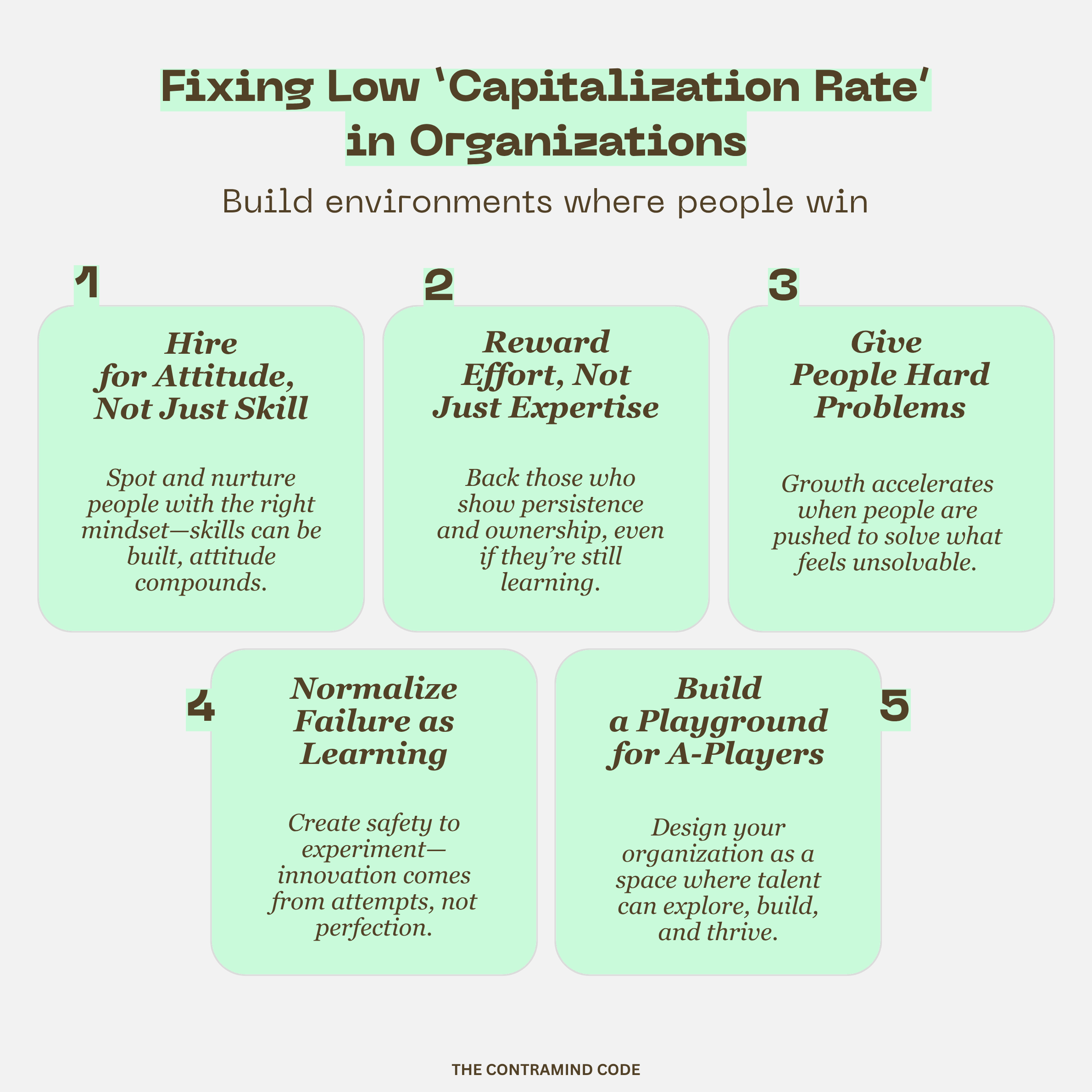
For a high capitalization rate, building the environment and conditions will have a great compounding effect on the company’s talent pool.