

Every child is asked the same question - ‘What do you want to be when you grow up?’
A child who loves cricket can answer it. She has watched the senior team play every tournament or match. She can see what the best players look like, she gets a score every time she bats or bowls, and she has a coach who tells her what to fix next. The destination is in front of her.
Now ask a 15-year-old if she wants to be an economist, an orthopaedic surgeon or a computer scientist. She has never seen any of them at work. She studies subjects whose purpose nobody has shown her, chooses a stream because it seems safe, pays a high salary and picks a college from thousands of options. Years pass studying subjects that seem to matter little. She cannot see where all these efforts lead to.
This is what I call ‘The Invisible Destination’.
What is ‘The Invisible Destination’?
‘The invisible destination’ is a career you are asked to aim at before you have ever seen it.
The irony is that you cannot want what you cannot see. So you choose by default, and the default is whatever - by rank, by prestige, by demand or what is familiar to your parents.
You might think sport and music solve this by deciding early. They do not. In 2025, Arne Güllich, a sports scientist and researcher at the Technical University of Kaiserslautern and his colleagues reviewed data on nearly 35,000 top performers in science, music, chess and sport. ‘Early stars’ and ‘Later stars’ turned out to be largely different people. About 82% of international junior athletes never reached senior international level. The top ten chess players under 14 and the later top ten adults were about 90% different. He found from his studies that most world-class performers had sampled several activities before they committed to one.
So a young athlete doesn't start with a destination either. What she sees is different. She can see the end state, gets feedback every week, has a coach, and climbs a ladder of small wins. Our schools and colleges hide all four. The question to ask is: ‘How many of our teachers are capable of being coaches?
In 2018, when one of the leading international intergovernmental organisations, the OECD, asked 15-year-olds in 41 countries what they expected to do at 30, about half named one of just ten jobs. They were choosing from the few jobs they could see.
How does intent actually form?
Intent matters because it decides what all your effort adds up to. Intent turns all your effort into a meaningful direction. Intent drives smaller goals, gives meaning to what you do every day, and shows the way for hard work and insane commitment to succeed with a sense of purpose.
We usually assume the order runs like this:
Choose a goal, then work towards it.
Research suggests just the opposite. The order is involvement, then interest, then identity, then intent.
In 2018, Paul O'Keefe, Carol Dweck, and Gregory Walton at Stanford University published research showing that people who believed passions are fixed and waiting to be found lost interest faster the moment the material got difficult. They read difficulty as a sign that the interest wasn't really theirs. In fact, the authors went on to suggest that "develop your passion" is better advice than "find your passion".
Similarly, Prof. Shoshana Dobrow of the London School of Economics, who studied and followed young musicians for years, found that their sense of calling grew with their ‘involvement’ and with encouragement from others, not with their ability!
Identity follows the same path, too. Identity is your answer to “Who am I, as someone who does this kind of work?” Research shows that newcomers start at the edge of real work, doing small but genuine tasks, and gradually move toward full participation. Over time, they do not just learn the work. They become the kind of person who does it or the person they look up to.
This is why so many people’s careers either ride like a conveyor belt of exams and rankings, committing before exploring, or meander from one irrational or unreasonable job move to the next, continuously exploring without ever committing. Both happen when people skip an important step, which is involvement. They don’t see it coming until it hits them in their mid-40s.
How did we lose sight of the destination?
History shows that when people apprenticed to a tailor or a carpenter, they worked beside their master for years. They could see exactly who they were becoming. Learning and work happened in the same room.
Mass schooling and education changed that.
It gave millions of children and students an education no apprentice ever had, but it also moved learning into classrooms, away from the work itself.
In an interesting but provocative study, in 1991, the education researchers Allan Collins, John Seely Brown and Ann Holum described school curricula as "divorced from what students and most adults do in their lives".
For most of the 20th and 21st Centuries, the large organisation filled the gap. They handed you a ladder, and people who worked there believed climbing it ‘felt like intent.’ However today, organisations are becoming flatter, have shorter longetivity but careers are getting longer.
What if you are already in the middle?
If you are a working professional, you chose a stream at 16, earned a degree at 21, got a first offer at 22, and have been working ever since. You make up a large part of today's workforce - employed, competent, and often perceived as successful based on your yearly evaluation, promotion and salary movement, yet carrying a career you never really chose. If this describes you, the destination may still be invisible! Or maybe you’ve simply stopped asking where it is.
The good news is that you can grow intent at any age, often within the job you already have.
In 1997, leading Wharton Professor and psychologist Amy Wrzesniewski and her colleagues asked employees whether they saw their work as a job, a career or a calling. Among 24 administrative assistants doing much the same work, nine saw it as a job, seven as a career and eight as a calling. The most surprising thing was that work was similar. However, the relationship to it was not. Wrzesniewski and Jane Dutton later called the way people reshape their tasks, relationships and view of their work as ‘job crafting’.
Prof. Herminia Ibarra, Charles Handy Professor of Organisational Behaviour at London Business School, followed 39 professionals aged between 32 and 51 through their career changes over three years. Those who succeeded did not plan their way into a new identity. They tried things through side projects and new circles of people. She concluded, "Doing comes first, knowing second.”
Closer to home, consider Verghese Kurien. In May 1949, aged 27, he arrived in the small town of Anand in Gujarat to serve out a government bond at a dairy. According to Amul, "His only intention at that time was to obtain a release from his bond and get out of Anand as quickly as possible." Late that year, Tribhuvandas Patel, who chaired the local farmers' milk cooperative, asked him to stay and help. He did. ‘Involvement turned into intent’, and Kurien spent the next half-century building Amul and the dairy cooperative movement in India. Looking back, Kurien graduated in physics from the University of Madras in 1940 and earned his master’s in mechanical engineering from Michigan State University in 1947. It had nothing to do with running a dairy!
So, how do you grow your intent?
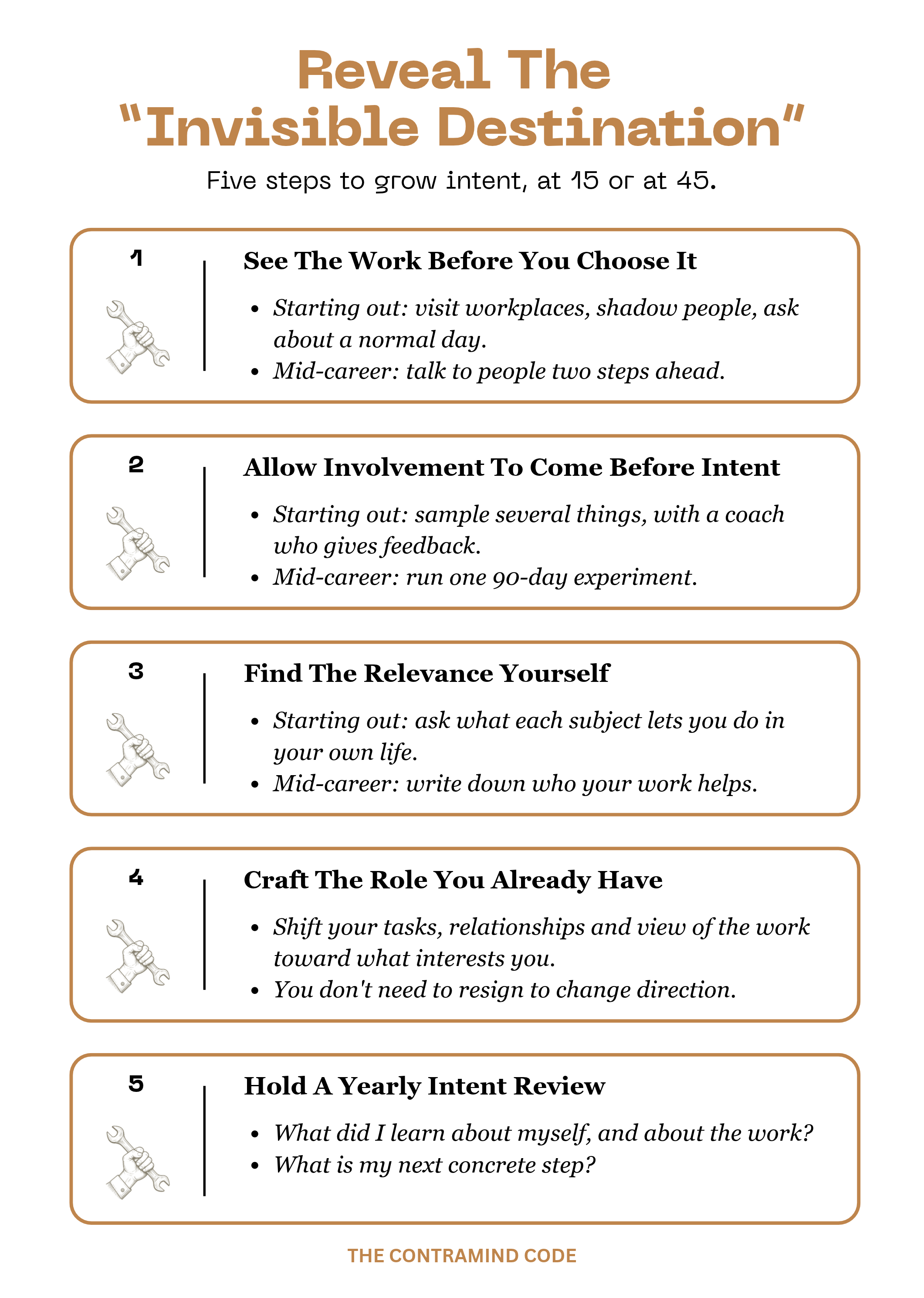
Whether you are starting out, parenting someone who is, or well into your career having put in a decade or two, here are five steps:
See the work before you choose it: If you are starting out, or wanting to change a job or do a start up, visit workplaces, shadow people, and ask them what a normal weekday looks like. If you are in the middle years of your career, have honest conversations with people two steps ahead of you in a direction you are curious about. You cannot aim to succeed at what you have never seen.
Allow involvement to come before intent: Students should sample several things, ideally with a teacher or a tutor who has a coach-like mindset who gives honest feedback. Professionals should elicit the help of a senior leader who has coach-like instincts and experience, pick one small experiment, such as a side project, a stint with another team within the company or a course with a real assignment, and give it ninety or hundred and eighty days. Carefully, notice what pulls you in.
Find the relevance yourself: For every subject or job or course that you do, ask what it lets you do in your own life. For every role, write down how and who your work actually helps. Purpose that serves people beyond yourself sustains the energy and effort through its dull or boring parts.
Craft the role you already have: You do not need to resign to change direction. Shift your tasks, sense the gap, your relationships and the way you see your work towards what interests you. Small changes keep adding up. Do them with involvement and intent, and learn to notice the connections between them.
Hold a yearly intent review: Once a year, ask these three questions:
What did I learn about myself?
What did I learn about the work?
What is my next concrete step?
A sense of ‘future self’ pulls you forward only when it is tied to a next step.
The hard truth is that nobody starts with a clear destination, not even the athlete or the musician. The difference is that some people get to see the work, take part in it, and grow into it. If your destination is invisible, stop waiting to find it. Get involved, and let intent grow from there. That is how you make ‘The Invisible Destination’ visible. This is the only way to turn the career that you did not choose into a career of your choice to succeed on your terms.