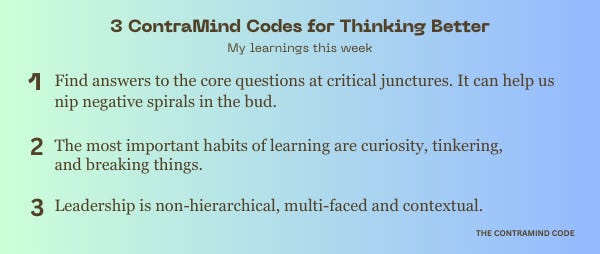
Introduction
The ContraMind Code is published by ContraMinds Labs, which runs a successful podcast that explores thoughts and conversations around the DNA of purposeful minds. It helps you explore and discover what it takes to achieve personal excellence and professional fulfilment. It tries to decode what really goes behind the minds of people with a purpose, what are their motivations and inspirations, and attempts to understand the why behind what they do and how they successfully accomplish what they set out to do. It helps provide a mental framework, markers and a mind map for each one of us to learn and discover from their life purpose, their cultural ecosystem and their experiences. These conversations and thoughts will hopefully open your mind and help you put some of these thoughts to practice both in your life and career.
Subscribe to get full access to the newsletter and visit our ContraMinds website, which has a treasure trove of podcasts from leading thinkers, successful entrepreneurs and practitioners.
Why We Spiral.
This is one of the 2025’s most-read articles of Behavioural Scientist.
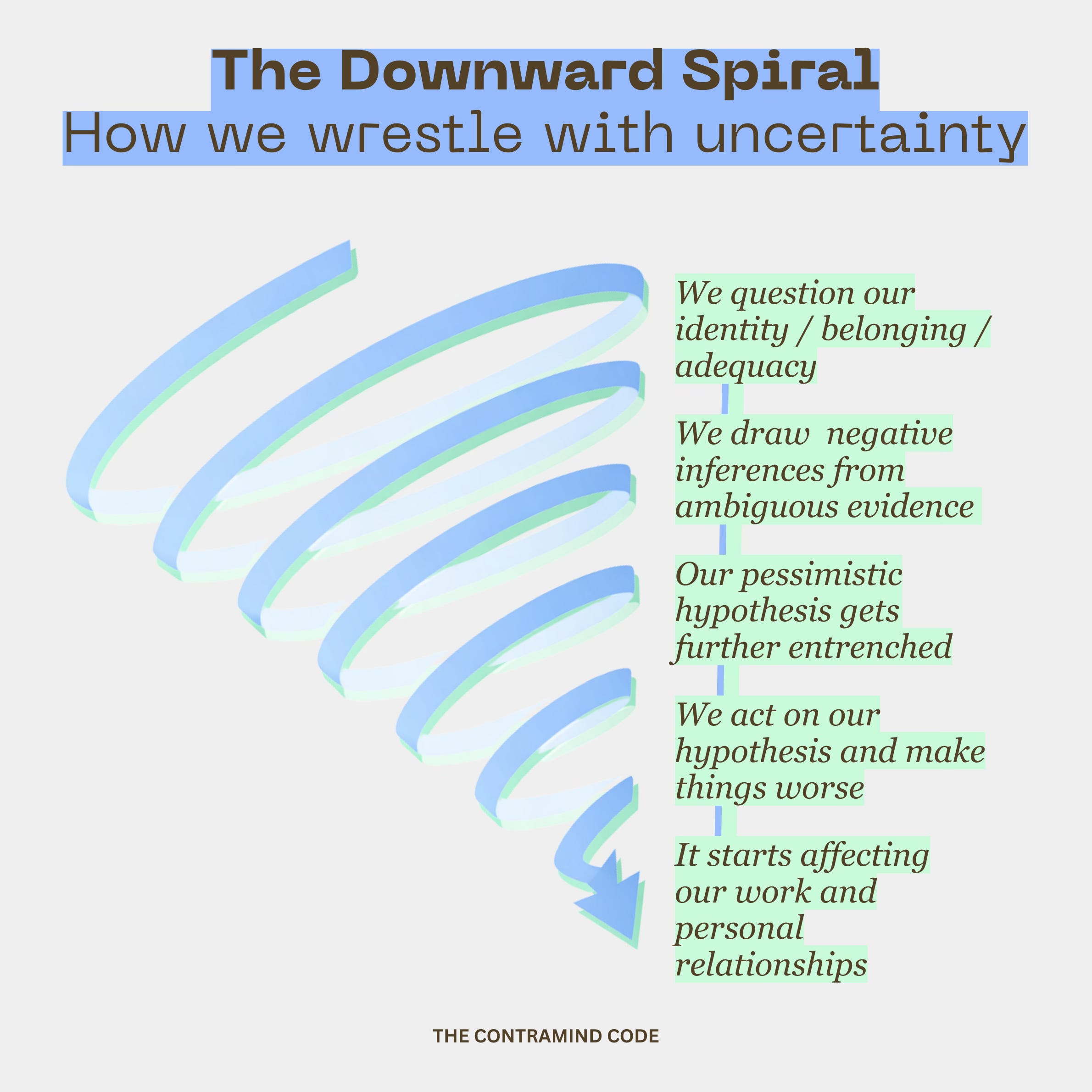
Written by Gregory M. Walton, he helps us understand how self-defeating spirals start and how they gather speed. He helps us understand the psychological processes and how we wrestle with uncertainty.
He writes:
“A circumstance places a big question on the table—about identity, belonging, or adequacy: You’re new at work. You want to succeed and belong, but you wonder . . . That question looms, latent and inactive, but present.”
“There are three key concepts at play: “core questions” (number 1), meaning making or “construal” (numbers 2 and 3), and “calcification” (number 4). Think of these as “the three Cs” of spirals—whether positive or negative.”
“By understanding the questions that come up at critical junctures, we can offer people better ways to think through challenges—ways that can help them spiral up, instead of down.”
Read the entire article here.
Curiosity, Chaos & Real Education.
In this powerful conversation, Prof. Jeevanjyoti Chakraborty of IIT Kharagpur breaks down something we all struggle with — how to really learn. Most of us study for exams, memorize formulas, follow structured notes… yet never develop the mental muscle of learning on our own.
Here are some key takeaways from the conversation:
Learning how to learn is more valuable than any degree — it builds self-sufficiency and lifelong adaptability.
Coaching-driven education creates students who know solutions but lack the ability to explore ambiguity or solve messy real-world problems.
Curiosity, tinkering and breaking things are essential habits that Indian students are discouraged from cultivating.
Interdisciplinary exploration (math → biology → mechanics) opens new mental models and stimulates deeper understanding.
India needs systemic change in school teaching, teacher training, continuous professional upskilling, and a culture that rewards learning over memorization.
You can listen to the entire episode on: Spotify | Amazon Music
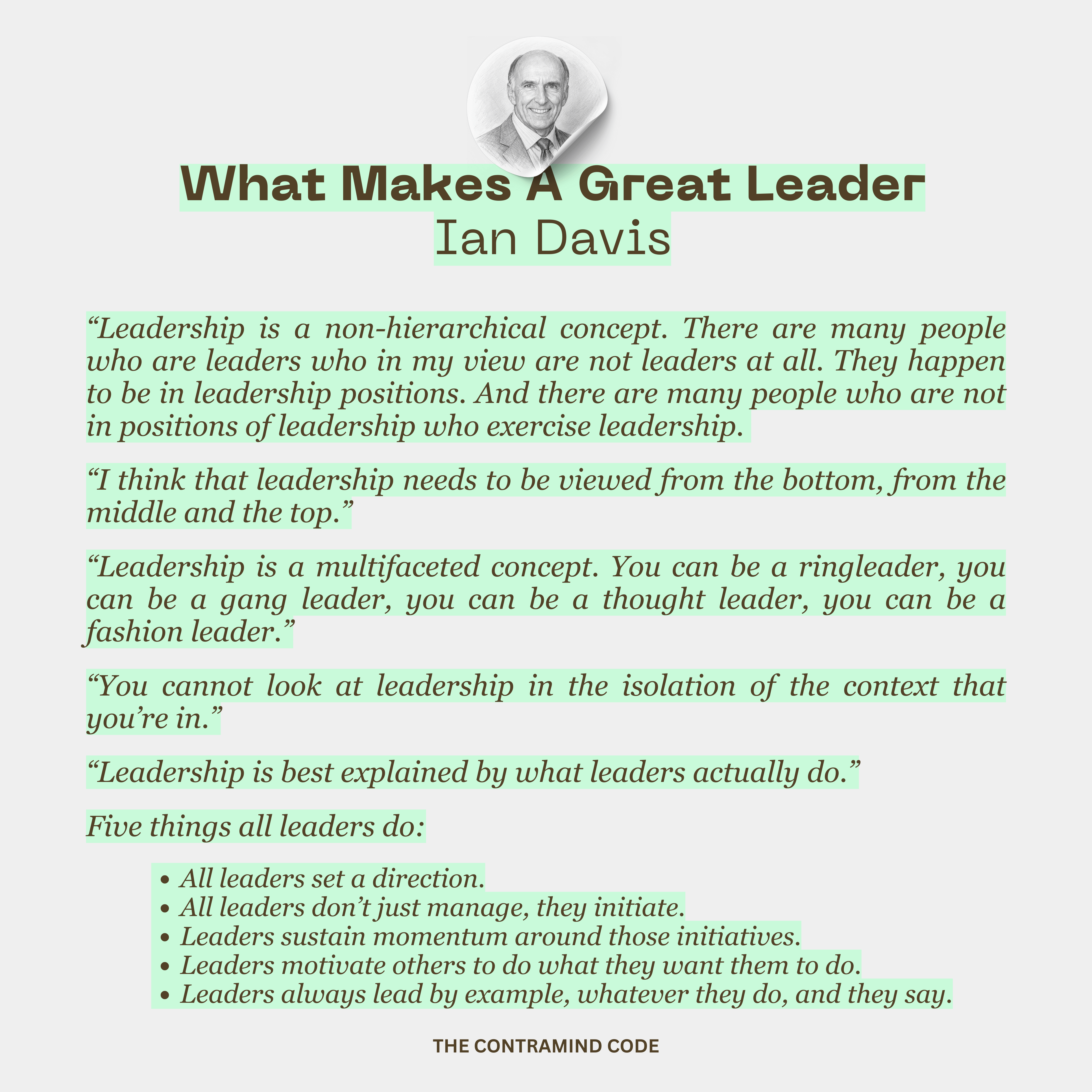
Ian Davis: View from the Top
Ian Davis, a former Managing Director and retired McKinsey senior partner, talks about what makes a great leader.
Here are some very powerful but simple ideas about leadership that Ian Davis has shared in his talk:
Leading Without Leading.
When people think and talk about leadership or successful leaders, it’s traditionally always viewed through a very narrow lens. It is always seen, by most people, through a lens of hierarchy - the position one holds, or displaying an aggressive attitude and high energy to achieve set objectives or goals, or showing an urgency and speed to move things, or driving people to get things done. Do these templates and beliefs hold true? We often don’t question or think deeply about the broad ‘brush strokes’ of characteristics painted about leaders or leadership. Most successful leaders, or leadership principles, begin when leaders lead without leading!
Do you need a position or designation to be a leader? The answer is a definite no. In whatever role or level you are in an organisation, if you don’t just ‘do’ things that you are asked to do but ‘initiate’ things, you start playing the role of a leader for that team or group. If you ‘motivate’ others in the team, you are already displaying leadership qualities. Therefore, leadership is non-hierarchical. The question is how many of us do it? With leadership comes accountability and responsibility. It requires ‘ownership’ of outcomes - success or failure, and that’s not something many have the maturity to handle personally. You need to build the muscle of high agency and the emotional maturity to handle these situations.
Do you expect others to do things when you don’t do them yourself? People are highly perceptive. You may not observe them closely, but others do. For example, if you expect others to come on time to the office or meetings, but you are constantly late, then people don’t take what you say seriously. If you don’t do or respond to things on time but expect your team members to be prompt in their responses, you can be sure it will never happen. They may not say it to your face, but their actions do. The best and most successful ‘do’ what they ‘expect’ from others.
Do you have the ability to lead from the front and behind? Most people and leaders think successful leadership is about leading from the front. When you look back in history and examples, the best leaders have the ability to lead from behind, too. They play the role of a ‘backroom boy’, guiding and closely mentoring the team members for their success. They diligently go through their plans, intervene and course-correct when needed, give others the credit, but stay behind the scenes because they understand the ‘mission’ is more important than the person. They silently build leadership capacity and are conscious not to leave a ‘vacuum’ when it’s time for them to leave.
Can you ‘communicate silently’? The best leaders often are not loud communicators. They communicate and inspire when there is a need or a crisis. However, they have this incredible ability to communicate silently. It’s the ‘small acts’ of communication that have the maximum impact. It may be ‘talking’ to a younger colleague in a lift, ‘enquiring’ about the health of a family member, ‘quick chat’ when they pass by a colleague’s workstation, ‘listening’ to a problem from a customer, etc. These ‘small acts’ make a big difference to people, and they act as motivators to ‘commit’ to the mission or cause.
Can you ‘sustain’ the pace as much as ‘setting’ the pace? There is a lot of attention and hype about successful leaders’ ability to set the pace. But ‘sustaining’ the pace is far harder than ‘setting’ the pace. Think a little more about it. Sustaining the pace requires the everyday discipline and tenacity to get up and do it, regardless of what happened the previous day. Sustaining the momentum requires incredible patience and humility to align people, process, and systems that cannot be fixed overnight. It requires daily influence, nudging and pushing the entire ecosystem, which can drain your energy as a leader. Transformation or change happens over months and not in one day. You need the ability to be humble and change gears when needed. This will require situations where you need to lead and also be willing to be led by others. Great leaders are ‘marathoners’, not ‘sprinters’.
Ask yourself one question: ‘How good am I at leading without leading?’