
Try thinking about two of your colleagues. One is always the last to leave. The light by her desk is on at nine, and her status is green at midnight. The other leaves at six, but when something goes wrong with the client, a key customer for the company, everyone knows whose phone to ring because she is the one who understands the whole account. The key question to ask is: “Who owns the work?”
Most of us know the answer. Yet most workplaces still reward the first colleague.
And the arguments continue about how to fix this, and they keep reaching for the same three levers.
‘Working longer works’, say some leaders, stretching themselves toward a Big, Audacious, Hairy Goal (BHAG) and their teams to near 70-hour weeks.
‘Work less’, says the four-day-week movement.
‘Find Your Calling’, says everyone who tells you to follow your passion.
This essay seeks to answer this plain but simple question about each lever: which of them works?
‘Owned Hours' versus ‘Shown Hours’
The funny thing about work that you do is that it’s mostly invisible!
Nobody can see you understanding a problem deeply, noticing a risk early, or sensing your ownership of a decision you have taken, which you will answer for. However, organisations look for something they can see. For a long time, this was the hours people clocked. Companies began judging commitment by the signals people could see, rather than the work itself. Increasingly, people displayed more of this with enthusiasm!
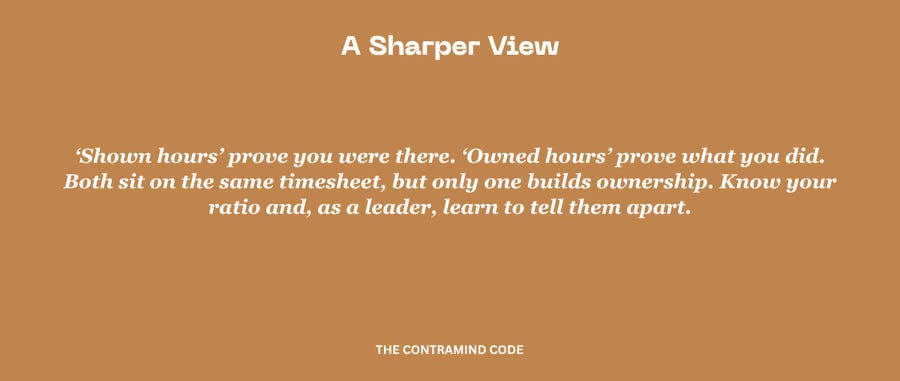
The brutal truth is, there are two kinds of time. 'Shown hours' are the hours spent being seen in meetings, being seen coordinating, staying late, keeping the work status light green, etc. 'Owned hours' are the hours spent deep in one piece of work that you think about, control, and know well. Both appear on the same timesheet. Only one of them builds ownership and drives outcomes. The question worth asking yourself is what’s your ratio of ‘Shown Hours’ versus ‘Owned Hours’. Also, as you grow into a leadership role, your ability to assess this correctly becomes key when people come to you with the work they have done.
Does working long hours work?
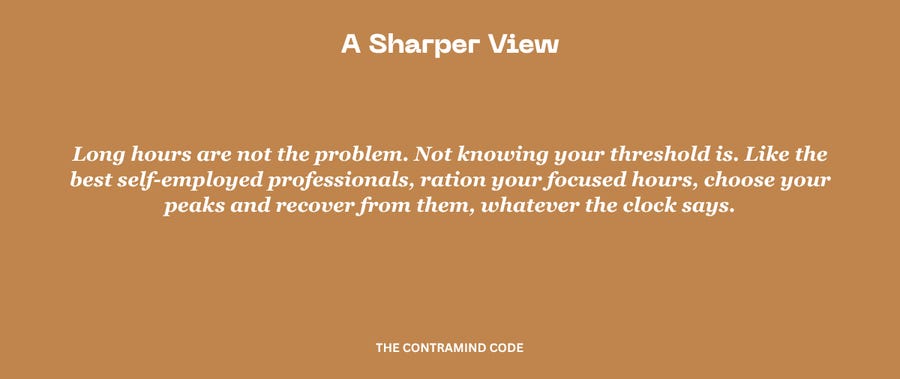
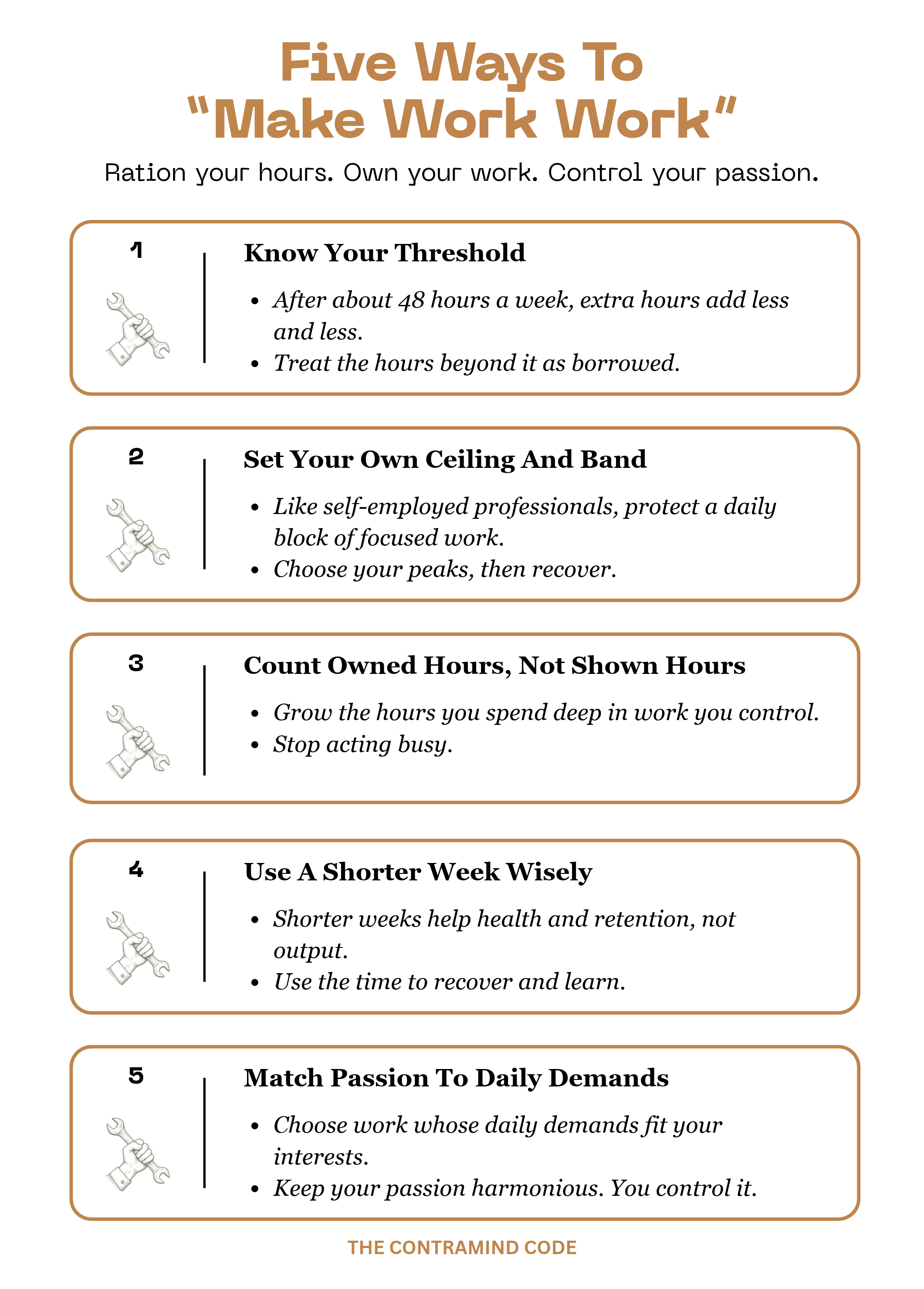
Working long hours is not the problem. But knowing the threshold seems to be vital. Research has also found that output starts declining when work extends beyond a threshold. Beyond about 48 hours a week, each extra hour adds less and less. Beyond about 56 hours, extra hours add almost nothing. What seems to work in workplaces with significantly longer working hours is that long hours go hand in hand with flexi-time. Workplaces that combine long hours with flexitime see less of the productivity loss.
Many professionals, especially the self-employed (musicians, sportsmen, partners, freelancers, architects, designers, businessmen and the like), have no cap on how long they can work. They don’t have an HR department looking over their shoulder or to complain, or a boss to help them regulate their working hours. It’s their prerogative. It seems such expert performers have a self-imposed version of ‘a fixed ceiling and a flexible band’ of working hours. They seem to have a short daily block of protected, focused work, give themselves time for deliberate recovery, choose the peaks, and then recover from them. Total hours can be long, but the focused, ‘owned hours’ are bounded.
Therefore, the answer seems to be not just long hours, but knowing how to ration your work hours. Honestly, nobody in the organisation cares about this, as it is a difficult fix. Companies only give you a broad-brush stroke of work timings. To be an elite performer, you have to behave like a self-employed professional with ‘your own fixed ceiling and a flexible band’.
Do shorter weeks improve productivity?
Research has not shown that they reliably do.
Wen Fan and Juliet Schor, leading sociologists from Boston College, studied 4-day workweeks and found that well-being indicators like burnout decreased, and other factors like job satisfaction and health improved. But what they measured was well-being, not output. In another study in Germany, they found that shorter weeks improved revenue and profit only slightly compared to the year before, but not by a meaningful margin. In France, a 35-hour work week created more jobs, but productivity fell in select groups of firms. Other studies find people get more done per hour, but not more overall.
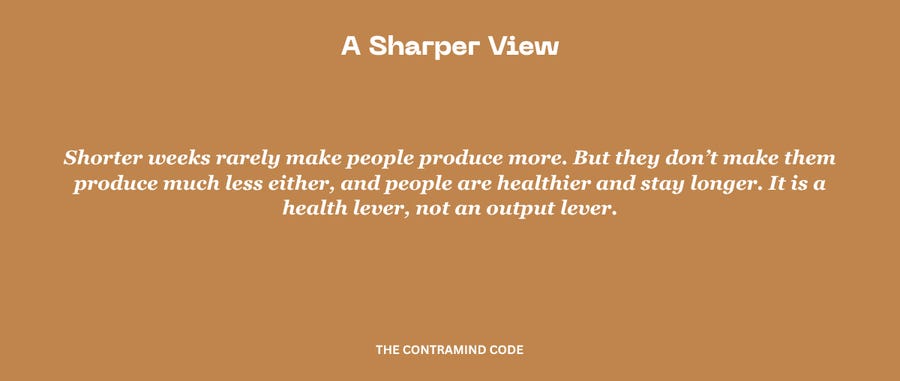
To summarise, shorter weeks don’t make people produce more. But they don’t make them produce much less either, and the bigger benefit is that people are healthier and stay in the job longer.
So if you believe a shorter work week can help you perform better, the limited data show it doesn't pass the productivity test, yet.
Is having more passion at work enough?
If longer hours or shorter weeks have limitations, then passion is an alternative lever to consider to make work work.
The argument that when you are passionate about the work you do, it doesn't matter whether work is longer hours or shorter weeks surely carries a lot of weight and credibility. Therefore, the solution is to find a job and work you like, and the rest will take care of itself. Ironically, research says this is only half right!
Christopher Nye, a professor at Michigan State University, offers an interesting perspective where he finds that having high enthusiasm or general interest in a field is only half the equation. According to him, “True performance gains come from aligning your specific profile of preferences with the actual daily demands of your work environment.” Most people fail to appreciate or understand the reality of that field's ‘daily demands’ and end up being unhappy or unable to cope, and end up with anxiety and burnout.
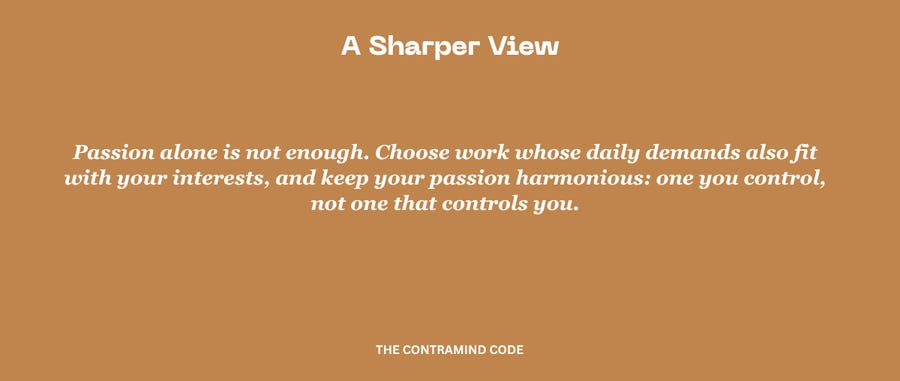
In fact, Dr. Robert Vallerand goes one step further. Dr. Robert J. Vallerand, Professor of Psychology at the University of Quebec Montreal, separates passion into two types ‘obsessive passion’ and ‘harmonious passion’. Dr Vallerand describes ‘obsessive passion’ as one that controls you, while ‘harmonious passion’ is one that you control!
Here’s an example of ‘obsessive passion’. Picture a consultant who loves his work, but his sense of worth rests on it. He is also extremely anxious about his ‘shown hours’. He keeps checking email at midnight, can’t stop thinking about a client presentation at his daughter’s performance, and feels guilty on holiday. His output looks impressive for a few years. Then he suddenly starts making mistakes because of fatigue, a health scare, and strain at home. He was working longer, but not better.
Here’s an example of ‘harmonious passion’. Now picture a software architect who also loves her craft. But she protects her ‘owned hours’ each day, stops at a fixed time, and sets aside time for family and running. When her project fails or is delayed, she’s disappointed, but she still sleeps well. She finds a way to keep improving for 20 years without burning out.
Passion without understanding the ‘daily demands’ of the field or a new role you are getting into, and developing a sense of ‘harmonious passion ’, is key to making things work.
So what does it take to make work work?
It’s neither the clock, in either direction, nor the passion on its own.
The professionals who do their best work over decades behave as if nobody has set the limits for them. They are not influenced by the chatter or the rules in their employment contract. They know where their hours stop giving them the returns. They protect a few focused hours each, choose when to sprint, and when to recover and look for work whose daily demands, not just its idea, fit with what they love. Longer hours, shorter weeks and passion are all levers. The skill is knowing which one to pull and when.
So each week, ask yourself three questions to make work work.
What is my ratio of ‘shown hours’ to ‘owned hours’? Do I know my threshold, the point where more hours stop working? And is my passion still harmonious, or has it crossed the line into obsession?