Introduction
Welcome to The ContraMind Code.
The ContraMind Code provides you with a system of principles, signals, and ideas to aid you in your pursuit of excellence.
The newsletter shares the source code through quick snapshots for a systems thinking approach to be the best in what you do.
The Code helps you reboot and reimagine your thinking by learning from the best, and enables you to draw a blueprint on what it takes to get extraordinary things done. Please share your valuable thoughts and comments, and start a conversation here.
Take a journey to www.contraminds.com. Listen and watch some great minds talking to us about their journey of discovery of what went into making them craftsmen of their profession to drive peak performance.
When You Have To Execute A Strategy You Disagree With.
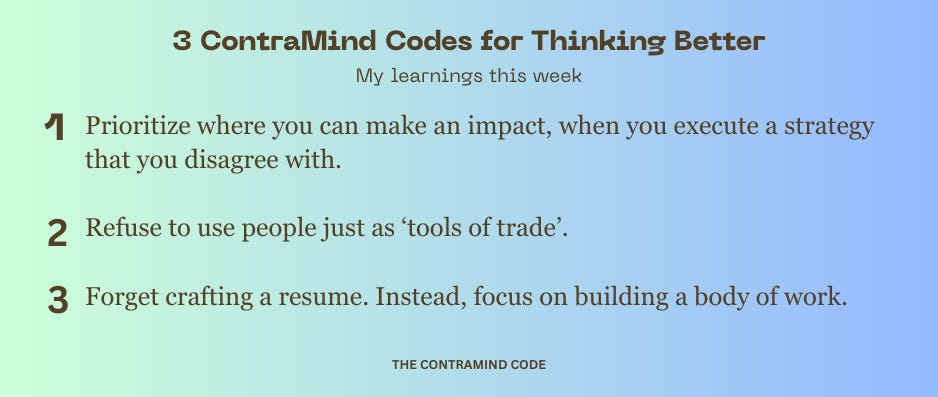
This is a situation that many of you at the workplace struggle with. You have a different perspective or limited view of why the strategy was adopted and is being executed. Sometimes, senior management fails to communicate the strategy, or may be limited in their power to do so. So, how do you execute a strategy that you have been asked to implement while upholding your principles? This HBR article outlines how to do it very well:
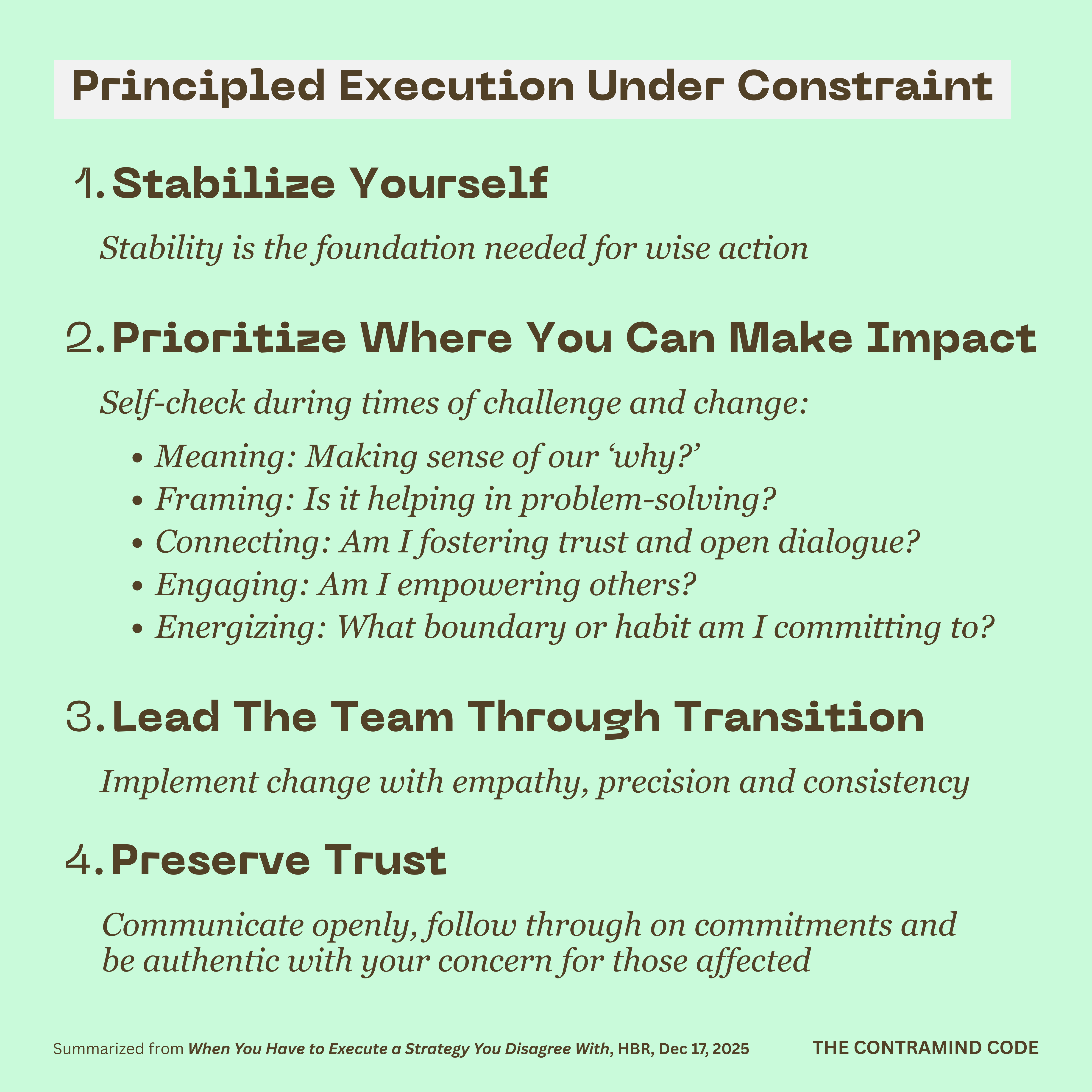
Read the entire article here.
How To Unlock Your Team’s Creative Potential.
In this episode, Reid Hoffman, who is the host of Masters of Scale, does a brilliant analysis of Indra Nooyi’s conversation with him, specifically around how it is crucial not only to attract talent, but why it is essential for leaders to back them, create an environment for them to thrive, and find new ways to connect with them( in her case, she reached out personally with a letter to over 400 employees’ parents and met parents of over 40 of her direct reports!) and not just use them as ‘tools of trade’ as she calls it. She also discusses how such a culture of talent can unleash innovation within a company.
You can also listen to this episode on: Spotify | Amazon Music
40 Harsh Truths I Wish I Knew In My 20s.
Dan Pink, a well-known author and speaker, does a great job of sharing what he wished he had known in his 20s. While all of them are valuable, here are the top 5 from the list:
1. Don’t craft a resume, build a body of work.
2. Protect your reputation - it takes years to build one and is one of your most important and fragile assets.
3. Consistency beats intensity.
4. Mediocrity is the real threat.
5. Curiosity beats certainty.
You can click on the above link to watch the video.
On Talent, Operating-fit & Growth
It’s not uncommon for us to hear, during hiring discussions in companies or when HR teams or senior leaders are looking to fill new positions or vacancies, that they're seeking top-notch talent.
The first question you may want to ask yourself is, ‘What is the right definition of talent?’ Is it the credible references they come with or the pedigree of their education, grades, the rich experience they have, blue-chip companies that they have already worked for, their past performance or achievements, etc?
The answer is - it depends and is relative. This is because a top talent in a large enterprise may be a poor fit for a startup. Or, if you are looking for someone in a company that’s operating in an industry-transforming category, while role-specific competence is the baseline, the learning agility of the individual becomes more critical, as skills decay faster than roles. Because roles evolve, change, and disappear within such companies, learning velocity and behaviour agility become important when defining what top-notch talent means to them.
Therefore, talent is more than just having baseline competence along with role or job-specific execution skills. An additional layer of context, and character must be added.
‘An acceptable talent is someone who performs well within the system, a good talent is someone who improves the system that already exists within a company, department or function, and an extraordinary talent is someone who forces a new one into existence.’
Three fundamental qualities are key:
Can the person do the work? - This is baseline competence & capability.
Can the person grow with the work? - Transfer skills, handle ambiguity & change.
Can the person be trusted to deliver? - Consistency, Ownership, Accountability.
Most people plateau at three different levels:
Level 1: Can only ‘do the work’ and ‘be trusted to deliver’
Level 2: Can ‘do the work’ and ‘grow with the work’ but lower levels of ‘trust to deliver’
Level 3: Can ‘do the work’ + ‘grow with the work’ + ‘trusted to deliver’
An acceptable talent tends to plateau at Level 1, a good talent plateaus at Level 2, and an extraordinary talent has or can move or grow into Level 3.
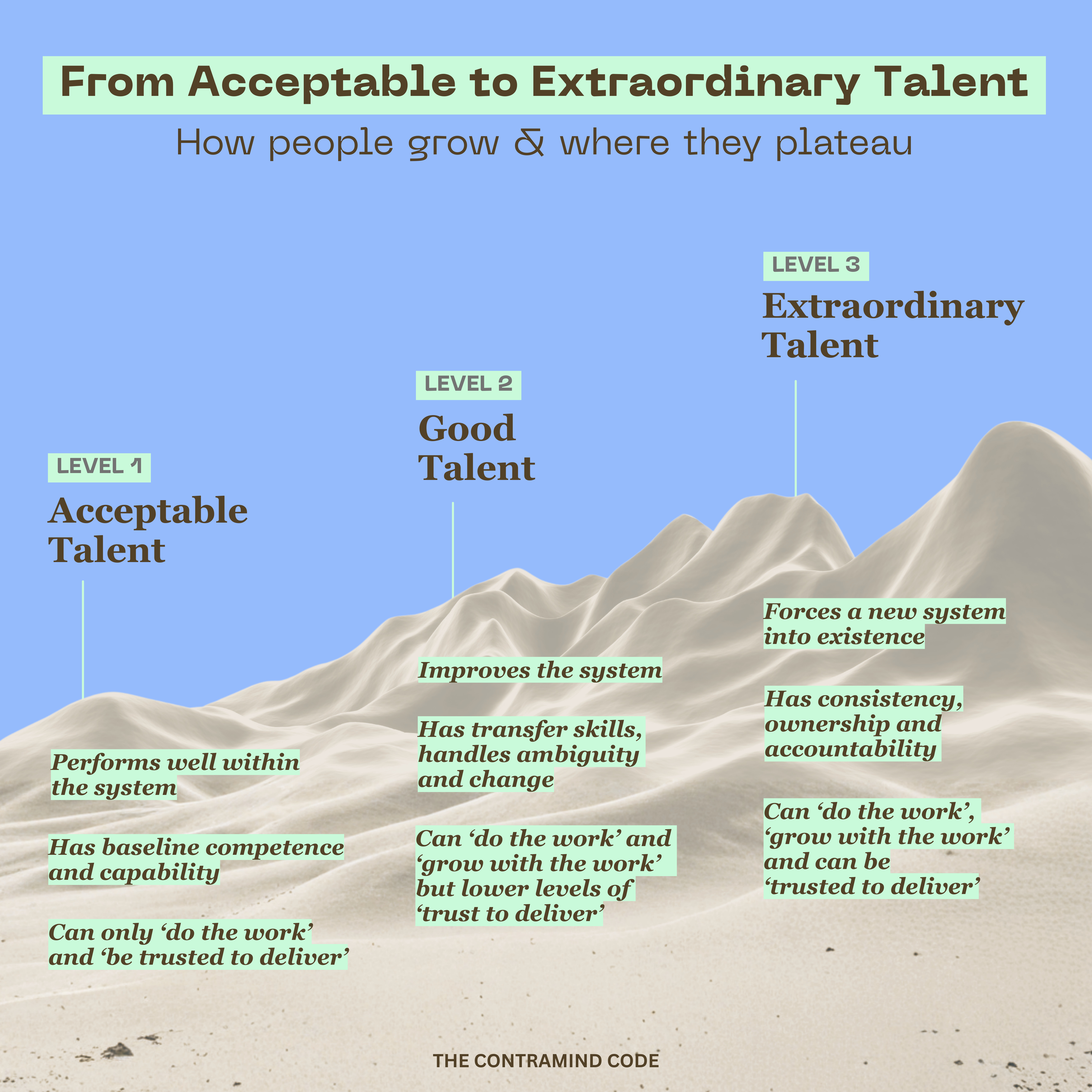
Acceptable talent thrives within well-defined ecosystems, good talent tends to thrive in adaptive ecosystems, and extraordinary talent thrives in breakthrough-minded cultures, category creation, and technology inflection point company ecosystems.
Finding the ideal talent -to-‘operating-fit’ imperative.
Large, established or mature companies tend to mostly settle for Level 1 talent. If they do end up hiring Level 2 or Level 3 talent, then the challenge of managing and providing an environment for such talent to thrive becomes a challenge for them. It’s the role of the senior leaders in the company to create a good enough playground and opportunity for them to be challenged. Level 3 talent needs open, high-trust, high-autonomy ecosystems and culture.
When large or mature companies pursue strategic transformation or acquire startups or young growth firms, Level 2 leaders can play a significant role in the integration, if they are supported by a set of Level 1 leaders within the established large organisation.
For a startup or a high-growth company, if you are not a Level 3 talent or are not motivated or driven to be a Level 3 talent, then you will not be comfortable or enjoy anything you do there, even if you perfectly fit the role and have the experience.
Your ambition defines your ‘operating-fit’ and growth opportunities.
If you are satisfied being a Level 1 talent, you can be ‘individually brilliant’, restrict yourself to what fits your role and execute well. You get comfortable operating within a boundary.
However, if you choose to be Level 2 talent, you need to be not only ‘individually brilliant’, but you also need to be adaptive, elevate others’ performance, learn to take measured risks, and improve existing systems.
If you want to aspire to be a Level 3 talent, then you need to be not only ‘individually brilliant’, but also to perform and deliver, you have to be a talent magnet, influence others, collaborate across disciplines where you can learn from, and be willing to experiment, fail and learn. You have to redefine expectations, discover new problems and alter the playground.
For talent to thrive and grow, if the company stage, or type and operating-fit, don’t align, an individual’s growth and probability of success get severely hampered. For an individual, your willingness to continuously develop and work on your skills, your ability to find the right company fit, and your ambition define your growth.