Introduction
Welcome to The ContraMind Code.
The ContraMind Code provides you with a system of principles, signals, and ideas to aid you in your pursuit of excellence. The newsletter shares the source code through quick snapshots for a systems thinking approach to be the best in what you do. The ContraMind Code helps you reboot and reimagine your thinking by learning from the best, and enables you to draw a blueprint on what it takes to get extraordinary things done. Please share your valuable thoughts and comments, and start a conversation here.
Take a journey to www.contraminds.com. Listen and watch some great minds talk to us about their journey of discovery of what went into making them craftsmen of their profession to drive peak performance.
The Changing Role Of The CMO—And What It Means For Growth.
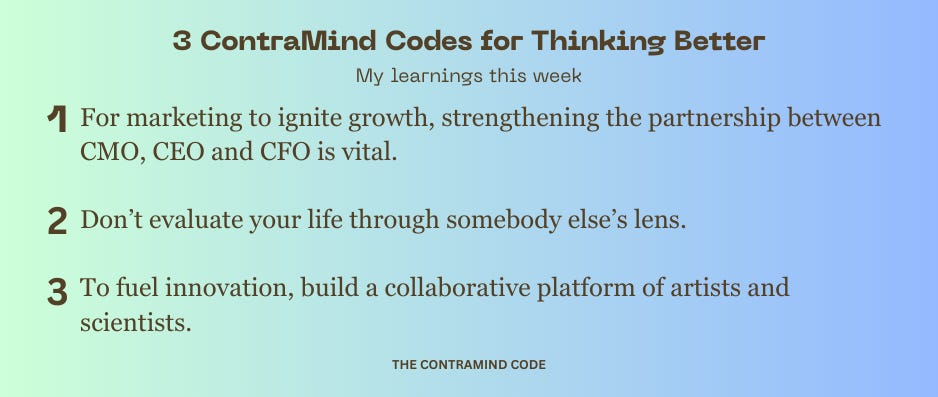
This McKinsey podcast highlights key findings from their research on the importance of strengthening the partnership between the CMO, the CEO and the CFO and how it this can help reignite growth.
Here are some key highlights:
“When marketing leaders are embedded in strategic decision-making and take responsibility for a customer-centric growth strategy, companies perform better.”
CMOs must find a way to develop a measurement framework, think about an allocation approach to the spending, and develop a cadence for an ongoing dialogue with their CFO and the broader leadership team.
“It’s very important for marketers to show up every morning thinking: What can I do to drive the business forward today? I don’t think marketers or marketing managers or creative directors are often asked that question.”
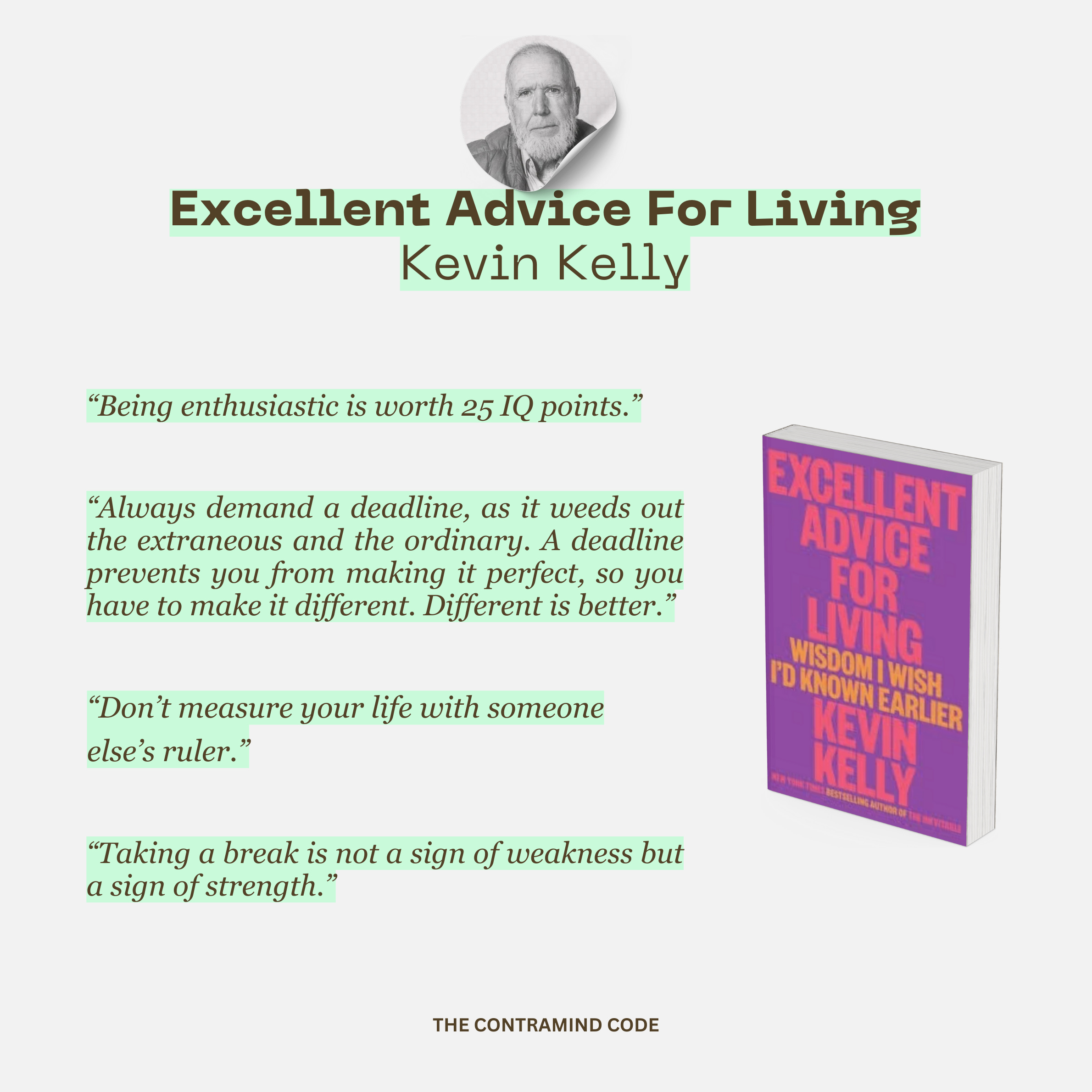
Excellent Advice For Living.
This episode of the Founders podcast showcases Kevin Kelly’s book Excellent Advice for Living, where he writes down for his young children some things he had learned about life that he wished he had known earlier. This was on his 68th birthday, and to his surprise, Kelly had more to say than he thought, adding to the advice over the years and compiling a lifetime of wisdom into these pages.
There is a heap of great thoughts and advice here that comes out of the life experiences of Kevin Kelly, and here are some that can motivate you to listen to this episode.
When Artists and Scientists Talk | World Economic Forum Annual Meeting 2026
This is one of the most refreshing conversations you must watch, especially if you are from India, where education is highly skewed toward technical and math skills. A whole generation of people who are ‘artistically numb’ is something that’s not good for pure science! The importance of art skills and how they help people improve their research and scientific work is clearly demonstrated in this conversation. Building a collaborative platform for artists and scientists can spark new insights and life skills which are vital to fuel innovation.
The conversation features Thijs Biersteker, Fabiola Gianotti, Priyamvada Natarajan, Nomzamo Mbatha, and Caroline Lustenberger as panel speakers.
Here are some interesting thoughts that were shared during this conversation:
“Fundamentally, as humans, we are wired to respond to storytelling.”
“Facts don't move people, emotions do.”
“There are very, very strong relations, as we know, between the arts
and science.”
“Emotion is the fuel of intuition.”
“Einstein famously said imagination is more important than knowledge, and imagination is very much close to our emotional sphere.”
You can click on the above link and watch the video
Overcoming Artistic Numbness In The Age Of AI.
You live in interesting times now. You were always told that, to be better or do well at work, you must be more logical and analytical. Hence, all your tests and assessments, from school through your first job and beyond, tested your logical, numerical, and analytical skills. You have consistently prepared for these and focused on being among the top percentile of people who can crack them.
However, AI is getting better at logic. It also enables faster analysis and insight preparation, and does so more cost-effectively than others. However, AI still cannot feel the wonder of things, express a feeling of surprise, or act with greater meaning, intuition and passion. There is no feeling of happiness or sadness with AI, which is core to driving emotion, loyalty and commitment. The successful professionals and leaders of the future will have to transform themselves into curators of meaning and feelings, rather than remaining merely managers of numbers or performance.
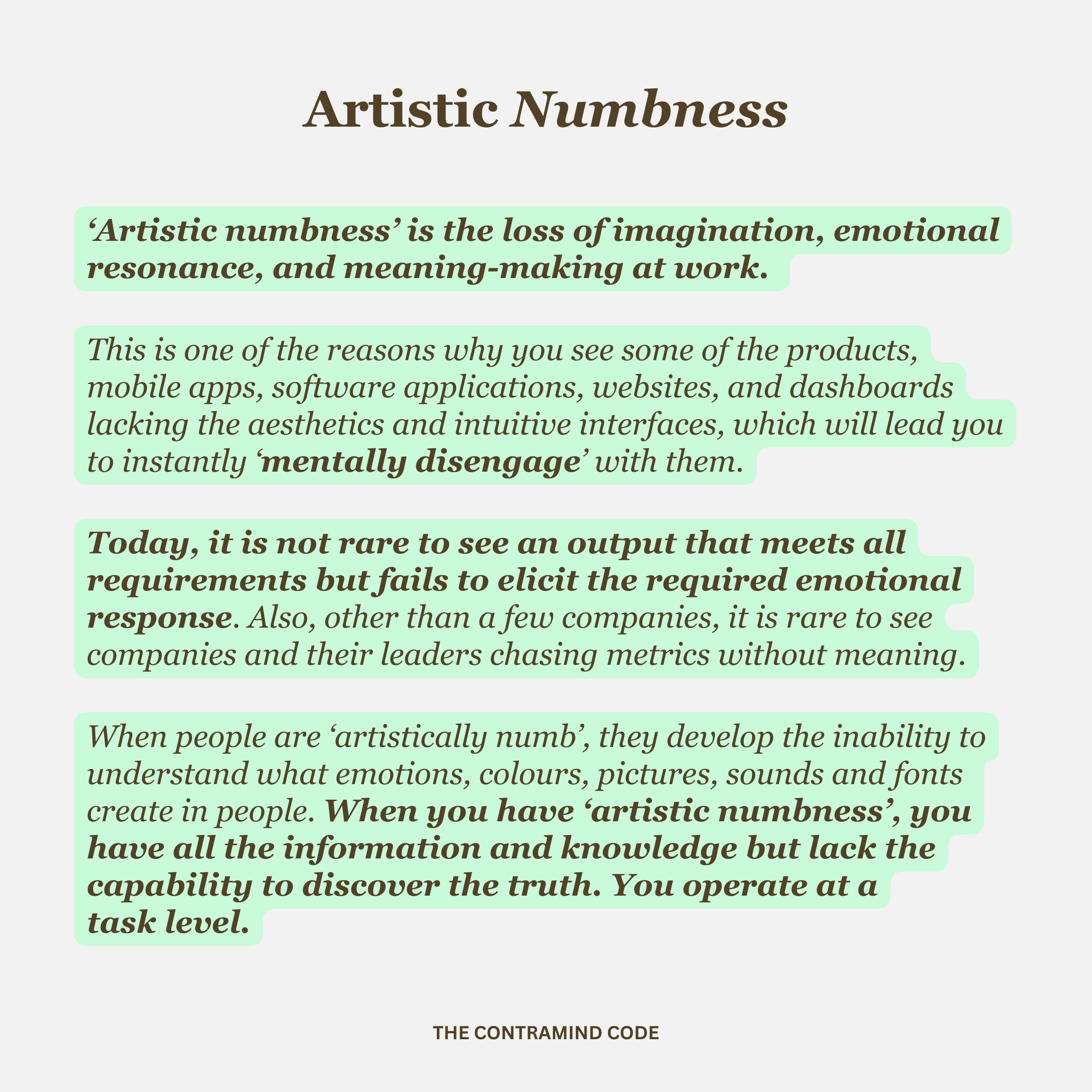
How can you overcome artistic numbness?
Reducing artistic numbness starts with ‘re-humanizing’ what you do.
Move from “What’s the KPI?” to “What moved me?” thinking.
A design that made you ‘feel’ good.
A painting or a presentation template that caught your ‘attention.’
A song and lyric that you ‘connected’ with.
Get comfortable with imperfect and unfinished expressions.
“I am not sure if this works, let’s figure out”
“What if we think this way?”
“This is incomplete, just wanted your early thoughts about this.”
Express your feedback and thoughts from a first-person point of view.
“What the data suggests” to “I sense the numbers tell this”
“I am wondering what we must do to counter that price?”
“I’m keen to explore this a little further.”
Empower and convert people from being ‘instruments’ to ‘creators’ of work.
When you start practising ways to overcome artistic numbness, you begin to value cross-domain analogies, find solutions through visual imagination, and develop strategies using metaphors. You become comfortable taking imaginative leaps, don’t fear speculative ideas, and are willing to make decisions by staying outside consensus-driven decisions.
If you want to break away from ‘artistic numbness’, learn to collaborate with experts outside your domain or industry, absorb and accept contrarian thoughts, begin to observe and notice deeply, and build the capability to express and stay with your ideas.