
Idea Starters For The Week

Rajendran Dandpani on the importance of practical, hands-on learning over traditional academic metrics.
Encourage students to pursue their interests actively rather than passively receiving information.
Why cultivating real-world skills is vital.
Find one’s true calling, rather than merely chasing jobs.
»YouTube | Apple Podcasts | Spotify | Amazon Music
Revisiting first principles from past editions
Think Of Work Like A Sport
When we look at sports, there are some great lessons we can take to our business, profession, and workplace.
We should learn to compete with ourselves.
Build better mental skills to handle risks and setbacks.
Become the “CEO of Your Own Performance.
Explore more here.
The ContraMind Code Thought For The Week
Patience Is Not Absence Of Ambition
Patience is the most misunderstood trait or skill.
In the workplace, patience is sometimes seen as a sign of weakness, as it makes a person seem outwardly non-aggressive and slow to make decisions. Often, such people are seen as soft, tentative, or lacking the drive or energy to move fast and decisively.
What is patience? Is it a trait or a skill?
Patience is the capability of sustaining purposeful action toward a long-horizon outcome while remaining fully in control and also aware of the short-horizon environment around that is not yet rewarding the direction one seeks.
Patience is both a personality trait and a learnt skill. Patience is partly a temperament, a raw, biologically based, individual-specific emotional baseline on how they react or respond to anything, and partly a practised skill, built through deliberate effort and training.
The Emotion of Impatience
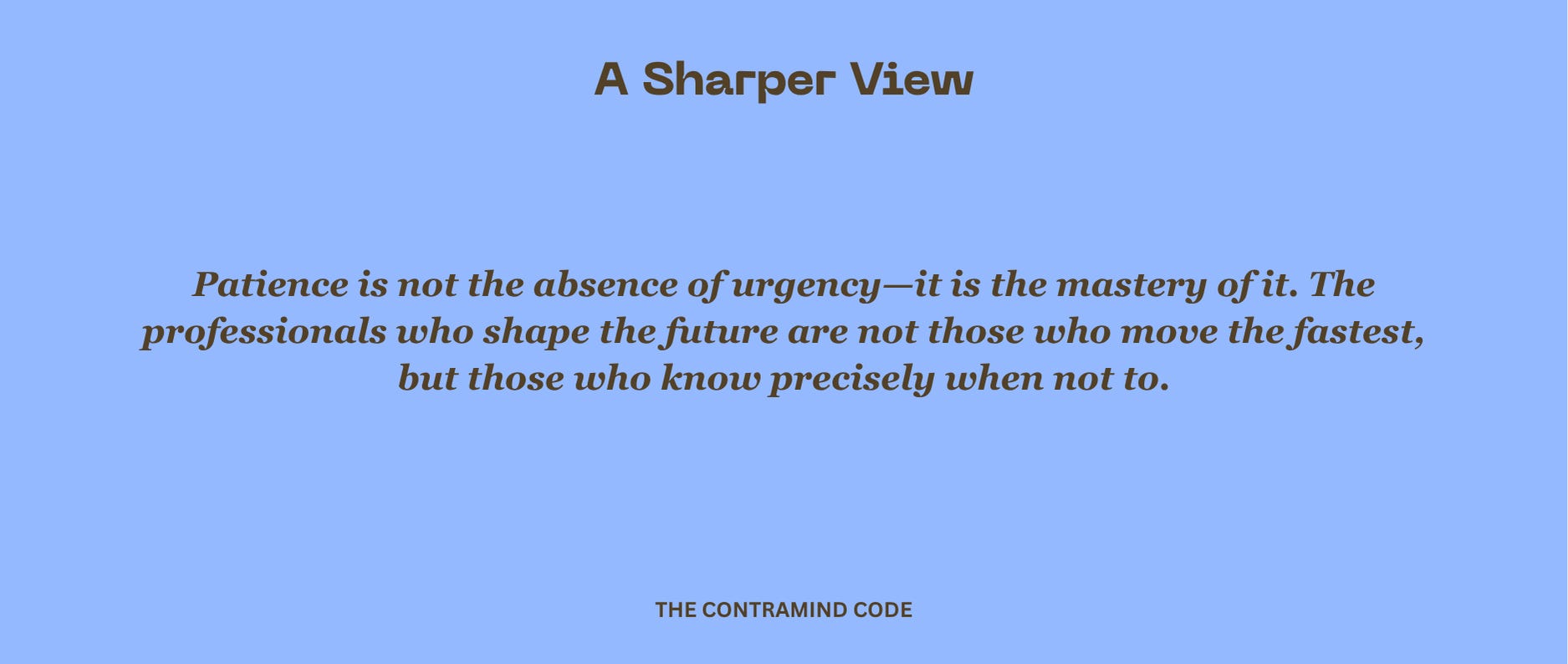
According to Kate Sweeny, Professor of Psychology at the University of California, Riverside, in one of the most recent research findings on patience, concluded that “Impatience is the emotion — triggered when we face unwanted delays. Patience is not a trait that some people have, and others lack. It is the name given to the self-regulation tools applied to cope with the emotion of impatience.” What does this mean in the real world? This means that emotion regulation is a skill, and you can train yourself to become more patient.
What does impatience do?
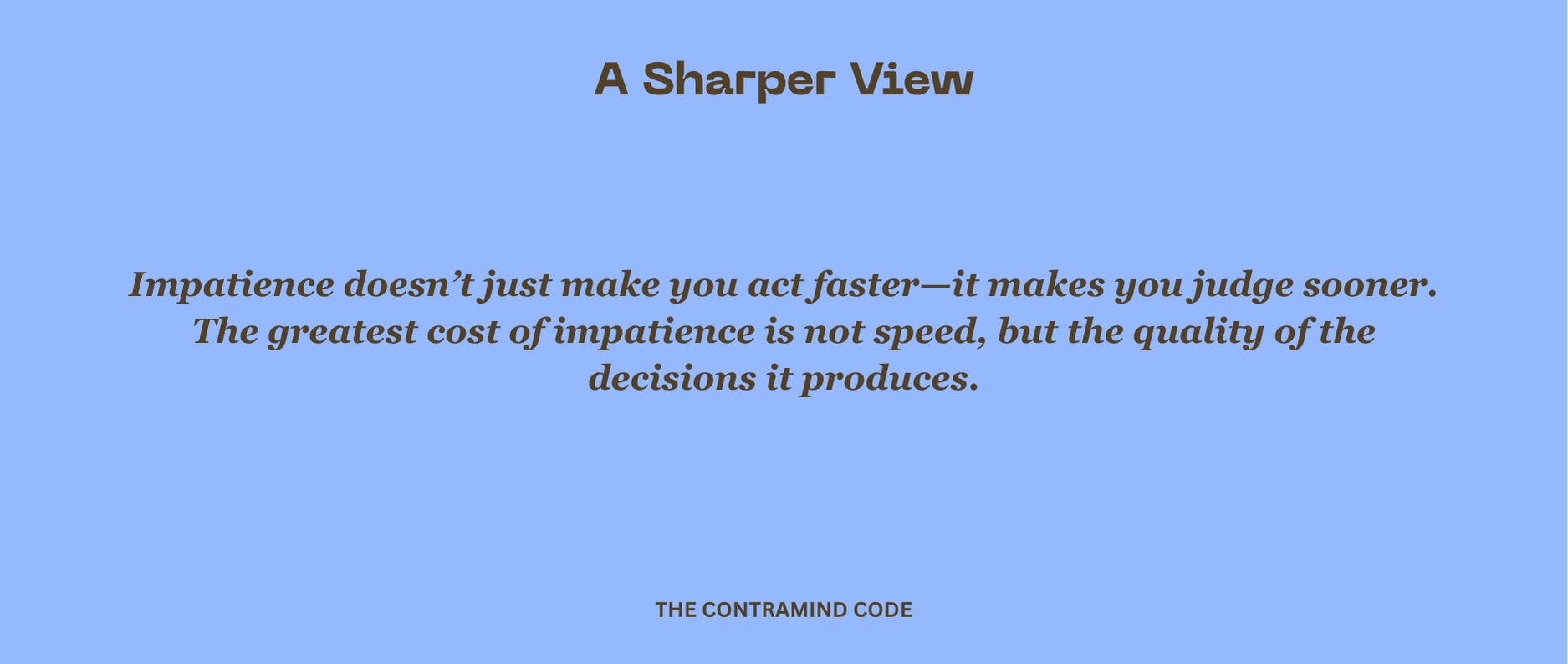
Impatience destroys your professional life. It forces you to jump to wrong assumptions. It damages the quality of your subsequent decisions. Therefore, you increasingly react to surface signals rather than to real information.
The well-known Stoic philosopher Seneca offers a brilliant analogy to bring this behaviour to life. His analogy of a ‘court of law’ and a ‘mob’ illustrates the true value of reason when one practices patience. Seneca writes, “Reason behaves like a judge. It grants a hearing to both sides, it seeks to postpone its own decision until it has adequate evidence, it aims for a conclusion that is actually just.” However, a mob “refuses to hear evidence, it loves its error and clings to it, it will condemn the accused because it dislikes the advocate.”
So, impatient professionals get sucked in, driven by whatever the environment sends as signals, and become reactive rather than responsive. On the other hand, patient professionals don’t get pulled in but can stay outside the problem or decision they want to make. It’s not because they want to be indecisive, but because they understand the need to control the timing or judgment in any given situation before making decisions.
Therefore, every significant decision you make—whether it's a talent call, a product decision, a strategic pivot for your business, your response to a market signal, or even a mundane incident like a challenge from a peer—is either a court proceeding or a mob verdict. If you are a professional who has built patience as a practice, you will default to how a court behaves. However, if you are a professional who responds urgently to everything that comes to your table, you will default to mob behaviour.
But does patience produce success in real life?
Here are professionals who have demonstrated the value of patience in both global and APAC contexts.
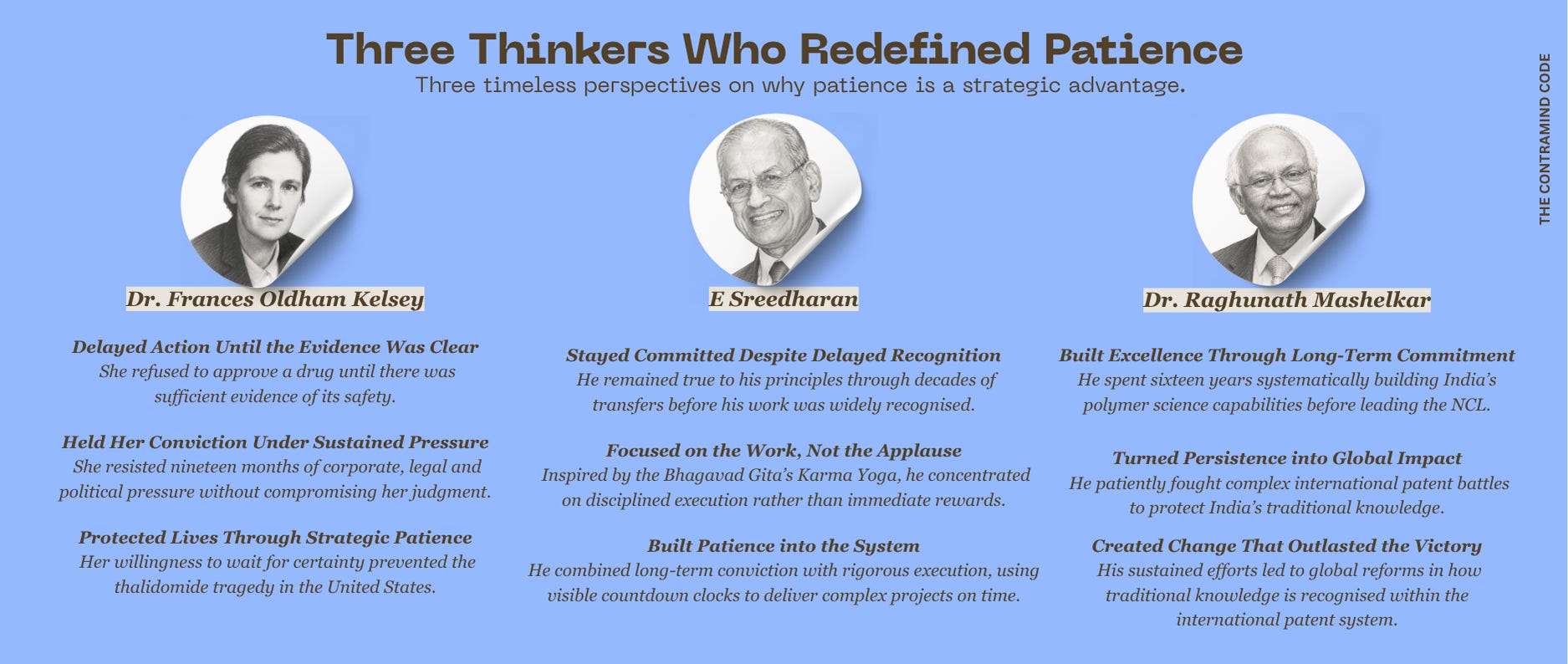
The story of Dr Frances Oldham Kelsey, a leading pharmacologist and physician who had a 45-year career with the U.S FDA, is simply inspiring. It is a masterclass in practising patience in the face of extreme professional pressure and the potential damage to her professional reputation. It’s the case of thalidomide, a drug application that reached her desk. Under U.S. law, the FDA had just 60 days to reject a drug application. Any failure by the FDA to act meant automatic approval. The interesting point that Kelsey found in the application was not evidence that the drug was dangerous. It was the absence of evidence that it was safe. After further analysis and review, she rejected the application and requested stronger evidence. The company Richardson-Merrell resubmitted the case again. She rejected it again.
Over nineteen months, the company made approximately fifty visits to the FDA office, escalating pressure through corporate representatives, then legal channels, then political contacts. She did not relent. In her own words in an interview several years later, she said: "Here was a drug that looked like it should be no problem, but at the same time there was just a feeling that there was something in the data — or the absence of data — that was a cause of concern." The key point here is she was not waiting for the data. She was refusing to act until it arrived. The urgency to act did not ruffle her. The answer to her doubts happened when disaster arrived in November 1961. It emerged from medical reports in Germany and Britain of an epidemic of severe limb deformities in newborns. The cause was thalidomide, taken during early pregnancy! Kelsey did not retire after the thalidomide case. She remained at the FDA for forty-five years — until 2005, till the age of 90!
The now well-known ‘Metro Man’ from India, E. Sreedharan, began his career in the Indian Railway Service of Engineers (IRS) in 1953 as a Probationary Assistant Engineer. Over the next thirty-seven years, he was transferred at least twenty-five times! It is phenomenal that neither the work principles he stood by nor the tribulations he endured received external recognition during those years.
When Sreedharan was given India’s first metro project, he drew his operating philosophy from the Bhagavad Gita's Karma Yoga framework - ' Do the work, do not seek the outcome.’ This is by no means passivity at work. It is the precise cognitive framework Seneca's De Ira recommended — decoupling action from urgency, decoupling effort from the demand for immediate validation. It’s a widely reported story about how Sreedharan had a reverse clock installed in every Delhi Metro project office, counting down the days to the deadline. The countdown was visible. The patience he practised was structural. Time magazine listed him among Asia's Heroes. The Government of India awarded him with the second-highest civilian award, the Padma Vibhushan. All these recognitions he got did not come during the thirty-seven years of his invisible professional career. It happened after his retirement!
Another great example, closer to home in this part of the world, is the patience practised by the well-known scientist Dr Raghunath Mashelkar. He joined the National Chemical Laboratory (NCL) in Pune as a scientist after completing his chemical engineering degree. He went on to build what would become India's first internationally recognised polymer science research programme. It was 16 arduous years of diligent, systematic work that led him to become the director of NCL. He was only the third Indian engineer in the twentieth century to be elected a Fellow of the Royal Society. He holds 53 honorary doctorates — more than any Indian engineer before him!
Here is the most incredible moment of his career that is less cited or even discussed anywhere. In 1994, a U.S. patent was granted on the wound-healing properties of turmeric — a remedy documented in Sanskrit medical texts for centuries. Mashelkar led a 14-month legal battle before the U.S. Patent and Trademark Office, presenting ancient Sanskrit texts as prior art, and secured revocation of the patent. He then did the same for Basmati rice, challenging a Texas company's patent before the U.S. Patent Office. The combined outcome of these two wins forced the World Intellectual Property Organisation (WIPO) to revise its International Patent Classification System for the first time in decades, creating new subgroups specifically for traditional knowledge.
So, how do you practice patience and get better at it?
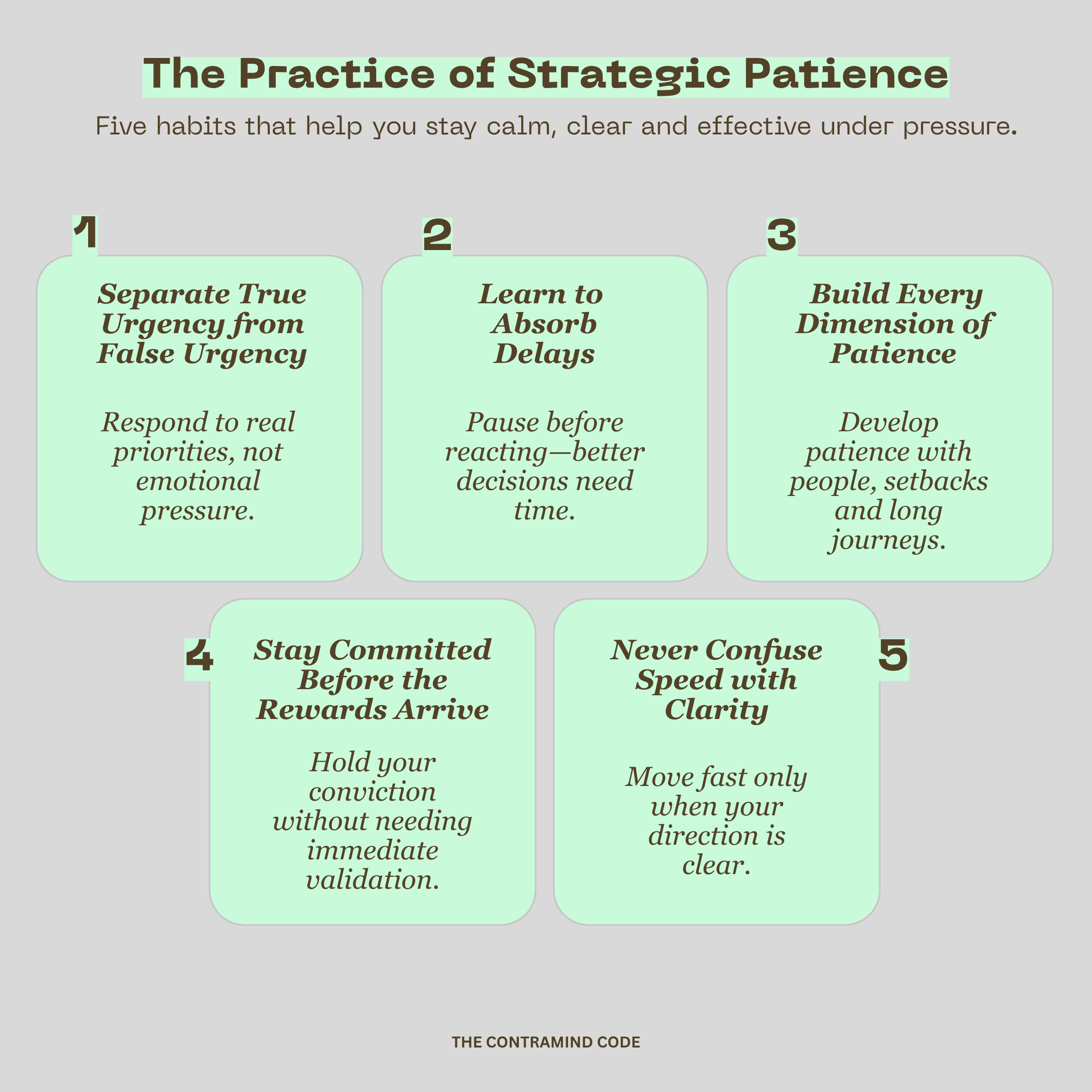
Learn to differentiate between ‘True urgency’ and ‘False urgency’: Well-known Harvard Professor John Kotter’s research offers valuable insights into how to understand and work on them. According to Prof. John Kotter, “ True urgency is purposeful, evidence-driven, and directional. However, False urgency is rooted in anxiety and anger — it produces frenetic activity without productive results. It looks busy, sounds urgent, and generates enormous energy. But it is not aimed at the critical objectives.”
Know how to absorb the delay: Delays are inevitable. Not everything will happen when you want it or the way you want it to happen. Don’t forget Seneca's single most repeated and most urgently recommended technique - deliberately insert time between provocation and response.
Understand that not all patience is equal: Prof. Sarah A. Schnitker's brilliant research provides deeper insights into the different types of patience, which will enable you to handle each of them better :
Interpersonal Patience: Develop the capacity to remain emotionally controlled and patient when dealing with difficult people. It is active emotional regulation in response to social provocation. Don’t worry if others misunderstand this as you being passive.
Daily hassles patience: This is your capacity to remain calm amid the accumulation of minor frustrations, like a meeting, an email, a failed process, or a colleague who underdelivers.
Life hardship patience: This is your capacity to maintain mental poise and exhibit strong character in the face of chronic adversity, such as career stagnation, organisational dysfunction, and systemic obstacles.
Refuse to leave the system when it is unrewarding: The easiest act you can display is to quit when things are not going your way, or you are not adequately rewarded for your contribution. You must develop the ability to hold your conviction without urgency — not merely passively, but without demanding immediate validation. Develop the muscle to handle the extreme contradiction you will experience in your mind, and be ready to push it to the edge as much as possible.
Don’t act with urgency when you don’t have strategic clarity: It's common to see urgency in many projects or initiatives in companies without conviction. This is a precursor to structurally breaking your patience. You will need to develop the capacity to hold a strategic conviction for extended periods when people do not believe your viewpoints and the environment has not yet validated them.
When should you act with impatience?
Not all patience is good, too. There are situations when you need to act with impatience. This could include situations:
Where ethics, safety, or integrity is in question
When complacency is rampant in the system
When the window of opportunity in the market is genuinely closing
When purpose-led patience is leading you nowhere
When passive behaviour is hidden under the label of patience
When relationships require honest confrontation
When your growth requires discomfort which you have been avoiding
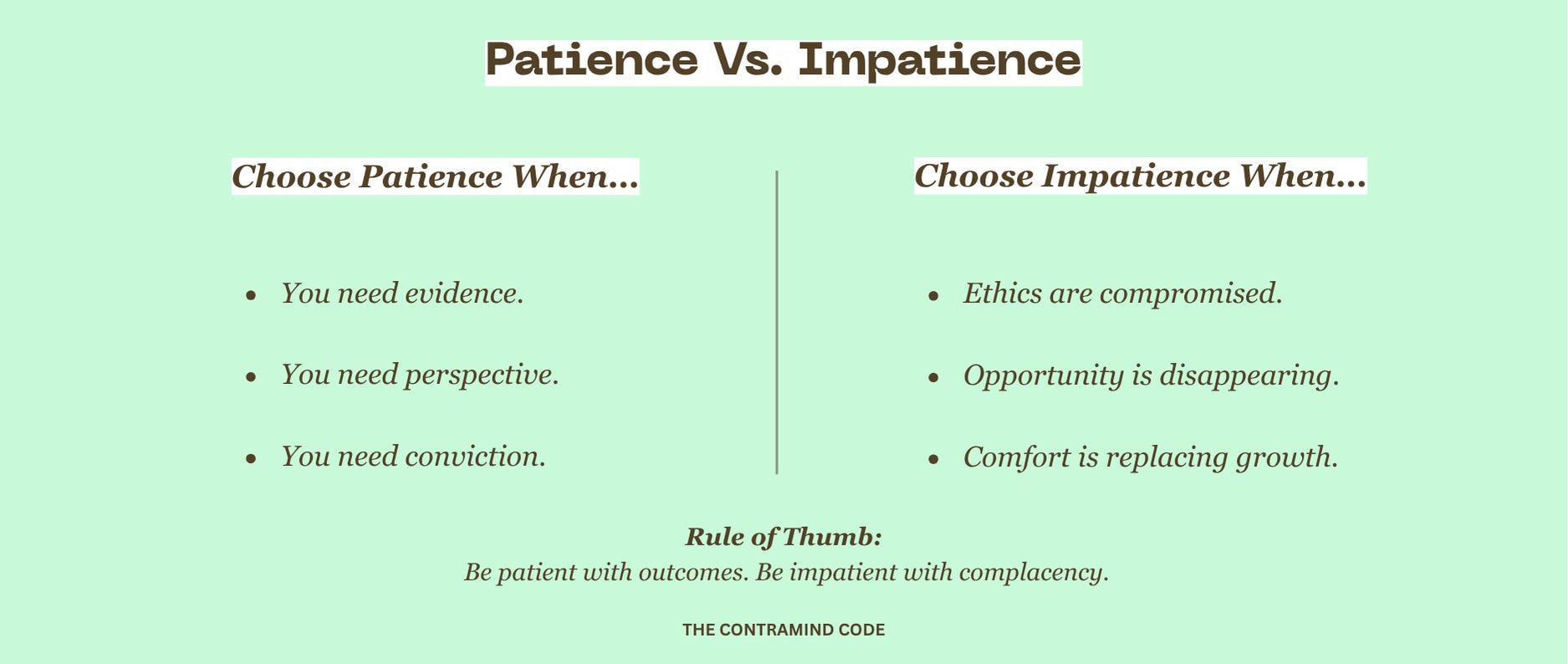
It is important to remember that patience is the meta-skill that sits underneath resilience, self-awareness, deeply held values and beliefs, controlled timing, delayed reasoning, evidence-led and the ability to hold your strategic conviction in the most testing times. Don’t confuse patience with passive behaviour, and ambition with urgency. The patience architecture has high ambition and low urgency at its core.
Some of the lessons we learnt from this week’s mission:
In the real world, skills triumph over scores.
Learn to compete with yourself.
Don’t confuse ambition with urgency.