Introduction
The ContraMind Code is published by ContraMinds Labs, which runs a successful podcast that explores thoughts and conversations around the DNA of purposeful minds. It helps you explore and discover what it takes to achieve personal excellence and professional fulfilment. It tries to decode what really goes behind the minds of people with a purpose, what are their motivations and inspiration and attempts to understand the why behind what they do and how they successfully accomplish what they set out to do. It helps provide a mental framework, markers and a mind map for each one of us to learn and discover from their life purpose, their cultural ecosystem and their experiences. These conversations and thoughts will hopefully open your mind and help you put some of these thoughts to practice both in your life and career.
Subscribe to get full access to the newsletter and visit our ContraMinds website, which has a treasure trove of podcasts from leading thinkers, successful entrepreneurs and practitioners.
The One Leadership Skill We Forgot To Teach.
In this brilliantly written article in Founding Fuel, Kavi Arasu, a talent and organisational change specialist, highlights the importance of a core skill leaders need or a tool that seems to have been forgotten - facilitation.
What does facilitation mean, and why is it becoming important?
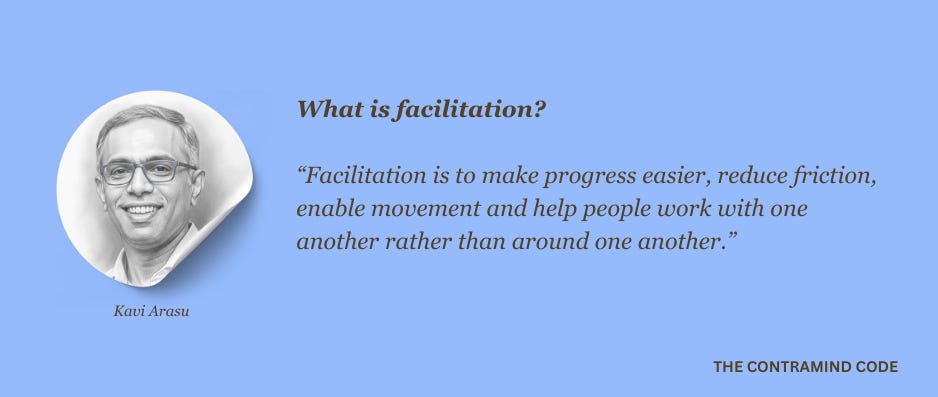
According to Kavi Arasu, “Facilitation is to make progress easier, reduce friction, enable movement and help people work with one another rather than around one another.”
He writes about why this is becoming increasingly important:
“People now expect to participate, not spectate.”
“Most leaders have been trained to present, not host; to speak, not listen; to run a meeting, not hold a space.”
“Great communicators are not the ones who sound impressive. They are the ones who leave people feeling understood.”
“Leaders who learn facilitation do not impose clarity. They help groups find it.”
“If you want faster decisions, slow the conversation down.”
Read the entire article here.
Why Talent Alone Isn’t Enough. The Surprising Habits Of Thriving Teams.
Is attracting top talent alone enough for companies to succeed? Or being just brilliant sufficient for you to succeed in your career?
In this Next Big Idea Podcast, Michael Kavanagh is in conversation with Jon Levy, a behavioural scientist, about this topic. In his new book, Team Intelligence, Jon shares his findings from his years of research on the talent myth, a belief often held by leading HR teams and companies.
Jon unpacks his five insights in this conversation, which are quite revealing and powerful:
“Teams win not because they have the best individuals, but because they have learned to combine their efforts into something greater than the sum of their parts.”
A perfect leader is a myth. “You don’t need to fit into a mould or master every trait on a leadership checklist. Find the strengths that make you effective and use them to have people feel that there will be a new and better future.”
Jon emphasizes the three pillars of team intelligence:
Reasoning, alignment around clear goals.
Attention, knowing when to collaborate and when to focus.
Resources - knowing how to unlock and empower talent.
Be aware of the ‘superchicken’ problem. “Success isn’t about gathering the most stars. It’s about creating conditions where people can thrive together. Where collaboration, trust, and shared purpose matter more than individual stardom.”
“Don’t just chase superstars. Value the people who connect the pieces.”
You can listen to the entire episode on: Spotify| YouTube
Success Is Hard Until You Build Systems Like This.
How do you convert intent to action in your pursuit of success?
You know deeply within you that you want to succeed, but what does it take to succeed? Hard work, more effort, more discipline, being more intelligent and capable than others?
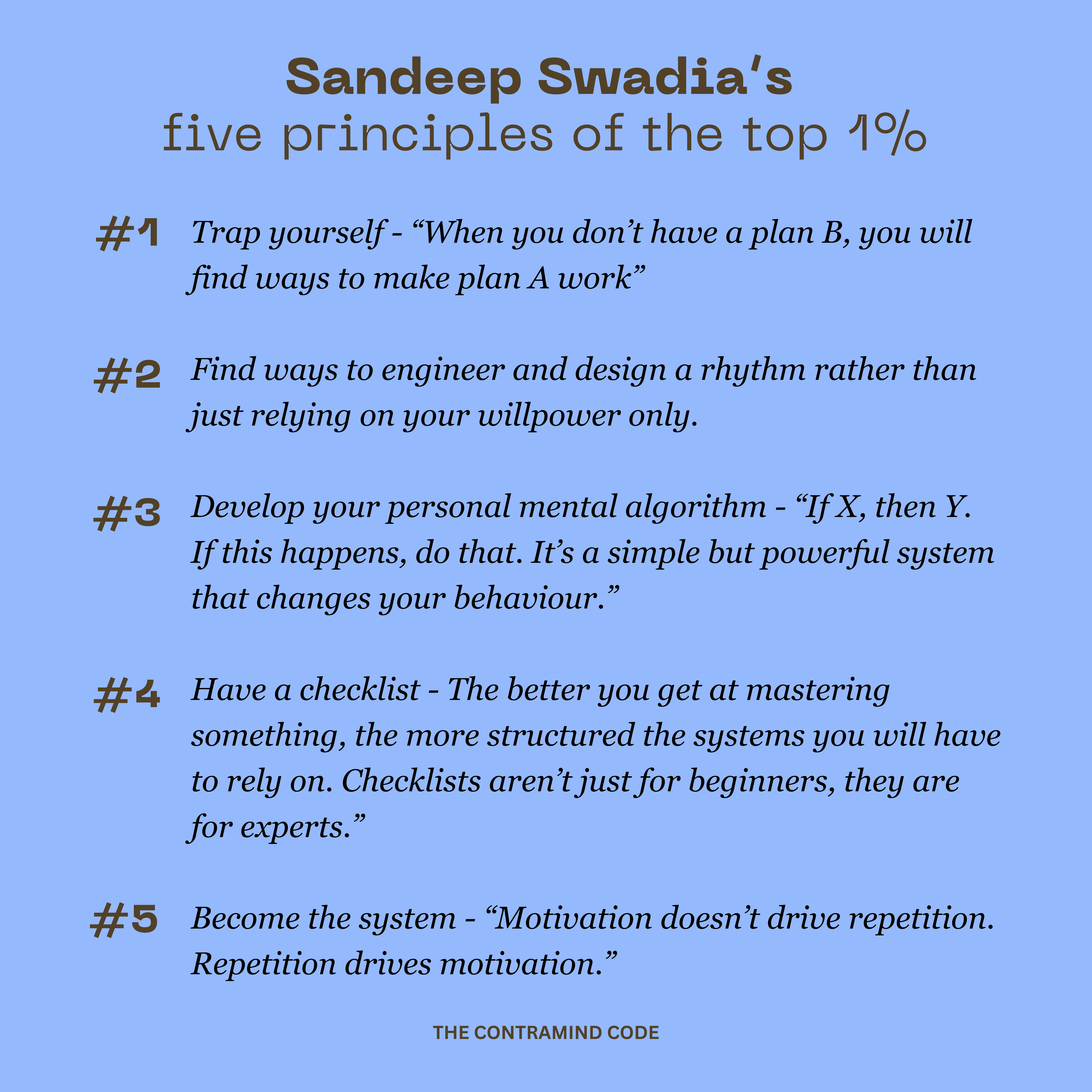
Sandeep Swadia shares 5 principles that sound simple but are hard to execute. He explains what the top 1% do to get there.
Here are my thoughts on how you can become the system.
Talent Alone Will Not Take You To The Finish Line.
Listening to Jon Levy brought to the forefront one hard truth about the myth of talent that we put so much emphasis on.
Just being talented and working to be the best doesn't guarantee you'll reach the finish line. Right from the early school days, you are always ‘primed’ to beat the other students in the class. Hence, you are always looking at ways to ‘prove’ that you are better than others. Rank serves as a marker to show that you have beaten the best in your group. Ranks merely serve as a ‘cut-off’ to shortlist from a host of people vying for the same seat or position, etc. It’s the same with grades, too. Having top grades means you have done well and better than others. If you carefully look at the language that your brain has been used to, it’s more about ‘competing’ rather than ‘collaborating’. Collaboration does not get you the rank or grade; competing does.
However, when you come to the workplace, it’s not about being ‘better’ than others or ‘beating’ or ‘competing’ with others, but it is about how to collectively be the best in what you do as a team. Suddenly, the markers of success change.
It requires you to ‘raise’ the bar of all the people who are working with you. You may be extremely good at one thing, but may not be as good in a few other things that are critical for achieving the success of that initiative or program. It may mean seeking help or adding someone to the team who can ‘solve’ problems quickly. At the other end, it may require a team member who ‘consistently maintains’ what has been created or built. He or she may be good at doing the same thing with precision day in and day out. There may be another team member with a stronger ability to ‘align’ teams and keep them together. There may be another team member who can ‘network’ better with the outside world than others. There may be somebody else who can ‘think’ outside the box and come up with solutions. Hence, it’s a case of ‘shared’ success at work.
You must learn the art of connecting the pieces
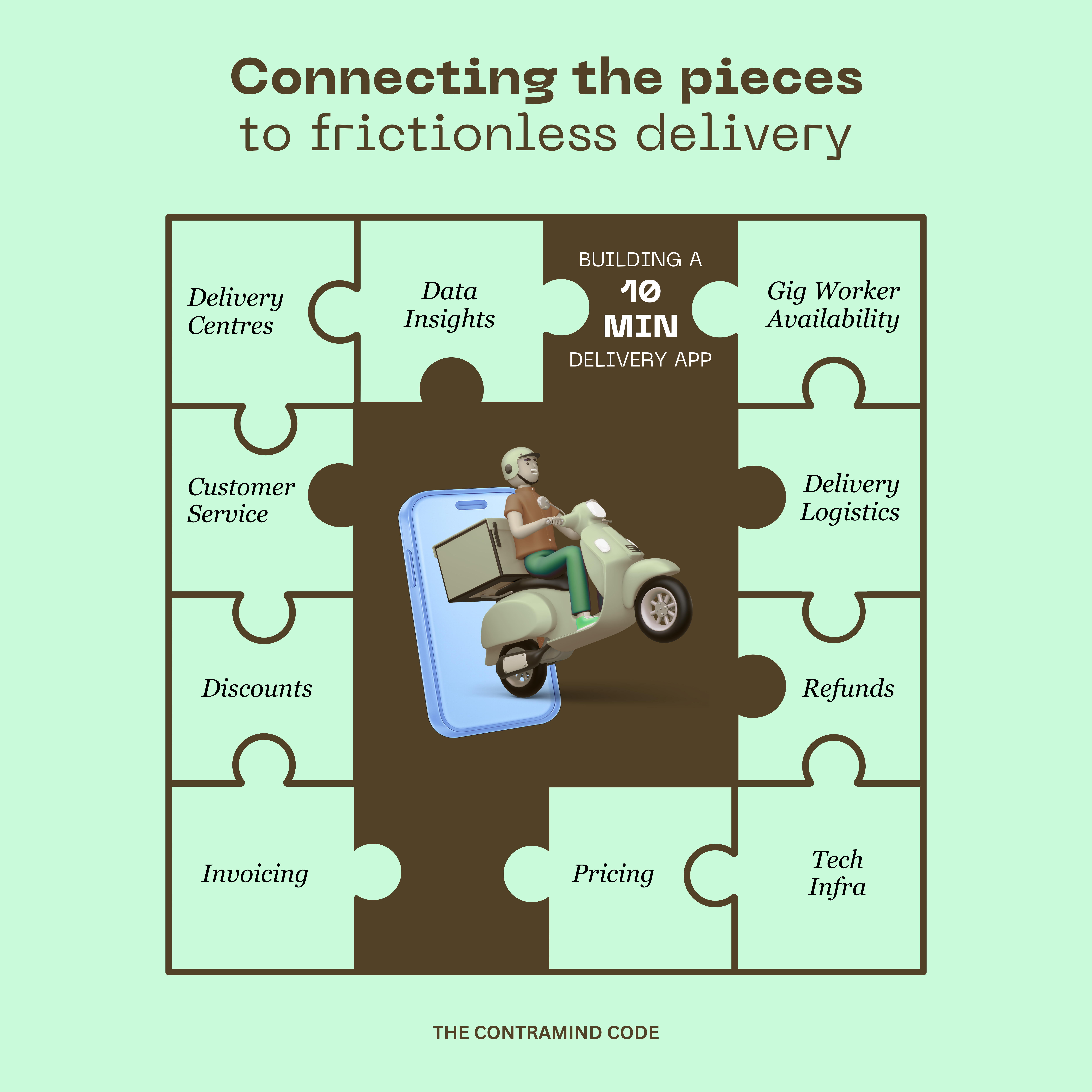
What does ‘connecting the pieces’ really mean? At the workplace, it is not rare to see work and people function in silos. Let’s take the example of a quick commerce mobile app. If the promise of “10 min delivery’, there are many parts connected to the promise in addition to the mobile app design and development - inventory, delivery centres, gig-workers availability and capacity, customer service, invoicing and payments, tech infrastructure and reliability, data insights for intelligent decisioning and pricing, etc. If you were the best mobile app designer and developer in the world, you would need to be able to ‘connect’ the pieces of the business promise and ensure a frictionless experience across these functions and departments. Imagine you were heading the IT infrastructure; you must be able to look at all these parts and connect them in your IT architecture design.
Moving from ‘Circle of Expertise’ To ‘Circle of Influence’
With your innate talent, you must be able to expand your ‘circle of expertise’ in your core area to a ‘circle of influence’, where the rest of the teams across functions begin to respect your perspective, improve your ability to understand their constraints and viewpoints. The ways of working, rhythm, and methods they follow may be totally different from how you work in your core area of expertise. That’s when your ability to influence has a direct correlation with your ability to ‘be influenced’. This is where empowering teams, aligning individual team members, working with diverse points of view, adaptive working styles and listening to others’ perspectives become as important as your talent or expertise.
At the workplace or in your career, there is not one ‘first ranker’ but many ‘front rankers’ who contribute to the success.
Talent can get you, as an individual, off the starting block faster, but to reach the finish line, only a ‘medley of people with varying levels of talent and capability’ can help you get there. Great teams will beat great talent hands down.