Welcome to The ContraMind Code.
The ContraMind Code provides you with a system of principles, signals, and ideas to aid you in your pursuit of excellence. The newsletter shares the source code through quick snapshots for a systems thinking approach to be the best in what you do. The ContraMind Code helps you reboot and reimagine your thinking by learning from the best, and enables you to draw a blueprint on what it takes to get extraordinary things done. Please share your thoughts and comments to start a conversation here.
Take a journey through www.contramindslabs.com. Discover a complete system for ambitious professionals who refuse to plateau, and also a place where you can listen and watch some great minds talk to us about their journey of discovery of what went into making them craftsmen of their profession, to pursue excellence and drive peak performance.
Burnout Looks Different Across the Org Chart. Watch For These Signs.
In this HBR article, Daisy Auger-Domínguez, Global Chief People Officer at a fintech company and author of Burnt Out to Lit Up and Inclusion Revolution, highlights some probable root causes of workplace burnout.
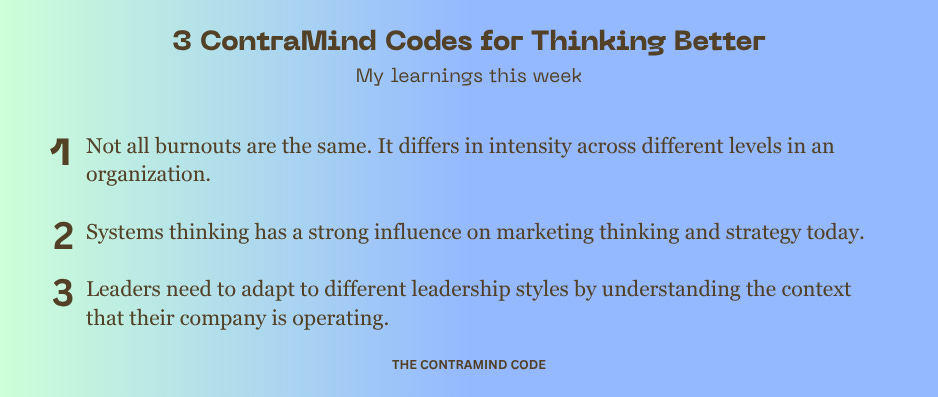
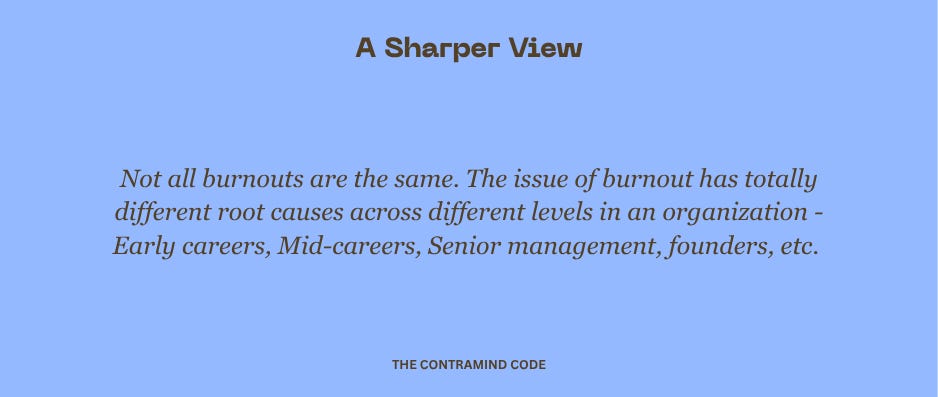
She makes some insightful points about burnout - “Not all burnouts are the same.”:
The issue of burnout has totally different root causes across different levels in an organization - Early career, Mid-career, Senior management, founders, etc.
Among early-career professionals, a lack of control and unclear expectations are strong predictors of burnout.
Mid-career professionals are stuck between committing to a plan they don’t believe in or understand, and teams demanding clarity, protection and support. This causes frustration, leading to burnout.
When senior leaders are asked to act or when they act in conflict with their values, it creates moral injury that leads to burnout.
Read the entire article here.
Systems Thinking: What It Is And What It’s Not.
In the WARC Podcast, David Tiltman speaks with JP Castlin, a strategist and prolific writer who has conducted extensive research on applied complexity science. The conversation is about the growing importance of a systems thinking approach to marketing and brand building. The chat explores various aspects of systems thinking and its influence on marketing thinking and strategy today.
JP Castlin goes on to explain that, much as people may like for their ‘Systems of work’ or ‘Systems of life’ to be fundamentally ordered, for example, daily workloads being linear or what they do in everyday life to be linear, things in reality don’t pan out as they expect them to.
Similarly, in marketing, we focus a lot on the marketing funnel. We expect people to go through a series of linear steps - becoming aware of a brand, then considering various choices, then purchasing a brand, and then repurchasing it again and again over time. However, in reality, consumers jump various stages - for example, usage may come before attitude formation, etc.
Therefore, when you plan brand campaigns or build your media plans, applying a systems thinking framework to marketing is increasingly vital.
How Influence Really Works In Modern Leadership.
In this video, Sergei Guriev, Professor of Economics and Dean at London Business School, is in chat with Niro Sivanathan, Professor of Organisational Behaviour at London Business School, and Diana Torres, Senior Managing Director at Teneo.
Here are some thoughts that have been shared, which will help you think through your leadership style and focus:
In times of uncertainty, clarity becomes essential for leaders.
Timing and leadership style go hand-in-hand: Learning when to be a ‘peace-time ceo’ and a ‘war-time ceo’ is important.
To be a successful leader today and make an impact, you need to have a ‘Duality of Personality’.
Leaders today need to engage with very different generations within the same company to execute their plans. Hence, they need to adapt to different leadership styles.
“Command and Control will not sit well with the new generation.”
The downside of ‘command and control’ type of leadership leads to innovation stagnation, losing the engine of growth. Leaders need to be aware of this.
With a collaborative leadership style, the leader can command implicit dominance in the room, and people can learn from one another about leadership traits.
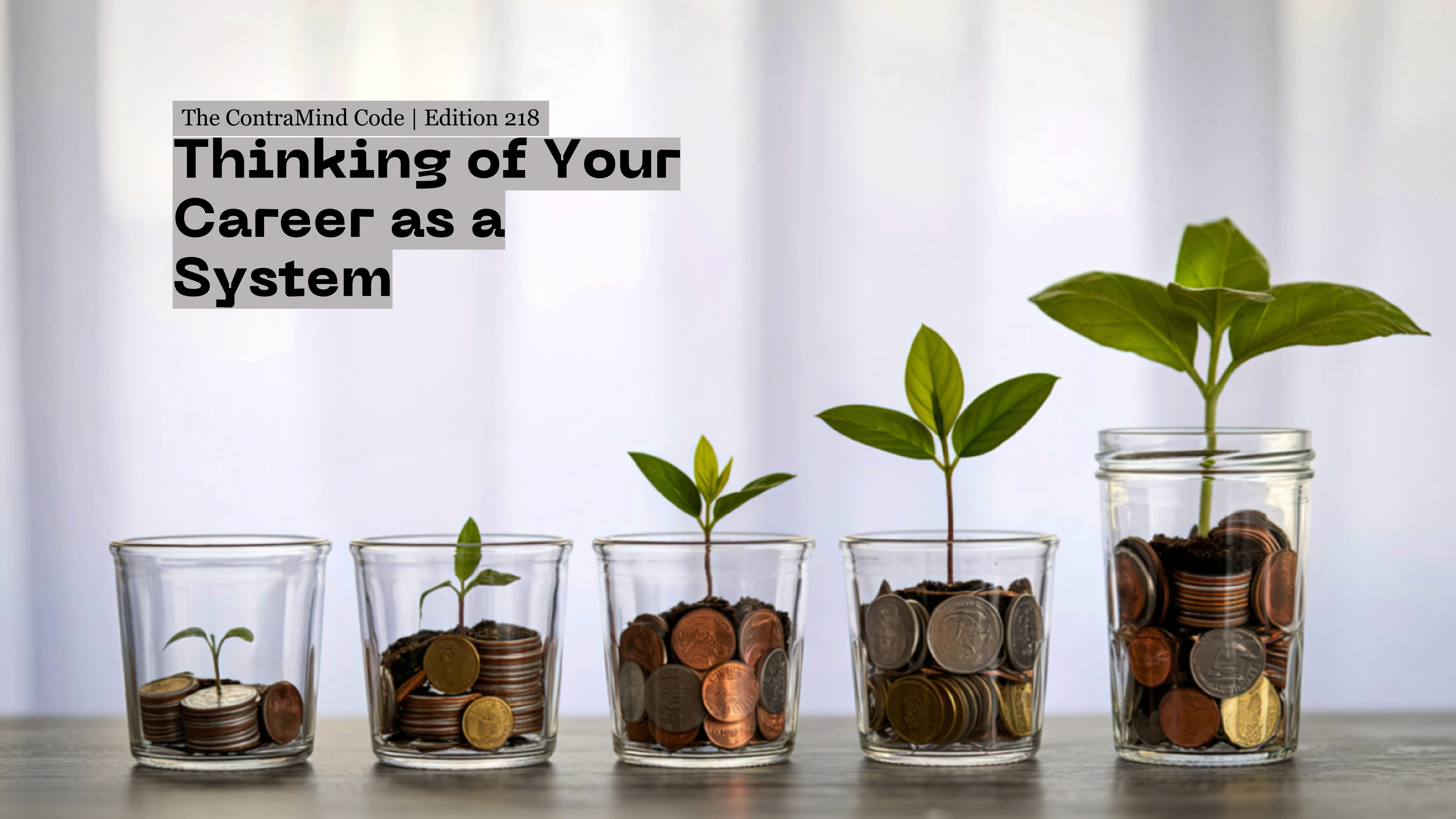
Thinking Of Your Career As A System.
JP Castlin’s ideas around systems thinking mirror a lot of similarity in how people must begin to see their careers, too.
Most people think of their careers like a ladder. The most frequently used sentence when it comes to building a career is ‘How do I climb the career ladder?’ - which means the expectation is that you will join and grow from the bottom to reach the top of an organization. Then, your career is considered successful. The underlying expectation is that careers are linear, vertical and predictable. But the question to ask yourself is, “Is the concept of career ladder relevant or even true when you look at the careers of successful people?” The answer is a big no, and great careers are built through systems thinking methods. When you see your career through a systems thinking lens, it allows for a lot more ebbs and flows, allowing time for preparation rather than immediate results or success, understanding the importance of interdependencies, etc.
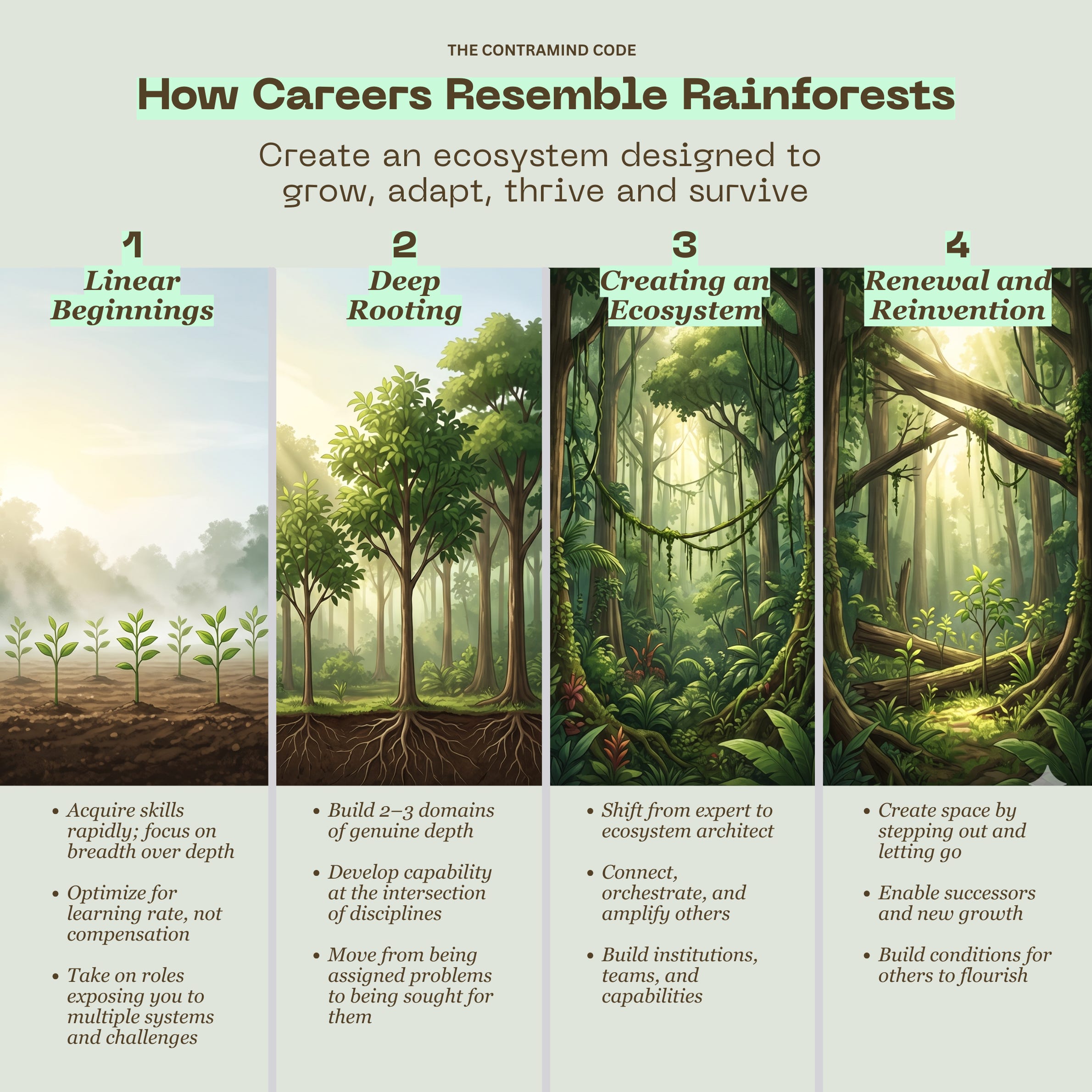
Most successful people’s careers resemble that of a ‘rainforest’ system. Rainforests evolve from bare ground to a canopy of dense trees over time. It’s the ecosystem that makes rainforests grow, adapt, thrive and survive.
How careers resemble rainforests
Careers are similar in that they start pretty much from a barren land when you just begin. During this stage, how you make the soil or the foundation fertile is key. Soil serves as a foundation that’s built over time for the trees in the rainforests to grow and expand. If there’s weak soil, the tall trees collapse. Similarly, during the early years (1-5 years), it is important to acquire as many skills as possible as quickly as possible. The focus must be on breadth over depth. You must optimize for ‘learning rate’ rather than compensation. You must be willing to take up roles that expose you to multiple systems and challenges. Investment in learning precedes returns over the years. Like how a rainforest comes up, this is a period when you are making the soil fertile for what’s going to come next in your career.
The next phase in your career (5-15 years) is like how deep-rooted trees take shape in a rainforest. You must begin to develop 2-3 domains of genuine depth. It could be technology + marketing, operations + design, manufacturing + R&D, etc. You have to build credibility and capability at the intersection of disciplines. That’s what makes the trees in the rainforest stand tall and overcome any extreme weather conditions. How can you sense this? You will move from being assigned to problems to being sought for problems.
The next phase in your career(15-25 years) is like a period when the rainforest matures into a large tree habitat spread over a very large area. Think of it like the Amazon rainforest. It’s no longer about individual trees. It’s about nutrient cycling, predator-prey balance, pollination networks, etc. Similarly, at this stage of your career, it’s time to shift gears from being an expert to being an ecosystem architect. It’s no longer about you and what you know, but it’s about how you connect, orchestrate and amplify others. It’s about building institutions, teams, and capabilities for people within your network. It’s also a phase where you have to fight ‘forest fires’, which can destroy large tracts of forest, yet have the resilience to grow again. Failures at this stage are like forest fires. And you need to learn to cope with disruptions or derailments, and handle them with courage, too.
In the final years of your career (25-30+ years), it’s a phase when rainforests experience heavy treefall, and fallen giant trees let sunlight to the ground, triggering the rapid growth of new species as they decay. In your career, this is a similar phase where you deliberately create gaps, exit roles, and create open space for your successors. It’s about building conditions for others to flourish.
Satya Nadella's Career as a Rainforest Ecosystem - Case-in-Point
In his early years, Satya Nadella’s leadership philosophy was embedded as a seed for his answer to an interview question: "If you see a baby fall on a crossroad, what do you do?" Satya Nadella’s answer was: “Call 911.” The interviewer walked him to the door and said, "You need to develop empathy — when a child is crying, you pick them up and hug them.”
While Satya Nadella’s success is often discussed, his failure rarely gets enough attention. In 2012, Microsoft took a $6.2 billion goodwill write-down in its Online Services Division, largely due to a failed aQuantive acquisition, and it was during this time that he led the R&D for this division during its most turbulent years. In his career, this was his darkest ‘Treefall moment.’ This is where he learnt about the downsides of a market leader’s arrogance, how to rebuild culture after a canopy collapse, and the problems of misaligned acquisitions. Failure taught him many lessons at this phase of his career. It is important to note that failure also did not act as a barrier to his career growth.
When he took over as CEO of Microsoft, he focussed heavily on culture, and, using the rainforest analogy, he believed that for Microsoft, products are like trees and culture is like soil. His belief was that bad soil produced poor trees, regardless of seed quality. He also slowly killed the ‘competitive monoculture thinking’ through ‘symbiotic’ partnerships with Apple, Google and Salesforce, which were once seen as enemies of Microsoft. He also built a great biodiversity layer for Microsoft through his acquisitions of LinkedIn, GitHub, OpenAI and Activision.
Satya Nadella's career story stands as a great testimony to the rainforest ecosystem analogy and is a perfect example of how you must think of your career as a ‘system within systems’.
When you start planning your career as a system, you begin by asking a fundamental question: “What conditions must I sustain for the ecosystem to flourish over decades?”