

Introduction
Welcome to The ContraMind Code.
The ContraMind Code provides you with a system of principles, signals, and ideas to aid you in your pursuit of excellence.
The newsletter shares the source code through quick snapshots for a systems thinking approach to be the best in what you do.
The Code helps you reboot and reimagine your thinking by learning from the best. It also enables you to draw a blueprint for what it takes to get extraordinary things done. You can share your valuable thoughts and comments and start a conversation here.
Take a journey to www.contraminds.com. Listen and watch some great minds talking to us about their journey of discovery of what went into making them craftsmen of their profession, to drive peak performance.

How Many Digital Workers Could OpenAI Deploy?
If one of the growth levers for any business is labour, or shall we say talent, and if growth is constrained by labour, would the ‘potential of unlimited digital workers’ driven by the AI revolution be the answer?
This article from epoch.ai presents different perspectives on ‘the availability of digital workers’, offering a fresh lens through which to view this challenge. There are three different questions this article tries to answer:
How many AI “digital workers” can be deployed today?
How far is AI from fully substituting for human workers?
How are both of these changing over time?
The calculations and logic behind this number are very revealing, shedding light on the constraints and challenges of scaling ‘digital workers.’ It gives you a great picture of the underlying hardware that has been deployed, also looks at the volume of tokens’ traffic per day( it highlights that any mean message length is four thousand tokens long), which determines the number of raw computations that can be made, and therefore gives a fair capacity that has been utilised and is hence available. Finally, by converting all of this to understand how many messages and, thus, the number of tokens a human processes in a day, you could get a fair estimate of the number of digital workers.
It is fair to assume there is no infinite capacity right now, and one of the challenges that will constrain AI growth and velocity of adoption will be the availability, cost and deployment of hardware.
You can read the entire article here.

How To Learn Skills Faster.
In this Huberman Lab Essentials episode, Dr Andrew Huberman explores how to improve motor skill learning and proficiency—whether for athletic performance, learning an instrument or refining any physical skill. It applies to any skill that you may want to develop.
Here are some valuable research-based tips shared by Dr. Andrew Huberman:
When you want to build skills, you need to understand the difference between open-loop and closed-loop skills.
Open-loop skills involve performing a motor action and then waiting for immediate feedback on whether it was done correctly.
Closed-loop skills are more continuous, allowing you to adjust your behaviour as you go.
There are three components of skills that involve motor movement: sensory perception, actual movements, and proprioception, a sixth sense that enables you to sense where your limbs are in relation to your body. Which among these should you focus on?
If you want to learn a skill, you must perform as many repetitions per unit time as you possibly can, at least when you’re first trying to learn a skill.
Errors will tell you what to focus on. Without errors, the brain cannot change itself. Errors are generally good for you, and in order to win, you have to fail.
The key to learning a skill is to repeat it as many times as possible, allowing for a few failures within the same session, and paying attention to those errors every time, as this process provides cues to your brain. This approach improves your odds of learning more effectively.
You can listen to the entire episode on:
Spotify | YouTube | Amazon Music

Italian Tech Week 2025: Jeff Bezos, Founder, Amazon, In Conversation With John Elkann, Ferrari, Stellantis Chairman And Exor CEO.
This conversation between Jeff Bezos and John Elkann offers valuable insights into the man, including his family background, values, thinking, views on entrepreneurship, and plans.
Here are highlights from this conversation:
"We do these things not because they are easy but because we thought they were going to be easy”. This is a useful attitude for entrepreneurs to have!
“Stability favours incumbents, and rapid change favours small, dynamic, nimble startup companies.”
“I always advise young people to work at a best practices company where you can learn a lot of basic fundamental things - how to hire really well, how to interview, etc. There’s a lot of stuff you would learn in a great company that will help you, and then there’s still lots of time to start a company after you have absorbed it, which increases your odds in my opinion.”
“Every summer from the age of three or four until I was about 16, I went and
spent time with my grandparents on their ranch in South Texas. I think that in rural areas, people do everything themselves. He(grandfather) did his own veterinary work. He repaired everything. He had incredible resourcefulness, and he believed he could solve any problem. And I sort of watched him.”
My grandfather told me, “You’ll understand that it’s harder to be kind than it is to be clever. I think this is a very meaningful lesson because there’s this idea that technology is clever but not kind.”
“I would always rather lose a sale than lose a customer.”
“Reality wins every time.”
“You have to release the work(Bezos’ ideas) at the right rate that the organization can accept it.”
You can click on the above link and watch the video.

To Spot Trends, Go Back To History.
Theoretically, there should be no constraints to expand the availability and capacity of AI-capable ‘digital workers’. After all, all that is needed is the underlying infrastructure foundations to be put in place as demand continues to grow. So, nothing can stop the rapid growth and adoption of AI, right? But it is a good idea to try to remember Jeff Bezos’ statement, ‘Reality wins every time,’ as you dream about the future. What does history teach us?
History has taught us that every technological disruption or change follows a pattern of hype, growth, moderation and penetration. Sometimes, we either overestimate or underestimate its impact.
As a business or professional, how should you view the growth and impact of AI on your operations or career?
These may be some of the questions you must be asking yourself:
How can I determine whether AI will have a marginal or significant impact on my operations or skills? How will it impact in the near-term or long-term?
As a business, how do I justify the cost of the early, huge investments that I need to make, and how do I factor returns on these investments, and over what time frame should I look at them?
As a business, should I invest ahead of the curve, or should I moderate my AI investments, keeping in mind the hype and reality surrounding it?
What is the expected adoption of AI across the business environment I operate in, so that there is a thriving ecosystem that my business can leverage as adoption and penetration grow across my partners and clients?
How are pricing factors expected to change, and which parts of my business value chain will be affected? Additionally, which business models can I expect to generate margin premiums and which ones will become commoditized?
To understand this better, it’s always good to go back in history and see what has happened in the past. The internet is a technology that has transformed or created many businesses, fundamentally redefining business models. It will be worthwhile to examine its history and growth to identify any lessons that can help us understand AI's potential for growth and adoption over the next few years.
Internet - Growth Challenges And Its Path to Universal Adoption
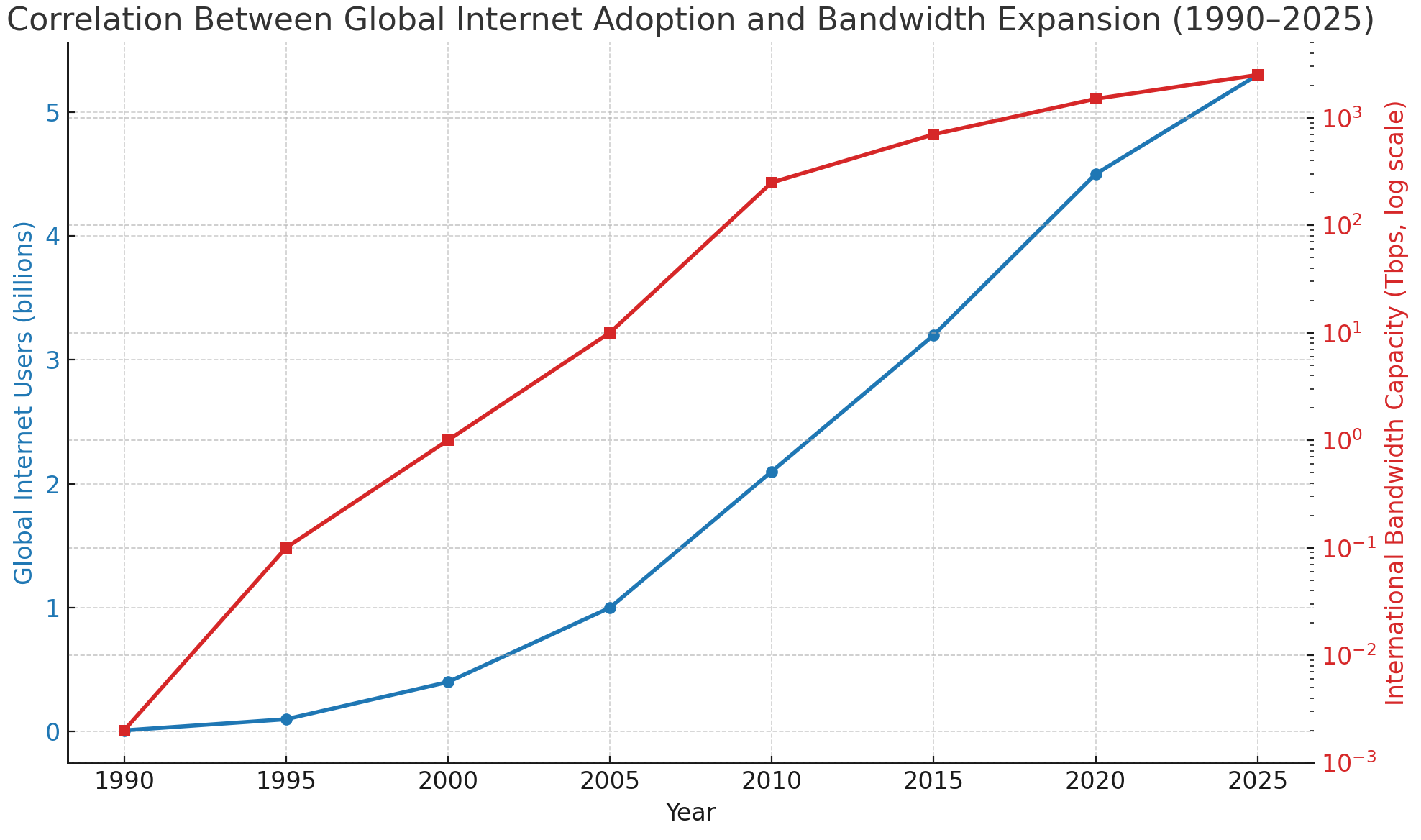
Bandwidth was the biggest bottleneck to internet growth and universal adoption. It is interesting to note that every phase of bandwidth expansion preceded the mass adoption of the internet. There is a lag effect between bandwidth expansion and consumer adoption, but by 2005, adoption had taken off.
AI- Growth Challenges And Its Path to Universal Adoption
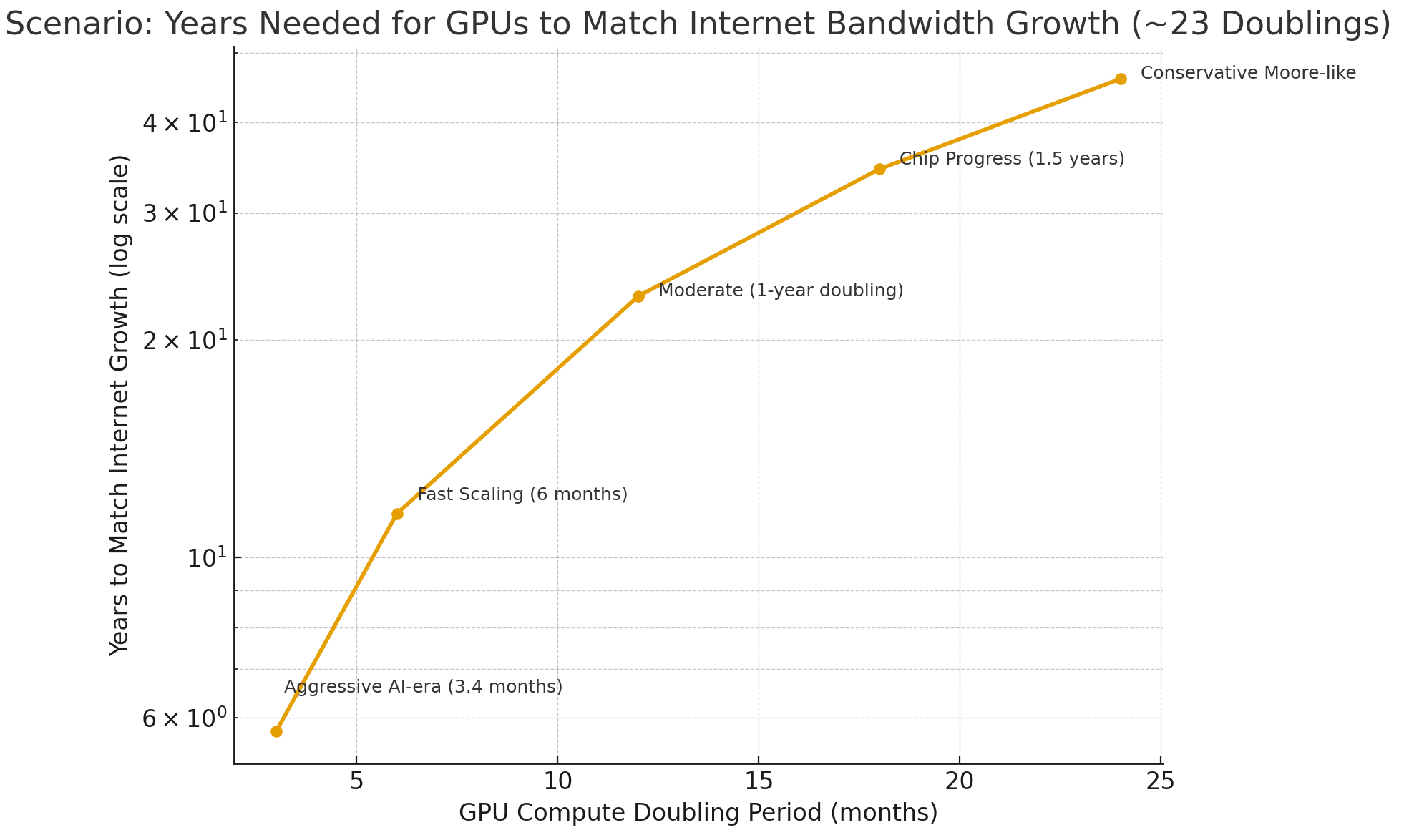
If you plot back and see how many years it will take for AI to replicate internet growth based on GPU progress, it is estimated to take 45 years! If bandwidth were the constraint for universal adoption of the internet, GPU availability, demand and growth would be the bottleneck for universal AI adoption.
Internet - Evolution of business models over time
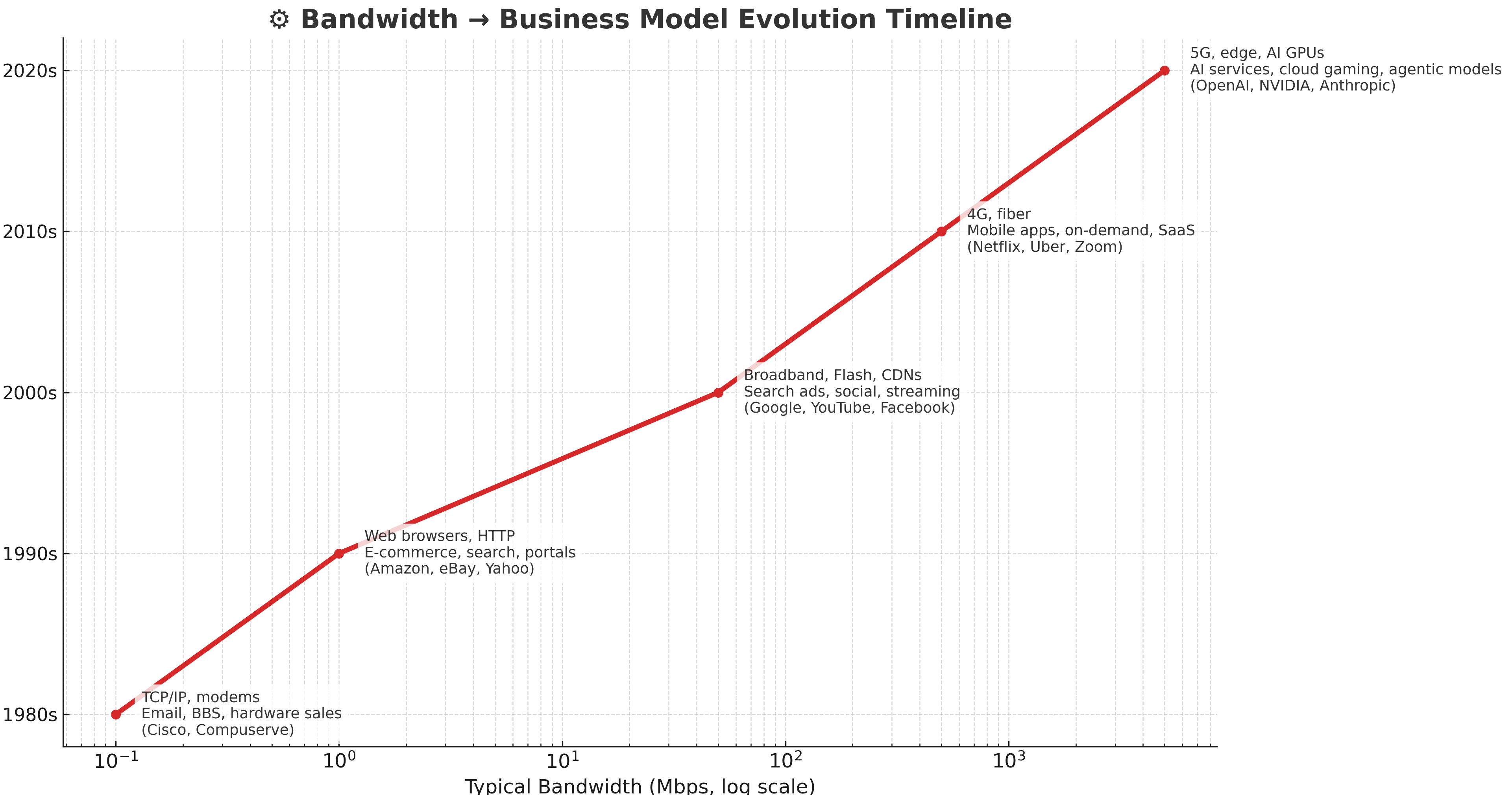
Let’s now go back and look at what business models got unlocked in the internet era over the years. It provides valuable insight into how each wave of bandwidth expansion has created a new business model pivot.
AI - Evolution of business models over time
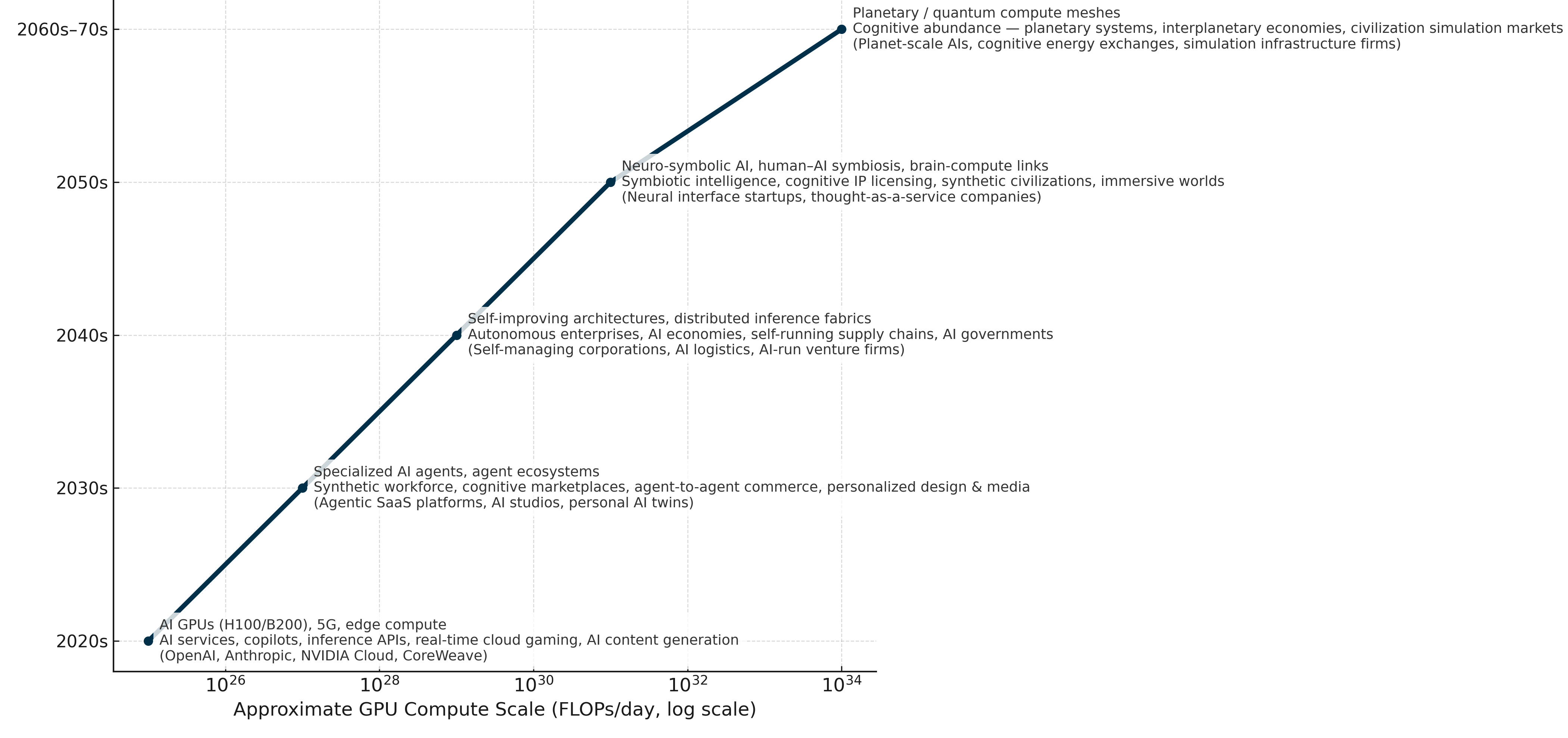
So, what can history teach us about the potential AI-led business models that could emerge in the next 45 years? This chart illustrates how GPU Compute Growth over the years will drive the evolution of new business models over the next 30-40 years.
What can going back to history show us?
When you dig deep, plot and try to learn from history, some incredible opportunities emerge. As Charlie Munger said, “There is no better teacher than history in determining the future... There are answers worth billions of dollars in a $30 history book.”
To understand and envision the future, turn back to study history. It will reveal a lot of truth and offer a refreshing perspective and reality on growth and adoption.

Some of the lessons we learnt from this week’s mission:
There are considerable infrastructure challenges to be overcome for AI to substitute or support human workers at scale.
If you want to learn a skill, repetition and learning from errors are critical.
How to handle stability and rapid change is something businesses need to learn, regardless of their size.