

Introduction
Welcome to The ContraMind Code.
The ContraMind Code provides you with a system of principles, signals, and ideas to aid you in your pursuit of excellence.
The newsletter shares the source code through quick snapshots for a systems thinking approach to be the best in what you do.
The Code helps you reboot and reimagine your thinking by learning from the best. It also enables you to draw a blueprint for what it takes to get extraordinary things done. You can share your valuable thoughts and comments and start a conversation here.
Take a journey to www.contraminds.com. Listen and watch some great minds talking to us about their journey of discovery of what went into making them craftsmen of their profession, to drive peak performance.

Is Google Screwed? Maybe. But Not How You Think.
The recent issue of the a16z Newsletter has a brilliant article on how AI will change commerce. The question to consider is how commerce was done before the internet, how it transformed during the internet era, and finally, how it is expected to change in the current AI era. Additionally, another perspective to consider is that our shopping journeys are not the same for all products or purchases. Thinking like a retailer is essential. Can you recall the products that are kept near the billing counter when you visit the store to make a purchase? Those are impulse buys that don’t need too much thinking. Therefore, the way you buy impulse products, routine essentials, lifestyle purchases, functional purchases, and life purchases will be different. AI will fundamentally create new AI-first commerce journeys, and the article captures this really well. If you are a brand looking to prepare for AI commerce, this will be a great starting point for your thought process and to prepare for the disruption that is on the horizon.
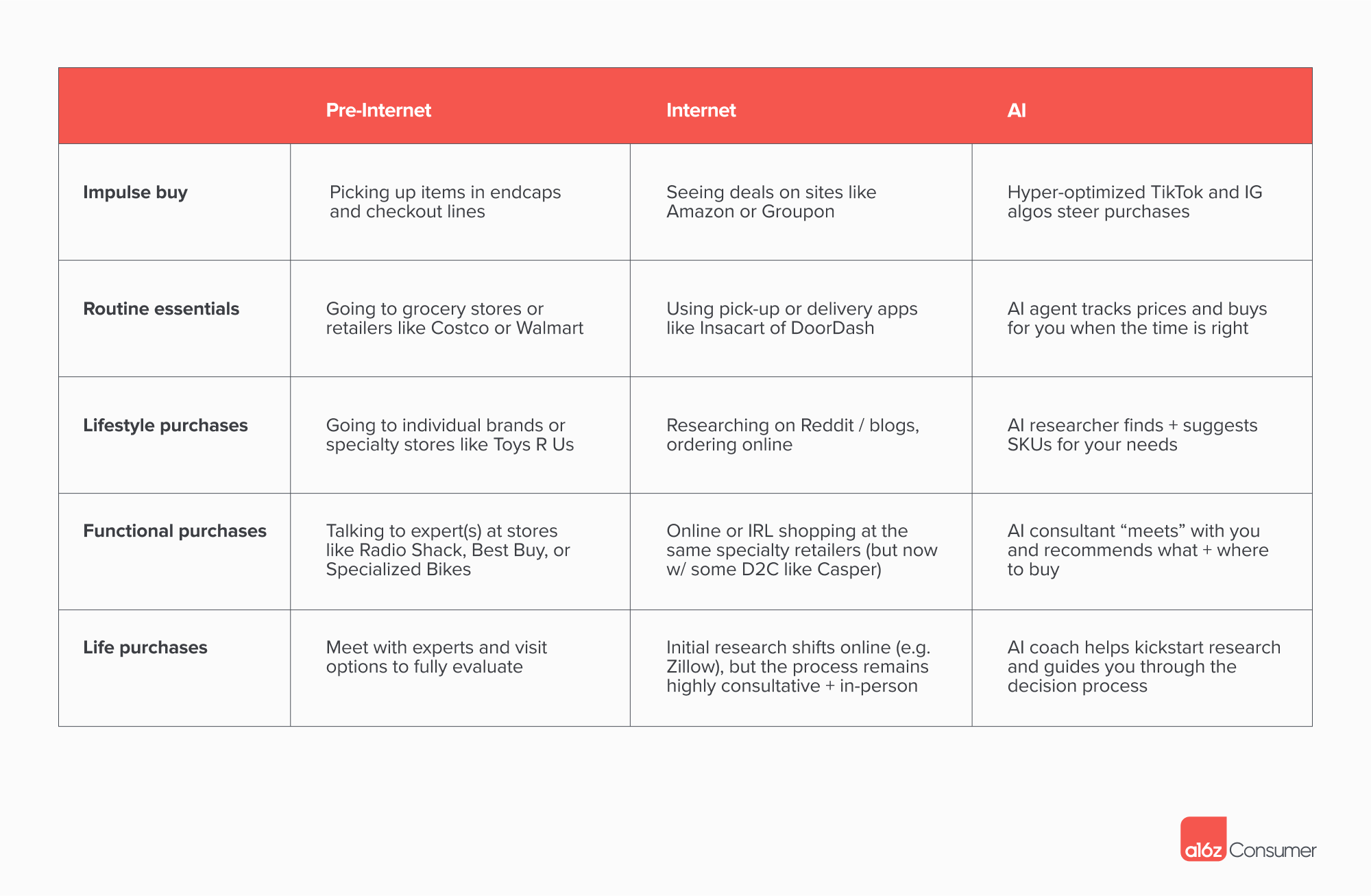
You can read the entire article here.

How To Create Fun And Meaningful Conversations.
It’s always challenging to initiate a conversation with people you don’t know, and sometimes this happens when we meet someone we know but haven't seen in a long time. Or it can be someone you have just been introduced to at a conference coffee break, or met at the conference table, etc. How do you really make these conversations meaningful and fun? There are some nice tips here in this podcast.
Here are some key thoughts shared by Dr. Tom Barrett and Tim Downs:
“Pick the right time and place.”
Don’t talk about the expected topic- “Talk instead about the unexpected.”
Prepare and imagine new conversation starters -“What new conversations and topics can you imagine?”
Learn to ask questions and connect with them at a human level -“Ask imaginative and open-ended questions.”
Don’t jump in, give your thoughts and advice - “If you’re going to ask these kinds of open-ended questions, you need to discipline yourself to listen without judgment or offering advice.”
Be a keen observer when there is a bit of resistance and discomfort-“Watch and listen for defensiveness.”
“When you’re talking and when you’re asking questions, you need to watch them, their body language, and listen for things that they’ll say that indicate they have just raised shields. Maybe you touched a nerve there and the shields went up.”
Don’t dominate even if you know enough and can add more interesting information - “Don’t steal the show.”
Embrace moments of human connection and authentic exchanges -“Celebrate the moments. Celebrate those microbursts of moments where we know we went below the surface and we had the privilege of having a human, candid, fun moment with them.”
You can also listen to this episode on:

What Are Teachers Doing Wrong In Class?
We have always known that lecturing is not the same as teaching.
Millions of students over many years have attended schools and colleges across the world, where they endure the grind of attending classes but often fail to learn anything. This is especially true not only in STEM (Science, Technology, Engineering, and Mathematics) education, but also across other subjects and courses.
In this video, Prof. Felder, Hoechst Celanese Professor Emeritus of Chemical Engineering at North Carolina State University, is one of the pioneers in the field of research and writing on teaching and learning.
Here, Prof. Felder speaks with Prof. Jeevanjyoti Chakraborty, Associate Professor of Mechanical Engineering at IIT Kharagpur. The conversation is laced with honest reflections from Prof.Jeevanjyoti on how he has evolved his teaching methods in class. Additionally, his probing questions to Prof. Felder on what it takes for students to learn, based on his extensive research over many years, and Prof. Felder’s explanation of the concept of Active Learning and how it helps people learn and retain information better, are valuable lessons that can be learnt by watching this video.
You can click on the above link and watch the video.

Want To Be A Great Leader? Learn To Be A Great Teacher, Too.
Many of us enter the world of work from schools and colleges where we have ‘earned’ paper grades, but in reality, we have not truly not ‘learned’ well enough. However, the world of work expects that you have not only know the concepts but also apply them very well.
However, each one of us has gone through an education system for more than two decades that rewards scores but does not put us through the ‘process of learning’. When you listen to Prof. Felder, he discusses the concept of ‘Active Learning,’ a process where ‘students engage in their learning by thinking, discussing, investigating, and creating. In addition, students practice skills, solve problems, struggle with complex questions, make decisions, propose solutions, and explain ideas in their own words through writing and discussion within the class.’
Think about the above for a minute. How often were we subjected to this process in our schools and colleges? We were usually discouraged from doing any of these. Then, you enter the world of work, and you are expected to do all of these things. When you begin to do this, you struggle to answer complex questions to problems where there are no easy answers. Sometimes, you may not have the perfect answers for them, and you may fail a couple of times when trying to find answers with your own hypotheses, which puts you under tremendous pressure, as you may not have ‘ failed’ in your school life. Failing at anything is seen as taboo. You are trained to have answers for everything. The questions that are thrown at you are things that you know have appeared in question papers in the past, and you prepare accordingly. Understanding is not essential, but answering them is most important. However, in the world of work, you are tested for your understanding, not for the answers you give without considering their implications. As there are no correct answers, you must be perceptive enough to learn as you go along. That's how people learn.
Therefore, when you are a leader, ask yourself these questions:
How often do you make your people think?
Do you have the patience and ability to tolerate wrong answers and failures that are bound to happen?
Do you encourage a discussion on a business problem and have the ability to debate alternatives before coming to a solution?
How often have you made the people you work with create something? Or do you just have people around you who only execute what you want?
Are you comfortable guiding people when they struggle with complex questions? The tougher question is, how good are you at guiding them through this process of finding answers for some complex questions?
As a leader, do you have a process for making people explain their ideas? Are you comfortable with people not being able to excel at it first, but improve as they go along?
As a leader, you don’t always have access to such ready-made talent. It is a sad truth that our education system produces individuals like this. It's not their fault. A relatively small number of individuals manage to overcome these bottlenecks. As a leader, you must learn to act like a teacher for them. When you, as a leader, provide and help them with a platform for learning methods to ‘discover the process of how to fundamentally understand and act on things rather than just get them to do things,’ you have the opportunity to become their leader beyond your current designation. You will also create a pipeline to help new leaders emerge.
Great leaders seldom ‘lecture’, they drive performance by making people ‘learn’.

Some of the lessons we learnt from this week’s mission:
AI commerce will fundamentally create new business models and opportunities.
To have an enjoyable conversation, learn the art of asking imaginative and open-ended questions.
Lecturing does not lead to learning.