
To achieve peak professional success throughout your career, skill or ambition alone is not enough. Many companies have examples of executives with ambition but relatively weak skills who rise quickly, only to hit a glass ceiling or get stuck because of performance issues. At the same time, companies have a long line of executives with superior skills who either can't grow or don't get the recognition and advancement they deserve.
Let’s explore why this happens and how to overcome the skill-ambition deficit that can subsume executives from sustained, long-standing professional success.
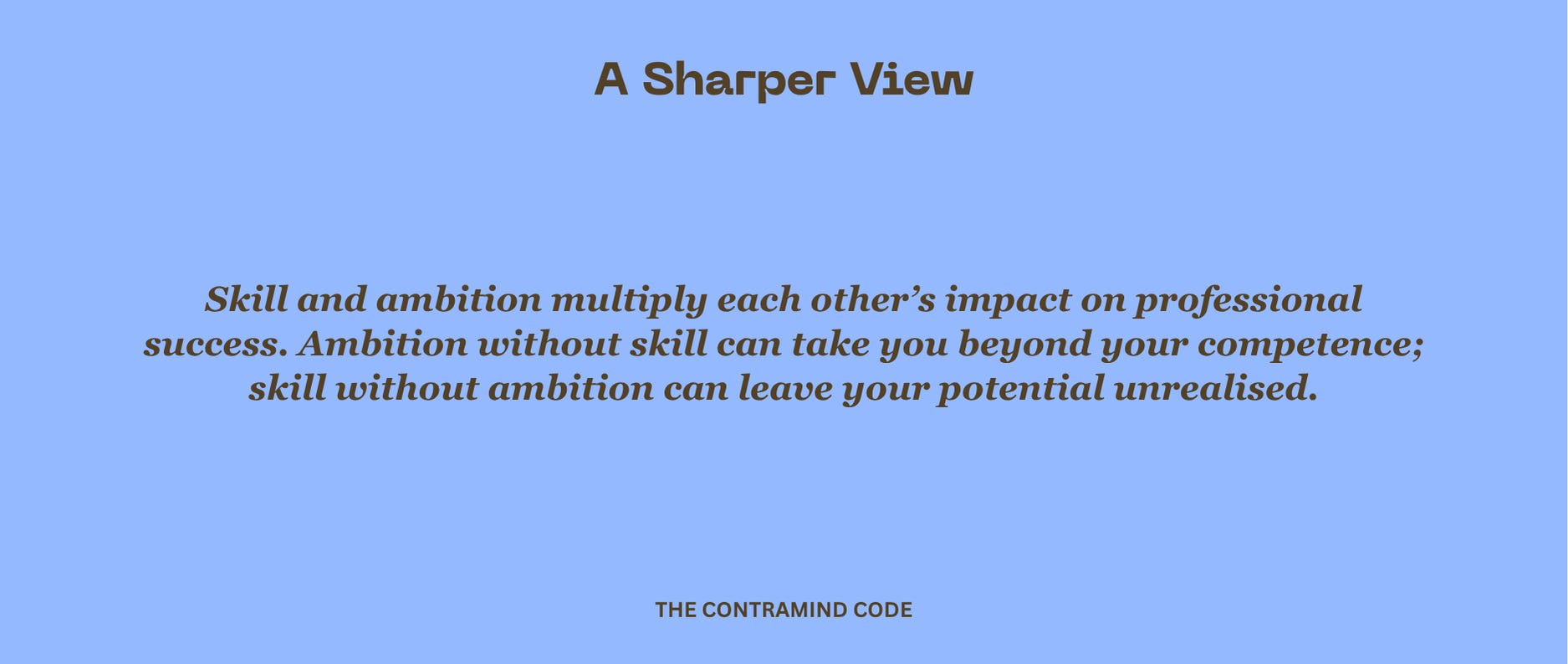
First, as a professional, you need to understand that ambition and skill are distinct constructs. When skill and ambition come together, the impact on performance isn't purely additive, it creates a multiplier effect.
Some professionals or executives think they can compensate for weak skill with more ambition or drive, or for low ambition with deeper expertise. These assumptions are far from the truth when you look at research insights and results.
What Angela Duckworth’s achievement equation fails to explain.
Renowned author, psychologist and professor Angela Duckworth has a very powerful and extremely intuitive achievement equation which defines skill and achievement very well:
Skill =Talent x Effort
Achievement = Skill x Effort
This equation reinforces the widely held view that effort is critical, whether in skill-building or achievement. But it doesn't explain why some professionals apply effort only to improve their skills, while others apply effort to whatever skills they have, only to boost their ambition and, therefore, their achievement. This gap continues to grow between those with skills and those with ambition. Only a few professionals, executives, or senior leaders apply the right amount of effort to improve both their skills and ambition.
Why do some ambitious people lack the skill?
Most executives, senior leaders, or professionals suffer from Dunning-Kruger miscalibration. They tend to systematically overestimate their competence and, over time, become either poor or incompetent performers. In their early years, this may not have affected their growth much, but as they move into senior roles, the gap between what they perceive and what they actually know widens. Consequently, a perceived low skill level reduces their urgency to build skills. Also, many ambitious people mistake recognition for achievement. It leads them to believe, “I’m ambitious, therefore I’m succeeding.” Most of these ambitious professionals end up reaching positions above their competence band without even knowing it.
Why do some skilled people lack ambition?
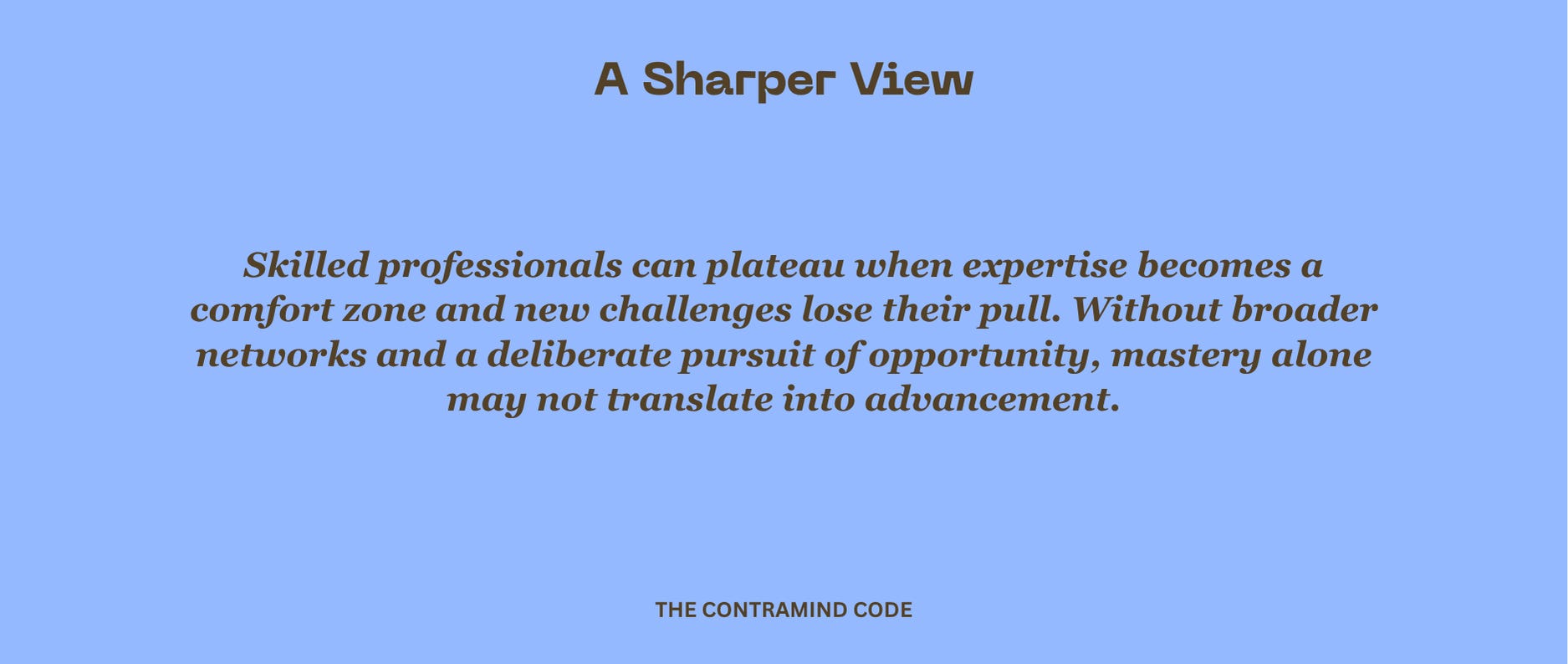
It is a widely known fact that skill is a necessary but insufficient condition for career advancement or growth beyond a threshold. Many extremely skilled professionals plateau not because they're lazy, but because they're stuck in a challenge deficit. When skill outpaces challenge, these professionals who have mastered a certain domain stop striving for higher-order challenges. Maybe taking a cue from the well-known Hungarian psychologist Csikszentmihalyi, who is considered the ‘Father of Flow’, they stop having a sense of flow in what they are doing. Also, they may have entered a comfort zone and got stuck to it. Or they box themselves into a certain boundary of expertise or knowledge and refuse to step outside it. Extremely skilled professionals also tend to get motivated not by status or recognition but by the quality of the work itself. What’s more, skilled professionals who don't build social capital end up hitting an invisible ceiling. Also, skilled professionals can get stuck in similar thinking and behaving within expert communities, which limits their exposure to new opportunities and roles that people in their inner circle don't always know about. Research also suggests that to grow in a career, a professional’s network must include people with influence, information, and decision-making authority above them, not just lateral peers. Skilled professionals tend to associate, bond, or form relationships with people who are similar to themselves. It leads them to believe, “I don’t care about advancement, I care about the work.” This restricts their thinking and their ambition and therefore acts as a bottleneck for their achievement.
So what does sustained, long-standing professional growth and success take?
For sustainable and long-standing professional success, you need more than the right dose of ambition and skill. The proportion and mix of elements may vary from person to person, but having one alone isn't enough and doesn't guarantee you'll go far.
Here’s a precise relationship that can help you understand this better.
Ambition acts only as fuel. Achievement purely indicates the distance travelled.
Skill is like a measure of engine efficiency. Social capital provides access to the road that helps you reach the destination you want.
As a professional, you can travel a great distance on a modest tank if your engine is efficient enough, provided your roads are clear or have sparse traffic - read as not having too many extremely competent people competing along with you.
You can also have a full tank and a powerful engine but still go nowhere if you lack road access. Therefore, building the right social capital is vital.
However, if you have a full tank and social capital but an inefficient engine, you can go some distance but begin to stumble after a while. Energy or passion alone can only take you so far. Continuously improving and upgrading your skills is critical.
In effect, your sustained, long-term professional success depends on four interdependent levers. Their presence doesn't simply produce an additive effect, it produces a multiplier effect. If even one becomes weak, the entire professional success system underperforms. If one is absent, your professional success system tends to collapse and keeps you away from reaching the top orbit. Here are the four interdependent levers:
Lever 1 - Skill: Skill acquisition is not a mere one time exercise. You must see it as a living, breathing system that requires continuous improvement and enhancement. You can’t assume, experience, measured in number of years as helping you build your skills. Also, experience is not an accurate indicator of the quality and depth of your skills. If you don’t keep learning and applying skills every day, your skills will most certainly start decaying.
Lever 2 - Ambition: Ambition is a sort of fuel that sustains your effort over years and decades. Ambition must contain the right amount of fuel to survive failure, obscurity, and long periods without rewards. The fuel in your ambition must be capable of triggering and firing both intrinsic motivation (not contingent on external validation or recognition) and extrinsic motivation (like promotion, salary, designation, recognition, etc.). It must be powerful enough to trigger a higher degree of intrinsic motivation when things don’t go as planned.
Lever 3 - Social Capital: This is not blind, superficial networking skills. It is all about gaining access, respect and attention of people positioned above your current level. It’s is about having access to information about opportunities, or having the capability to act as a necessary bridge to solve problems or come up with alternative ideas or solutions when your professional network is unable to solve them. Your network believes you are the ‘go-to’ person who can help them. Every person you have influenced becomes a node in your network that you no longer have to maintain actively. The network grows through the connections your successors make, not through only the ones you make yourself.
Lever 4 - Non-Linear Impact: The impact and outcome of your thinking and work must not be restricted to your current job or designation or role or company domain. Your impact must multiply through others rather than just be limited to what you personally produce as output or results. It must leave an imprint on:
People: When your thinking becomes the way other people think and act, you have created followers, mentees, and successors who further go on to build more people like how you had carefully planned, nurtured and built them and this goes on to create an exponential momentum of talent and resources.
Artifacts: When you find ways to document proprietary frameworks, designs, methods, and ideas that help people to carry on your thinking or decode your thinking behind the ideas and build on them further, it creates a long-lasting impact.
Institutional effects: Companies become institutions when the entire system runs without the person who built it. A working method or culture you built must have the velocity to develop its own momentum. The company or the function or department that you worked for must be capable of generating value independently of your continued presence.
So, the formula for your sustained, long-standing professional success is:
Professional Success = Skill x Ambition x Social Capital x Non-Linear Impact
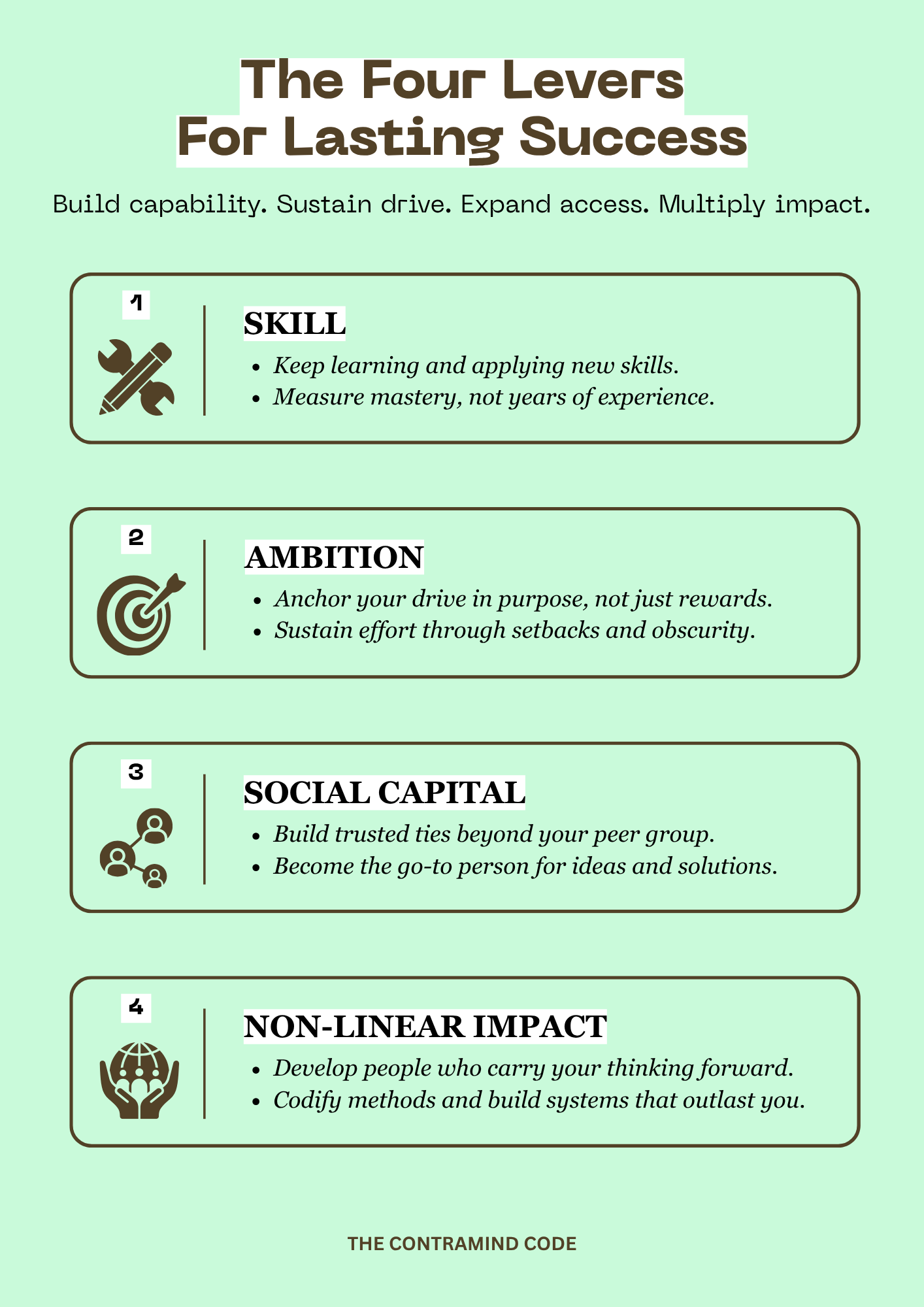
To summarize, if you really want sustained, long-standing professional success, you must keep enhancing your skills continuously, fill up your ambition with the right amount of fuel that can outlast any ups and downs, find ways to become an important, influential node in your professional network that creates valuable connections, and build non-linear impact that outlives your working years.