Introduction
Welcome to The ContraMind Code.
The ContraMind Code provides you with a system of principles, signals, and ideas to aid you in your pursuit of excellence. The newsletter shares the source code through quick snapshots for a systems thinking approach to be the best in what you do. The ContraMind Code helps you reboot and reimagine your thinking by learning from the best, and enables you to draw a blueprint on what it takes to get extraordinary things done. Please share your valuable thoughts and comments, and start a conversation here.
Take a journey to www.contraminds.com. Listen and watch some great minds talk to us about their journey of discovery of what went into making them craftsmen of their profession to drive peak performance.
Are We About To Witness The Slow Fading Of Human Fingerprints In Creative Work?
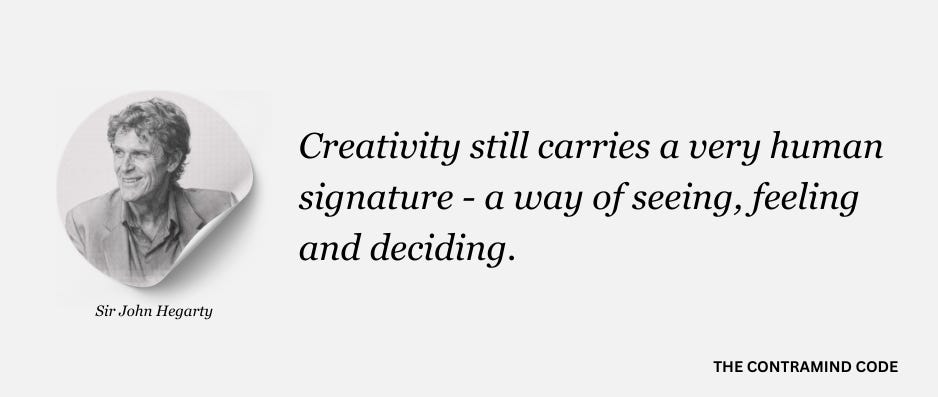
The above line is from an article written by the legendary Sir John Hegarty. He raises important questions about why it is important to first appreciate, then learn, practice, and preserve your creative thinking abilities in the age of AI. While he is talking about a course that they are launching, the points he raises are valuable and worth considering:
“Maybe that’s where we’re heading. Maybe credits will soon come with a breakdown of how much AI was used. 40% machine. 60% editor.”
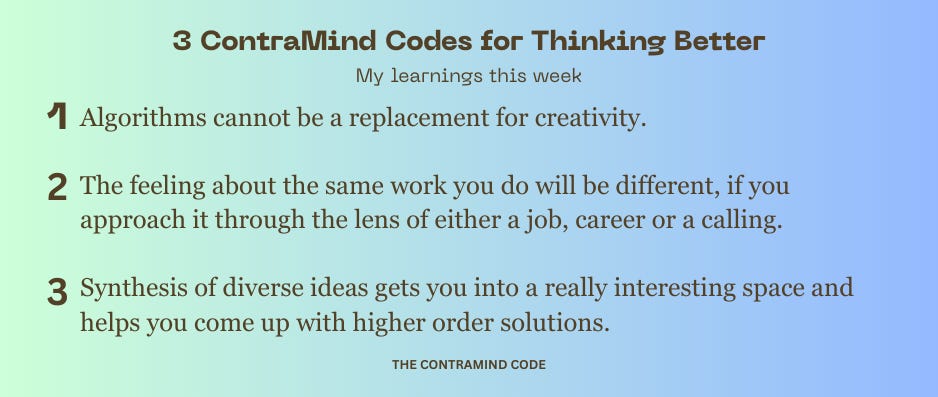
“Creativity still carries a very human signature - a way of seeing, feeling, deciding. The presence of judgement, of taste. You can’t write an algorithm for that.”
“You can’t rewrite the creative process without rethinking responsibility.”
It will be no more about how we produce content but how we assign value - “Recognition will be demanded, not assumed. That’s going to make end credits more interesting. Not just who made the work - but what. And when it says, no humans were harmed in the making of this film, what it really means is: none were needed.”
Read the article here.
You 2.0: The Practice Of Patience.
In the Hidden Brain podcast, this conversation led by host Shankar Vedantam brings focus on two important topics that are vital in your life - patience and finding your calling at work.
The first half of the podcast covers the importance and value of patience in whatever we do, especially in a world filled with credos like ‘fail fast’, ‘get the MVP out quickly’, and those who fuel behaviours which encourage instant gratification. This conversation is filled with tips and ideas on how to build and strengthen your patience.
The second half of the conversation discusses the work you do in three buckets: job, career, and calling. The difference between the three is beautifully brought out by Jeniffer Tosti Kharas, who is also the author of the book Is Your Work Worth It.
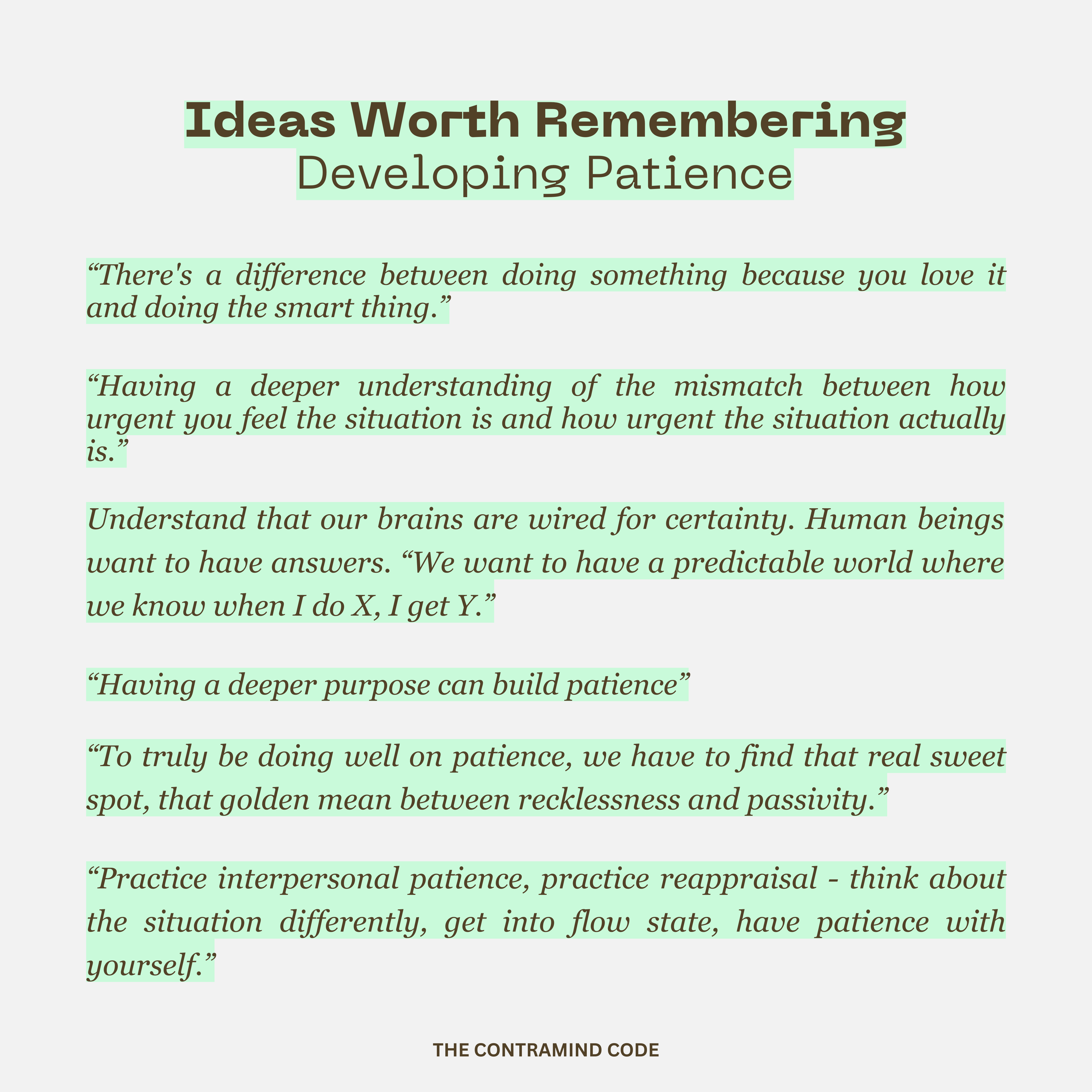
The interesting aspect is that there is a deep correlation between patience and calling at work, and that can be something you can reflect on or think about.
You can also hear this episode on: Spotify | Amazon Music
How To Be A Thinker & A Doer At The Same Time.
In this brilliant conversation, Jim O’Shaughnessy chats with Johnathan Bi. Jim, a quantitative investor, author, and founder of O'Shaughnessy Ventures (OSV), shares his life experiences and learnings. Jonathan beautifully breaks them into acts at different stages of Jim’s life. It also unpacks how not only an individual but also a family can sustain deep integration between action and contemplation while pursuing entrepreneurship, and how the influence of humanities education, history, and the arts shapes all of these.
Here are some thoughts for you to ponder over from this conversation:
“Markets change minute to minute. Human nature barely budges millennia by millennia.”
“Arbitraging human nature is the last sustainable edge.”
“Letters are among the most significant memorial a person can leave behind them.”
“I think that much of history is lost in the edit.”
“You honour your word on a simple handshake. It doesn’t need to be in writing.”
“It's the synthesis of ideas that gets you into a really interesting space. I'm really big on synthesizing ideas and borrowing.”
“Emotional overlays in financial trading decisions are often subtracting value not adding value.”
“I’m a believer in feedback because without feedback, you’re not going to be able to improve what you’re doing.”
“People often times are really painfully unaware of who their true friends are and who their not so true friends are.”
“I personally looked at money as an information system. And when you look at it that way, it makes a lot more sense.”
You can click on the above link and watch this video. It should be a ‘must-watch’ on your list.
Why Cognitive Diversity Outperforms Talent.
A majority of professionals would like to be surrounded by people who think and work like them, creating homogeneous groups or teams. Most workplaces spend a lot of time in interviews, background checks, and references, finding out whether the person will be a fit with their values, culture, and the way he or she works or worked in the past. Or growth in an organisation may be linked to alignment with senior leadership thinking and a similar way of doing things. However, aligning people or teams on core values and culture is very different from embracing ‘Cognitive Diversity.’ There are fundamental values of integrity, mutual respect, accountability, responsibility, ownership mindset, etc., which are non-negotiable. But ‘Cognitive Diversity’ is very different from ‘Homogenous Thinking’.
‘Homogeneous Thinking’ teams look at problems through a narrow lens of what they know or are exposed to. They converge quickly to solutions that emerge from discussions, and they tend to be fast but sometimes end up being fragile. It often ends up with a default approach that leads to the feeling- ‘This is how we do things here.’
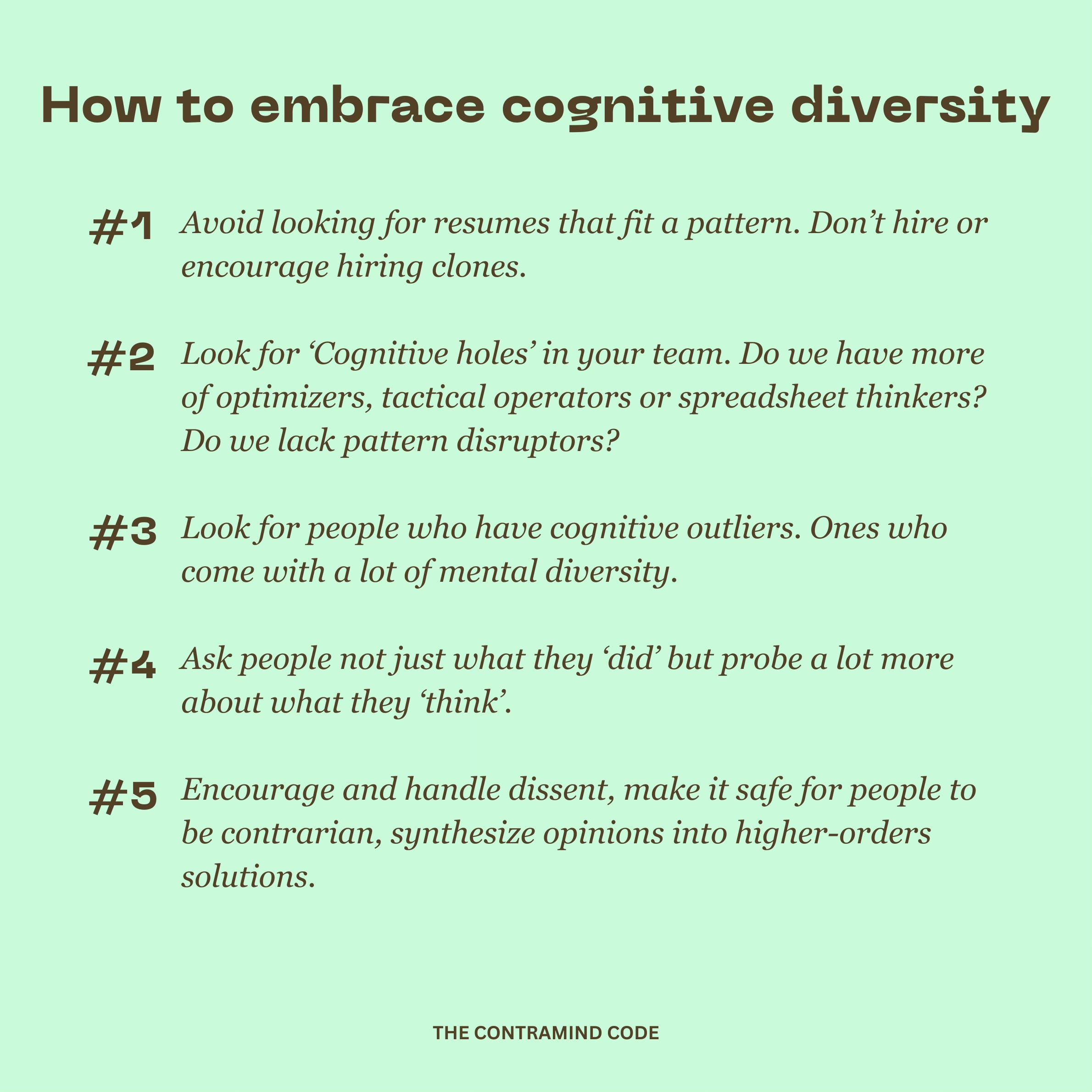
‘Cognitive Diversity’ in a team or in a company’s senior management is defined by how leaders and their teams encourage and handle dissent, make it safe for people to be contrarian, and synthesise opinions into higher-order solutions.
Scott Page, the John Seely Brown Distinguished University Professor of Complexity, Social Science, and Management at the University of Michigan, Ann Arbour, has a brilliant take on solving complex problems. But this is also equally applicable to any simple problem or solution you are looking at, as today’s problems require ‘group dynamics’ to come into play. Imagine if you were somebody trying to solve an Electric Vehicle(EV) strategy problem, you would need:
Design Engineers - Their approach to car design ergonomics must be very different from that of automobile engineers of yesteryears, who placed a lot of emphasis on manufacturing and production systems.
Behavioural Psychologists/Scientists - Ones who study behaviour and habit change, also try to understand adoption barriers to new technology products and usage. They are insight miners across product categories and industry.
Economists - People who must come with knowledge of demand estimation, commodity pricing trends, regulation, government policies, understanding supply chains and price elasticity, etc.
Software Engineers - Those who will need to define application standards and build new emerging platforms like SDV(Software Defined Vehicles). This was not a need in the automotive industry a couple of decades ago.
Futurist - An individual who can foresee autonomous vehicle trends, urban living trends, digital products usage habits, etc.
Marketers - Individuals who bring in the branding, messaging, distribution network and communication blueprint to make the value proposition count.
Each of them will bring in a perspective totally alien to the other, but will play a role in the final outcome. If these perspectives are missing, not understood, or not appreciated by each team member, the strategy will be incomplete. This will have an impact on execution. It is worth noting that most failures in companies are not because of a lack of intelligence, but a lack of perspective.
Professionals or teams with ‘Cognitive Diversity’ play a role in fostering a better understanding of alternative perspectives brought by a diverse set of team members, as in the EV strategy example. They must be able to play with differing perspectives and their impact in their heads. They must be open to seeing a point of view different from their own worldview and discussing it without it becoming a personality issue or an opinion bias. World-class organisations design, plan and are comfortable with such a ‘cognitive collision’ in individual team members and leadership teams.
How do you transform into a company or a professional who embraces ‘Cognitive Diversity’?
When you want to hire, look for ‘Cognitive holes’ in your team. It is vital to be aware of the current gaps. Ask yourself some of these questions:
‘Do we have more of optimizers, tactical operators or spreadsheet thinkers?’
‘Do we lack pattern disruptors?’
‘Do we lack long-term horizon thinkers?’
‘Do we have more risk-avoiders or risk-seekers?’
Avoid looking for resumes that fit a pattern. Don’t hire or encourage hiring clones. Ask people not just what they ‘did’ but probe a lot more about what they ‘think’. For example get a flavour of their ‘independent thinking’ by asking what’s their view of what the industry is not doing right, test their ‘cognitive flexibility’ when they had to change their own decisions or mind on some views they held closely to their heart, their comfort with ‘constraint thinking’ checking how will they operate on a zero budget for a launch or assess their strengths to ‘recognize patterns’ that were early indicators or signals of success or failure. Most people struggle to handle the two ends of the spectrum - between abstractness and concreteness, exploration and optimization, and being rational and intuitive. When, as a team or as an individual, you find people who can’t handle these extremes with ease and comfort, a culture of ‘Cognitive Diversity’ can’t flourish.
Also, find and look for people who have cognitive outliers - professionals who have had non-linear careers, who have cross-discipline experience( may have moved across functions or departments or industries), have been uncomfortable with their career moves, have failed but rebuilt themselves - they are the ones who come with a lot of mental diversity.
When companies, professionals, or teams lack ‘cognitive diversity’, they miss patterns, misinterpret signals, are risk-averse, surround themselves with clones, don’t practice multi-perspective or multidisciplinary thinking, and find it hard to handle multiple thinking styles. This is primarily the reason incumbents never end up being disruptors.
A team filled with professionals having higher ‘Cognitive Diversity’ skill or capability leverage will outperform highly-skilled or extremely competent homogeneous thinkers.
In your pursuit to be the best in your profession, build your capability to have ‘diverse experiences’ or learn from different industries, people or from history so that you can become an ‘orchestrator’ of multi-perspective thinking and action.
Some of the lessons we learnt from this week’s mission: