Introduction
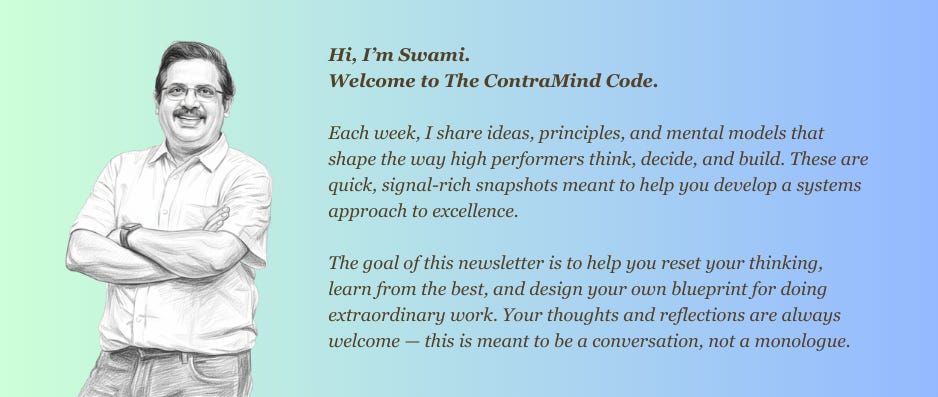
Welcome to The ContraMind Code.
The ContraMind Code provides you with a system of principles, signals, and ideas to aid you in your pursuit of excellence. The newsletter shares the source code through quick snapshots for a systems thinking approach to be the best in what you do. The Code helps you reboot and reimagine your thinking by learning from the best and enables you to draw a blueprint on what it takes to get extraordinary things done. Please share your valuable thoughts and comments and start a conversation here.
Take a journey to www.contraminds.com. Listen and watch some great minds talking to us about their journey of discovery of what went into making them craftsmen of their profession to drive peak performance.
As AI Eats Web Traffic, Don’t Panic—Evolve
In an insightful article drawing on Kelly Cutler’s perspectives, Rob Mitchum, editor-in-chief of Kellogg Insight, explores why businesses must reexamine their strategies and adapt to the way AI is reshaping search.
Here are some key takeaways from the article:
Adjust your SEO strategies and focus more on GEO (Generative AI Engine Optimization), as users get their answers from AI-generated summaries or responses rather than clicking a link.
Track more nuanced engagement metrics, such as time spent on your website, how long they spend on each page, and which types of content they engage with.
Lean into personalisation - With organic search traffic in decline, companies should also expand their customer targeting. Think beyond segmentation and get even more granular.
Read the entire article here.
The Multidisciplinary Approach to Thinking | Peter D. Kaufman
In this episode, Shane Parrish, host of the Knowledge Project Podcast, discusses his learnings from Peter D. Kaufman, Chairman and CEO of Glenair.
It’s a 30-minute episode, and it is filled with lessons that you can never get anywhere else. Here are some key points from the episode:
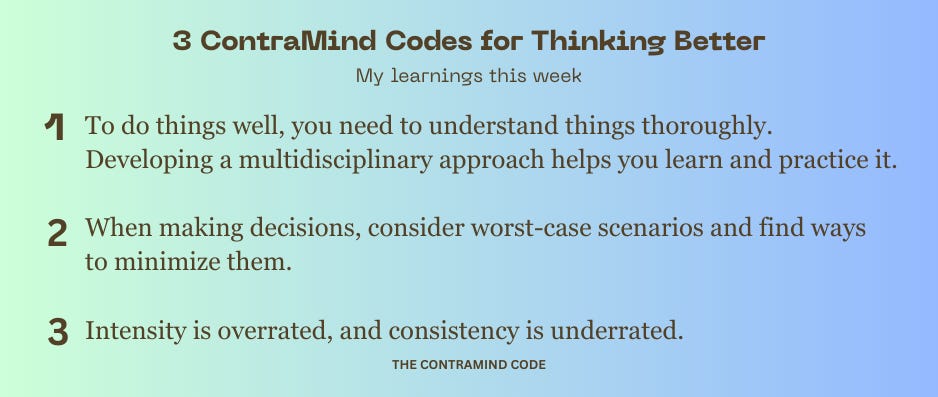
When you develop multidisciplinary thinking, you do things well because you understand them thoroughly.
“When you truly understand something, you don’t make mistakes.”
“The world doesn’t organize itself into neat academic departments. Problems don’t come with labels like economics or psychology or biology.”
Learn big ideas from different disciplines.
“If you can get over the momentary fear of looking like an idiot, the uncomfortableness of that, then you can accomplish amazing things.”
“Intensity is overrated, and consistency is underrated.”
You can also listen to the episode on: Spotify | Amazon Music
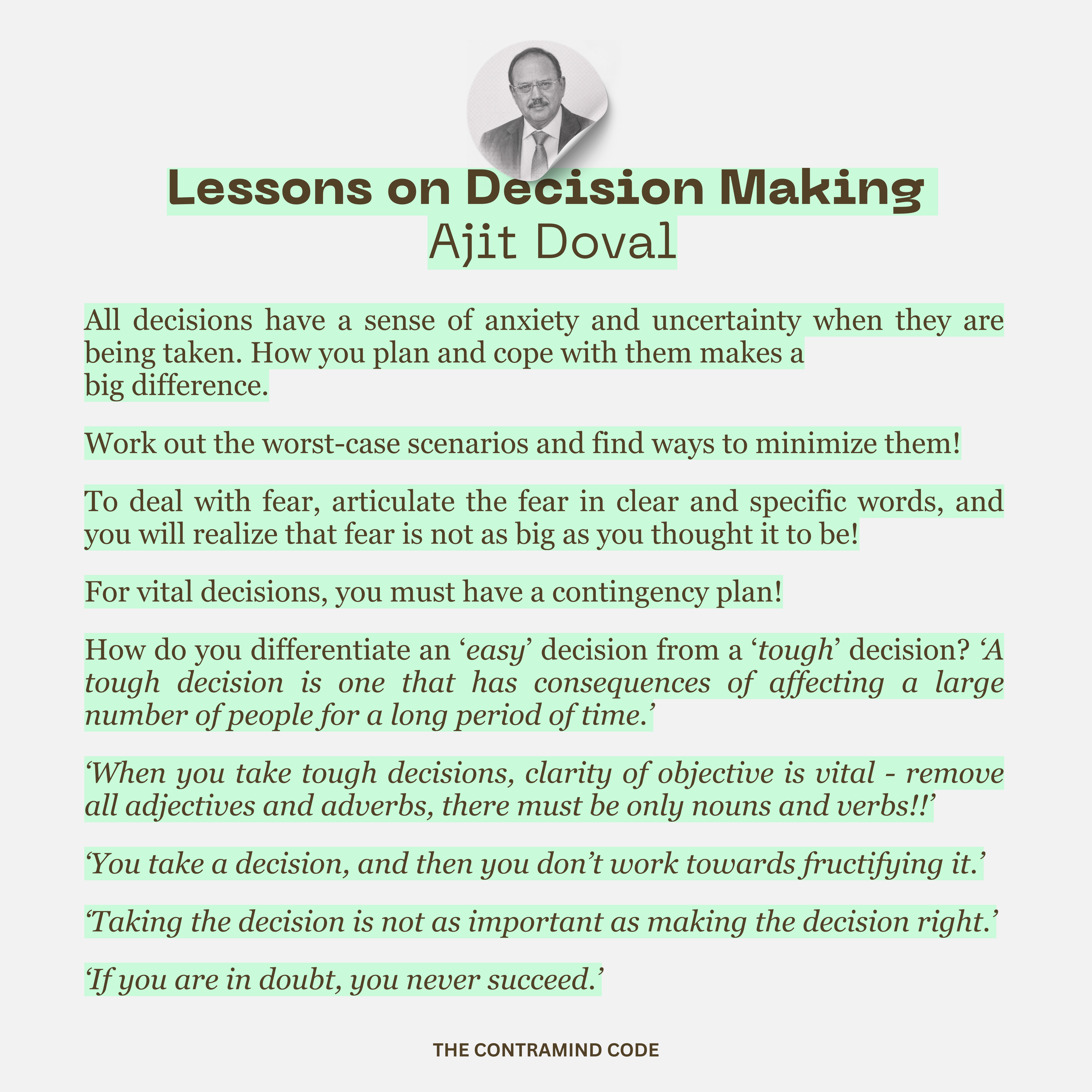
Decision-Making Lessons From Ajit Doval.
We have read about leadership lessons from the US Navy SEALs, whose stories, methods, and lessons are widely celebrated and written about. Their leadership emphasises decentralised command, extreme ownership, and adaptability, and trains leaders to make critical decisions in chaotic environments by empowering junior members, focusing on the team over self, and embodying traits like quiet confidence, discipline, and continuous learning.
This conversation, in the first half of this video, with Ajit Doval, National Security Advisor to the Government of India, offers remarkable insights into his thoughts on decision-making, including how to address fear, anxiety, and decision-making under uncertainty. As he puts it, knowing when to make a decision and when not to is also important.
Here are some powerful insights from this chat:
Why Consistency Beats Intensity.
In any company across the world or at any workplace, people who display intensity automatically get the attention and the recognition. Workplaces tend to celebrate people who do the night-outs, dramatic turnarounds become part of a company’s water-cooler conversations, get senior management or leadership focus, weekend work to push things for closure gets all the kudos, and sprint culture amplifies the intensity of efforts. Intensity creates peaks and becomes much more episodic, while consistency compounds cumulatively.
Intense performers tend to become heroes overnight in companies because effort is a lot more visible. Consistent performers do it quietly through a hard grind of daily reviews and disciplined documentation, striving for incremental improvement in every process and output. Intensity glorifies firefighters, however, consistency helps silently build fireproof infrastructure and systems that make the building and foundation resilient.
Intensity often makes managers and leaders jump to conclusions and make wrong judgments about people, and also about the quantity and quality of the work they have accomplished. When intensity is given more importance than consistency in a company, performance suffers or collapses when circumstances, context, people or market conditions change. Consistency, on the other hand, is based purely on resilience, as it relies on habits, discipline and routines rather than emotion.
One marker of performers with a consistency DNA is their tenure and growth within a company or in their chosen area of work or profession. You will see a high correlation between growth and long tenure in a company, or the ability to stay on top of their profession for a long time. Performers with higher intensity DNA will have relatively shorter tenures than those who tend to be consistent in their approach to their work.
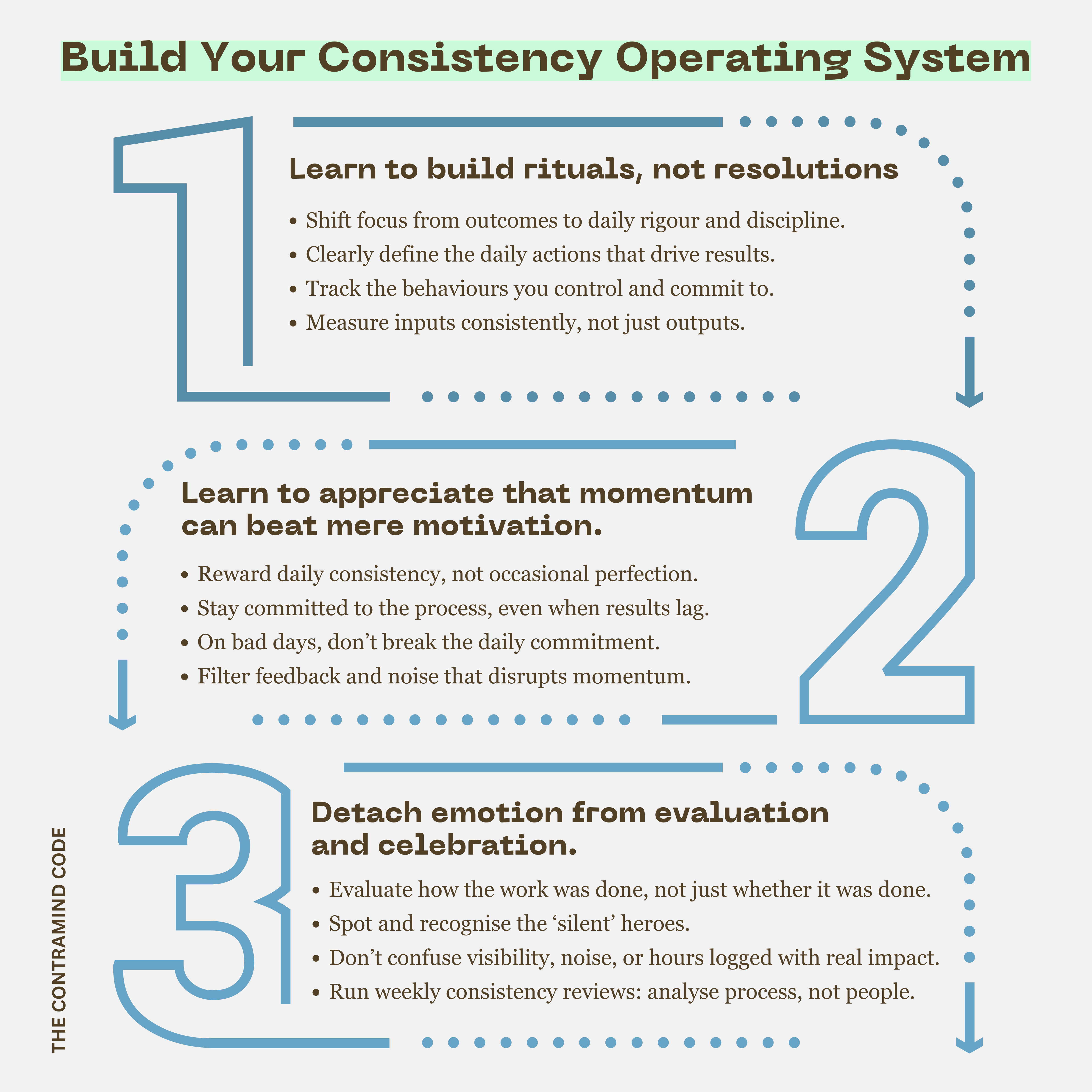
How can top performers build a ‘consistency’ operating system?
Learn to build rituals, not resolutions.
Don’t focus just on results or targets, focus on the daily rigour or discipline.
List down what will be done every day to achieve the results or targets.
Track behaviours or habits you have committed to and have control over.
Measure inputs in addition to just outputs.
Learn to appreciate that momentum can beat mere motivation.
Reward yourself or the people you're working with for being ‘good’ every day rather than ‘being perfect’ periodically.
Even if the results are not as expected or take longer than anticipated, stick to your regimen rather than quit or get disheartened by interim setbacks.
Overcome good or bad days by not missing what you committed to doing every day.
Filter the noise or feedback that can pull you back.
Learn to suspend judgment and emotion when evaluating or reviewing or celebrating work.
Understand ‘how’ work got done rather than ‘if’ the work got done.
Spot and recognize the ‘silent’ heroes.
Don’t get swayed by the ‘after-office hours’ email, meeting lengths, or the loudest or most articulate voice in the room.
Do a weekly consistency review - Number of times or instances of when what got committed vs what got done? Who committed vs who missed? Analyse the root cause of the process, not the person.
Intensity is fragile and often depends on mood, fear, an adrenaline rush, or personal likes or dislikes with the specific work, project or client. While consistency converts experience into expertise over time through rigorous focus on incremental momentum, progress and improvement.
Intensity creates people-dependent firms, while consistency creates process-dependent firms that are more resilient and enduring.
To become a world-class firm, companies must develop the capability to create the right balance between intensity and consistency. To become a world-class professional, you must develop the right mix of intensity and consistency in everything that you do.
Some of the lessons we learnt from this week’s mission: