
Why GPA Is Not The Best Indicator of Future Performance!
It’s conventional wisdom that when you look for people to hire, you look for the highest credentials, best grades, most prestigious institution, and the best market compensation to attract them. This is what most companies, startup founders, and HR departments optimise for. Most senior executives and leaders in companies go through this Pavlovian behaviour and are conditioned to it. Hours of effort go into sifting through resumes and potential profiles, shortlisting them, and interviewing a bunch of them by different people within the company before they decide on one. A year or two later, there are these questions and doubts that arise:
Why did this person decide to quit so early?
Why is this person not performing as we had expected them to?
Why is this person not firing as well as we had thought they would?
Why is this person not fitting into our culture despite all the credentials?
Why is this person failing when it comes to team dynamics and working?
If you are an individual who goes through these situations, you feel perplexed and confused, as you were always told, “work hard to get into the best colleges or schools, get an awesome GPA, and life is made.” You are also left with these questions: “What broke? Why did this happen? What’s not working? I did all the right things that I was told, but is there any reason why I ended up in this situation?”
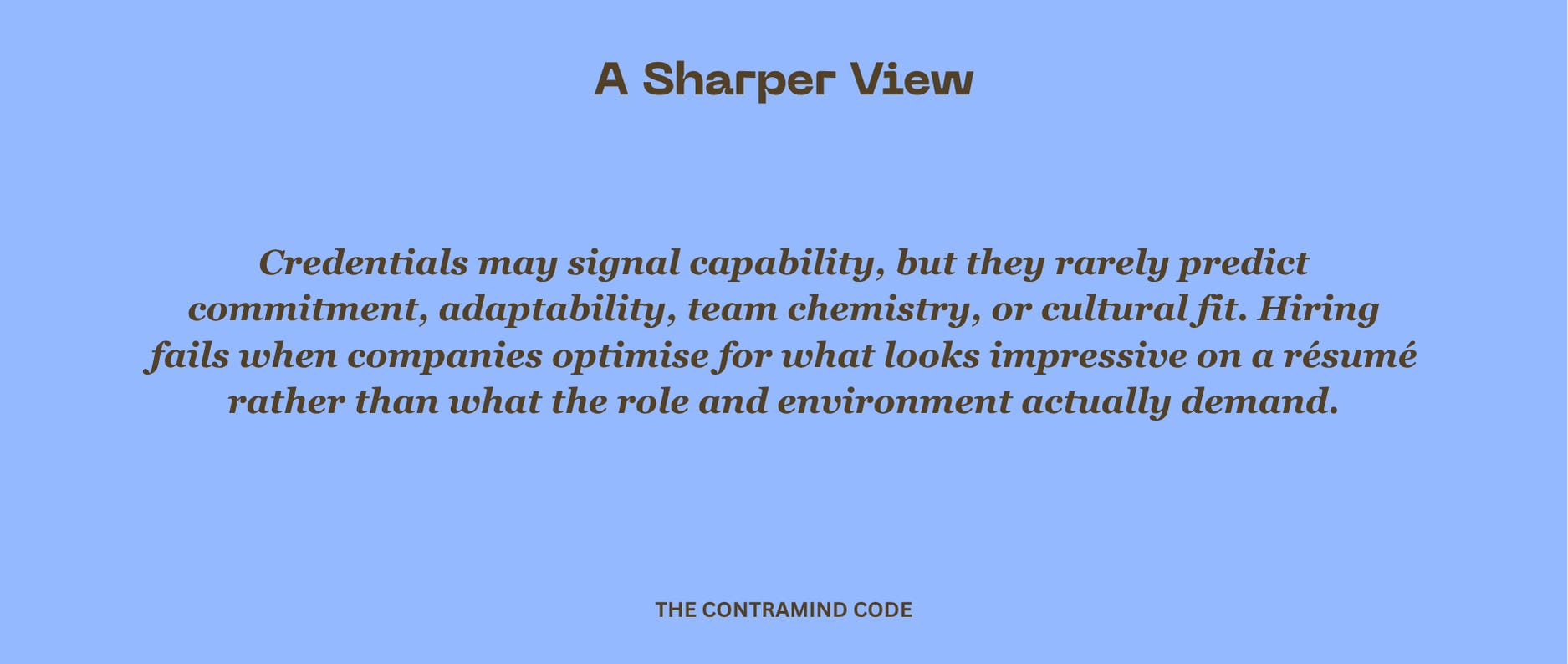
Research leads to some surprising but shocking truths.
In an interesting but thought-provoking research study published by Google, where they analysed their internal hiring data, they found that GPA is not correlated with job performance after 2-3 years of work experience. Lazlo Bock, Google’s erstwhile head of people operations, said, “GPAs are worthless as a criteria for hiring, and test scores are worthless - no correlation at all except for brand-new college grads, where there's a slight correlation." If candidates were more than two or three years out of college, Google stopped asking for transcripts and GPA scores. In another landmark 2022 study, researchers found that students were studying primarily to satisfy external demands like parental expectations, fear of failure, and grade competition. These students demonstrated high short-term performance on exams, but their performance deteriorated on complex reasoning tasks where intrinsic engagement was required. The GPA they produced is real. However, the motivation structure that produced it is not predictive of sustained complex performance.
What’s even more fascinating is that another 2024 study, which looked at various research studies over eighty years, further corroborated the above finding. This study, which looked at over 114 research findings across 47000+ data points, confirmed that academic performance predicts early performance, but its predictability weakens rapidly with experience. The study found that the mean correlation between academic performance and job performance was just 4.4%! What is more stunning about the finding is that the insights thrown by the 2024 study are not very different from a 1998 study that was done before this!
This leads to an interesting question: what explains this poor correlation, and what are the best indicators of good performance as people gain experience?
Many studies show that academic performance is merely a good predictor in structured learning environments. However, the real problem is that jobs are not structured learning environments. Another Google study provides some answers to this problem. In a study called Project Oxygen, conducted in 2008, they tried to measure the effectiveness of managers and found that, of the top eight attributes, technical expertise was ranked last. The top attributes that were highlighted in this research were behaviours and interpersonal capabilities, which included:
Being a good coach
Ability to empower the team
Inherent ability to express interest in team members' well-being
Having the ability to be productive and result-oriented
Communicating and listening well
None of the GPA scores measures these attributes!
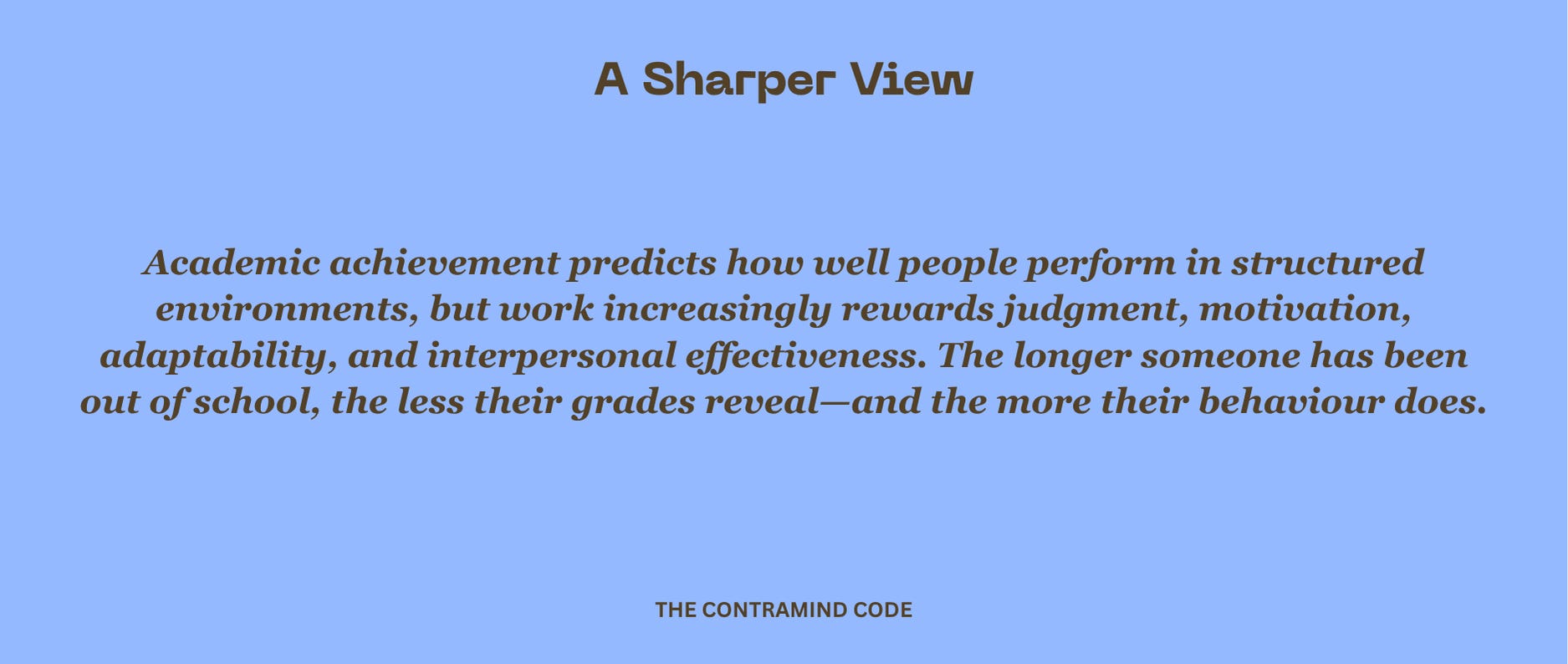
Therefore, it’s not about hiring the best people but the right people. For individuals, it is about being aware of whether it is the right job where they can fit.
First, let’s look at the difference between best and right people.
The best people have the right credentials, GPAs, etc. However, what’s the definition of ‘right people’? Jim Collins, author of the best-selling book Good to Great, has an extremely good definition of ‘right people’.
Shared core values
Are strong on self-management (no tight supervision needed)
Have demonstrated exceptional ability
Have an ownership mindset
And is someone who you would hire again knowing everything you now know about them.
Very often, ‘right people’ is confused with ‘like us’ or ‘like me’ by most people. This is disguised under the name of ‘cultural fit’, which is not right. Most often, this leads to looking for people with a similar social or ethnic background, personal working style, shared leisure interests and hobbies, etc., which loses attention and focus on the top five attributes that Jim Collins mentions as most vital but often get missed.
Another aspect of the right people approach also depends on the kind of company and situation that the role or job requires. Some of the best people can’t work in startups because belief and resilience matter more than a credentialled track record, and there are great startup folks who just can’t perform in a large, structured organisation because they need to constantly influence and align people, need diplomatic skills, and the decision hierarchy frustrates them. Therefore, behavioural and interpersonal capabilities play a more important role than GPAs, as they matter a lot less in these scenarios. Here’s where the person-organisation fit begins to influence a lot more than just grades or scores.
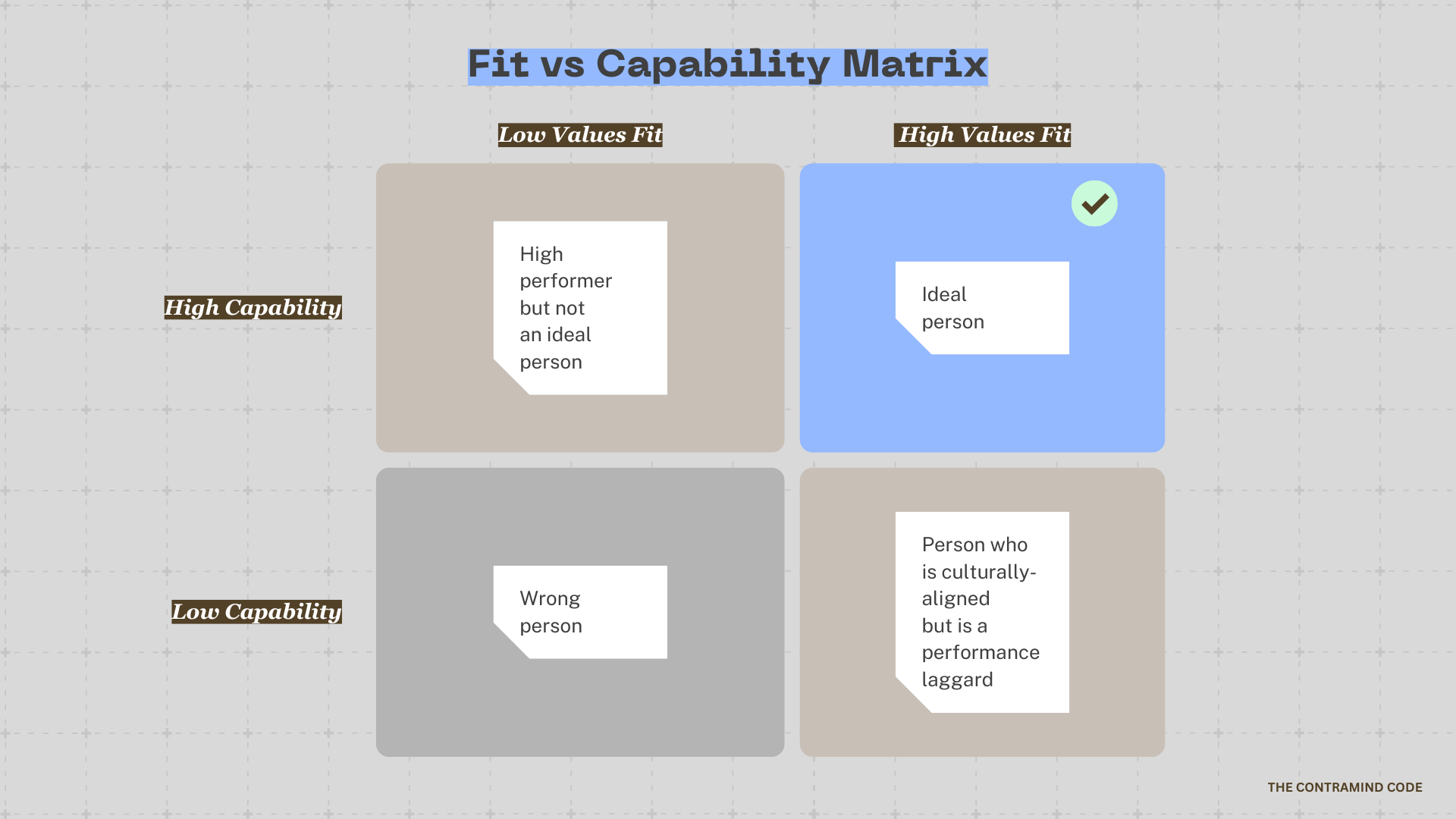
One of the best frameworks to consider while hiring, rather than just looking at credentials or GPAs, is to place the person across a Fit vs Capability matrix.
Apply the football analogy.
A football team selection makes this idea come alive even more.
As a football coach, it is vital to select a striker who can score goals — that is the minimum capability criteria. But if that striker does not follow the tactical discipline or erodes team morale, their individual ability gets neutralised. Many celebrated and successful coaches have done this. Mourinho let Arjen Robben leave Chelsea, Guardiola let Zlatan Ibrahimović leave Barcelona, Ferguson dismantled Paul Scholes’ era — not because these were poor players, but because the fit had broken. But Guardiola’s Barcelona from 2008–2011, arguably one of the greatest club teams in history — had Messi, Xavi, and Iniesta. Not just “right.” Also, genuinely “best.” The winning condition is understanding both are important.
What does all this mean to you?
You may be a high-or low-GPA person, but what determines success in the workplace is how you improve your behavioural and interpersonal capabilities. All these attributes matter even more as you gain experience, and they help improve your performance. The rest can be learnt once you are motivated. Your GPA score is only an indicative factor of your ‘controlled motivation ’-you did it for reward or to avoid punishment. However, your performance at work is an indicative factor of your ‘autonomous motivation ’-doing the work because it aligns with who you are and what you want to do. In this context, a low GPA could be an indicator of high ‘autonomous motivation’ but a poor match to the academic structure that person was subjected to. It does not need any more importance or attention than that. It is also vital to remember that, during your school days, many students who excelled at ‘controlled motivation’ may have resorted to just strategic/surface learning, barring a select few. Most of them would have studied with a focus on the exam, optimised for grade metrics, and performed well in the structure that generated the GPA. This structure disappears in employment, and this gap accentuates with experience. What is needed at work for top performance is a factor beyond the GPA -‘autonomous motivation ’-and asking this one critical question: “Am I doing the work because it aligns with who I am and what I want to do?” Once you answer this question, performance is an outcome with a certain degree of certainty.