Introduction
Welcome to The ContraMind Code.
The ContraMind Code provides you with a system of principles, signals, and ideas to aid you in your pursuit of excellence. The newsletter shares the source code through quick snapshots for a systems thinking approach to be the best in what you do. The ContraMind Code helps you reboot and reimagine your thinking by learning from the best, and enables you to draw a blueprint on what it takes to get extraordinary things done. Please share your thoughts and comments to start a conversation here.
Take a journey to www.contramindslabs.com. Discover a complete system for ambitious professionals who refuse to plateau, and also a place where you can listen and watch some great minds talk to us about their journey of discovery of what went into making them craftsmen of their profession, to pursue excellence and drive peak performance.

Prof. Sanjay Khosla, Senior Fellow and Adjunct Professor of Marketing at Kellogg School of Management, offers a common question many people ponder about: “When is the right time to quit the company I am working for?”
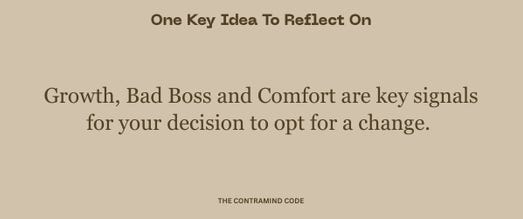
Prof.Sanjay Khosla writes in Kellogg Insights that “It’s better for career growth to err on the early side.” He identifies three signals that will help you make this decision:
Signal #1: When your growth stalls
Signal #2: When you have a bad boss
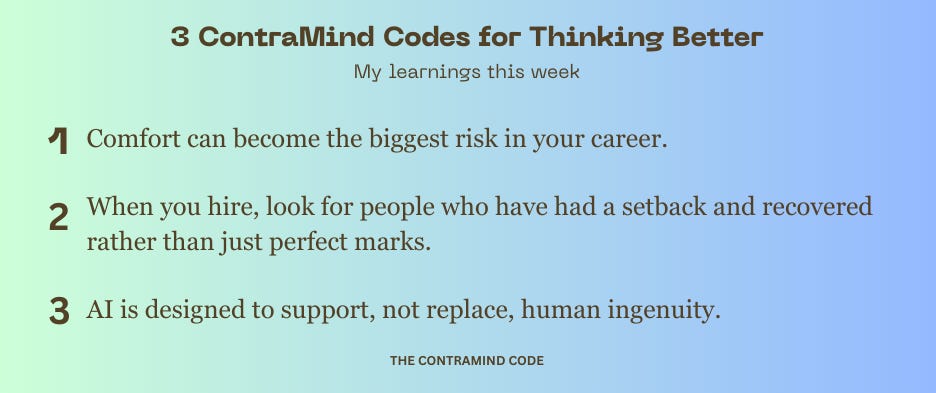
Signal #3: When comfort becomes your biggest risk
Read the entire article here.

We have often observed that what goes out of fashion can make a strong comeback when the fundamentals of the concept or design remain compelling. Also, the concept or idea can go into hibernation for a couple of years, but in moments of crisis or disruption, old world models and thinking make a strong comeback. That’s exactly what's happening to media planning now. In this The WARC Podcast, Paul Stringer, Managing Editor of Research and Insights, WARC, is in conversation with Jonathan Rigby, who is Global CSO of Omnicom Media.
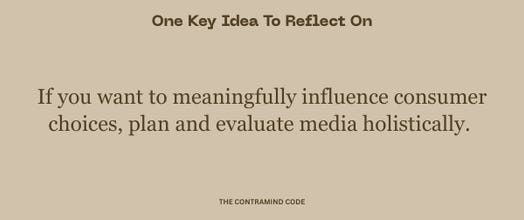
Here are some thoughts and ideas for you to reflect on from the conversation:
“The job of planners isn’t to plan media in the traditional sense, but design systems that listen, adapt and influence in real time.” This is where systems planning is gaining traction in media planning.
Media agencies must transform themselves into orchestrators who can make the client’s entire marketing ecosystem work more effectively.
AI is swallowing a large part of media execution.
“84% of us are using at least one or more search tools than they were a year ago. And 77% are using multiple platforms for search in a single session” - Search is undergoing a fundamental transformation.
An era of interdependence between creative and media is returning with the rise of AI.
In this video, the HBR conversation between Adi Ignatius, Editor at Large & Co-Host of IdeaCast at Harvard Business Review, talks to Bob Sternfels, Global Managing Partner, McKinsey, on a wide range of topics that include the transformation McKinsey is going through from being ‘an advisor to an impact partner’ for companies, moving from pure advisory services to outcome-fee based models etc.
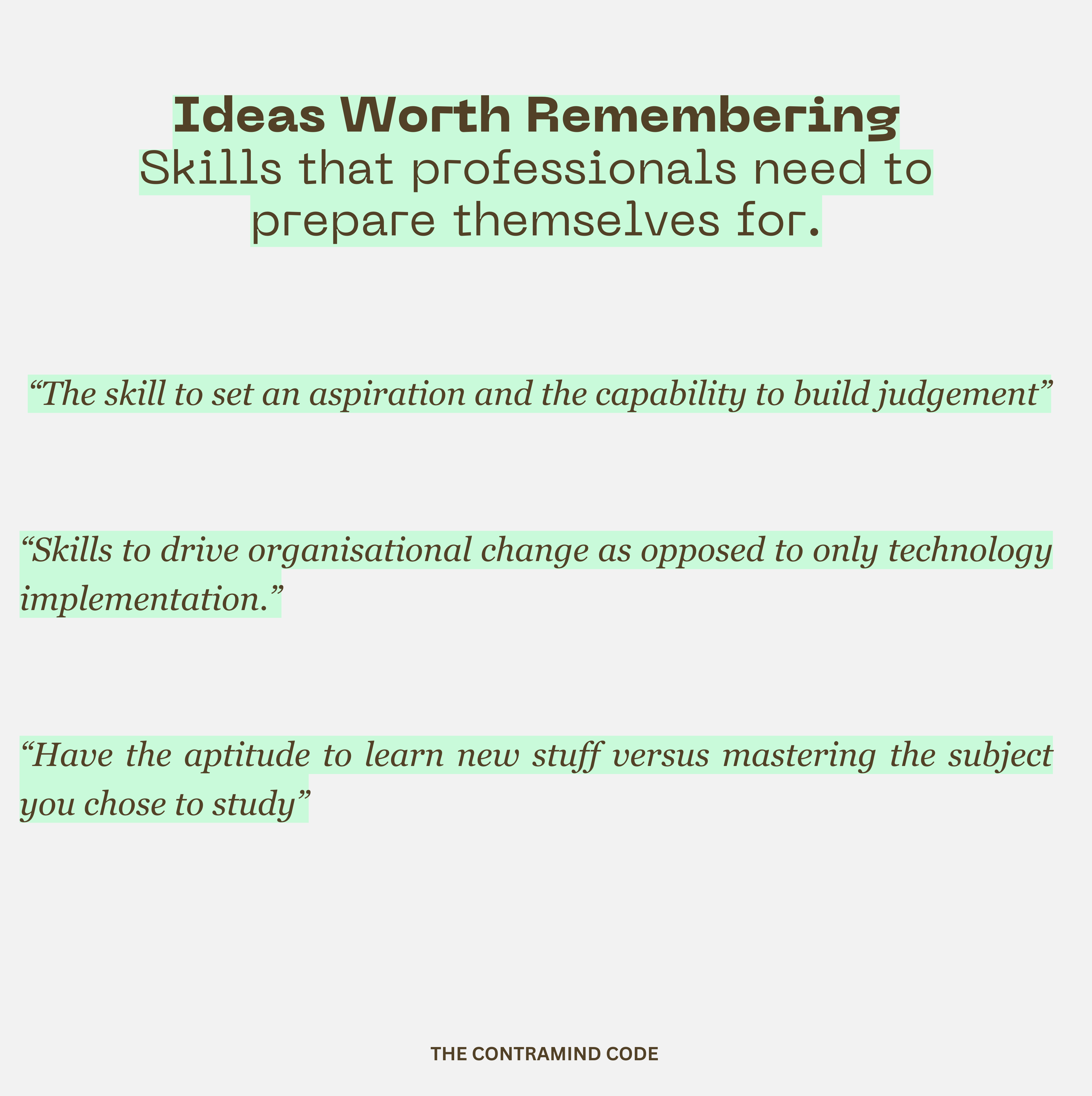
However, what’s more interesting is the kind of talent they are looking to hire, which is an indicator of the skills that professionals need to prepare themselves for in the future:
“Did you have perfect marks versus did you have a setback and recover. So we've changed the process to look for resilience”
“We are indexing higher for real experience, in a significant way, working with others.. You've had to engage with others. And it's built skill of human-to-human skill.”
“Have the aptitude to learn new stuff, versus (having) mastered the subject
that you chose to study?”
‘The skill to drive organizational change as opposed to technology implementation.’
“One of the great things leaders do is they help set an aspiration
and get people to stretch. So we’re focusing on that. The second is judgment.
There’s no judgment in the model. Humans need to impose those parameters. So, how do you build judgment, and how do you build that capability?”
You can click on the above link and watch this video.
You live in a world where information and knowledge are increasingly commodified and abundantly available. What’s becoming more and more important is the ability to improve your judgment when all the answers and information are available in front of you. Today, you can ask a question about a problem you are facing to an AI agent, and it will throw a truckload of answers. It throws back at you many perspectives you may never have considered or been aware of. But the key to your decision in selecting the best possible answer(s) to your questions is where you will have to apply your judgment. And that is becoming the most critical skill for professionals to succeed in the future.
So, what is judgment?
According to London Business School:
“Judgment is the ability to combine knowledge, experience, context, and values to form a sound opinion or decision under uncertainty.”
The key words to focus here are experience, context, values and uncertainty. AI will provide all the information and knowledge accumulated from many sources over many years. It’s your ability to apply your judgment to pick the right answers for your problem that will make a difference.
How do you develop judgment?
Judgement comes from real-world experience, which is unique to your situation and your context. Renita Folds, Director of Professional Education at Georgia Tech Research Institute, says that "…It's crucial to understand while AI may automate certain tasks, it's designed to support, not replace, human ingenuity, opening doors to new opportunities and greater productivity."
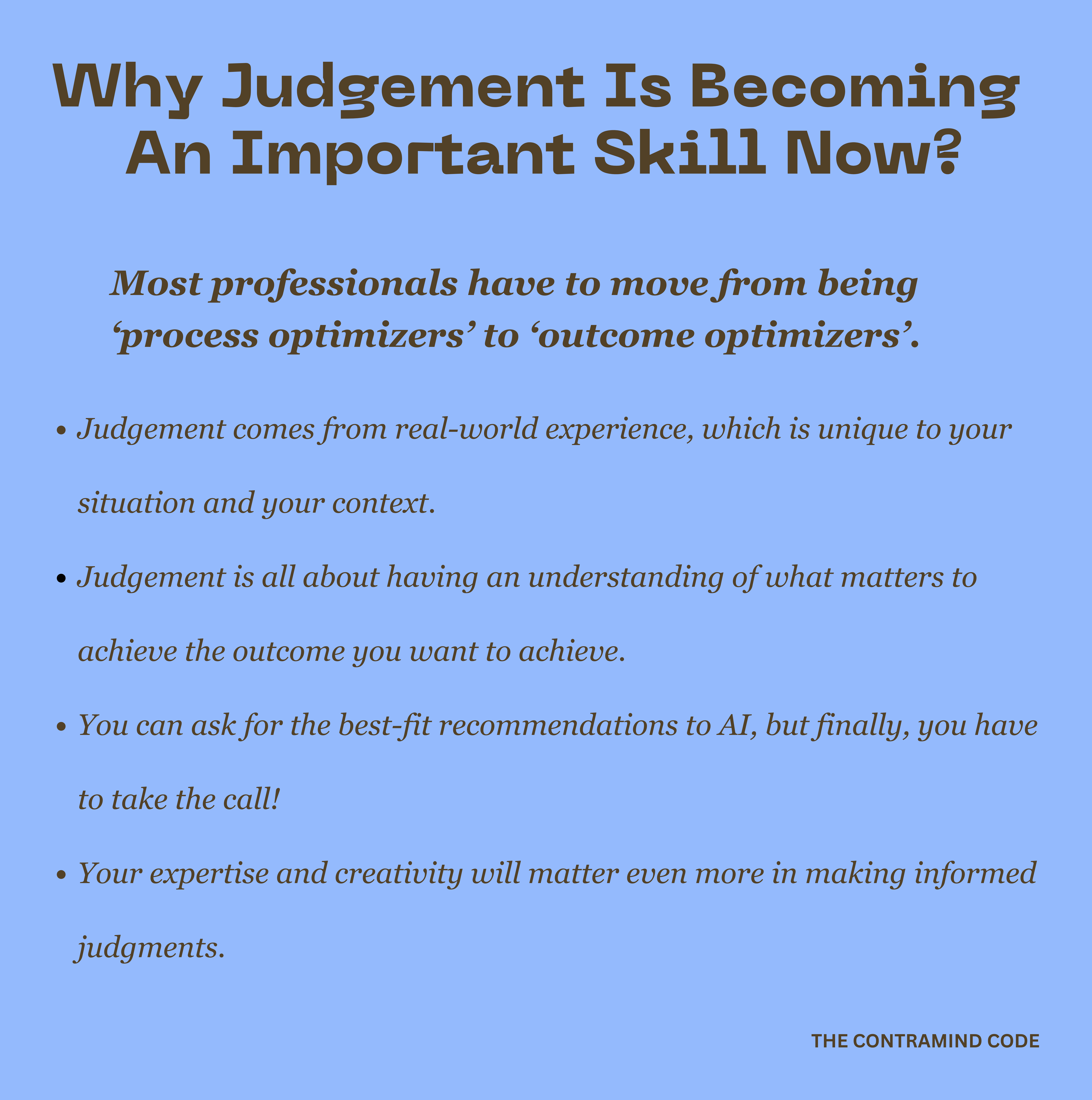
Data and judgment are complementary levers that you need to be good at when making a decision. Judgement is all about having an understanding of what matters to achieve the outcome you want to achieve. You can ask for the best-fit recommendations to AI, but finally, you have to take the call! You can’t go to your company and say you made the decision because AI recommended it. This is where your judgment based on experience and context comes into play. The pressure on your judgment will begin to increase exponentially in the future. You will be valued for asking the right questions and picking the right answer that matters. So, here are some key steps to get better at judgment:
Develop the ability to ‘interpret the meaning’: You will have all the facts, statements and numbers that matter. But your ability to understand why some of these matter more than others, what these signify as underlying signals that are hidden behind them, and the ability to foresee the implications of action, if taken using all of them, will become vital.
Improve your ability to not just ask questions, but ask interconnected questions: Judgment does not get better if you just learn to ask questions. Yes, that is important. But judgment means ‘layered inquiry’. AI can generate many answers, but it will require enhanced skills in asking the right sequence of questions for each answer. A network of questions from your side will prevent you from making shallow decisions. You will need to develop the ability to connect facts to context, consequences, timing, etc.
Make your experience ‘intentional and deep’ - In the past, your number of years of work experience may have been equated with expertise by companies. Work experience will no more be a competitive advantage. As knowledge becomes abundant and intelligence gets automated, developing domain depth in your chosen field, carefully nurtured and built over years, allows you to ‘recognize patterns’ beyond data. Making your experience count will be crucial.
You can no longer ‘manage’ your way to professional growth. It will no more be a case of ‘professional coordination’ of management of people, resources and tasks. Most professionals have to move from being ‘process optimizers’ to ‘outcome optimizers’. That will require strong judgment skills, drawing on knowledge, experience, values and context.
As prediction becomes cheap, judgment will become expensive. Your expertise and creativity will matter even more in making informed judgments. Improving your judgment will help you synthesize insights into action.