How to Start a Career When AI Is Doing Your Entry-Level Job.
Katie Parrott is a staff writer at Every, and in this article, she provides valuable advice and insights on how to approach your career if you are just starting out in the age of AI. In fact, the advice is so practical and relevant that anyone, whether you are beginning your career or at the mid- or senior level, can take many takeaways to apply them in your workplace.
Here are some thoughts and recommendations she makes for you to think and reflect on:
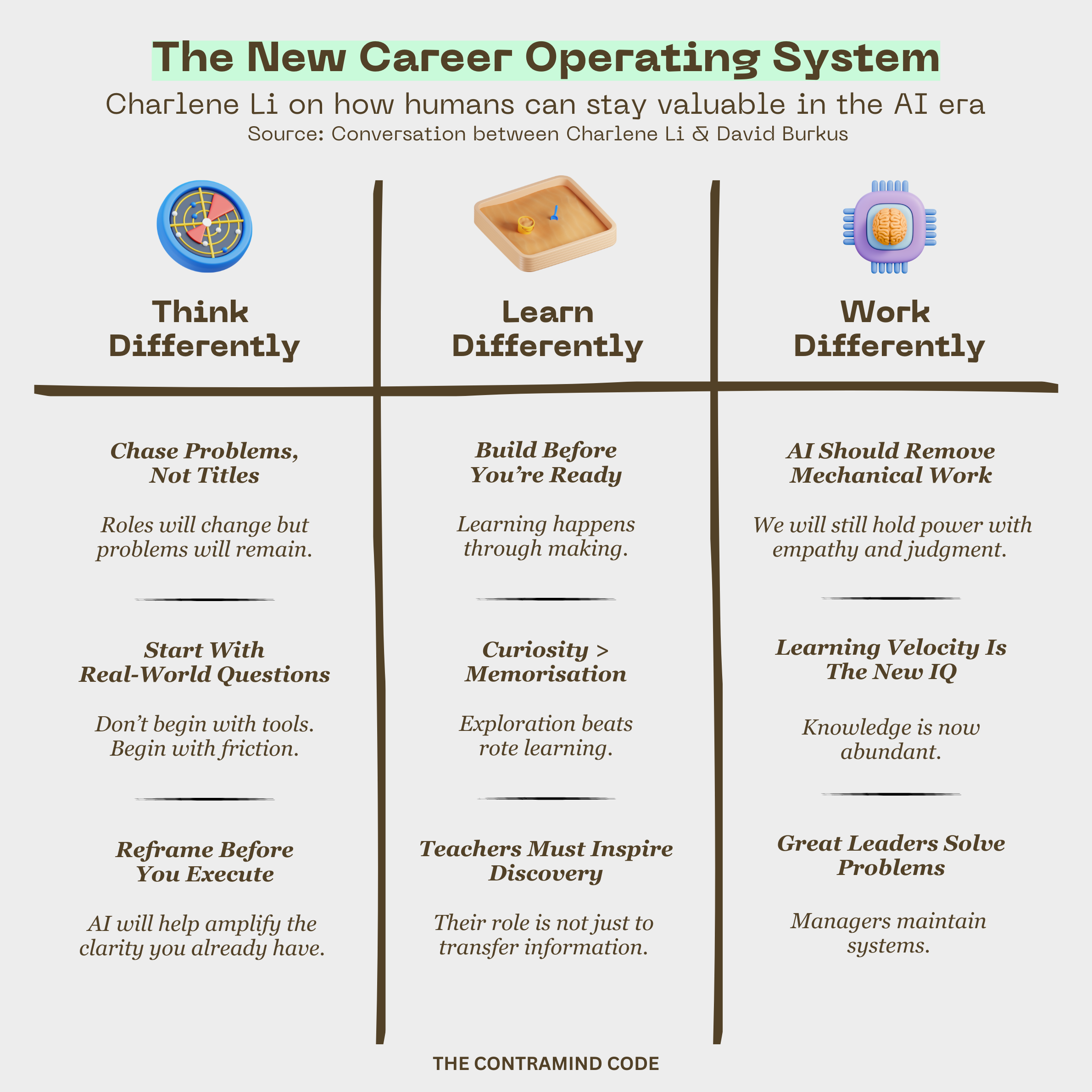
Chase problems, not professions: “The role of “content marketer” or “data analyst” may shrink, split, or even vanish, but the problem behind those titles—how to get a stranger to pay attention to something they didn’t know they cared about, how to make sense of a pile of messy numbers—will still be there, and somebody will still be paid to solve it.”
Choose one discipline to protect: “Once you’ve picked your problem, pick your craft, whether it’s writing, building, researching, designing, strategizing, or operating. You don’t get any good at anything until you’ve done it many, many times.”
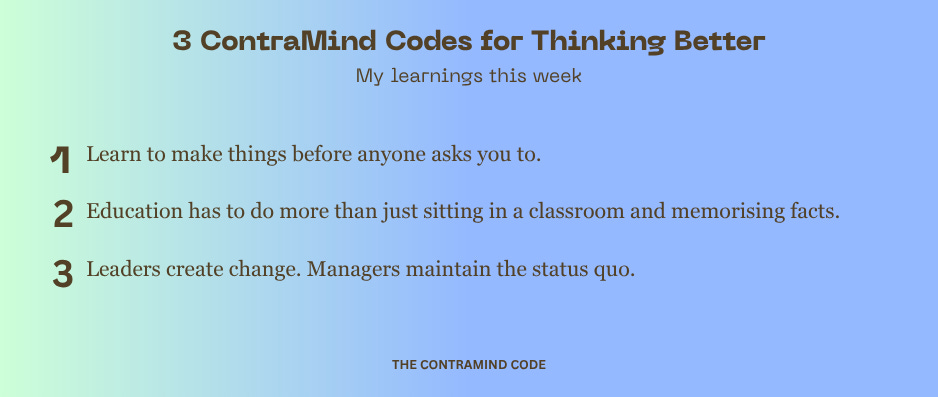
Make things before anyone asks you to: “Pick the thing you’d want to use yourself, and make it. Once your work gets you in the door, the conversation that follows is going to be about how you made it.”
You can read the entire article here.
Building Robots To Get Kids Hooked On STEM Subjects.
In the Working Scientist Podcast series, Solomon King Benge, Founder & Executive Director, Fundi Robotics, highlights the importance of giving education a stronger practical focus and the imperative to move away from rote learning at a blackboard.
Here are some thoughts that he has shared in this conversation:
What can permission-driven education do for learning and understanding science?
Why does there have to be something a little bit more to education than just sitting in a classroom and memorising facts?
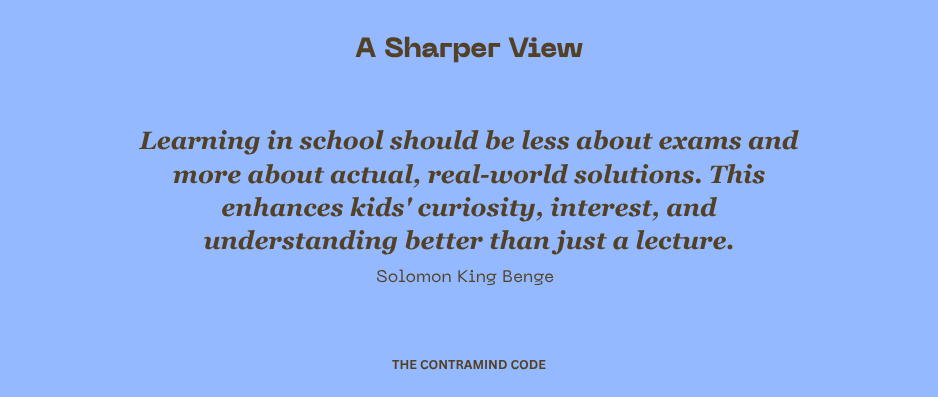
Learning in school should be less about exams and more about actual, real-world solutions. This enhances kids' curiosity, interest, and understanding better than just a lecture.
The importance of kids exploring and experimenting in learning and the curriculum.
Teachers cannot enter the teaching profession just because it’s their last resort.
The Reason Your AI Rollout Isn't Working with Charlene Li.
Charlene Li, an author and strategic advisor, says in her conversation with David Burkus that most organisations treat AI as a software upgrade. They just buy the licenses, hand them to IT, measure adoption rates, and call it a transformation. It isn't. She makes a very strong point when the CEO outsources AI to the CIO, the whole organisation stays stuck in adoption mode. She says that in most organisations, these AI tools get installed. Therefore, behaviour doesn't change, and value doesn't follow.
Here are some points that she makes on how we can leverage AI:
“AI can emulate empathy, but it's not the same(as humans). So if AI can do the heavy lifting and spare us empathy fatigue so that we can reserve our empathy for the times
and places where AI can’t do it.”
“I look at AI as the ultimate translation tool, not in terms of languages, but in terms of perspectives.”
“To normalize the use of AI, just begin a meeting by saying so how did you all prepare for this meeting with AI.”
“Knowledge is a commodity now. What are we teaching in schools? We’re teaching, in reality, the ability to learn, to be curious, and to exercise good judgment and wisdom. What's your velocity of learning?”
“How are we creating a workforce for the future that is going to be very flexible, knowing that your job is probably going to change every 18 to 36 months?”
“You have to direct AI to solve the right problem. So it forces you to think about things in a much more systematic way to look at things and to reframe things.”
“Do not get distracted by the bright shiny object. Do not let a vendor begin the conversation with their pitch. Always begin the conversation by saying these are our problems.”
“Leaders create change. Managers maintain the status quo.”
Why ‘What You Know’ Is No Longer Good.
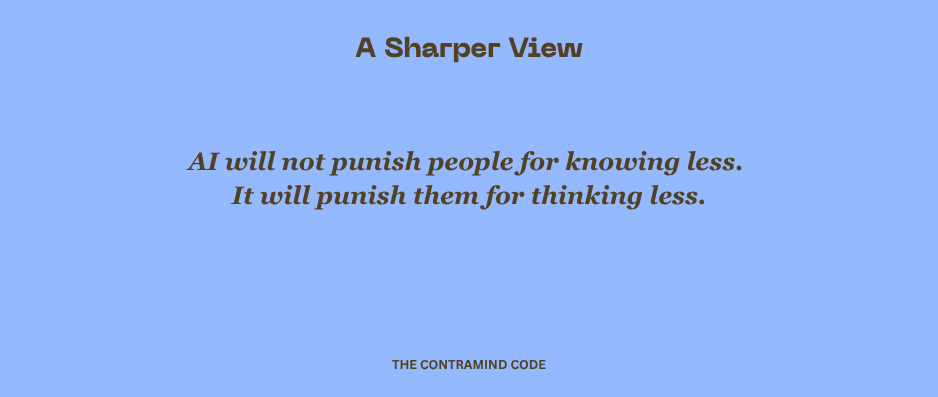
What you can perceive and do with what you know is increasingly becoming more valuable.
As AI takes centre stage, the gap between people who simply know and those who know, understand, and have a perspective will widen and become clearly more visible. This difference, amongst people irrespective of their levels and years of experience, was not so stark in the industrial and knowledge-economy era, but it will become quite apparent as AI gets embedded in everything we do.
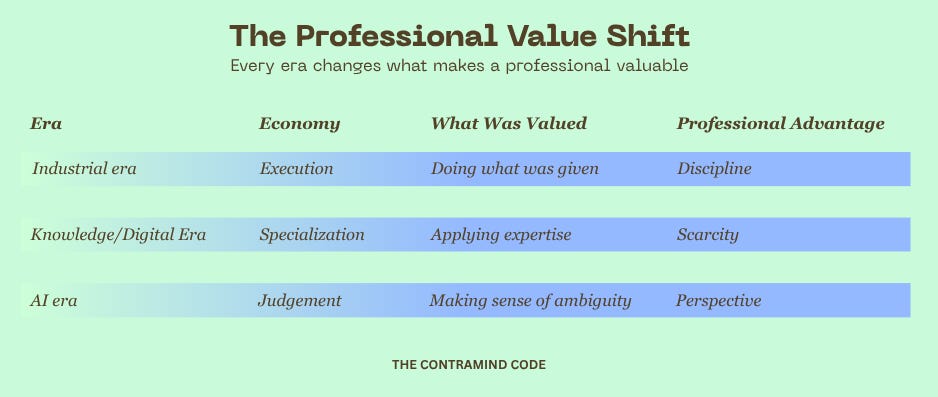
Let’s analyse how the importance of these three levers is changing today. And what makes this difference or gap among professionals strikingly apparent and dominant across the three phases of the Industrial (1760s-1960s), Knowledge/Digital(1960s–2020s), and AI (2020s to present) eras?
Knowledge: Knowledge is nothing but a collection of facts, data and information. At one point, it was enough for people to simply remember, state, and describe what they knew. The professional markers of knowledge were just degrees, credentials and certifications. People could still survive by knowing some information, facts, etc., but understanding very little of it. Fragile knowledge was sufficient to get or do a job. The industrial era was an economy of physical execution. Consistently doing what is given to people was considered valuable. Largely, people were hired, rewarded and promoted for this capability during this era.
Understanding: It's about grasping the "why" behind the information or data people know. It goes beyond data and facts to understand causality, relationships, etc. Understanding requires people to do thought-demanding things like thinking, explaining, finding evidence, generalising, analogising, applying the knowledge and using it in new ways. Therefore, the understanding was gained through years of application and practice, and it resided in professionals’ heads. The knowledge or digital era was an economy of specialisation. During this era, companies transformed from production organisations to service organisations. The ability to apply and use acquired knowledge was valuable. Expertise was scarce, and scarcity made people valuable. Most of the time, scarcity drove unrealistic premiums in what people earned or demanded.
Perspective: This is not all about having both knowledge and understanding, but about having the ability to interpret and contextualise in the situation. As AI handles more and more routine tasks, people’s contribution will increasingly be perspective-centred - focusing on judgment under uncertainty, creativity, relationship-building, and through tacit knowledge that comes from experience. The AI era will be an economy of judgement and perspective. Therefore, people will only be able to add value when they apply knowledge and understanding, along with perspective, by evaluating, creating and applying the understanding to new and ambiguous situations. It will also become imperative to transfer learnings across domains. Knowledge and understanding will begin to collapse when a novel problem arises, and there’s no template to apply. They need to develop a perspective on what they know and understand.
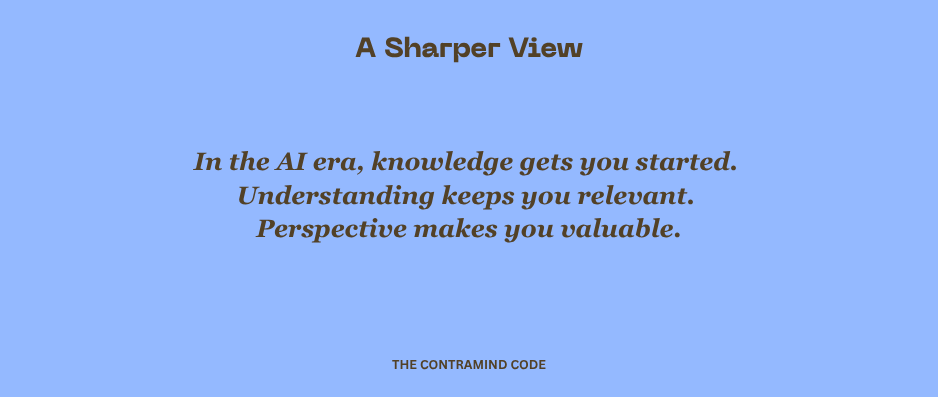
So what does all this really mean to you?
Neither formal education nor your current work environment prepares you for these capabilities.
It is a hard truth that most of these capabilities and skills gaps are widening faster than most formal education and work environments can adapt. Therefore, many job roles are getting restructured, not just disappearing or getting replaced. They are getting redesigned. Most job descriptions are increasingly being rewritten. Over the last 100 years, it has always been assumed that anyone entering the workforce is a linear accumulator of knowledge. They start as juniors, move to a mid-career role, and grow into a senior role. These long-established organisational structures and career ladders are breaking down.
If AI is automating entry-level work, the assumption is that the first few years of grinding, repetitive work, and practice that helped people gain knowledge and understanding over time will no longer be available to this generation. Mid-career professionals who grew just by managing people, tasks, and work processes are being replaced by workflow agents. Senior-level professionals will have to bring their domain knowledge and genuine perspective to their roles and drive outcomes, not just output. With AI, they have to learn to lead, be hands-on, and still manage, do this concurrently. And they must learn to do it at scale, with agentic AI extending support with more hands and insights.
Therefore, if you are a professional who is knowledgeable and comfortable with doing or delivering repetitive tasks, going through the grind or being told what to do or executing without knowing, AI will outcompete you.
However, if you are a professional who understands and knows how to apply the knowledge you have gained, AI will help you amplify the work you do.
Finally, if you are a professional with a perspective and can share it with the organisation or the people you work with, you will be able to drive AI on your terms and become highly valued by your team and the organisation as a whole.
So, how do you prepare yourself for this change?
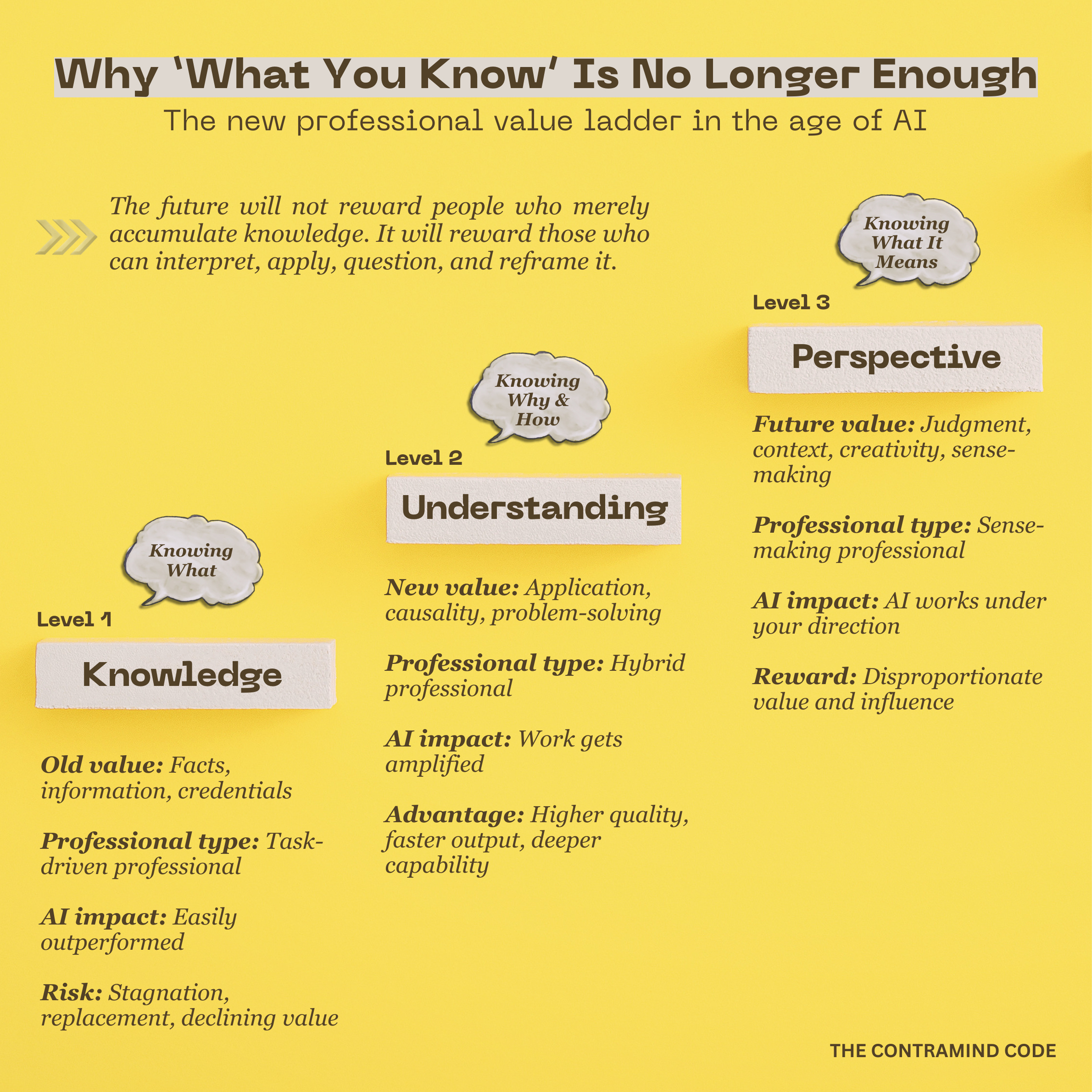
Level 1- Stop being a ‘Task-driven’ Professional: Refuse to be the person who executes identified or given tasks within an established template. Having surface-level knowledge is not good enough, as AI will come with deeper knowledge, perform repetitive tasks better, and be more productive, as increasingly, knowledge is getting democratised by AI. If you don’t transform yourself, be ready to face declining compensation, lateral stagnation, and the wrath of headcount reduction.
Level 2- Grow to become a ‘Hybrid’ Professional: You must expand your domain knowledge and combine it with a deeper understanding of the concepts and problems you are working on. You will see accelerated growth if you preserve and deepen your understanding layer. You must begin using AI as a tool to improve the quality of your work and enhance productivity and output velocity.
Level 3- Elevate to become a ‘sense-making’ professional: This specifically can apply if you are or want to become a senior professional, as you will need to combine your deep domain understanding with a genuine perspective of the situation and context of the macro-environment in which you are working. You must be able to develop novel frameworks, derive meaning and make high-stakes judgements under ambiguity, and not just process information but also interpret it from others' perspectives. Such professionals will drive exponential value and get disproportionately rewarded.
What should you protect yourself from?
As you move from one level to the other, the accelerated use of AI in your daily work will restrict your ability to explore diverse viewpoints, develop a high probability of being unable to distinguish algorithmic content generated by AI and challenge some of the underlying assumptions it works with. You may feel more productive, but in reality, you may be losing your ability to think independently. It may lead to a situation where you feel you are seemingly producing more, but understanding less. You will end up going back to being a ‘task-driven’ professional as your ability to think critically reduces. You must be wary of this ‘understanding, thinking and perspective-centred degenerativeness’ that can set in very quickly.
Your ‘Knowledge-Understanding-Perspective’ loop needs to continuously spiral upwards as you embed more and more AI in your work.
Therefore, it will no longer be enough if you learn and know more. You must develop the ability to think more deliberately, reflect more deeply on what you know or learn, and think more independently. Just be aware, AI makes it easier for you not to do it!