

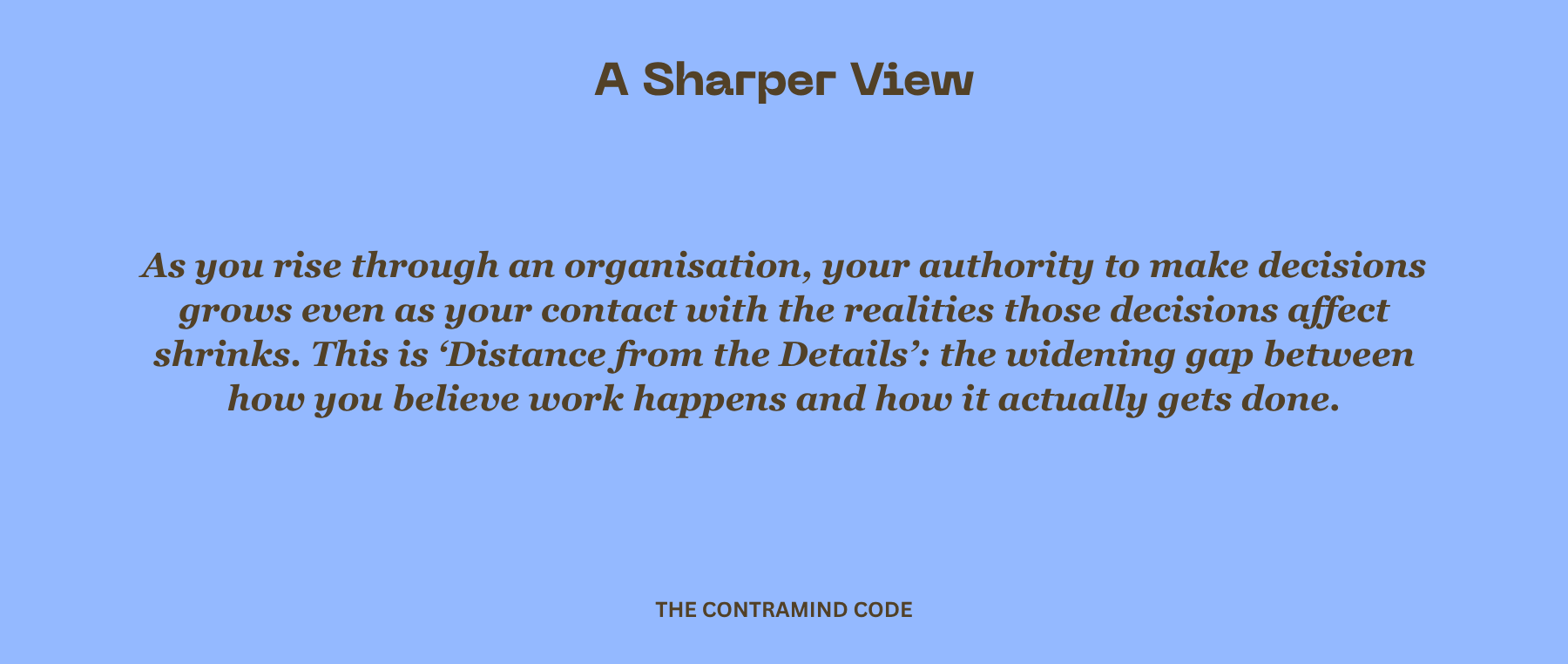
As you move up in an organisation’s hierarchy and also in your career, you slowly begin to experience a very strange problem - one that’s not always explicitly felt, or you begin to feel it, but you struggle to come to terms with it when you want to understand, discuss and make crucial decisions - ‘Distance from the Details.’
What does ‘Distance from the Details’ really mean?
‘Distance from the Details’ is the progressive divergence, across every professional’s working life, between their operative mental model and ground-level operational reality, driven by their own organisational elevation or time away from practice or doing things. In short, hierarchy clouds or hides professionals from operational reality.
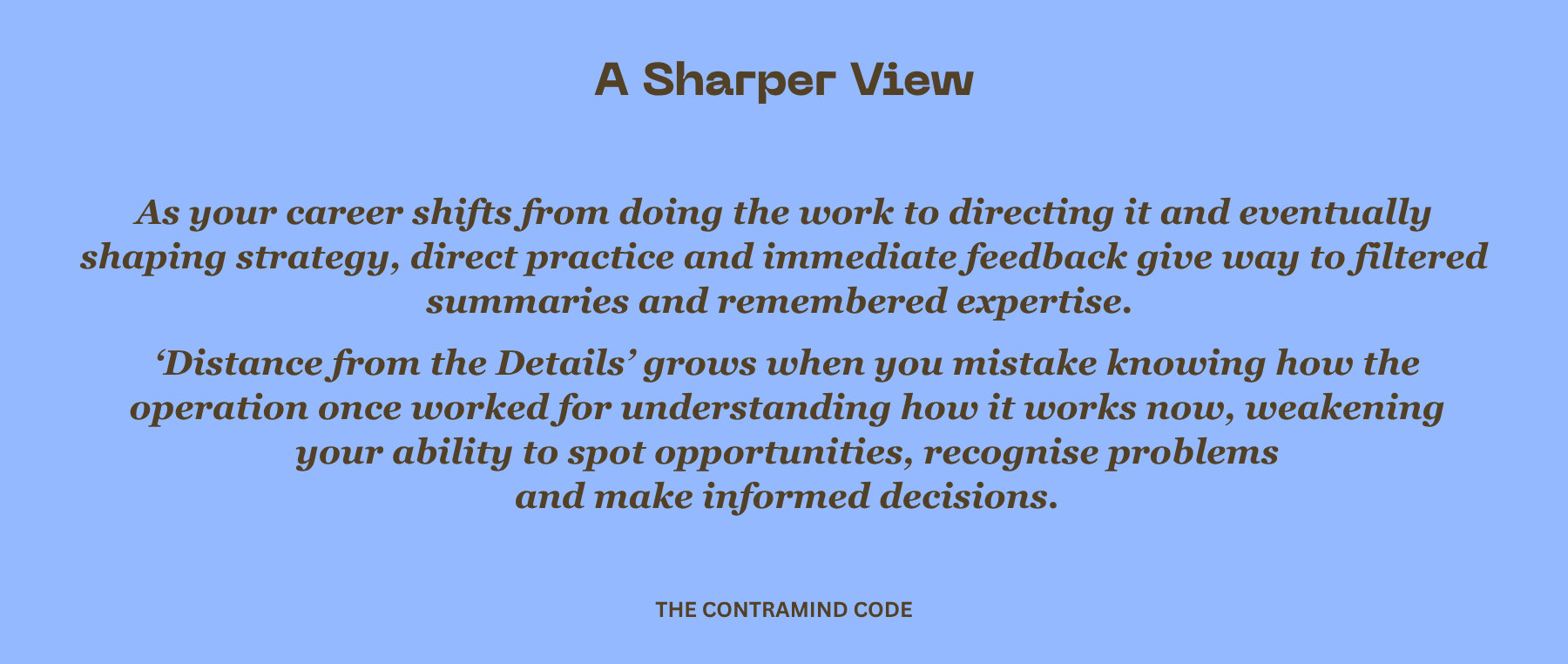
How do you, as a professional, get into this loop?
As a professional, you go through three phases in your working life.
In the first phase- let’s call it the Immersion years - it’s your early professional years, which are 0-10 years of your working life. You stay close to opportunities or problems and address them head-on. This is a phase where you do things yourself. Any error surfaces quickly, and you fix it because the feedback loop is tight and your reporting manager closely manages or corrects you.
To improve your expertise, research suggests three interventions-repetition, immediate feedback, and iterative correction of specific weaknesses. You get all three involuntarily at this stage of your career.
In the second phase - let’s call it the Direction Years - it’s your middle professional years, which are 10-20 years of your working life. This is when promotion arrives in your life, moving you from ‘doing to directing.’ Every promotion during these years pushes you into a role where you no longer do the work but instead describe and supervise the work getting done. You slowly begin operating on a false model of the work, without feeling the impact it creates in your career. In this phase, information distortion slowly begins. You no longer have the operational calibration to detect the gap between the filtered summary notes and the reality.
Research on ‘skill fading’ around clinical skills, which can also be applied to technical or functional skills, found that ‘skills decline measurably over periods as short as 6 months of non-practice, following a decay curve steepest at the outset.’
In the third phase - let’s call it the conceptualization years - it’s your top professional years, which are 20+ years of your working life. By now, you're far removed from the details. You've moved from handling raw data to receiving curated summaries. As a senior leader, you are now operating almost entirely on pattern recognition from a professional context and role. As a senior leader, you begin to operate on a 15–20-year time horizon, while the frontline employee operates on a time horizon of days to weeks. These are different kinds of realities applied at totally different time scales.
In this phase, many senior leaders think they know how the operation runs because they ran it once. However, they don't know how it runs now, under current conditions and constraints.
Research shows that if you stop practising a cognitive, accuracy-based skill, you will have lost approximately 50% of your proficiency within 48 days of non-use. Research further shows that for physical, speed-based skills, you will lose 50% of your proficiency after roughly 106 days without practice. Research shows that, compared to cognitive accuracy skills (48 days), the body forgets more slowly than the mind. That is why you can still ride a bicycle after ten years without riding one, but you cannot accurately value a company after ten years without continuously doing financial analysis.
Therefore, your ‘Distance from the Details’ progressively affects your ability to see opportunities and problems, identify blind spots and make informed decisions in line with reality. A senior leader who stays close enough to the ground will have an enormous advantage over one who relies on sanitised, filtered summaries.
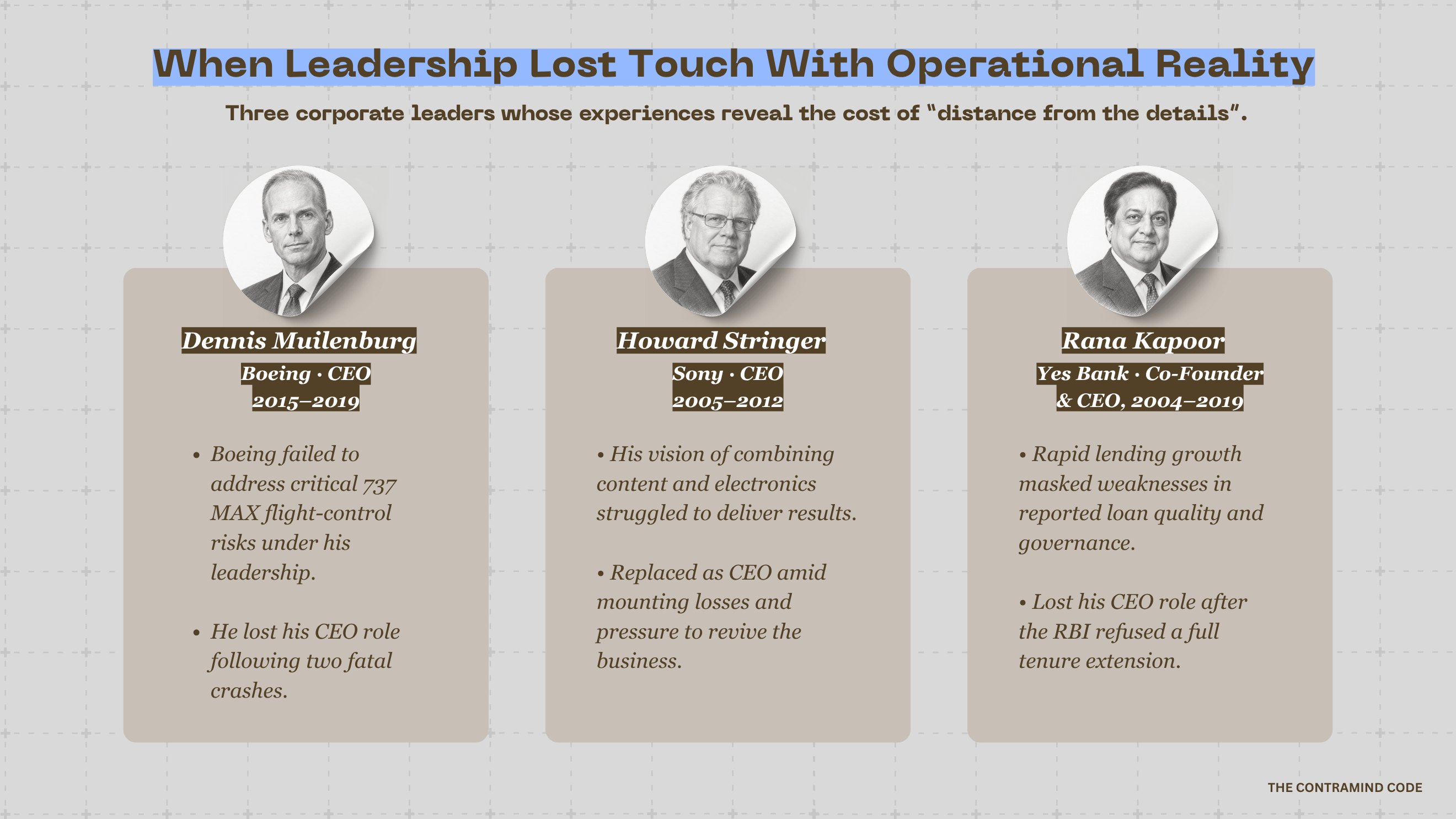
How ‘Distance from the Details’ can affect professionals.
Dennis Muilenburg, CEO, Boeing: Dennis was CEO from 2015 to 2019, and though he was an engineer by training, he spent much of his senior years in program management, contracts, and investor relations. By the time he became CEO in 2015, he was managing Boeing's narrative rather than its engineering. It was during his tenure that the MCAS system, the automated stall-prevention software that drove two 737 MAX aircraft into the ground, killing 346 people, was approved without its risks being adequately surfaced to the CEO's level. Muilenburg had assured the public that the 737 MAX was "as safe as any airplane that has ever flown the skies." He may not have been aware of the engineering, or may not have known, that statement was false. Muilenburg was unfortunately fired in December 2019. Here’s an example of a technically trained leader who rose through the hierarchy until his engineering intuition drifted so far from current engineering reality that he couldn't see what his organisation was missing.
Howard Stringer, President and CEO, Sony: Howard Stringer led the company from 2005–2012, and he was appointed to restructure a hardware-heavy organisation for the content era. Stringer backed managers who would execute his decisions over engineers who could deliver innovation. However, Sony's competitive advantage had always been in its engineering culture - "Sony engineers generated an average of four new product ideas every day." Because of his professional background in broadcasting, not product engineering, Stringer failed to sense this detail. He was distant from its technical identity. He wasn't distant from Sony's financial reality.
Rana Kapoor, Founder & CEO of Yes Bank: Rana Kapoor led Yes Bank from its inception in 2004 until 2019. He built Yes Bank as a part of India’s growth story in the 2000s with aggressive lending to corporate borrowers that other banks considered too risky. The loan portfolio grew rapidly. But the credit quality underneath was deteriorating. However, the official numbers were systematically disconnected from the operational reality of borrowers’ health. This created a liquidity crisis in the bank’s operations, which led SBI to take over the bank. Rana Kapoor's operating model of his loan portfolio did not match the reality on the ground. Either he chose not to know, or the internal reporting systems were designed to keep the real picture from surfacing.
So, how do you overcome ‘Distance from the Details’ syndrome?
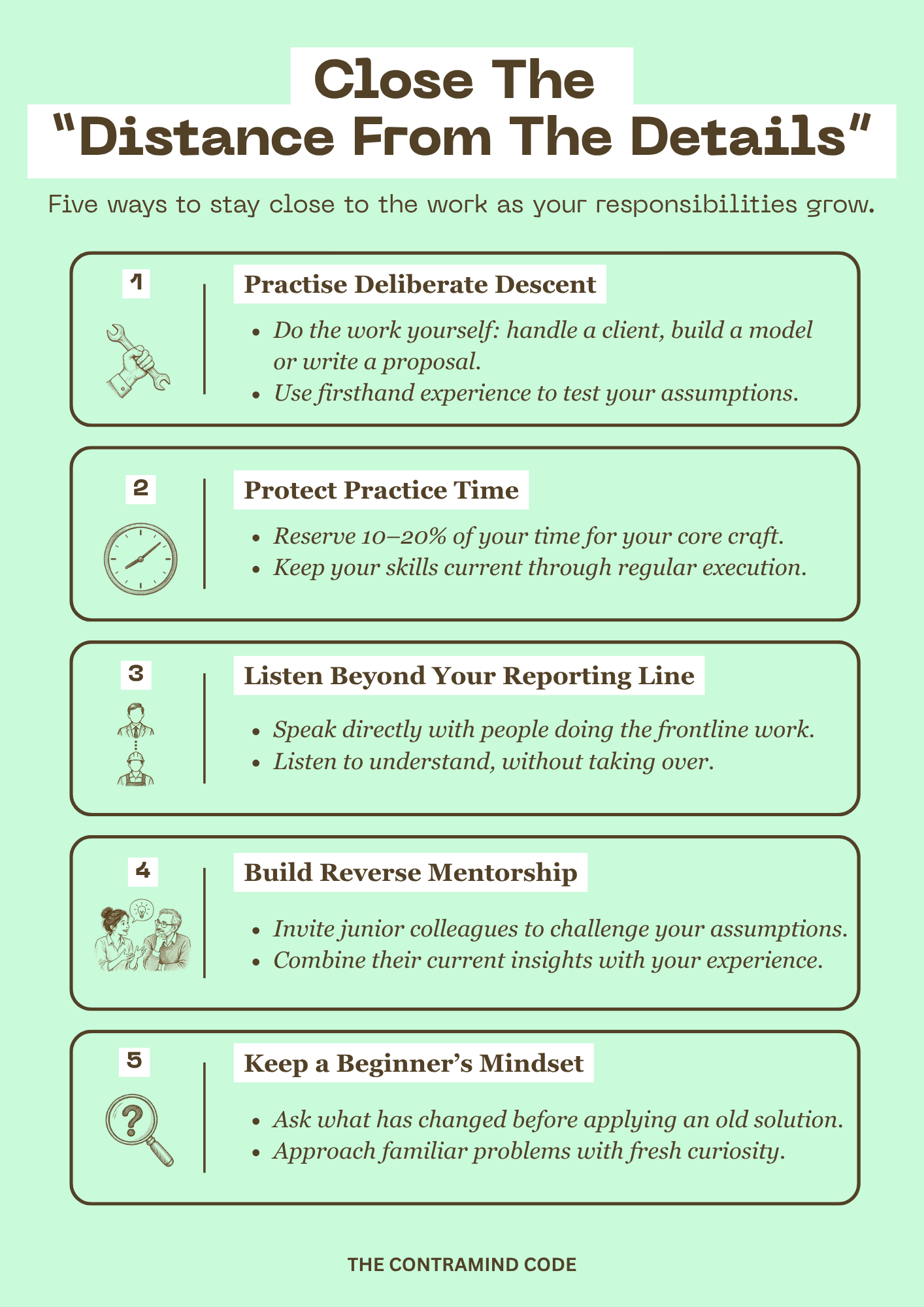
Here are some ways in which you can overcome this problem that organizational structure forcibly takes you away from the details:
Practice deliberate decent: As a professional, it may be important to understand and acknowledge that supervising work is not the same as doing the work. Regardless of your hierarchy in the company, find ways to structure and engage in operational details, like personally handling a client, building a model, or writing a proposal.
Carve-out practice time: It’s always hard to find time to ‘do’ things yourself, as work will always be hectic and there will always be time pressure to get things done. Carve out 10–20% of your time for practice of the core craft that strengthens your functional skills, not just management of the craft or review of the craft, but remain in the execution of it.
Find ways to bypass the organisation hierarchy: Try to maintain direct access to people at the operational level who are not in your reporting chain and who have no incentive to filter what they tell you. Build a nuanced method or regular cadence with them to make it a process without affecting your direct reports. These are ‘sensing the environment’ meetings for you and not ‘fixing the problem’ meetings.
Build a reverse mentorship structure: Invite junior professionals whom you work with to share their perspective on your decisions and current operational reality. Don’t be defensive about the feedback. Treat it as a structured intelligence-gathering mechanism. Your junior shares the current operational issues, while you, as a senior, can spot patterns and interpret what they're seeing. Combining both can be more accurate than either alone.
Have a beginner’s mindset: As a senior professional, your biggest trap is the certainty mindset you jump into, feeling like you have seen and solved this problem before. With experience, the number of possible solutions shrinks. Without a beginner’s mindset, you will only know what you think you know. Approach every operational problem as a genuine learner and address it as if you are trying to understand and do it for the first time.
As you move up in any organisation’s hierarchy, your professional growth and success depend not only on your ability to think strategically but also on how well you stay connected to the ground, while balancing that with a deeper understanding of operational reality. It’s all about finding ways to reduce your distance from the details.