AI And The Importance Of The Human Narrative.
Lynda Gratton is the Professor of Management Practice in Organisational Behaviour at London Business School. In this article, she emphatically makes a case for the human side of the relationship in the age of AI. She urges that it is time we stopped seeing AI as a battle between machines and humans.
“In the machine-human relationship, we must focus less on the ‘end of work’ and more on the ‘end of boring, uninspiring, dangerous work’.”
“An LLM does not feel or look at the world. It does not have memories or stories. It does not dream of the future.”
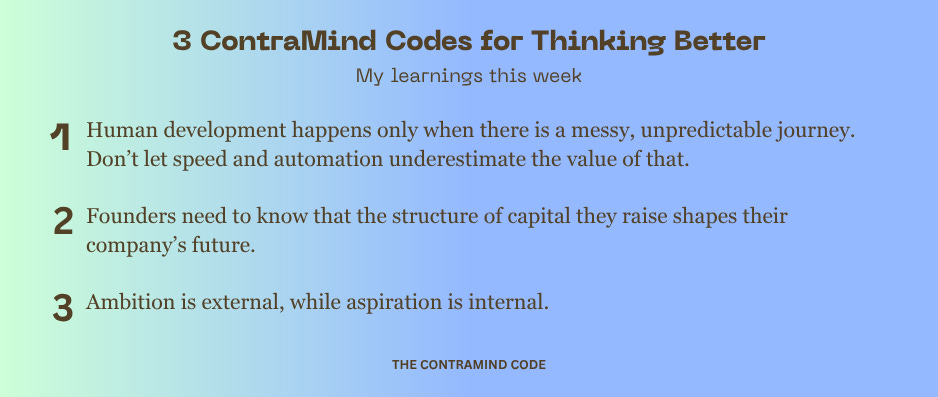
It is important to stop undervaluing the creative process. “By focusing on speed and outcome, the machine invites us to devalue the messy, unpredictable journey that is the journey of human development.”
You can read the entire article here.
Rethinking Capital: First Principles For Entrepreneurs(ContraMinds Timeless Wisdom)
In the ContraMinds Timeless Wisdom Episode (Part 1), Shyam Shekar, Founder and Chief Ideator of iThought Advisory, discusses how entrepreneurs should approach capital, how to distribute founder equity, and the risk of allocating capital to unproductive areas when fundraising is unnecessary.
Here are key takeaways from this conversation:
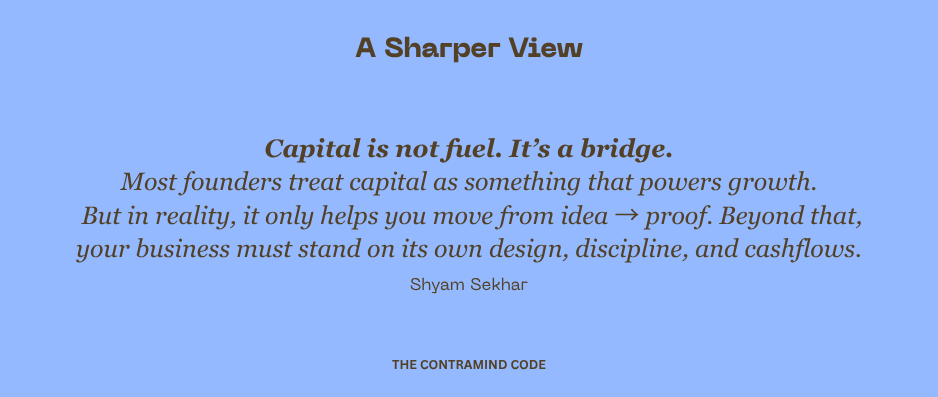
Capital is a bridge, not the business: It exists to validate your idea—not define your journey.
Over-raising is as dangerous as under-raising: Easy money often leads to poor allocation and long-term damage.
Dilution must align with outcomes: Equity given away should reflect value created—not just capital received.
Business model design can reduce capital needs: Rethinking cash flows can often replace the need for external funding.
Founders must think before they fundraise: the structure of capital shapes the company's future.
How To Be Ambitious Without Being A Jerk.
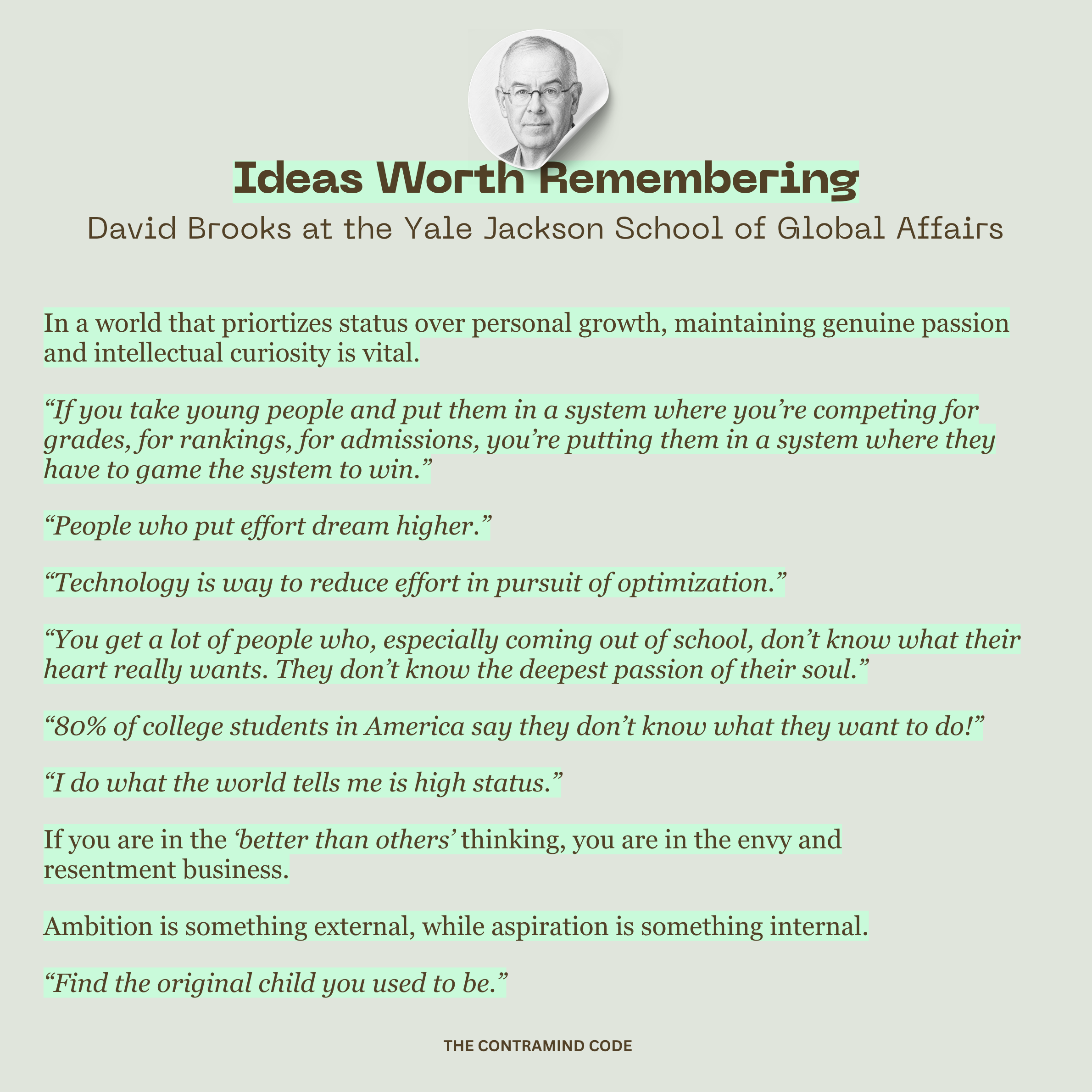
David Brooks, a Presidential Senior Fellow, delivered a lecture at the Yale Jackson School of Global Affairs and here talks about ambition and how to cultivate meaningful personal drive while avoiding the pitfalls of arrogance or cynicism.
Here are some great points that he makes to think about:
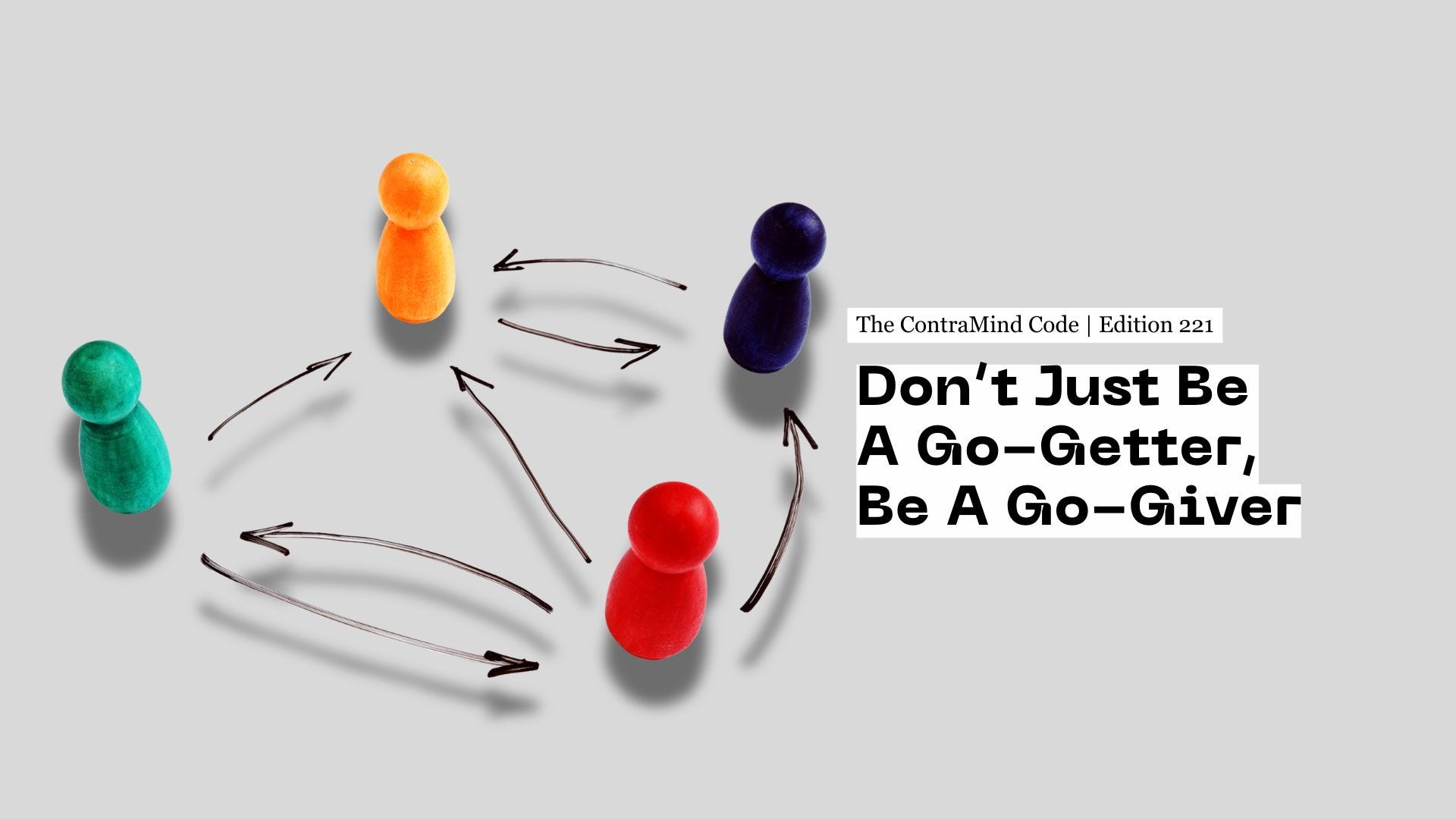
Don’t Just Be A Go-Getter, Be A Go-Giver.
If you want to be a leader who can create meaningful, purposeful impact that lasts a lifetime, this is a germ of an idea that’s worth thinking about. The mental models of leaders that are spoken, written about, and celebrated are those of go-getters. You sit in a regular feedback or appraisal meeting in your company, and you are told you must have a ‘go-getter’ attitude. It may seem to work very well in the short term, but without you realizing, it begins to break down in the long term.
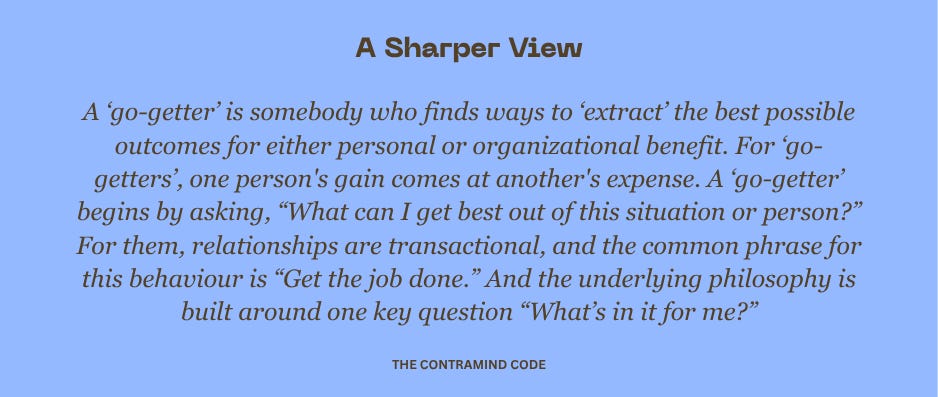
A ‘go-getter’ is somebody who finds ways to ‘extract’ the best possible outcomes for either personal or organizational benefit. For ‘go-getters’, one person's gain comes at another's expense. A ‘go-getter’ begins by asking, “What can I get best out of this situation or person?” For them, relationships are transactional, and the common phrase for this behaviour is “Get the job done.” And the underlying philosophy is built around one key question “What’s in it for me?” The focus is also much more on personal output, short-term extraction, and hoarding knowledge for power.
Organizations are wired to reward go-getters.
The root cause of the problem is in the wrong ‘system design’ of companies that have not changed over the last 100 years since this was set up. Organizations don’t inherit ‘go-getters’. They create ‘go-getters’ through their incentive systems, promotion criteria, cultural narratives, etc. The organizations, today, are optimized for individual output - revenue generated, deal closed, project delivered, target or goal achieved. It’s not that these metrics are wrong. However, these metrics don’t look at the full picture, or they are, in a sense, incomplete.
The metrics track, measure, and identify professionals who can effectively extract output from these organizations’ systems. These professionals win individual battles, destroy the collective capacity of the people with whom they work, undermine colleagues and stakeholders, both from inside and outside, are selective about information and knowledge sharing, and they create a ‘larger than life’ picture of their personal contribution. However, a professional who connects, shares intelligence, builds ecosystem strength within the organization, and actively mentors people across functions does not often appear in quarterly reviews, but the value compounds over the years. In fact, their impact and ‘ways of working’ continue to influence people and work processes long after they have left.
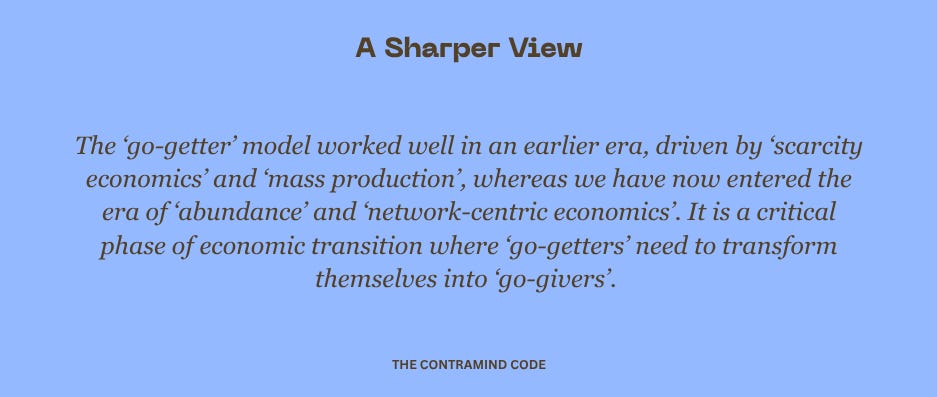
‘Go-getters’ end up optimizing for zero-sum outcomes, shrinking the number of collaborators in a room and over time they erode trust capital. ‘Go-getters’ typically build connections to people like themselves, in the same function, industry, or worldview. The ‘go-getter’ model worked well in an earlier era, driven by ‘scarcity economics’ and ‘mass production’, whereas we have now entered the era of ‘abundance’ and ‘network-centric economics’. It is a critical phase of economic transition where ‘go-getters’ need to transform themselves into ‘go-givers’.
There cannot be a better example of a ‘go-getter’ than Jack Welch, who was chairman and CEO of General Electric(GE) between 1981 and 2001. During his tenure, his performance was spotless on a single metric - market capitalization, which rose from $14 billion in 1981 to $410 billion in 2001. His leadership was a case of a high-performance ‘go-getter’ who built a machine optimized for extraction — and whose methods produced extraordinary short-run results and devastating long-run consequences. Every decision made at that time, regarding people, culture, strategy, and community, was evaluated through a single lens - ‘Does this increase the stock price?’ GE — once the most valuable company in the world — was eventually removed from the Dow Jones Industrial Average in 2018 after 110 years of inclusion.
Who is a ‘go-giver’ and how can you identify them?
A ‘go-giver’ is somebody who, regardless of the competitive pressure, is driven by the power of reciprocity - choosing reciprocal behaviour even if it compromises their personal interest in tough situations. When they get into an operating mode, they activate their relationship-building facet by default. Their act of helping, sharing, and contributing naturally draws people to them. They develop a strong ‘social proof’ where their reputation travels far ahead of them. ‘Go-givers’ consistently prioritize others and the returns of that compound for them over time. They have the unique ability to subordinate their interests, and that invariably increases their ‘circle of influence.’ They understand that ‘giving and receiving’ are not at opposite ends but a part of a single system. ‘Go-givers’ do not give ‘unconditional generosity,’ but they can respond immediately to prevent any exploitation or provocation, as they are deeply aware of deploying the strategy of ‘boundaries with consequences’.
If you are a ‘go-getter’, how can you transition to become a ‘go-giver’?
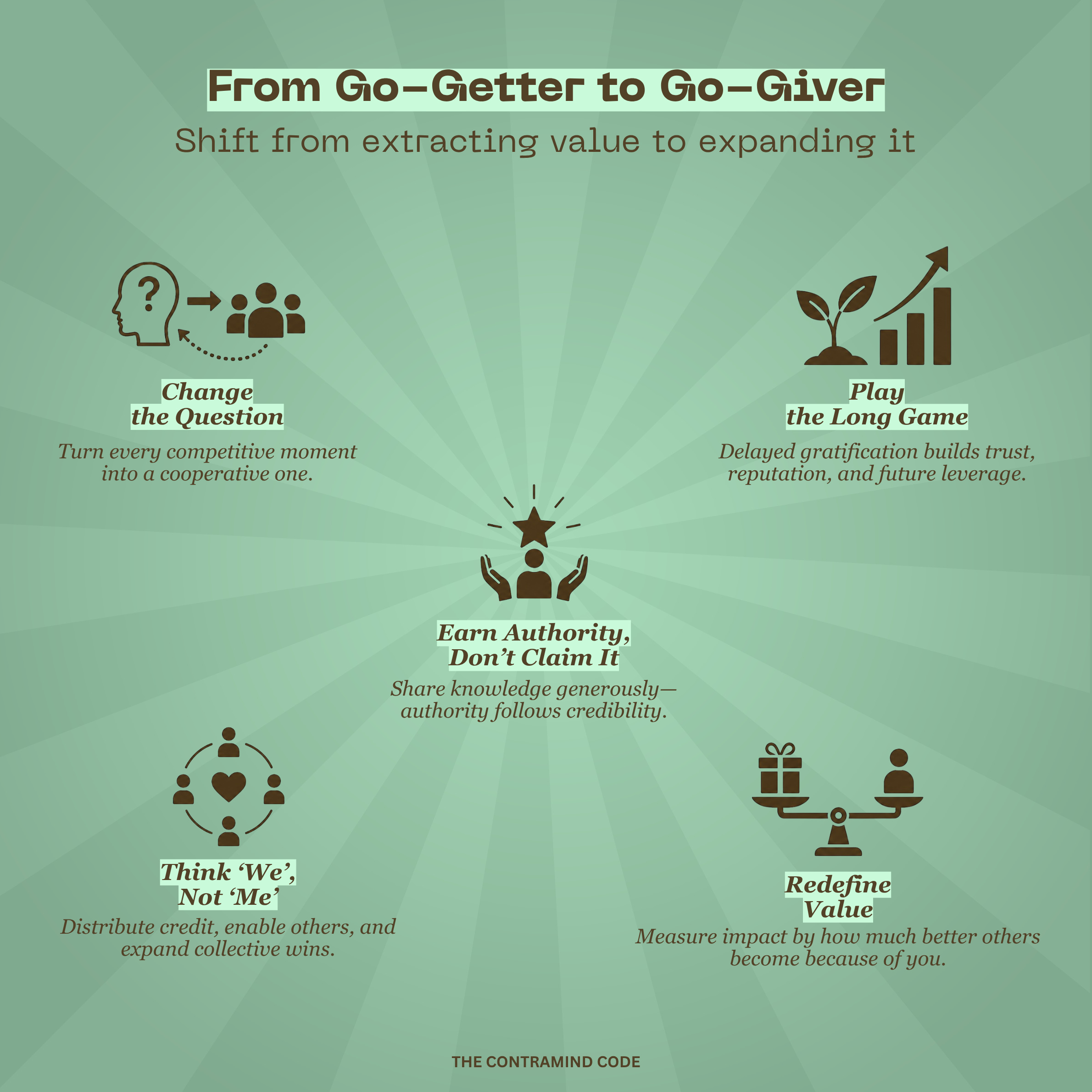
Begin with a different end point in view: ‘Go-givers’ start by asking, “What can I add to this ecosystem of people or resources?” In contrast, ‘Go-getters’ begin by asking, “What can I take and maximise for myself or stakeholders?” By asking these questions, you convert every competitive opportunity into a cooperative one, thereby enhancing value in the process. What this does is teach people to care about each other.
Become comfortable with delayed gratification: As human beings, we deeply undervalue future returns. Hence, we are susceptible to ‘instant gratification.’ It could be a reward, a recognition, or a new role or offer that may be relatively larger in comparison to what you may be getting today, but constantly keep in mind that the long game is where the ‘go-givers’ succeed. It broadens your horizon of the shadow of the future. You begin focusing much more on the future stream of cooperative returns.
Learn to earn, not claim authority: ‘Go-getters’ often assert authority. Mindless authority-seeking behaviour invites scepticism and fosters an indifferent attitude among those working with them. ‘Go-givers’ build authority through generous expertise-sharing behaviour. Authority works best when you use it appropriately across contexts, focusing on long-term relationship-building rather than mere compliance.
Build a shared identity: Be ready to share the credit or success with others. Develop and expand your vocabulary when you speak, with a lot more We’s rather than I’s. Strive to work towards productive cooperation with others. Practice forgiveness as it boosts mutual cooperation. Resist the natural instinct to aim for a payoff larger than the other person’s payoff. Stay away from constantly envying other people’s behaviour, actions, and growth.
Rethink the meaning of value: Value is determined by not what you take out of the system. What you give back must be greater than what you take back from the system. It’s about how you empower and enhance the credentials of people who work with you, putting their interests ahead of yours and having the humility to be open to receiving. That creates value surplus. Ask this one question after every meeting, every conversation, every decision: “Did I create more than I consumed today?” This behaviour redefines the fundamental definition of ‘pay off’.
The ‘go-getters’ invest disproportionately in financial and human capital, which may not be sufficient in an increasingly networked and shared economy. However, the ‘go-givers’ invest significantly more in social capital, which generates an increasingly higher return. The ‘go-getter’ lives in the short shadow of the present, while the ‘go-giver‘ lives in the long shadow of the future.