
“How Does Someone Entering The Workforce Now Build Real Expertise?”
This was a question posed by a reader of The ContraMind Code newsletter.
It was an interesting question in response to an article written a few weeks ago titled “Are You Building the Right Expertise?”
This is an extremely relevant and difficult question to answer. Because a young professional just entering the workforce doesn't have exposure to handling many similar or near-similar problems as they arise, nor do they have years of accumulated capability built through work experience under their belt. So how do they enter the workforce today with any proof of expertise to begin with and build it further?
Increasingly, entry-level skills demand senior-level skills
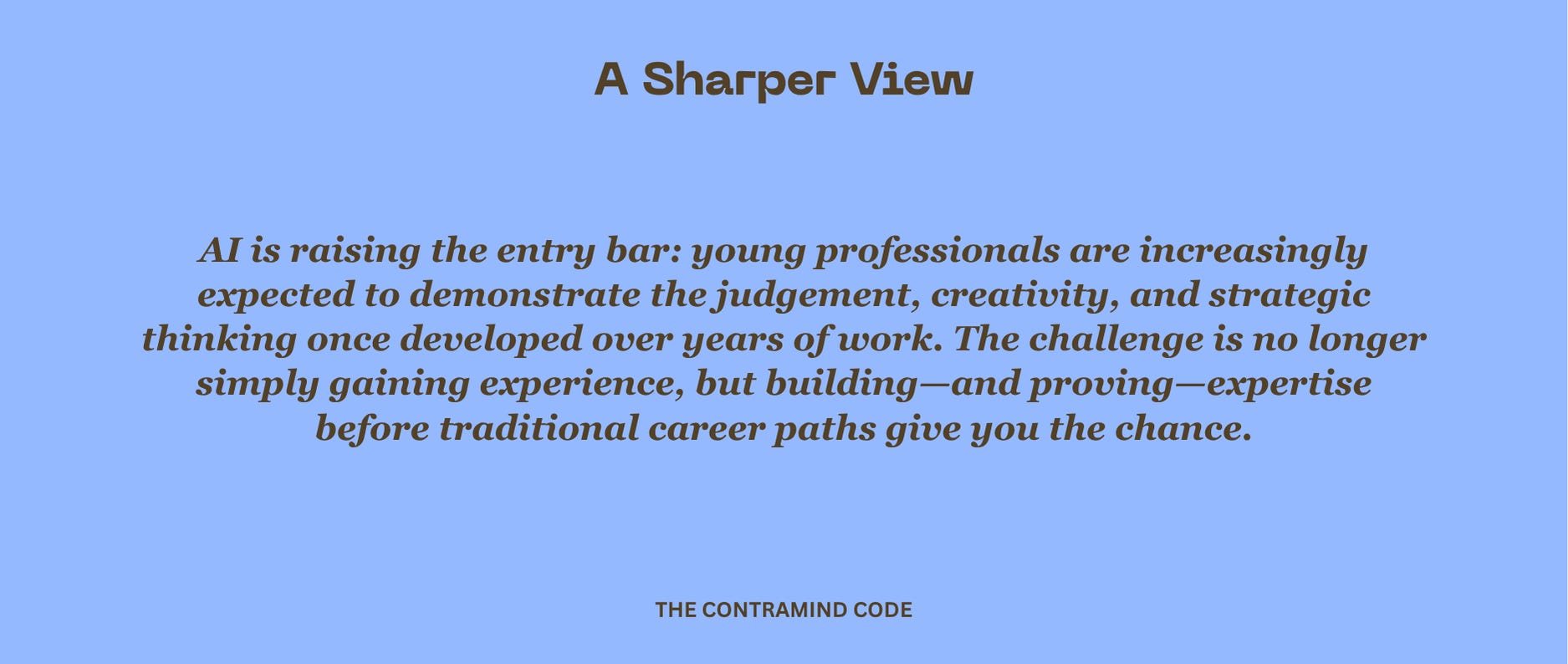
In a 2026 study, PwC found that the new tasks added to AI-exposed roles are 2.5 times more likely to rely on skills such as empathy, judgement, and creativity, which become even more valuable as AI absorbs some routine work. PwC calls this trend the "seniorization" of entry-level work. The study found that AI-exposed junior roles are seven times more likely to demand traditionally senior skills such as leadership and strategic thinking (compared to the least exposed junior roles). AI is ‘professionalising’ some jobs by reshaping them to require even more human expertise. AI ‘democratises’ other jobs by making them even easier for non-experts to perform.
The challenge is even greater for middle-level professionals, too, as they must change how they work and reskill faster than ever.
So, what does it take to build senior-level skills?
First things first, senior levels do not mean just designation-led positions, but rather senior-level skills that require deep customer knowledge, industry context, problem-solving, critical thinking, handling ambiguity, judgement, leadership, etc. This means it no longer matters which level you are in an organisation. In a consulting firm, you require many of the senior-level skills mentioned above right at the entry-level, and this climbs up in ‘degree of capability’ as you grow into the middle-level and senior level there. The same may not be true in every industry, but levels are crashing, crumbling, and flattening by the day. What was mid-level or senior-level skill yesterday is today’s entry-level skill!
Building these senior-level skills? Break down existing mental barriers
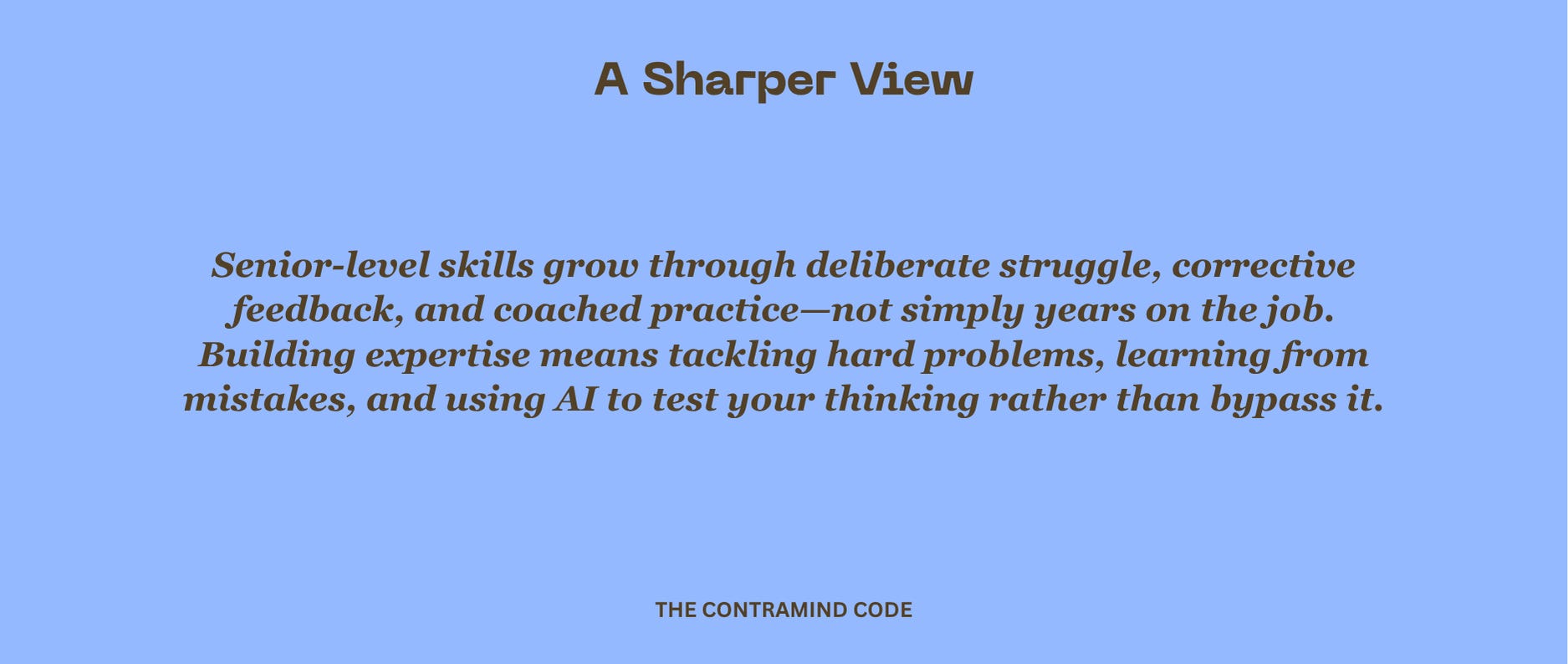
Removing the widely-held belief that entry-level work is the destination and work experience will take care of itself. It is just the vehicle you have got into for your long journey called career. Experience is built when there is ‘deliberate struggle’ to first do something, struggle by making mistakes, and that’s how knowledge accumulates. When it feels easy, you may almost always be accumulating years of work, not years of deep-work capability. AI tools make a task feel effortless but are a poor predictor of improving your expertise. It needs more ‘deliberate struggle’ to take the effort to do it first and then validate it through AI.
A study by Lisanne Bainbridge, a leading cognitive psychologist, found that automation led to a loss of manual judgement during emergencies! Remember, the machine doesn’t replace your skill, it lets your skill slowly expire.
Don’t resist correction or rework till done right. The first presentation you did, or the first-draft analysis you prepared, or the code review that happened- none of it is a standalone or independent task that can be outsourced. It made a difference because a senior or an experienced peer corrected it, and that’s where your learning began. Keep a count of the corrections you make on anything you do until you get it right.
If you have to build senior-level skills like problem-solving, judgement, etc., you do so by ‘doing hard things’ badly, in front of someone who tells you exactly why.
A surgeon does not become an expert overnight. They do the hard things under the oversight of senior surgeons. A trainee surgeon "must have observed or assisted" surgeries during their PG programs. They do hundreds of operations before they are called a chief surgeon. The ‘ladder of autonomy’ is slowly opened up for them, not in months but over decades. They begin as residents/assistants and junior surgeons, then become chief surgeons. Every observation, every assistance they provide during surgery, and every surgery they perform under supervision helps them build their expertise.
In a landmark 1993 study, Anders Ericsson, a well-known Swedish psychologist, studied the difference between elite and good violinists and found that elite violinists had accumulated 7,410 hours of ‘structured, coached, solo practice’ with corrective feedback by age 18, compared with 5,301 hours for good violinists. The key point is ‘structured and coached’ practice, not just raw practice.
It is vital not to confuse experience with expertise. There are many seniors with experience who have failed to develop their expertise despite the opportunities available to them. In contrast, some youngsters, through sheer intensity and effort, have built significant expertise but lack experience. Find the right senior or a peer who can teach and help you grow. There may be a select few around.
Prepare yourself for ‘Deliberate-Supervised-Struggle’
Embrace ‘deliberate practice’: Designations solve the need for recognition, not expertise. When you follow the art of deliberate practice, it allows you to define goals just beyond your current ability. You seldom stop at what you know, instead, you focus on what you don’t know, what you are not good at, and what you need to get better at. If you look at professions like surgeons, architects, chartered accountants, musicians and lawyers, none of them says “get some experience.” Surgeons require a certain number of ‘surgery hours’ to be completed to become surgeons. The same is true for architects, CAs, etc. Vague experience is unauditable. All of them go through a ‘ladder of autonomy’ as they grow in stature, but it is closely linked to the expertise that they have built over time. Pick the areas of skills or expertise where you want to put in the ‘practice hours’ beyond ‘work hours’, but seek structured supervision. Without that, deliberate practice is of no consequence in your path to building expertise.
Seek ‘Structured Supervision’: Like the findings of the elite violinist research, seek out people who are good at what they do - it can be either your seniors or peers, or people outside your industry who can help you with structured supervisory inputs. They are the ones who have the tacit knowledge. They could be somebody who can challenge your assumptions or your output, direct you to the right sources of information that can address your queries, bring forth their experience having been in similar situations or solved similar problems, recommend simple tweaks that may help you do things faster, or improvise on what you have built or recommended, etc. When you struggle without conditions that can reliably help or direct you, it can simply produce confusion and frustration. Every struggle must be followed by expert correction. An internship, an apprenticeship, or talking to a reporting senior alone does not build expertise. It requires someone who can observe and correct, explain your thinking more clearly, give you space to make mistakes while protecting you from adverse consequences, and help you articulate your thoughts more clearly.
Factor for ‘Struggle Time’: Your study grades or new tool certifications and daily work deliverables focus on the here and now. It is either an immediate assignment, an upcoming exam, a client request, or a task deadline. Cracking this on time only requires planning and discipline. AI tools may help you compress the time to get them done but remove the process of struggle, which is critical to building expertise over time. Therefore, factor in ‘struggle time’. Struggle improves your memory’s storage strength (how durably something gets embedded) and retrieval strength (how easily it can be accessed right now). Struggle leads to stronger long-term learning, improving muscle memory and, in turn, building your expertise. Don’t simply reach for the AI tool when a problem is posed to you with a deadline. Spend time working and curating after AI throws answers at you. Interpretation is a struggle too and not easy.
Most companies only attempt to take you through a ‘title ladder’ but skip the question of mechanism and the motivation entirely and therefore are rarely conducive to developing your expertise. Building expertise lies solely in your hands.
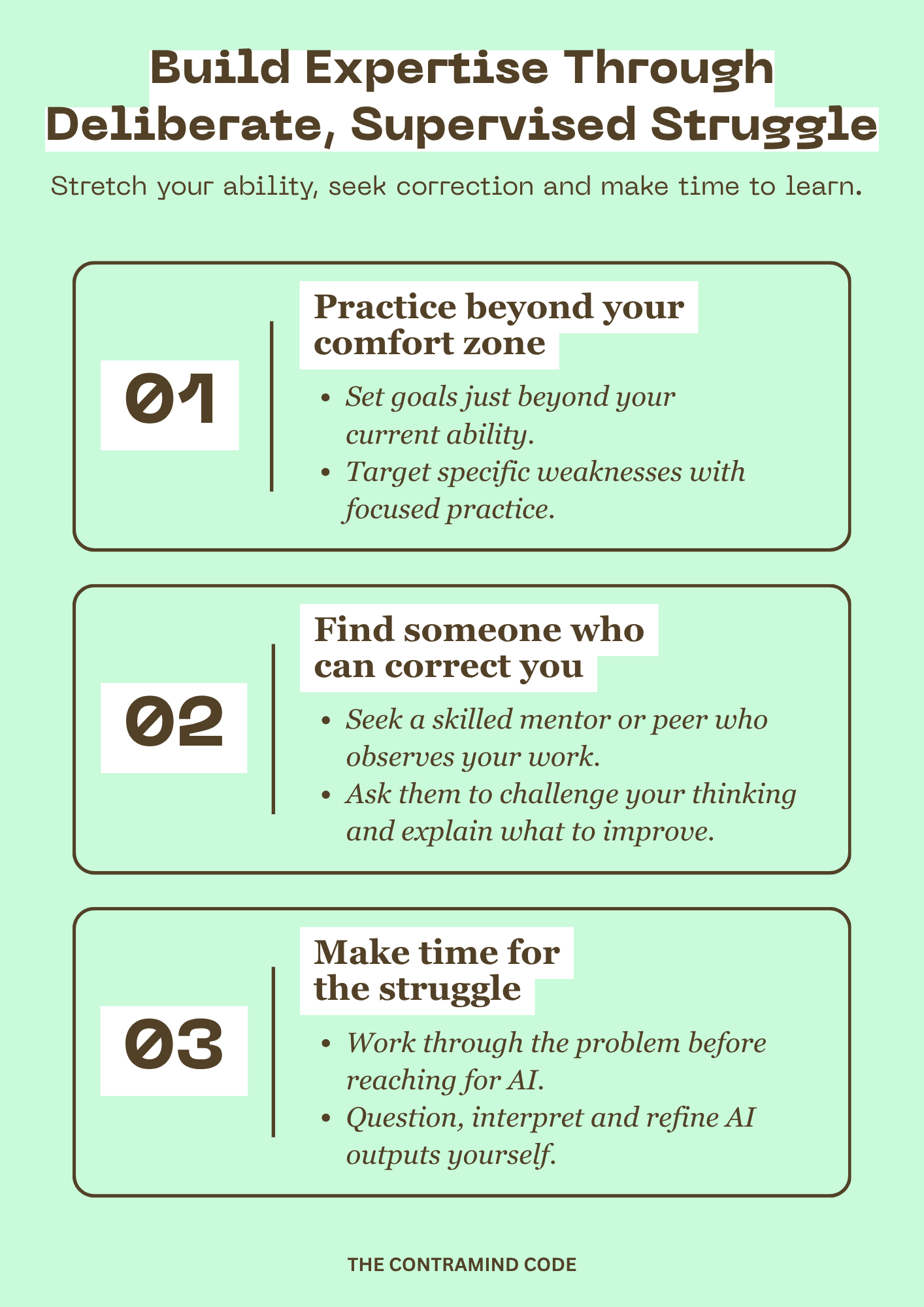
To summarise, if you are entering the workforce, to build expertise in the profession you have chosen and in the work that you do every day, personally build a sense of choice in your work routines, a sense of effectiveness to get visibly better at something, and a sense of meaningful connection with others at work for a shared learning culture.