

When building expertise, you need to understand the difference between ‘knowing how to think about something’ and ‘knowing how to do it ’. And you need both kinds of expertise.
For most of your professional life, you are told your depth is your greatest asset. And your breadth of knowledge is not as important, and it is only optional. Expertise is largely seen through a vertical lens. The deeper your domain, the higher your value. The more you know about your function — whether you are in R&D, procurement, software, accounting, engineering, marketing, law, technology, customer service or strategy — the more indispensable you become. You are rewarded for one thing - becoming very good at something specific.
That model served us well for over a century. But it is always built on a hidden assumption that the environment you are trained for would remain largely the same as the one you would work in. During stable times, that assumption holds true. But in a largely disruptive time that we are going through right now, you may need to rethink this.
Before you spend another year building expertise, it is worth understanding what kind of expertise you are actually building — and which type of expertise is now under the most pressure and will be in greater need.
Two types of expertise. One is under threat. The other depends on it.
Harry Collins and Robert Evans, Professors at Cardiff University, spent decades researching and studying how expertise actually works, not how we assume it does.
They identified two fundamentally different types of expertise.
Contributory expertise is the ability to ‘do’ the work. The surgeon who performs the operation, the engineer who designs and builds the structure, the analyst who builds the financial model, the programmer who writes the code. You develop the ability to produce new output in your domain. You possess the ability to contribute to it. If you can do all this, you earn the right to be called a practitioner.
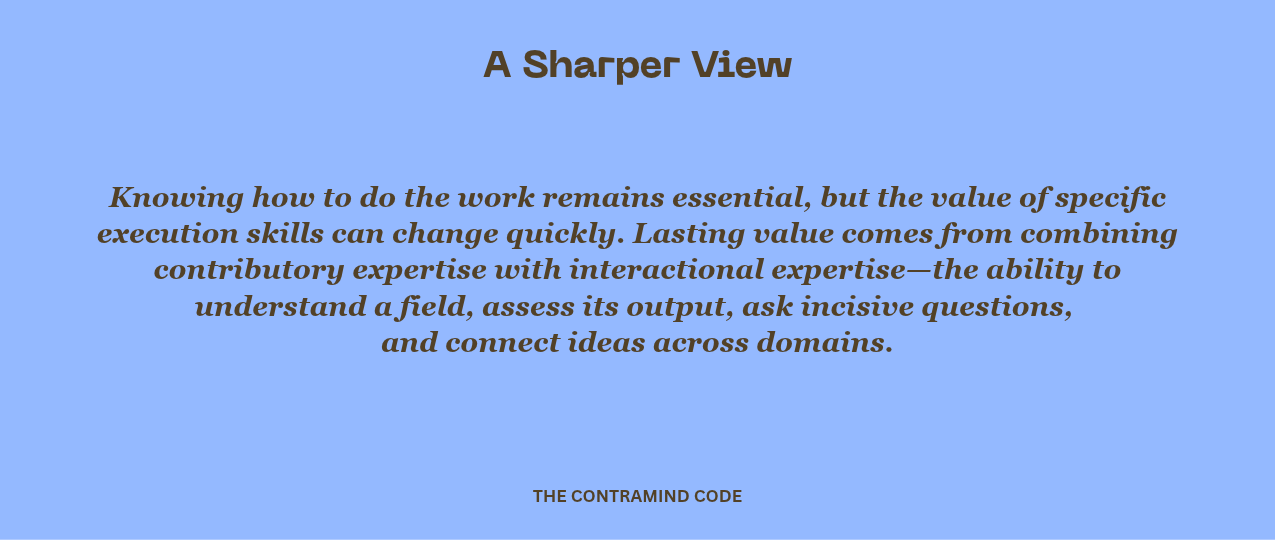
Interactional expertise is the ability to ‘engage meaningfully’ with the work and possess the ability to engage with people who do it without being able to do it yourself. You understand the landscape. You can ask the right questions. You can evaluate the quality of the output within the domain. You can switch and apply concepts between domains, spot when something is not right, and communicate across boundaries. But you cannot do them yourself.
Most of us as professionals sit somewhere on the continuum between these two types of expertise. The question is, when disruptive forces hit, or new technologies shake up industries or the work that you do, you are forced to ask yourself: “What exactly am I doing, and am I still valuable? And is that where I need to be, or what must I change to stay valuable?”
How expertise gets rebalanced and revalued in every era.
In the industrial era, the dominant currency of expertise that professionals had to build was contributory expertise, and of a narrow kind - extremely specialised in the nature of the work they were involved in. Interactional expertise remained a dominant currency of expertise for management roles, say, roughly 15 to 20 per cent of the workforce. The other 80 to 85 per cent were focussed on developing contributory tasks, many of which were narrowed deliberately.
This balance of expertise shifted when the transition happened to the internet and knowledge era. The famous ‘T-shaped professional’ became the dominant professional archetype - deep in one domain (contributory expertise), broad across others (interactional expertise). And the most valued among them were those professionals who could bridge between domains.
David Autor, a professor and economist at MIT who has tracked labour market shifts for two decades, defined a framework for understanding which expertise was safe and which was not. According to him, the key variable was not skill level. It was whether the task was routine or non-routine. The knowledge era did not replace contributory expertise but instead stratified it in a very different way. Routine cognitive tasks (let’s call it routine contributory expertise) in the middle of the market, such as bookkeeping, data entry, structured analysis, clerical reporting, and rule-based decision-making, could be decomposed into steps and automated. This got squeezed and hollowed out. Non-routine cognitive tasks (let’s call them non-routine contributory expertise), such as complex problem-solving, cross-domain judgment, and nuanced communication, could not be replaced. Therefore, deep domain expertise remained valuable. However, the most valued professionals were those who could bridge between domains - the technologist who understood business strategy, the designer who understood systems engineering, the marketer who understood data, etc. The bottom, which included non-routine manual tasks like janitorial work, construction, home care, etc., that required physical presence in unpredictable environments, proved difficult and expensive to automate, and these survived.
How will expertise get rebalanced and reshaped in the AI era?
AI tools are absorbing contributory expertise at a genuinely quick pace. Not physical tasks, but cognitive ones. Drafting, analysis, code generation, financial modelling, legal research, diagnostic reasoning, design ideation, etc. - these were the domains of knowledge workers with deep contributory expertise. AI can now perform versions of these tasks at a level that is, for many applications, good enough. And it is improving rapidly at breakneck speed.
This has therefore led to a widespread belief that interactional expertise is the future. These include interactional expertise tasks such as knowing how to use AI, how to communicate with it (prompt engineering), and how to synthesise outputs across domains (supervisory engineering), which are becoming premium capabilities. ‘The contributor’ is being replaced by 'The interactor'.
This assumption is only half right. The half that is wrong is the dangerous part that labour markets, companies, and, more importantly, professionals have failed to understand its implications and impact.
It’s easy to fall into the hollow expertise trap.
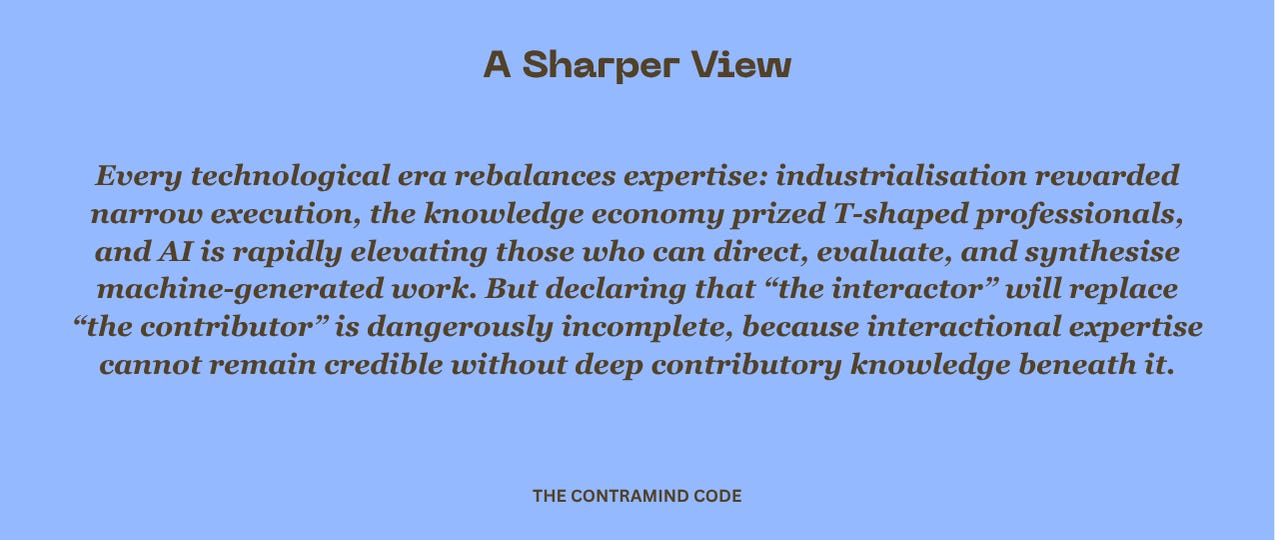
One of the limiting conditions of Prof. Harry Collins’s framework is that being genuinely good at interactional expertise requires some contributory expertise grounding in the domain. You, as a professional, cannot acquire expertise just by asking the AI tool or by reading through the answers that the AI tools generate.
The problem of ‘interactional incompetence’.
Without sufficient grounding in contributory expertise, what looks like interactional expertise leads to what Prof. Harry Collins defines as ‘interactional incompetence’. You can develop vocabulary fluency without an in-depth understanding of the underlying concepts. You can develop the ability to speak and generate the right-sounding words. However, you cannot evaluate whether what you are saying is correct.
A practitioner of medicine, R&D, manufacturing, finance, marketing, procurement, sales, etc. acquires contributory expertise through years of sustained practice and engagement with other practitioners in their field, by attending conferences, debating with other fellow practitioners, reading literature and articles, learning from their mistakes when they applied their own intuition or reasoning, etc. This allows them to spot a flaw in methodology or approach or identify a claim when it is overreaching.
This is the trap that millions of professionals with AI tools in their hands can fall into. Imagine a person who has never built a financial model can now produce one using AI, or a person who has never written a line of code can now produce functional software, or a person who has never drafted a legal brief can now produce a document that looks like one. The output looks credible, but the person’s ability to evaluate it critically and to catch what the AI has got wrong is very hard.
A great conductor has the knowledge of playing many instruments.
Your expertise must be like that of a conductor. You must transition yourself into a conductor who cannot play every instrument but has played several well enough to know what each sounds like when played badly. You cannot be a conductor if you have never played an instrument. Therefore, it is impossible for you to hear or identify what the ensemble is getting wrong. Also, a conductor who has played only the violin cannot hear all that the orchestra is capable of. That’s the contributory expertise built over years that helps a conductor direct the orchestra very well.
You must be an orchestrator with genuine, deep, multi-domain contributory grounding to do what neither the pure specialist nor the pure generalist can. You must be able to produce coherent, integrated output that is greater than any single contributing part.
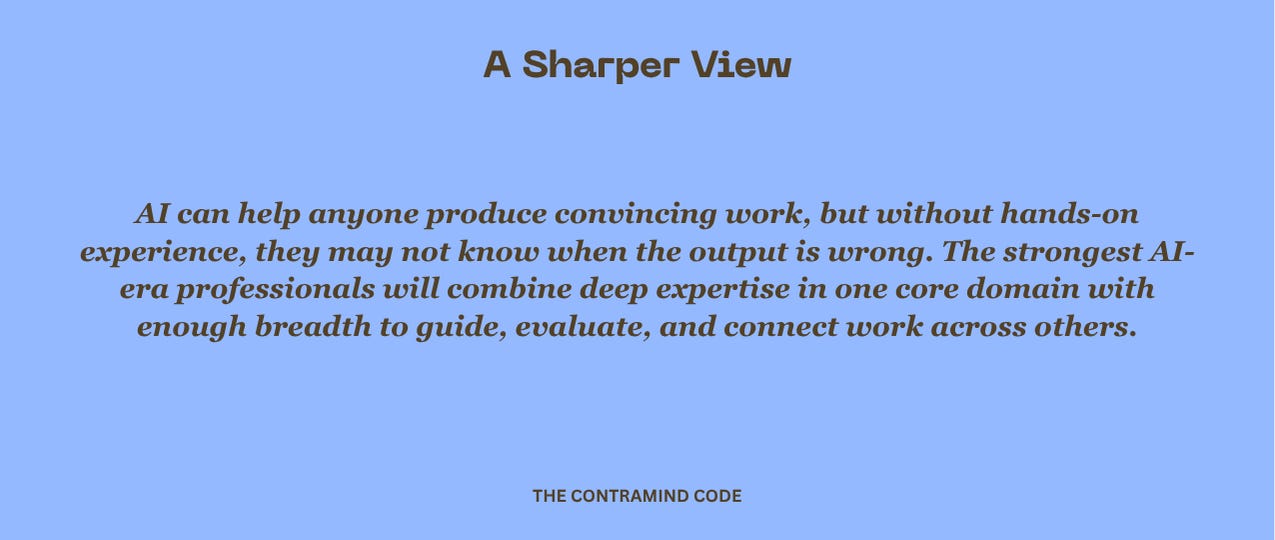
If you want to be amongst the most effective AI-era professionals, here is what you must build. It’s not enough to have just interactional expertise, which is the ability to speak fluently across many domains. Or build only contributory expertise in one narrow domain. You must build a strong foundation of real, contributory expertise in at least your core domain, and sufficient interactional expertise to operate across adjacent domains. This will give you the ability to direct AI systems with enough evaluative judgment to know when the output is right, when it is subtly wrong, and when it is absolutely catastrophic.
What kind of expertise will the next fifty years require?
Charlie Munger said: “Learning from history is a form of leverage.”
When we look at history, past historical patterns are consistent. With every major technological transition, it initially feels as if it will destroy expertise built in the past, but eventually it creates demand for higher-order expertise that the previous systems could not produce.
The printing press did not eliminate the need for literate people. It created a world of more sophisticated, mass-distributed literacy than before, but scribes-led expertise became obsolete.
Electricity did not eliminate the need for people with contributory expertise in mechanical systems. It created a completely new form of contributory expertise in electrical engineering and electronics as an adjacent frontier.
The internet did not eliminate the need for people with industry-vertical-led domain expertise. It created a premium on people who could connect across domains at a speed the pre-internet world did not require.
AI will follow the same pattern.
The contributory expertise which will be at greatest risk is the cognitive tasks that are codifiable. Routine cognitive tasks that can be automated as rules, patterns, and procedures.
The contributory expertise that will grow in value will be a lot more tacit, like
Ones that cannot be stored in words - something that lives in your bones, that cannot be codified, but only experience will teach you that, something you know how to do that you cannot fully explain.
Knowing that the same words mean different things in different situations. It’s like a good doctor who does not just read the test results but reads the patient - their anxiety level, their support system, their ability to process bad news, the situation they are in, etc. The treatment plan may be identical, but how it is delivered varies from patient to patient.
The ability to spot the structure underneath the surface details. It is akin to a firefighter who enters a burning building and immediately senses, before they can explain why, that the floor is about to collapse. The reason is that their brain has matched the smoke behaviour, the sound, the temperature against a pattern built from fighting real fires.
The interactional expertise that’s not shallow but will grow in value, like
Having the ability to navigate your way through expert communities and send credibility signals. Your capability to operate comfortably inside that world and not just observe it from outside - knowing who to call, what to ask, how to read the room in a room full of specialists, and how to earn enough trust so that the real conversations happen with you rather than amongst them after you leave. You cannot be someone who has used AI to produce a convincing cardiology report and merely use the vocabulary that’s there. You cannot walk into a room full of cardiologists and earn the kind of trust that makes the real conversation happen.
You can be good at talking to people within your own domain. But only a few can genuinely translate - not be a mere coordinator or just relay information, but develop an understanding of what it means in one domain and have the skill to reconstruct its meaning in another domain without losing what is essential. This will become the rarest of capabilities and the most valuable in a complex organisation. It’s not uncommon to see, in organisations today, two people from different domains who are unable to translate their requirements into each other's language and communicate effectively. An example that brings this to life is a hospital's clinical team and technology team working to build a patient monitoring system. Most clinicians know what the system needs to do for patient safety. The engineers know what the system can actually build. The translation failure between these two groups results in systems that are technically functional but clinically useless. This will increasingly become a liability if you are not good at it.
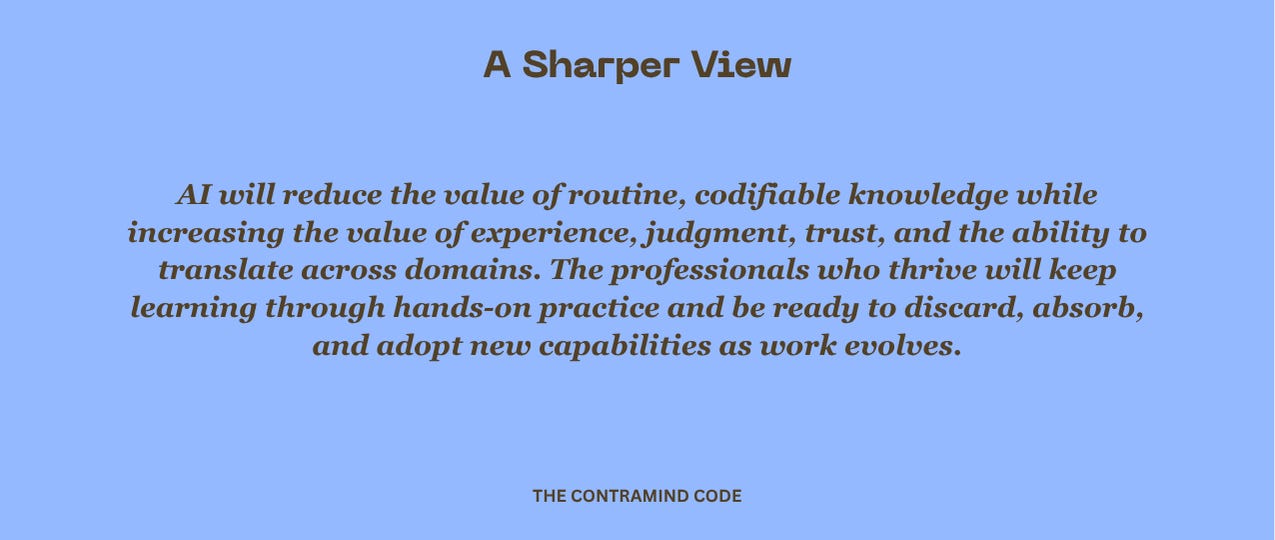
The underlying principle is pretty solid. Real expertise, whether contributory or interactional, requires regular hands-on working knowledge for genuine engagement, and you cannot outsource it to AI platforms or tools.
Therefore, according to a World Economic Forum and Massachusetts Institute of Technology study, by 2035, 39 per cent of key skills currently valued will have changed. By 2075, the dominant professional capabilities may not yet have names. So, be ready to discard, absorb and adopt new capabilities.
So what does all this do to your quest for building expertise?
Here are three questions for you that are worth spending time and thinking about:
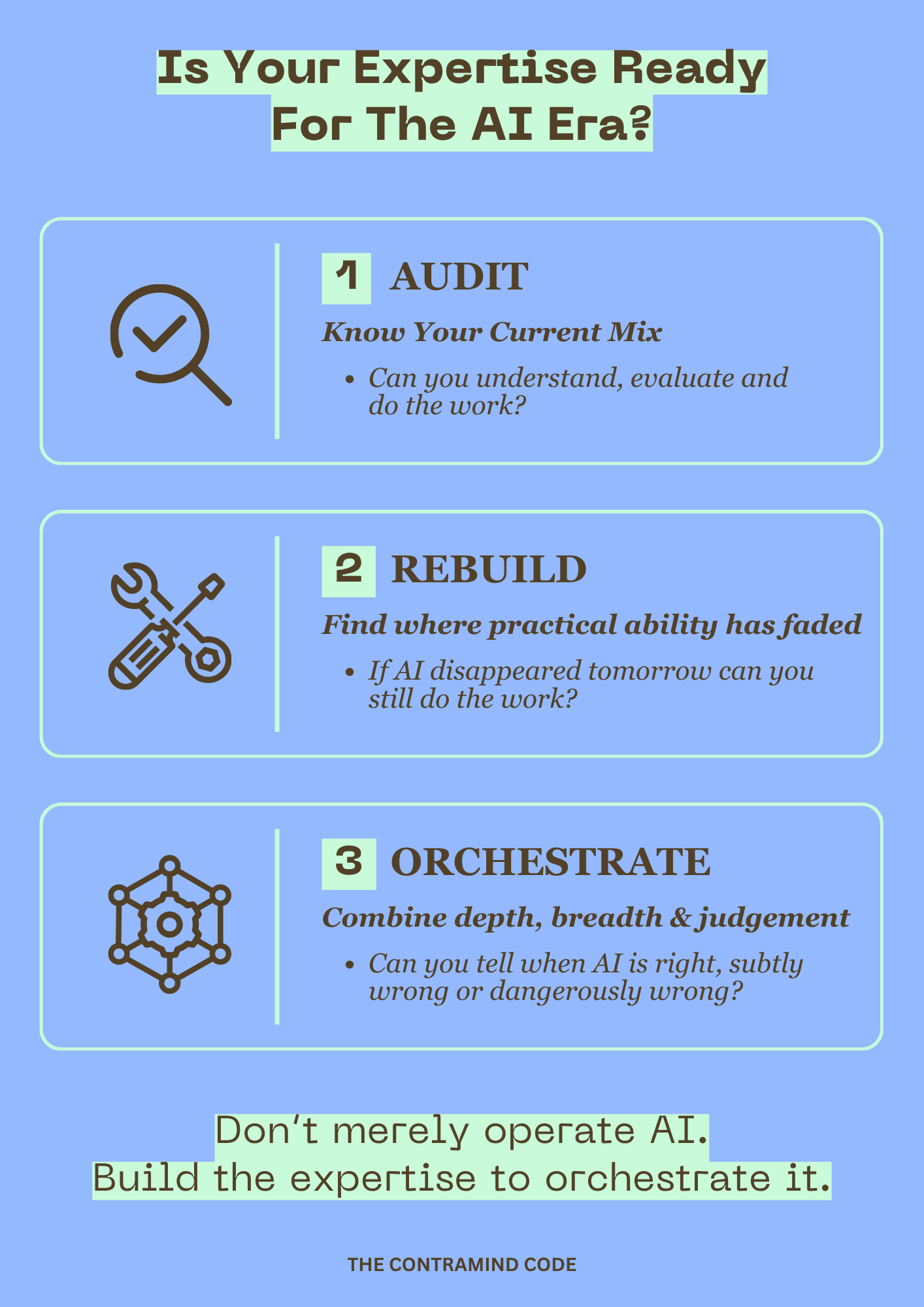
Audit the type of expertise you have been building: In the domain you claim you have competence in, assess if it is contributory or interactional. Analyse whether you can do the work, or engage meaningfully with those who can. Remember, there is no wrong answer. But you need to know what your portfolio mix of expertise looks like today.
Identify where your interactional expertise has lost its contributory foundation: As you gain experience and grow over time, many of you will find that your contributory expertise decays. Explore specifically, in your core domain, whether there are tasks that AI now handles that you previously performed yourself. If you stopped doing those tasks and AI disappeared tomorrow, could you still do them? If the answer is no, your interactional expertise in that domain is becoming hollow. That is where a lot of work is required.
Build your orchestration capability deliberately. You need to continuously develop and improve your expertise, at least in your primary domain, to maintain deep and genuine authority to evaluate AI outputs. You also need to embrace interactional expertise to operate across the adjacent domains that your role will require. Therefore, you need to practice the specific skill of directing AI systems using your own critical judgment, which comes with growing contributory expertise. Hence, you must remain open by not accepting the first output you get, not prompting the answer you expect or believe in, but genuinely testing the output against your own independent assessment of what the right answer could look like.
Capability, in any era, accrues value where cognitive effort is sustained and cultivated.
So what does expertise of tomorrow look like? You need the right balance of both contributory and interactional expertise. There is no perfect formula, but it requires constant practice. You must keep doing the hard work in your domain, while building sufficient knowledge across other domains. Also, be ready for them to be tested, refined and trusted when real-world collaboration happens.