
At workplaces, it is not rare to hear people lament, “We have very few people who can think out-of-the-box”. Most startup founders, business leaders, promoters, and business owners will tell you how many top performers from large enterprises struggled to transition to a startup or a new business-model environment. The reason is simple. Most people tend to manage and help scale what is already built, but very few can innovate by first thinking out-of-the-box about any problem and then scaling the idea or the process.
Scale was the moat. It no longer is.
Progressively, scale, which was a source of power, is getting dismantled. For more than 200 years, competitive advantage was simple - do more of the same thing, faster and cheaper. The business owner who could build 10,000 units where others built 1,000 owned the marketplace. The bank with 10,000 branches beat the one with 100. This model is being disrupted because AI is commoditizing execution. Therefore, throwing more people at the problem is no longer a competitive advantage, as agents can do it better and faster, and over time, network effects will begin to plateau.
We are therefore entering a future where execution is infinitely scalable and nearly free, and the only appreciating asset will be the capacity to think - thoughts that haven't been thought before.
Education was the moat. It no longer is.
Let’s look at this moment through a different lens.
Let’s first analyze what our formal education system prepares our people for. The formal education methodologies and the current education ecosystems were primarily designed to do two things:
Transmit existing knowledge at scale
Produce standardized worker/employee types
How does it transmit existing knowledge at scale?
Formal education does this through standardized curricula, graded assessments, sequential knowledge acquisition, and standardized testing and measurement. It discourages the generation of novel thoughts and ideas. The current education model was not designed for learning. It was designed for industrial compliance.
In a landmark study, Dr. George Land created a divergent thinking test for NASA to identify innovative engineers. This was administered to 1,600 children at three points in their school lives:
At the age of 5, 98% scored at the “genius” level for divergent thinking
At the age of 10, only 30% scored at the “genius” level for divergent thinking
At the age of 15, 12% scored at the “genius” level for divergent thinking
When administered to 280,000 adults, only 2% scored at the “genius” level for divergent thinking!
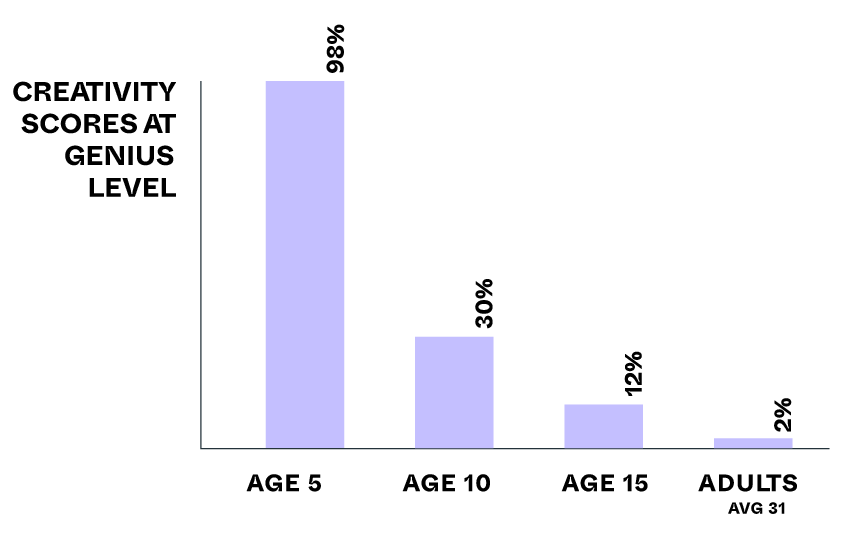
The only variable that changed between age 5 and adulthood was formal schooling! And the only variable that declined was creative thinking capacity.
The grade system, which is the operating measurement method of formal education, has become a ‘suppression engine’ for the motivation that drives original thought. According to Clayton Christensen, the late legendary Harvard Business Professor, “the most educated, best-trained people in an industry - those who understand it most deeply- are precisely the ones who fail to see disruptive threats.”
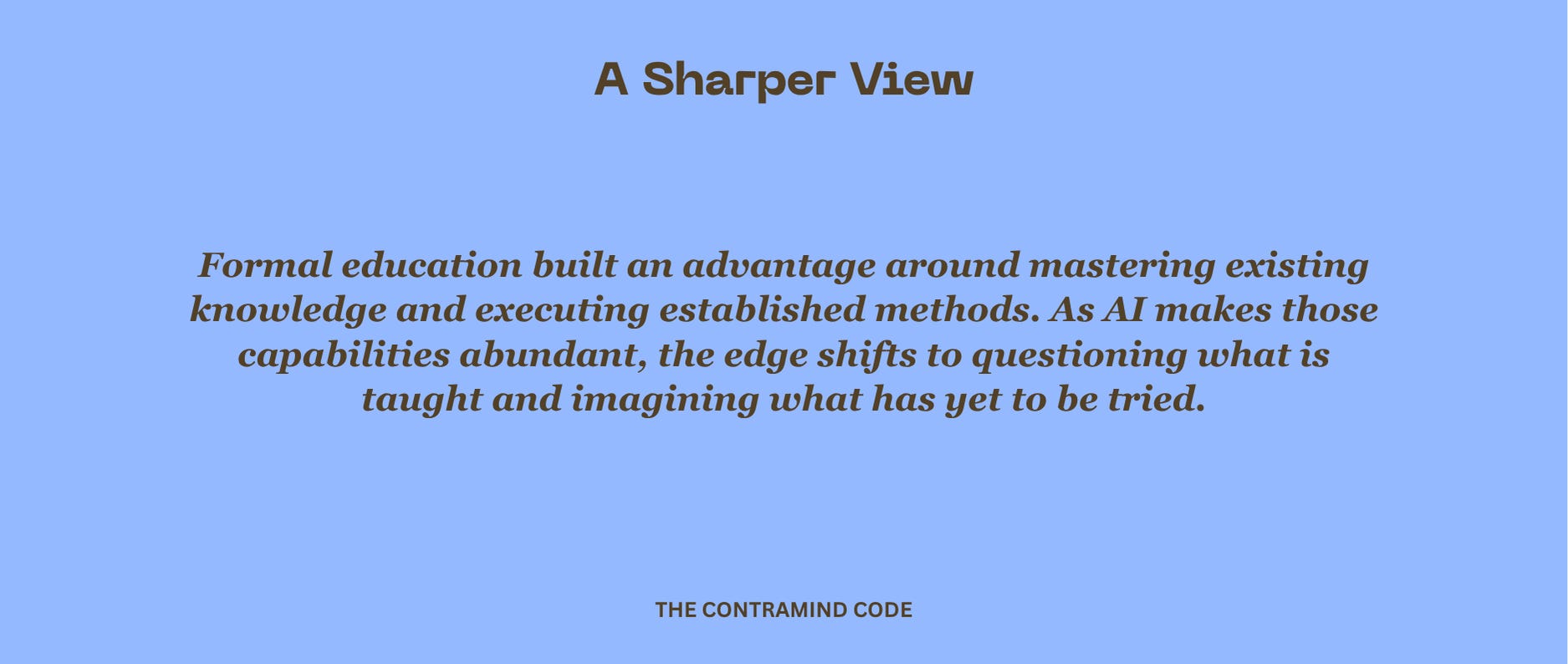
Formal education develops delivery skills like analysis, planning, attention to detail, and disciplined execution. These are execution capabilities. Formal education is hence structured to create more of the same people with pretty similar skills - who can get things done in a similar manner. Companies desperate to scale and win sought them out in the past. That is being disrupted.
How does it produce standardized workers/employee types?
Standardized workers/employees are those people who predominantly apply rules, follow decision hierarchies, process and manage transaction workflows, and produce and deliver predictable outputs. Give them a new problem, and they struggle. But when you ask them to do more of the same across functions and geographies, they simply excel at it. A structural shift is underway in how ventures are formed or will be restructured. Recent data on solo and micro-enterprise formation is just incredible and mind-boggling. Solo founders as a share of new startups jumped from 23.7% (2019) to 36.3% (mid-2025), a 53% increase in six years. The minimum viable enterprise size is dropping sharply.
Therefore, machines and general-purpose technologies like AI can scale any codified process infinitely at near-zero marginal cost. The only non-commoditizable resource left is the ‘thought’ that creates new frames, not the execution within existing ones. If you're working or a student, you are witnessing one such moment in history. Many more will come over the next 100 years. These are moments when standardization and scale begin to break down. You therefore need to adapt to new ways to learn, think, and work as enterprise sizes shrink and tighten over the next few decades before they start scaling up again.
It’s increasingly all about frame-breaking, not frame-optimizing
Most systems in the past - be it workplaces or education- rewarded you for operating within the box, executing by the rules, pre-defined measurement and scoring parameters, standard remuneration and promotions, and SOPs (Standard Operating Procedures) as envisaged by the people who set this up. They had workflows and processes to improve by doing the same thing faster - create more of the same, more efficiently. By their own definitions and boundaries, their ceiling became the edge of an existing frame of reference.
What you will increasingly need is out-of-the-box thinking and action.
Out-of-the-box thinking is the capacity to see the box that exists, question why it's shaped that way, and propose a different box entirely. The best analogy to bring this to life is comparing a chess grandmaster and a chess engine. Both are “thinking” about chess. The only difference is that the engine calculates 40 moves ahead, which is pure scaling of ‘within-frame’ logic. But the great grandmasters who invented modern chess didn’t play better chess, they redefined what good chess was. That is out-of-the-box - ‘outside-frame’ logic.
Once a new frame is created, thousands scale it for decades.
In the 1920s, you needed both the idea and the factory. In 2026, you need the idea, and the factory (execution layer) is available on demand. The idea need not be limited to a new startup, but it can be work and processes within your function, even in a large enterprise. What took many people to do can be done by a few.
Therefore this requires
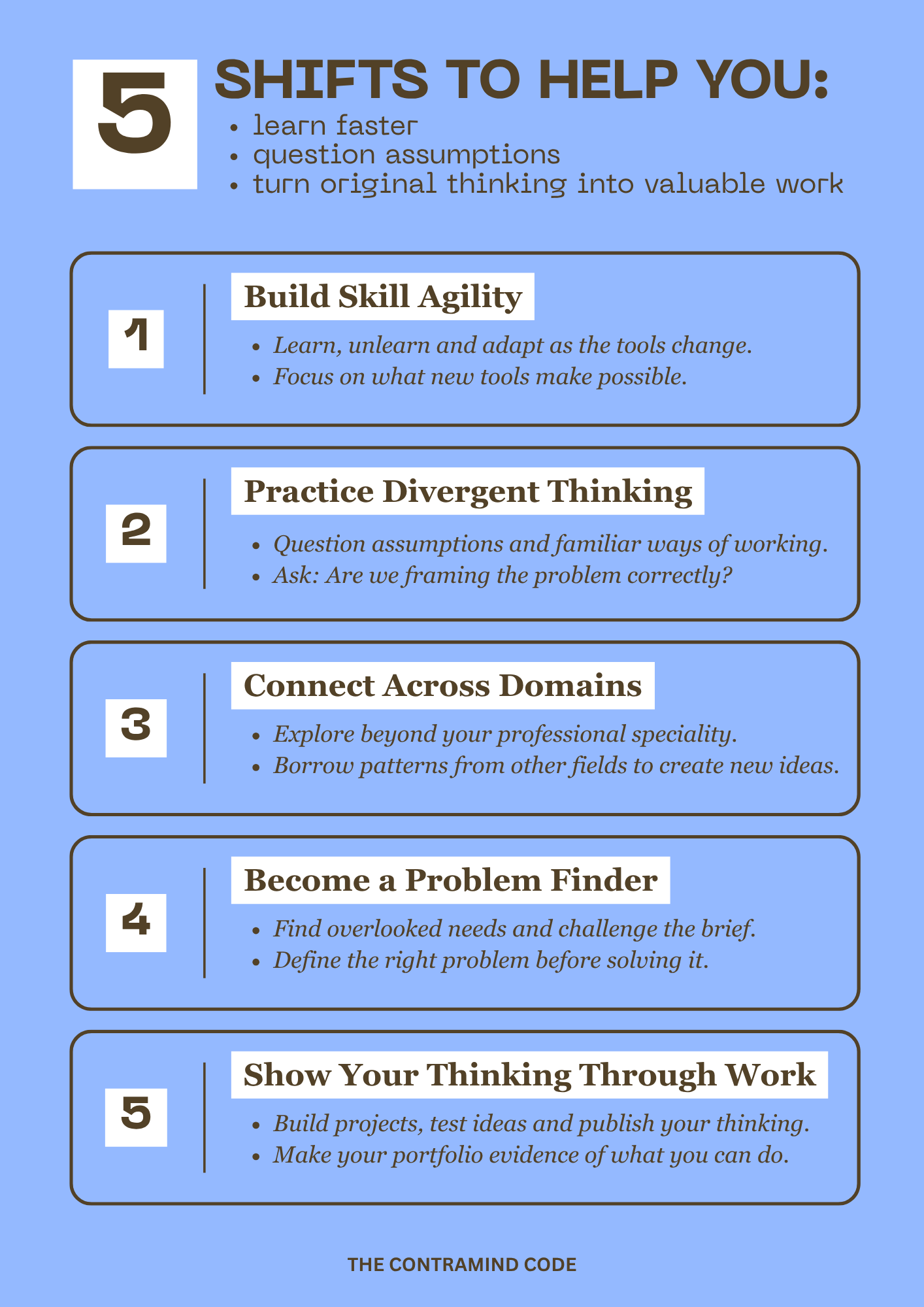
Skill agility: It requires the ability to learn and unlearn faster than the pace of external changes happening around you. This isn't about known situations that have rewarded people over the last 75 years: “earn a degree”, “Azure or AWS certified”, “learn Six Sigma”, “learn AutoCAD,” "learn Python", “learn Java”. Now, agents can do these at scale. Thinking about what you can do or what was not done with these tools will become more important. It’s about learning how to learn the next thing that hasn't been invented yet.
Divergent Thinking: Becoming uncomfortable with old and known ways of doing things. Be ready to ask and work with people who are willing to say, “Here is what we think we know, question whether the framing of the problem is right.” Be ready to interrogate the reality being given, discussed, presented, or shared with you.
Know more domains: Don’t see yourself as only a software developer, sales analyst, procurement or finance specialist. You cannot make analogies if you know only one domain. A pattern from biology could apply to organizational design, or a principle from architecture could apply to business strategy. This is the primary thought mechanism for generating non-standardized insight and work culture.
Move from problem-solving to problem-finding: Problem solvers are overhyped. They are valuable when problems or established ways of doing things are known. Maybe what is needed is to look at the problem through a new lens. It is worth taking inspiration from what Einstein said: "If I had an hour to solve a problem, I'd spend 55 minutes thinking about the problem and 5 minutes thinking about solutions." Become a problem finder.
Build demonstrable work, don’t accumulate just credentials: Any degree or certification only certifies that you sat through the curriculum and cracked some tests. However, any portfolio that you create proves how you think and build. A portfolio is nothing but projects you have done, products you've tried to build, problems you've found and solved, and your published thinking.
You are moving into a transitionary phase where skills and scale are being redefined. You need to think and act out-of-the-box to get prepared for this change. You can only make this transition effectively if you identify and develop capabilities the previous era did not require.