
Doubt is often read as indecision or a lack of commitment.
This is a skill that is systematically penalised in the corporate world. Not because it is dangerous. But because it is widely considered a weakness.
Over the last 100 years, in the industrial and knowledge era, the professional currency that is respected and rewarded has been conviction. If you are a professional at work at any level, and if you project a certainty-driven attitude and behaviour, you get all the attention and tend to get rewarded more than others. This is not limited to professionals who are just working. If you are a startup founder who expresses an unwavering belief in an idea, you could close a funding round faster. Also, a leader who exudes unshakeable confidence has unquestioned followers. Doubt, when expressed publicly, is often read as indecision, incompetence, or a lack of commitment. So most professionals learn to display certainty - whether or not they actually feel it. Most of them leave their doubt at the door or at home when they come to work.
This trade-off worked pretty well in a stable world. In a rapidly changing one like the one we are currently going through, it is increasingly becoming a liability.
What professionals from the past must leave behind
Most professionals build their identity on two pillars: deep expertise and high conviction. Both have served them well to date. It does not matter if they are an early-career, mid-career, or late-career professional. Expertise gives them speed. Conviction gives them authority. Together, these qualities accelerate careers and help them build teams and organisations.
But as we explored in last week’s issue on deskilling, the very expertise you strive for creates a paradox. As your depth grows, so does your inflexibility. The patterns and schema networks your brain builds to process familiar problems become the very filter through which you screen out unfamiliar ones. You begin to see more of what you already know and less of what is actually new.
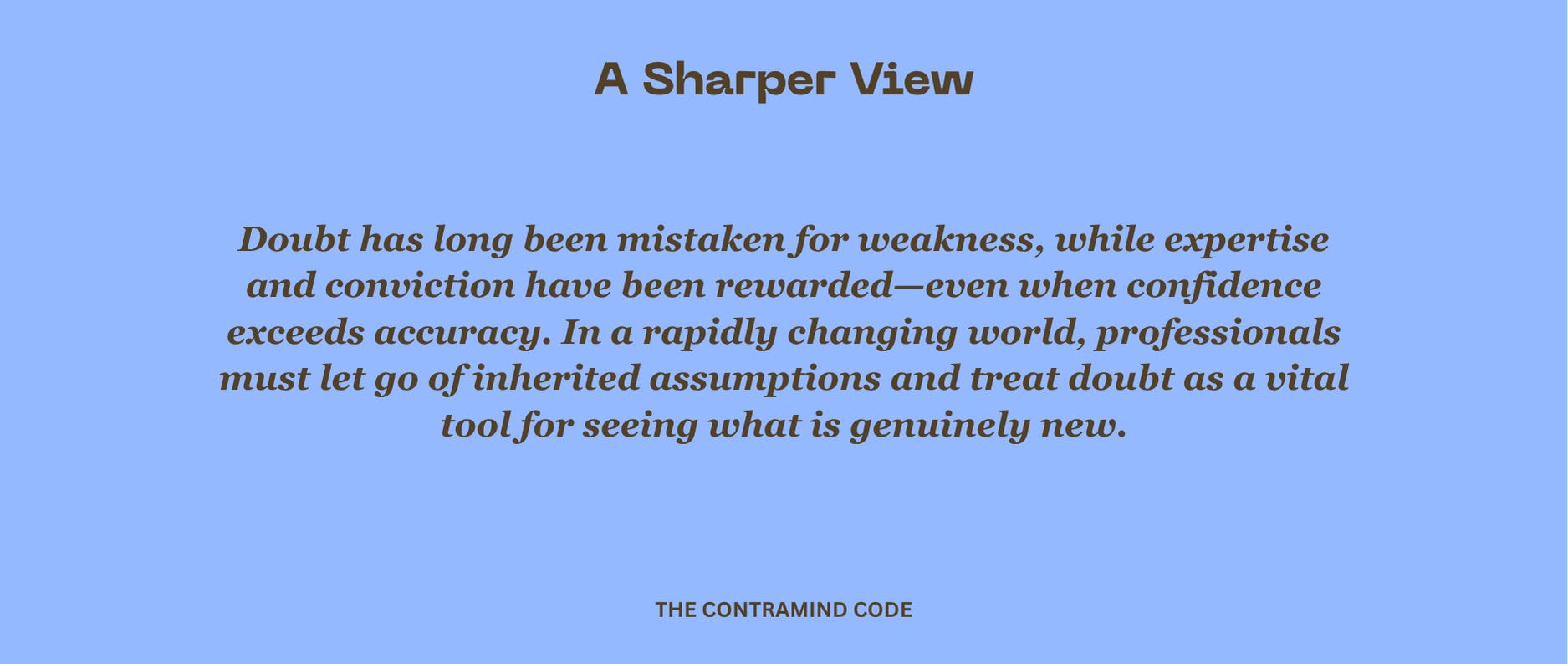
Most professionals from the past era were rewarded for never questioning the map - the larger assumptions, frameworks, or models that they were handed over or asked to work with. However, what they must now leave behind is the deeper belief they often hold - that confidence and accuracy are the same thing. The hard truth is that they are not. Ironically, they never were. The gap between projecting certainty- an “I know it all" attitude and being accurate is no longer a harmless career strategy. It is now a professional risk. Let’s explore the reasons further and how to avoid it.
The risk that AI has silently introduced at work.
Before exploring which aspects of these skills you must carry forward, it is worth understanding the new threat that has entered the lives of professionals without their noticing.
Most AI tools are engineered to produce near-perfect and authoritative-sounding outputs. They do not express any kind of uncertainty or doubt. In fact, they sound very authoritative and certain because of the depth of the research and rich analysis that they seem to throw at you. And when you, over time, work repeatedly with an engine that is never seemingly unsure and rich in reasoning, your own internal uncertainty, which is actually your most valuable signal, gets progressively overridden by the tool’s fluency. Your accurate recognition of the limits of what you know quietly begins to migrate to the tool, and you tend to go with confidence that has very little basis in your own reasoning.
Hence, this should prompt you to ask one urgent but vital question: “Is AI silently eroding my ability to know when and where I am wrong?”
Is being wrong or doubtful a loss of your credibility?
Philip Tetlock, a professor at the University of Pennsylvania’s Wharton School, spent twenty years running the most rigorous forecasting research study ever conducted. He studied thousands of predictions and thousands of forecasters. This included people from every domain, from geopolitics to economics. There was one finding, above all others, that proved extremely valuable. The professionals who were most accurate over time were not the most certain. They were the ones most willing to doubt themselves - systematically, deliberately, and in public.
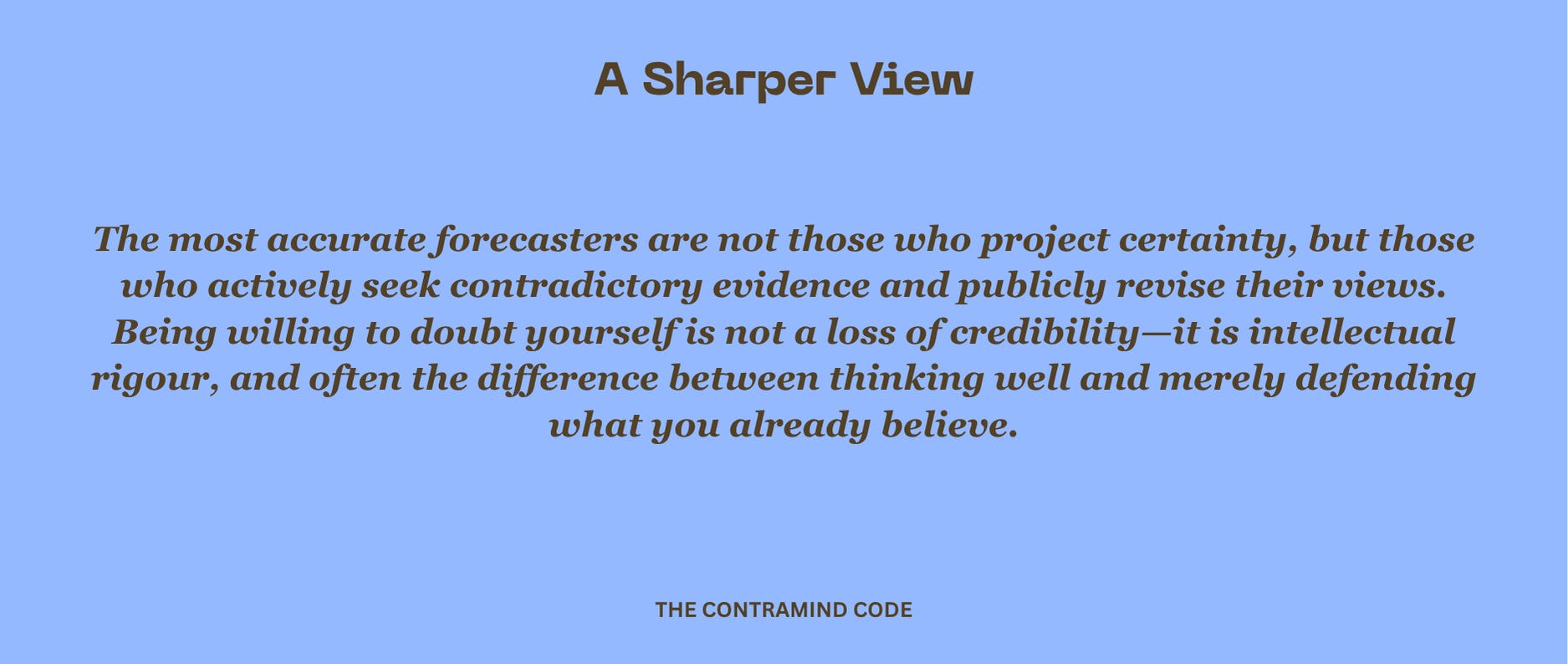
Prof. Philip Tetlock called this cohort of people ‘superforecasters’. He identified one specific habit that made a big difference in all of them. These people updated their probability estimates two to three times as often as average forecasters when new evidence emerged. They actively sought information that contradicted their existing views. And when the evidence demanded a change in their assumptions, they publicly changed their position, explaining what had changed and why. For them, being wrong was not a loss of credibility. It was a demonstration of intellectual rigour.
Prof. Philip Tetlock’s other finding is something you should seriously pause to think about and also reflect on. If you are a professional at work he identified two types of thinkers during his research:
‘Foxes’ - who know many small things and update readily
‘Hedgehogs’ - who know one big thing and defend it aggressively
Hedgehogs are the professionals the corporate world celebrates. They get speaking invitations on panels or as keynotes, board seats, advisory roles, and invitations to contribute to op-ed columns. They project conviction around what they say and how they say it. In reality, they are, on average, measurably less accurate than foxes. This externally focussed ecosystem creates the so-called experts’ group, who select certainty over restrained calibration. Also, the market for ideas rewards the untested confident storyteller. However, certainty, left unchecked, becomes a systematic liability.
Prof. Tetlock found that smarter people were more capable of generating sophisticated rationalisations for beliefs they already hold. This ‘cage of expertise’ that they have built around themselves is the strongest for those who built it most carefully.
Remember, as a professional, being good at thinking can make you worse at rethinking.
The value of ‘Productive doubt’
Productive doubt is not indecision.
It’s not about being seen as a professional who cannot make up your mind, or as somebody who delays every commitment, or as someone who demands more information before every action — that is not ‘productive doubt.’ That is paralysis. It produces nothing.
‘Productive doubt’ is the deliberate practice of questioning a belief or an output, not doubting yourself. You begin by asking:
“Is this claim actually true?”
“What am I assuming?”
“What would I need to see to update my views on this?”
“What are the sources of this truth or findings?”
And it is not about saying to yourself, “Am I actually good enough to be here?”
‘Productive doubt’ is about working towards getting closer to what is accurate, not towards anxiety. And critically, it operates in the zone before a commitment, not after you have committed to a solution. It improves the quality of your reasoning at the moment when it still matters.
Today, in a world where AI tools actively suppress this process by delivering confident and rich outputs, it is imperative that you build ‘productive doubt’ through discipline and practice.
Why do some professionals continue to grow while others plateau?
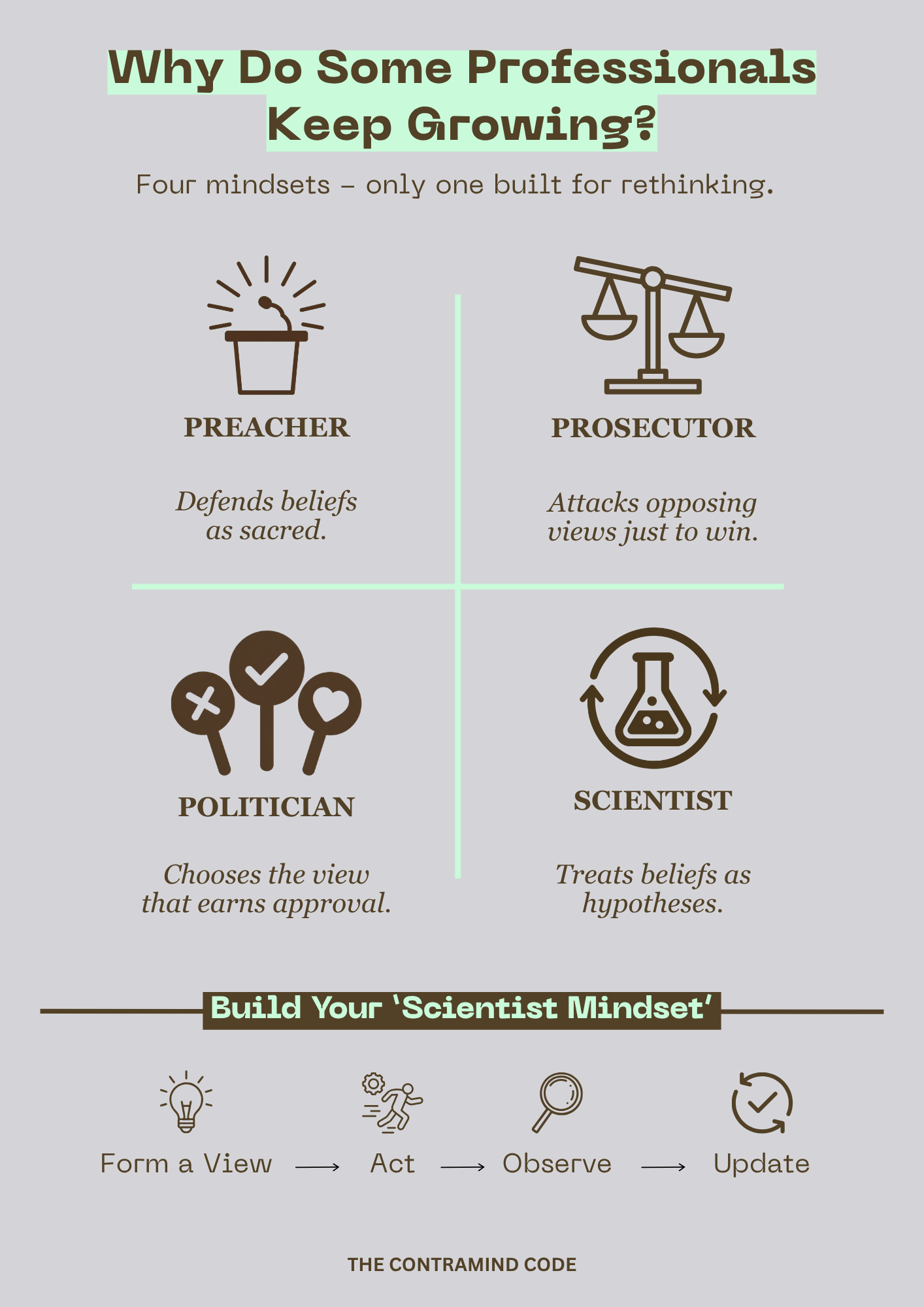
In another very interesting research finding, Adam Grant, the well-known organisational psychologist from Wharton, found that professionals fall into four types of clusters:
The preacher who defends their beliefs as sacred — any challenge to their position is treated as an attack on their character.
The prosecutor who attacks opposing views with the goal of winning, not of finding truth.
The politician who seeks the position that earns the most approval in the room.
The scientist who holds beliefs as hypotheses, not as identities. They form a view, act on it, observe what happens, and update accordingly.
According to Adam Grant, people with a ‘scientist mindset’ separate two things most professionals normally fuse together:
Their confidence to act.
Their certainty about being right.
Professionals with a ‘scientist mindset’ have the ability to act decisively on a hypothesis while remaining genuinely open to the possibility that the hypothesis could be wrong. In Adam Grant’s research, the most productive and innovative teams were not led by the most confident leaders, nor by the most humble ones. They were led by professionals who had a strong sense of direction and genuine uncertainty about the method.
How can you improve your ‘productive doubt’ capability at work?
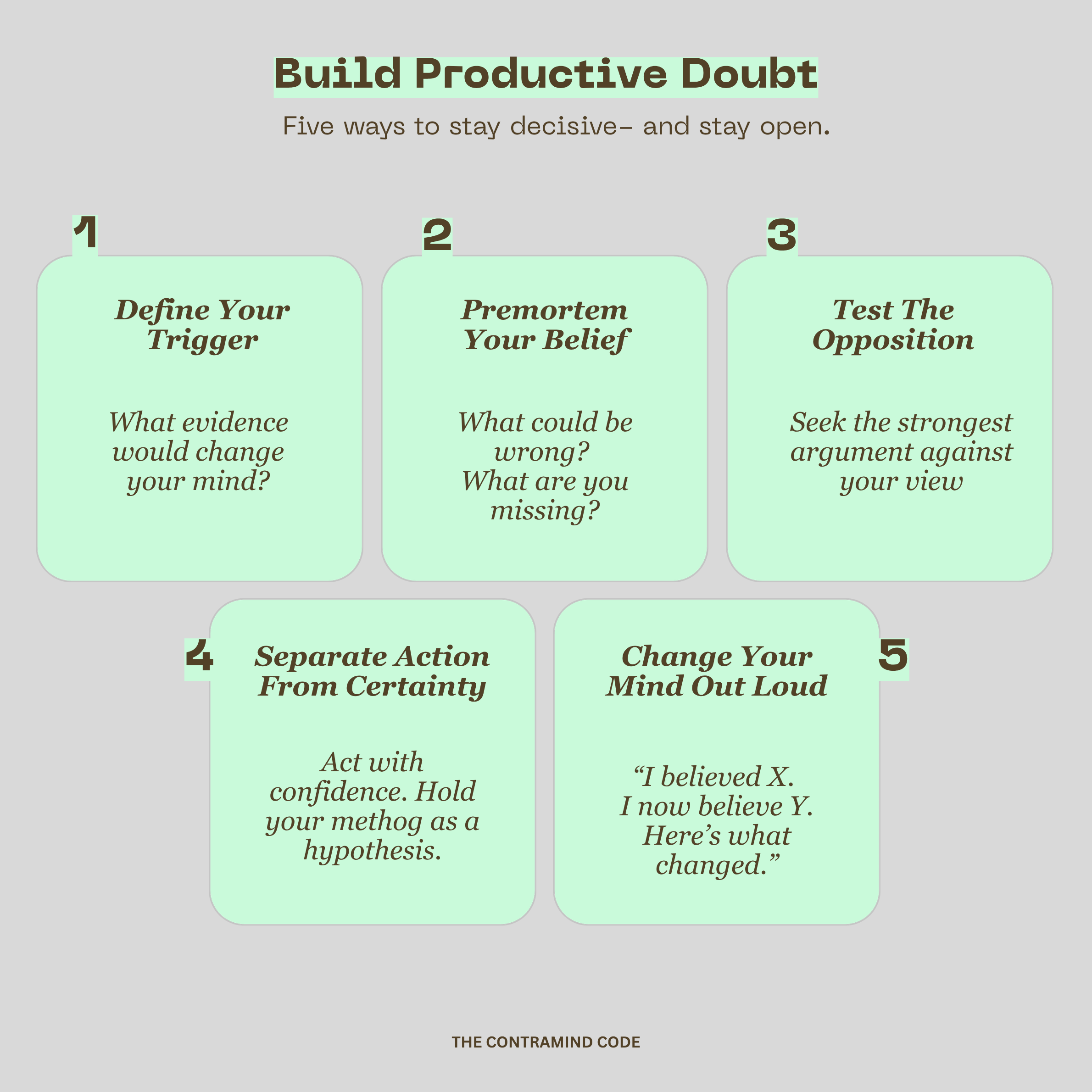
Before you commit to a position or a decision, try to think about what would change it: Ask yourself, “What new information or fact would cause me to change my decision or viewpoint?” If you are not able to name one, it is a clear signal that you are not applying enough reasoning, but you are rationalising the decision or position in your own head. This is what Prof. Tetlock calls the difference between a held belief and a defended one.
Run a premortem on your strongest beliefs: The premortem practice is widely used in project management and forces you to imagine the project has already failed before you launch and to examine root causes. Do the same for your beliefs or assumptions, as they tend to create bias. Ask yourself:
“What else could be wrong?”
“What am I not seeing?”
“What would a person holding the opposite viewpoint point to as evidence?”
“What is the active proof of this output that I have got from the AI tool?”
Test the strongest argument against what you strongly believe: You tend to consume information that confirms what you already believe, like “This is a market that will buy our products.” or “ This pricing will work the best.” Algorithms only make this worse. ‘Productive doubt’ requires a deliberate countermovement. For every position or point of view you hold with high confidence, find and read the strongest argument against it. Try not to get persuaded by it. Use it to test whether your position holds well with the best opposing case. If it does, your confidence is now grounded in something tangible. If it does not, you would have learned something more valuable than being right.
Try to delineate your confidence to act from your certainty about being right: Don’t forget, confidence is a communication strategy that you exhibit to others. Certainty is based on your experience, expertise or knowledge. They don’t need to be the same thing, and fusing them is where most professionals, like you, can make your greatest thinking error. It's only fair for you to say “I believe this is the right direction and we are moving on it,” while you may personally hold a view like “I am treating this as a hypothesis and watching for evidence that proves it.” It is not dishonesty. It is a way the best leaders separate conviction from arrogance.
Be ready to accept in public, not just privately: This is the hardest step you will find to take and act on. Because you have spent your career in a culture that treats changing your mind or failure as a sign of weakness. Treat changing your position or viewpoint as an act of intellectual integrity, not retreat. The next time you change your position because the evidence demands it, say so explicitly. “I believed X. I now believe Y. Here is what changed my thinking and why.” Over time, this does not weaken your credibility. You can be certain that this will build a reputation for you, which is far more valuable than an image of certainty, as it will greatly improve your accuracy.
Ask yourself, once a day, about the belief or assumption you are most confident or certain about: “What would change my mind about this?” If you cannot answer, that is exactly where the work for ‘productive doubt’ begins.