
For most of your working life, you were told one thing about experience - every year you put in makes you more valuable than the year before. Five or ten or fifteen years into your working life, you are told you will be more secure and more valuable. You also begin to expect an upward movement in position and earnings, as your years of experience add up.
Seniority was the moat. It no longer is.
Around the fifteenth year, the same experience that was supposed to protect you starts to be questioned. You cost more than the person ten years behind you. Behind closed doors, your company asks, “Are you worth that much?” Most professionals have never asked themselves this question. Every employer asks it every year.
This is what is called the ‘Experience Discount’.
What does ‘Experience Discount’ really mean?
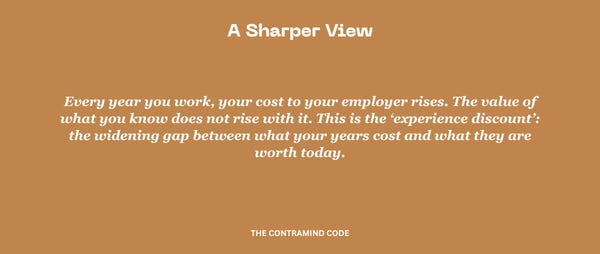
‘Experience Discount’ is the gap between what your years of experience cost an employer and what those years are worth to that employer today.
When you are young, this gap works in your favour. You are relatively inexpensive, hungry, deliver more than you're paid, and learn fast. As you grow, your pay rises every year. But the value of what you know does not rise in a similar straight line. At some point, the two lines cross. From then on, each additional year adds more to your cost than to your worth, unless you do something about it. The irony is that nobody tells you when you have crossed that point. You find out about this gap the hard way during a restructuring or a business transformation initiative, or when someone younger supersedes you or when a business gets hived off in your company.
In China, people have a term for the age when this happens. They call it the ‘curse of 35’.
How do you, as a professional, end up in this position?
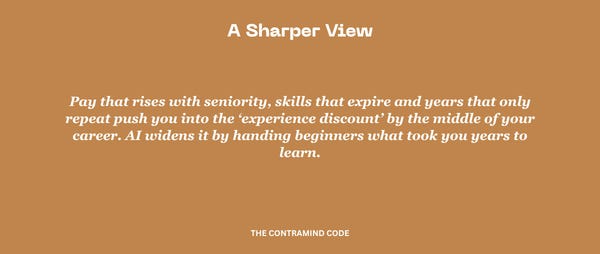
Three forces come together that push you into this position in your career.
The first is how you are paid.
In 1979, well-known economist Edward Lazear, Senior Fellow at Stanford University's Hoover Institution, explained why companies pay the way they do. They pay you less than you produce when you are young, and more than you produce when you are older. It keeps you committed and loyal, and it makes you work harder for a reward that comes later. This works well as long as the company keeps its side of its promise. However, when the business environment changes or slows, the senior employee becomes the most expensive line on the Excel sheet. In your early or middle years, you would have promised that commitment and loyalty would be rewarded later. ‘Later’ is exactly when the promise gets reviewed.
The second is that skills expire.
David Deming and Kadeem Noray, researchers from Harvard University, studied this in a 2020 paper published in The Quarterly Journal of Economics. They described the returns on work experience as “a race between on-the-job learning and skill obsolescence.” In fast-changing fields like computer science and engineering, they found that graduates' earnings advantage declines rapidly as they gain experience. What you learnt in your first five years is no longer what the job requires in your fifteenth.
The third is the hardest to accept.
More years of experience do not automatically make you better.
Many professionals begin rapidly gaining expertise early in their careers. After that, they only ‘collect’ years of work experience. In 2005, three researchers from Harvard Medical School reviewed evaluations of doctors and published their research findings in the Annals of Internal Medicine. Surprisingly, in a profession like medicine where it’s all about saving lives, 52% of doctors with more years in practice performed worse on every measured outcome. The research findings revealed a key reason. What a doctor learns in training may not be updated regularly, and older doctors seem less likely to adopt new approaches or medical care techniques.
In a 2023 working paper, Generative AI at Work, Erik Brynjolfsson, Danielle Li, and Lindsey Raymond studied 5,179 customer support agents who were given an AI assistant. Productivity rose by about 14% on average. For the newest and least skilled agents, it rose by 34%. For the most experienced agents, it hardly moved. The tool learned from the best agents and passed that knowledge to beginners. The advantage that took years to build was handed over in months.
AI does not care how long it took you to learn something.
Is your experience a ‘local currency’ or a ‘convertible’ one?
Think of your experience as money.
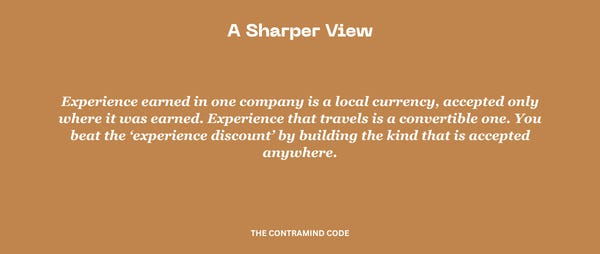
Some of it is like a local currency. It is accepted only in one country. You know how your existing company’s systems work, who approves what, which format each client likes in a B2B business, and how to get things moving through your organisation. This is valuable, but only inside those walls. Legendary economist Gary Becker called this ‘firm-specific’ skill. The day you leave, or the day you change your company, it converts into very little value. Loyalty is paid in local currency. The longer you stay in one company without building any addtional capability that you can leverage, the poorer you become outside it.
Some capabilities are like a convertible currency. It is accepted everywhere. You can read a market, judge risk, build something from scratch, or lead people through a difficult period, etc. These skills move with you.
The cost of holding capabilities only in local currency is high. A well-known study of displaced workers by Louis Jacobson, Robert LaLonde and Daniel Sullivan found that long-serving employees who lost their jobs at struggling firms suffered long-term earnings losses averaging 25% a year. The years they put in at the firm were real. But much of what they knew was accepted only in one place, the firm they had worked for years!
Now, let’s look at Morris Chang. He spent 25 years at Texas Instruments, from 1958 to 1983, and rose to run its worldwide semiconductor business. In 1987, at the age of 55, he founded TSMC, the world’s first dedicated semiconductor foundry. He brought a deep understanding of how chips were made and what the industry would need next. That capability could be applied anywhere.
You can also learn a lot from history. In 1820, Britain’s cotton industry had about 240,000 handloom weavers. Their skill took years to learn. As the power loom spread, their wages collapsed, and the findings of the well-known economists Daron Acemoglu and Simon Johnson showed that “The weavers had not become less skilled. The place where their skill was accepted had shrunk. Skill has never been protected by the effort it took to acquire it.”
So, how do you overcome the ‘Experience Discount’?
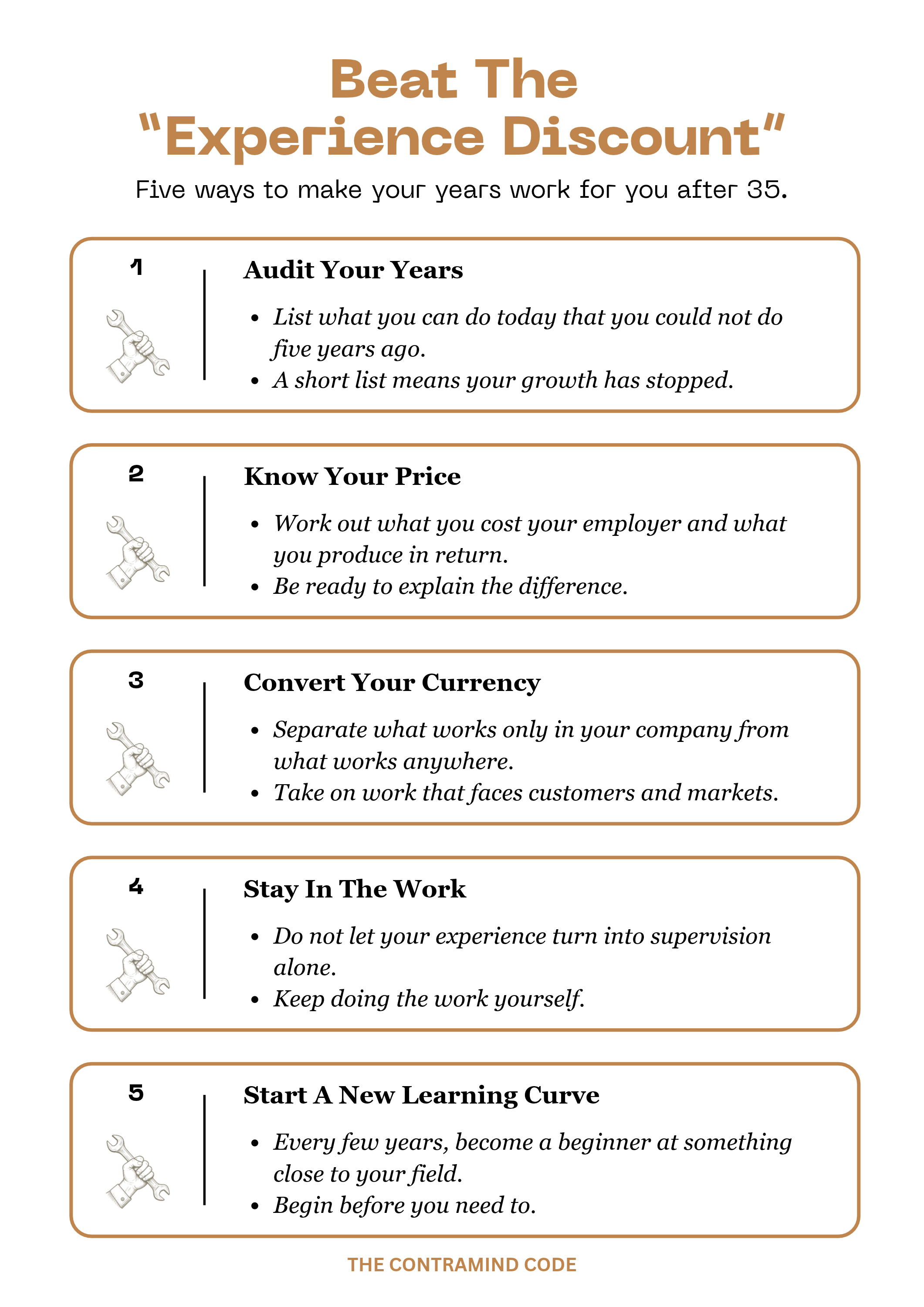
Here are some ways in which you can make your years of experience work for you:
Audit your years: Ask yourself an honest question. Do you have fifteen years of experience, or a couple of years of the same experience repeated fifteen times? List what you can do today versus what you could not do five years ago. If the list is short, your experience has stopped growing, even though your years would have.
Know your price: Find out what you cost your employer and what you produce in return. Most professionals know their salary but have never worked out their worth. For example, if you cannot explain why you are worth, three times a person with five years of experience, somebody else will ask that question to you soon.
Convert your currency: Look at what you know and separate what works only in your company from what would work anywhere. Then deliberately build capabilities of the second kind. Take on more work that faces customers, markets and outside partners. Write, teach, and speak about what you know so that it can be tested outside your own company’s four walls.
Stay in the work: Do not let your experience turn into supervision alone. As we wrote a couple of weeks back, every promotion takes you further away from the details. The professional who can still do the work is far harder to discount than the one who can only review it.
Start a new learning curve before you need one: Remember that experience is a race between learning and obsolescence. Every few years, become a beginner at something that is becoming important to your field. The discomfort you feel is your experience growing again.
Experience is still an asset after 35 only when you stop counting the years you have worked and start counting the places where what you know would be in demand and get you accepted tomorrow. This drives the ‘value premium’ of your experience. This is the only way you can beat the ‘Experience Discount’.