
Starting this week, there is a change to the newsletter format in response to the feedback I have been receiving. I am discontinuing the structure of sharing articles, podcasts, and videos that I have either read, listened to, or watched during the week.
One overarching piece of feedback was a request to share my personal perspectives, idea starters, experiences, and learnings on topics I have found valuable for personal or professional growth. Especially the ones that have forced me to reflect and think hard on them. Accordingly, the newsletter's structure has been changed.
I look forward to your feedback and continued inputs to make your reading experience more engaging and better.
Thanks for reading,
Swami
Idea Starters For The Week
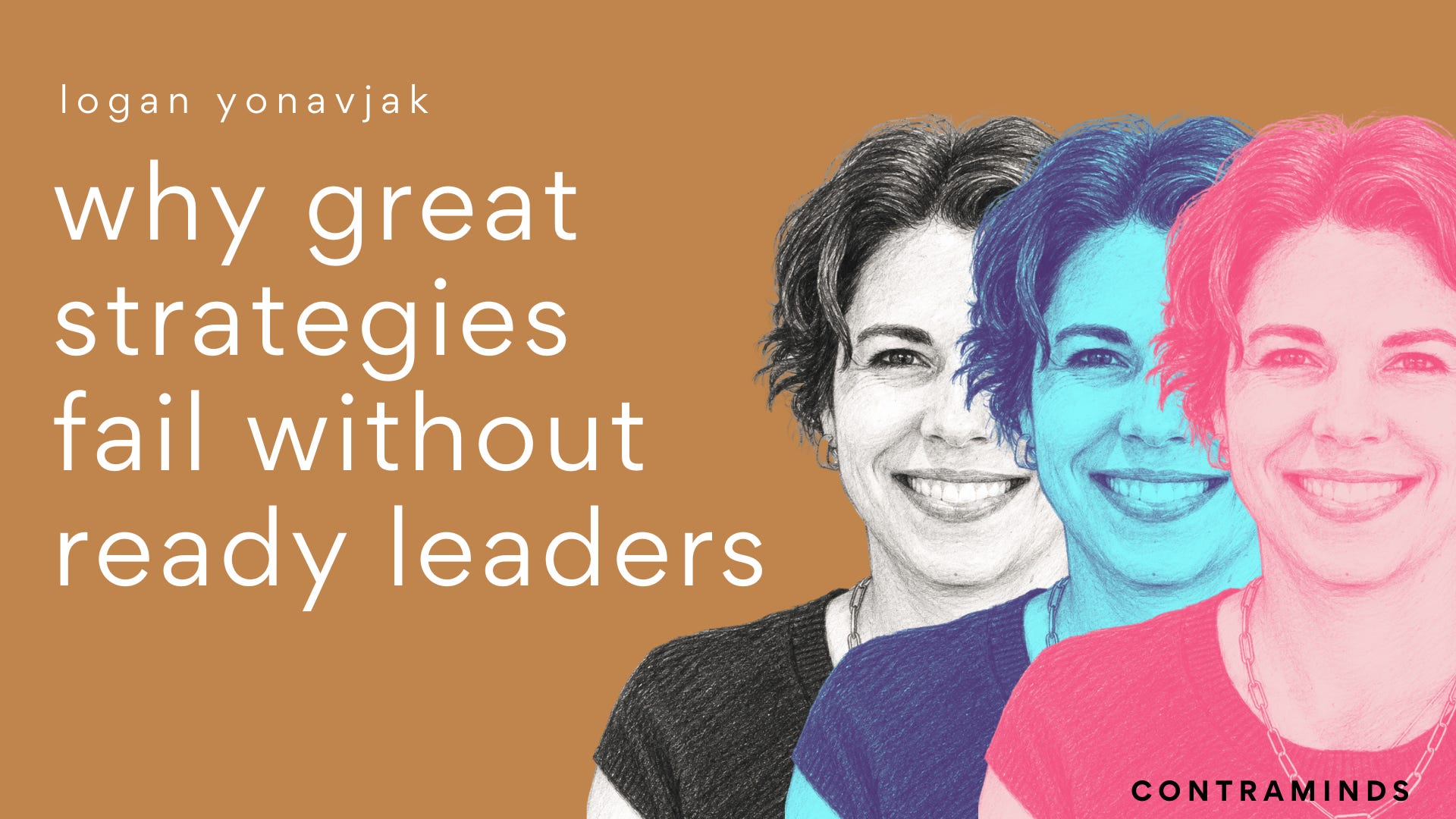
Logan Yonavjak on why great strategies fail without ready leaders:
“Strategy succeeds only when leaders have the capacity to execute it. Leadership readiness matters as much as strategic thinking.”
“Self-awareness is the hardest leadership skill.”
» YouTube | Website | Apple Podcasts | Spotify | Amazon Music
Revisiting first principles from past editions

How to avoid a midlife crisis.
View your career through a 30-year working lens, not through the narrow focus of your current job, and prepare yourself accordingly:
As you age and gain experience, ‘synergy takes precedence over energy’.
Find alignment between what you want to do and what you do.
Don’t confuse annual recognition with improved job capability.
“When your skills become uncompetitive with your compensation and capabilities, companies and the market will be the first ones to dump you!”
Explore more here.
The ContraMind Code Thought For The Week.
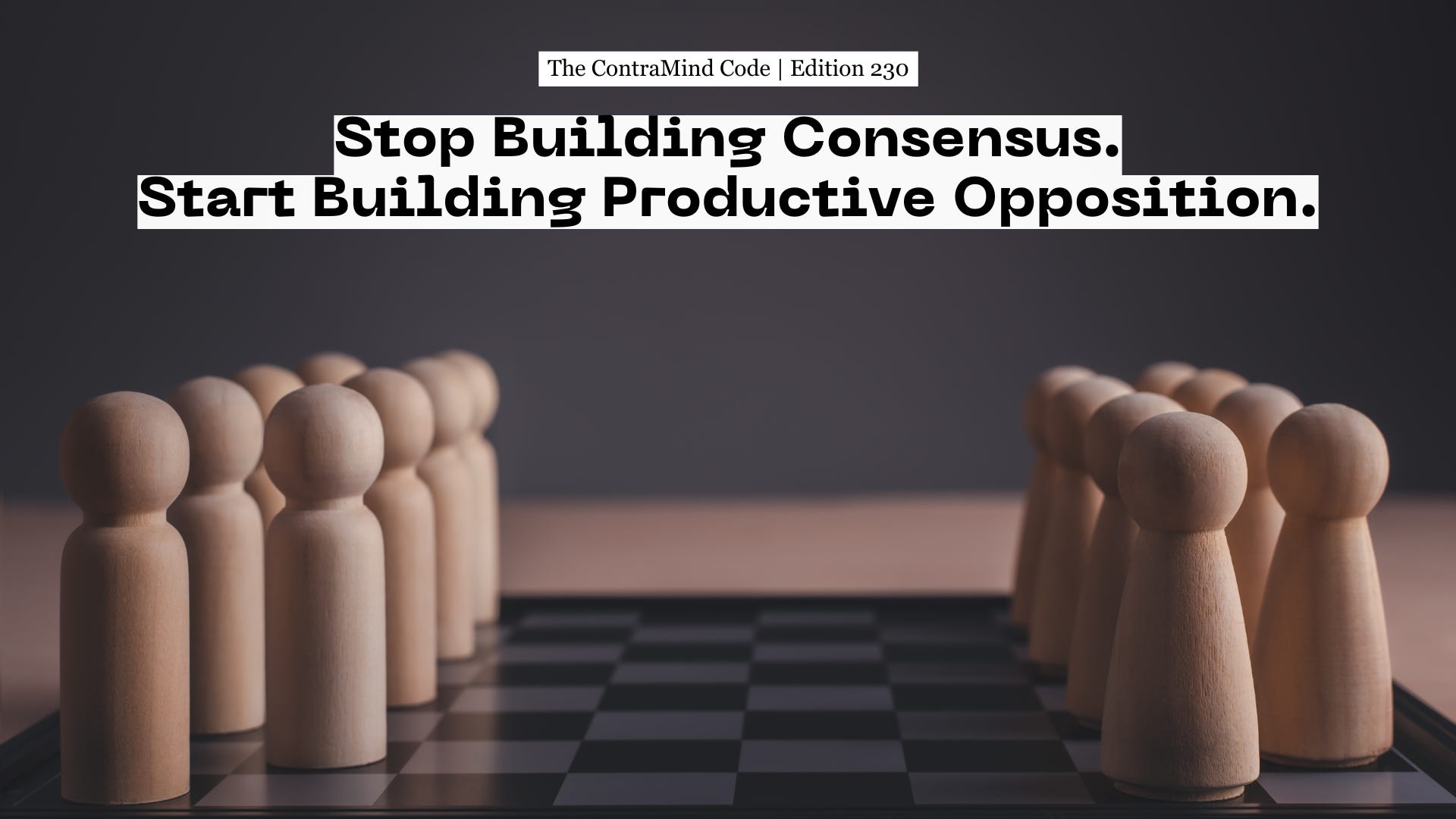
Stop Building Consensus. Start Building Productive Opposition.
The most dangerous professional habit that you will see around in company meetings, discussions, and in boardrooms is the habit of consensus addiction.
It’s not rare to see a slow shift in such situations where everyone agrees, debates are polished or diplomatic, and friction gets managed rather than encouraged. The most commonly observed failure in companies is the absence of constructive conflict - it is relatively minuscule and of the right kind. In fact, a quiet but uneasy atmosphere of harmony pervades the workplace, and it remains an unaddressed problem.
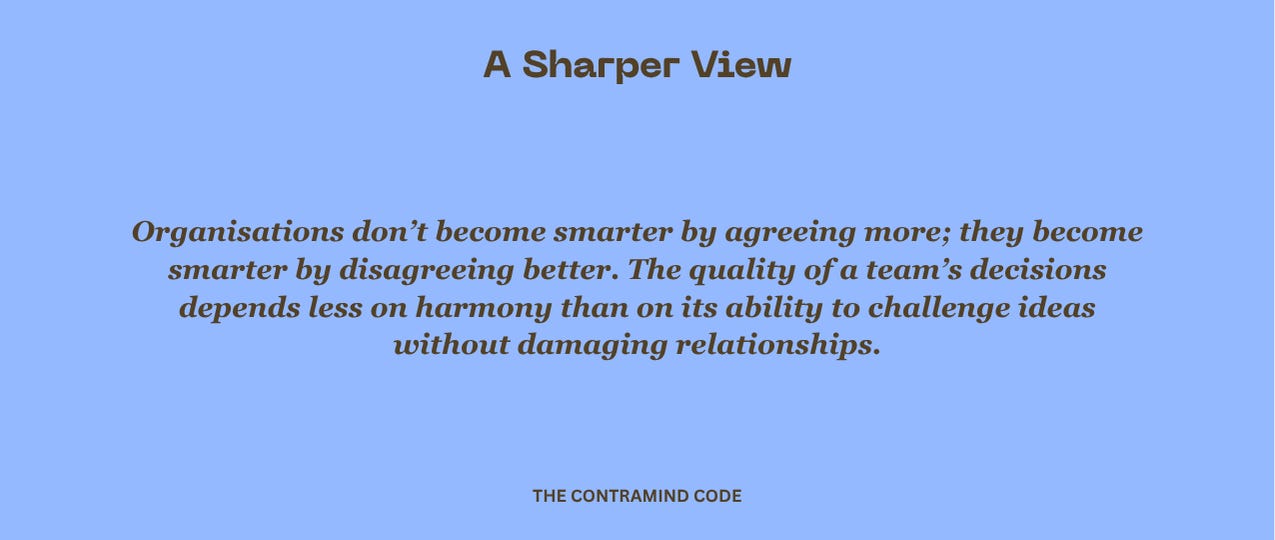
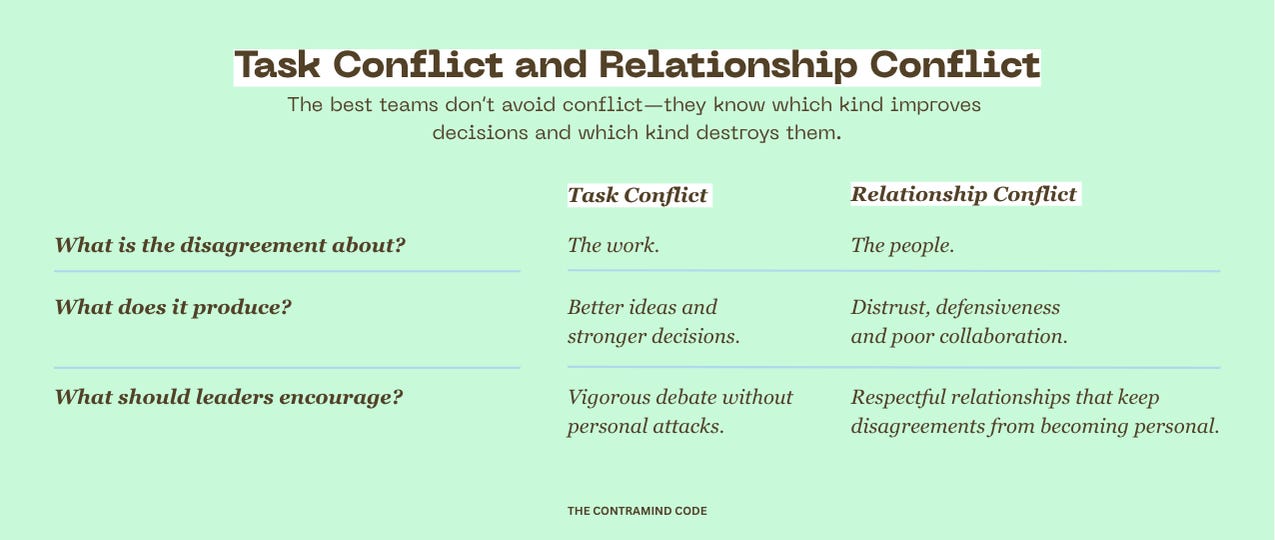
One of the many reasons for this kind of situation is the inability of the people in these companies to differentiate between ‘task conflict’ and ‘relationship conflict’. Most of the time, a majority of the people confuse one for the other or are unable to differentiate between the two. They treat both of these conflicts in the same vein without any difference.
A ‘task conflict’ is one where two people have a disagreement about ‘how to do’ something. It could also fall under the ‘what to do’ and ‘why to or why not do it.’ Here, the primary conflict, while broad ‘need-to-do-it’, is aligned, but the timing, approach, effort and intensity, resources - both financial and personnel to be used, and the way of doing it will be in conflict.
A ‘relationship conflict’ is one in which there is a ‘disagreement among the people involved.’ Here, there is a breakdown in the relationship, with trust and confidence in question, and the task at hand is not the core problem. The people involved don’t see eye to eye. The underlying mutual professional respect, which is vital, is not there between the individuals.
If you have a ‘task conflict’, it can improve decision-making. However, if you have ‘relationship conflict’, it destroys collaboration and teamwork. In the case of a ‘task conflict’, the outcome for the people involved is to reach an accurate solution through debate and argument. Here, the solution to the problem is not achieved by one person dominating the other, but through convergence via productive counter-viewpoints.
Most people and organisations often see disagreements as friction. They find it hard to see it as a way to discover alternative viewpoints, or as a method to agree on the final result they want, and to discuss different approaches among the many possibilities to reach that end result.
Therefore, how can you begin to practice this at work? Is there a way to start thinking about this problem differently and put it to work?
Understand the power of ‘adversarial collaboration.’
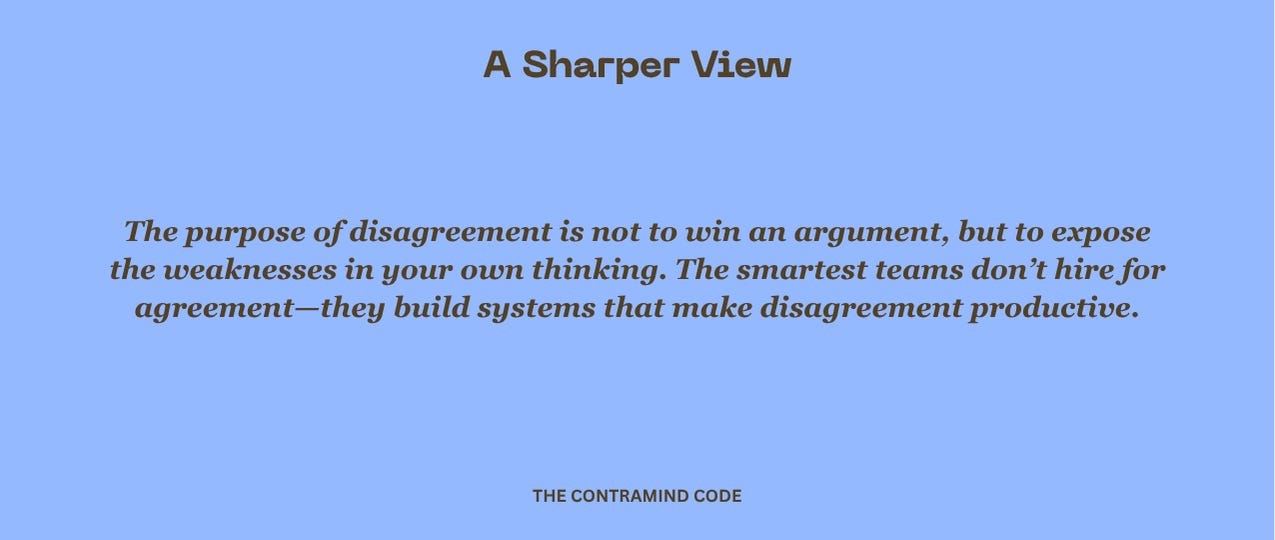
Well-known psychologist and a Nobel Prize winner in Economic Sciences, Daniel Kahneman coined the term ‘adversarial collaboration’. He used this term more in the context of research - to improve research, from problem definition and research design through to outcomes. It is a technique to remove bias at the point of designing the experiment, which is where, in his view, motivated reasoning most heavily distorts science (and organisational decisions).
One of the most profound insights Kahneman found from his own collaborations was that bias starts right at the problem design or definition stage. He mentions that researchers unconsciously select experiments likely to confirm their existing view. ‘Adversarial Collaboration’ forces the adversary, in this case another person who is a collaborator in the research, to propose experiments that challenge them, which exposes the weakest parts of their own theory. In a 2025 study, projects with adversarial collaborators led to a deeper understanding of the problem.
Another interesting but often-quoted example is Dr Alice Stewart, a well-known British Physician and epidemiologist, and her statistician colleague George Kneale. They formed one of the most well-known but highly effective scientific partnerships of the 20th century. The duo is celebrated for using "constructive conflict" to reveal severe dangers of low-level radiation. George Kneale once said, “My job is to prove Dr. Stewart wrong.” They collaborated for decades. But opposition was the method of their working!
When you apply the concept of ‘adversarial collaboration’ in the context of organisation or company and people dynamics, you have to come to terms with the fact that you cannot change the minds or belief systems of people by winning arguments. Most often, in companies, you will see people are hired for agreement:
“Can the person fit our culture?”
“Can this person take the team along?”
“Does this person demonstrate capabilities of being a people’s leader?”
While this is the final outcome you want - somebody who largely fits the culture, can work with people well, etc.- the ‘how’ behind these questions is not always thought through deeply enough. Therefore, senior leaders or managers tend to surround themselves with, or hire, people who conform to their existing views.
If you were to contextualise this using Kahneman's analogy of the research team of adversarial collaborators, you would end up hiring for the strategy or results you already believe in.
Therefore, if you are a founder, a CXO, leading a function or department, or even heading a small team, the adversarial collaborator on your team could end up being the most valuable person in the room. The person may not be the most agreeable for many people in the room. They may or may not even be the most credentialed in terms of designations or hierarchy. Building such an organisational structure within your teams and providing space for such an empowered relationship is a strategic act, not a cultural nice-to-have.
So, how can you build a culture of ‘adversarial collaboration’?
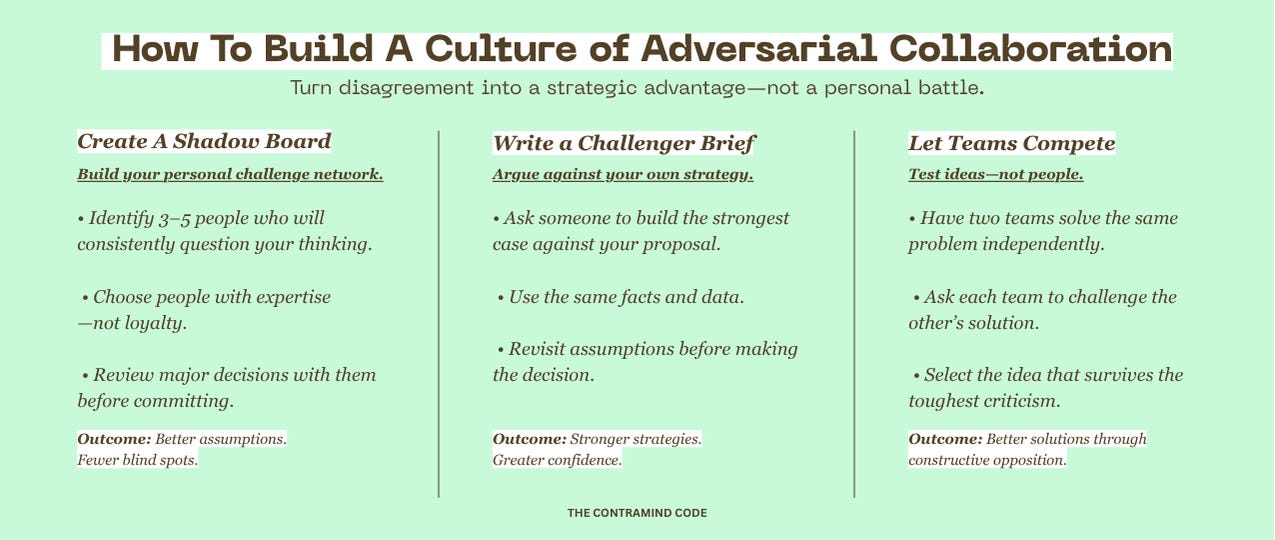
Create shadow board members or an invisible hierarchy: If you are a senior leader or CXO, identify three to five people who will consistently disagree with you, also they must have no stake in your success, and possess the expertise to be credibly wrong. However, if you are a middle or entry-level executive, create this invisible hierarchy of advisors or your personal advisory board who will challenge your work. You can meet them quarterly. You can brief on strategic decisions before they are made, or on the work you are currently thinking about or doing. You can act on objections with the strongest evidence base these people throw at you.
Embrace challenger briefs: Before committing to any strategy or project, work with your team to create a two-page challenger brief that argues the strongest possible case against the decision or approach — using the same data or information you used to make it. Create a safe space for people to question or debate the decision or approach through conversations, meetings or discussions. You can then score it. If there is a weak opposition, you can proceed with your decision or approach with confidence. If there is a strong opposition, you can revisit your assumptions.
Evolve solutions to problems through competing teams: It’s normal for people within teams to draw their own boundaries of what to work on or not. This also develops an entitlement mindset among team members. Also, other team members or groups are not allowed to take a shot at a problem they feel they are better at or for which they may have a different approach. You can break this method of working by creating competing teams working on a problem. One team’s job is to defeat the other team's strategy — not refine it, not improve it, but break it. This forces a fair test of the ‘adversarial collaboration’ design framework in an operational form on the ground.
By implementing some of these ideas, you have a chance to become the professional who actively engages credible opponents and avoids seeking consensus. It can also narrow the gap between your belief and reality — while everybody else waits for the market to show it for them.
A consensus-driven approach creates a bunch of look-alike thinkers and doers. Therefore, the question to ask yourself is “Do I have the nerve and inner strength to handle disagreements that question my view or hypothesis?” The ability to handle the answers and leverage such intellectual conflict is vital.
Some of the lessons we learnt from this week’s mission:
Self-awareness is the hardest leadership skill.
As you age, it may be vital to remember that synergy takes precedence over energy.
You understand problems more deeply when you can handle constructive conflict.