
In the future, what will it take for your knowledge to remain a competitive advantage? That’s an important question to ponder.
Sridhar Vembu, co-founder and chief scientist of Zoho, recently posted two stories on X which caught my attention. In the first, he wrote that he had prompted AI to optimise a difficult piece of code while he was on the road. It took about an hour for it to complete. He then wrote that the job “would have easily taken a very smart programmer at least a month”, and that AI planned the work, wrote the code, and tested it against test cases which it constructed itself. He went on to say that “The whole thing cost about $4 in tokens.”
In his second story, he wrote that a colleague with no engineering background showed him a detailed mechanical CAD design for a motor housing, made with his personal AI account and a newly released, low-cost CAD program. Sridhar Vembu described him as someone who “has a curious and active mind.”
Therefore, as you can see, some aspects of knowledge are losing their value and premium very fast. Some of it is becoming worth more than ever. So what does it take for you to turn your knowledge into a lasting advantage?
Let’s first try to unpeel what knowledge really is.
There are two kinds of knowledge, and they are priced and valued very differently.
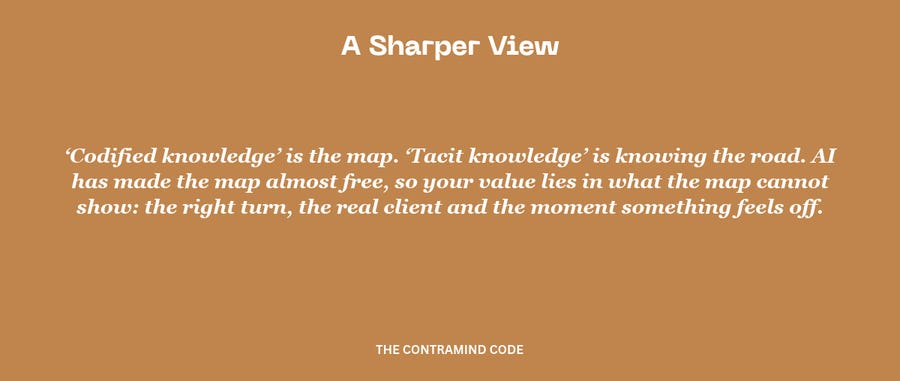
The first type of knowledge is ‘Codified Knowledge’. Knowledge that can be written down - rules, procedures, formulas, standard answers, the steps in a manual. This is something that can be taught in a classroom, searched for and copied. You can see this in action with Uber drivers in your city. They have the map and know exactly where to go. This is ‘Codified Knowledge’ in the form of a map.
Then there is another type of knowledge called ‘Tacit Knowledge’. It includes things that cannot be written down completely. It comes through practice, feedback and being near people who already have it. It’s knowledge that gives you a sense that something is off before you can say why, helps you know which question to ask, and shows you how this client and the team really behave. Going back to the example of Uber drivers, you will find many of them struggling, despite the map, to find routes and not knowing which turn to take if they are coming to that area for the first time! That's the 'tacit knowledge' that some of them are missing, though they have maps as 'codified knowledge' available at their fingertips. In March '26, I called this second kind 'craft capital'. Here I want to go a bit further into why it is now valued so differently, and how you must keep building it.
We are now at a turning point where AI has made writing things down and using them extraordinarily cheap. Sridhar Vembu’s $4 is what ‘codified knowledge’ costs now.
More and more, cheap and routine ‘Codified knowledge’ is becoming a pure commodity.
Is AI also absorbing your ‘Tacit Knowledge’?
This is the next question to ask yourself.
The short answer is yes, more than you might like or imagine.
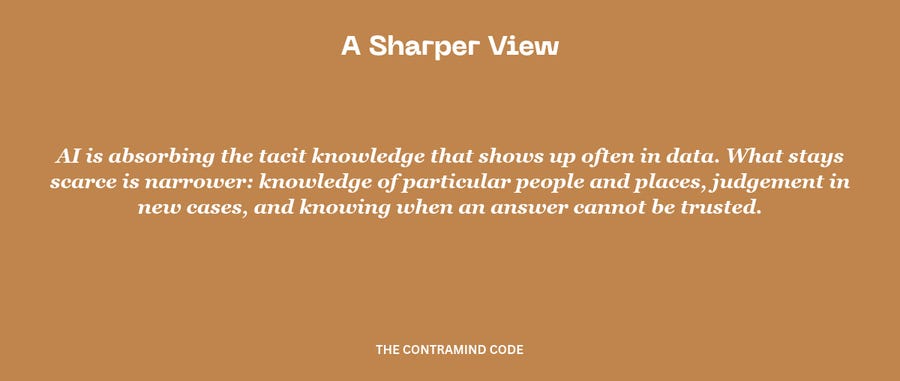
Any 'Tacit Knowledge' that shows up often enough in data is moving to the 'codified' side in AI.
What remains scarce is getting narrower by the day, and this would include:
Knowledge of particular people, institutions and situations that never appear in anyone's training data.
Judgement in new or high-stakes cases, where the pattern has not been seen before.
Knowledge that changes faster than it can be captured.
The ability to tell when an AI's answer cannot be trusted.
Now let’s go to Sridhar Vembu’s code again. AI did the ‘codified’ work - planning, coding, testing and executing. Then, Sridhar Vembu supplied the ‘tacit’ part. He knew which code was worth optimising, gave AI inputs on what 'optimised' should mean, and confirmed whether the code and the tests could be trusted. I've written before about developing expertise and how fluency without grounding is a trap. That trap is now open to anyone with a curious mind and an AI subscription!
Therefore, the more ‘tacit knowledge’ you build, the more valuable you will be. This is something you will need to build continuously, better than or ahead of AI systems you interact with. ‘Codified knowledge’ is like the grid on a map. Experience fills in the terrain. With the grid, every journey adds detail in the right place. Without it, you have a pile of memorable trips but no map. 'Tacit knowledge' grows in you only when you put your ‘codified knowledge’ into practice. Without practice, ‘codified knowledge’ stays 'inert'.
Osmotic Learning as a ‘Tacit Knowledge’ Catalyst.
Zoho has built a school around this idea. Zoho Schools of Learning began in 2004–05 with six students. It takes students aged 17 to 20 who do not hold a degree, charges no fees and pays them a stipend. After a year of classes, they spend a year working inside Zoho’s teams. It now receives about 20,000 applications a year, and Zoho says its graduates make up over 10% of its workforce. When I spoke to Rajendran Dandapani, Zoho’s Director of Technology and President of Zoho Schools of Learning, on the ContraMinds Podcast in 2024, he called it “ osmotic learning. It is learning because you are near it.” This is different from the structured supervision I wrote about in September '26. Supervision corrects you. Osmosis works even when nobody is teaching, as long as you stay close to the work.
From the first batch, Zoho put students “in the same room as two senior software engineers”. Of the college graduates Zoho recruits, he said they “have done computer science, but they don’t know software engineering”, which is the difference between cooking noodles for your dinner and cooking a feast for 2,000 people. You need to find ways to apply ‘osmotic learning’ at work every day, and in any project or initiative you take on. Through ‘osmotic learning’, knowledge can keep compounding over time.
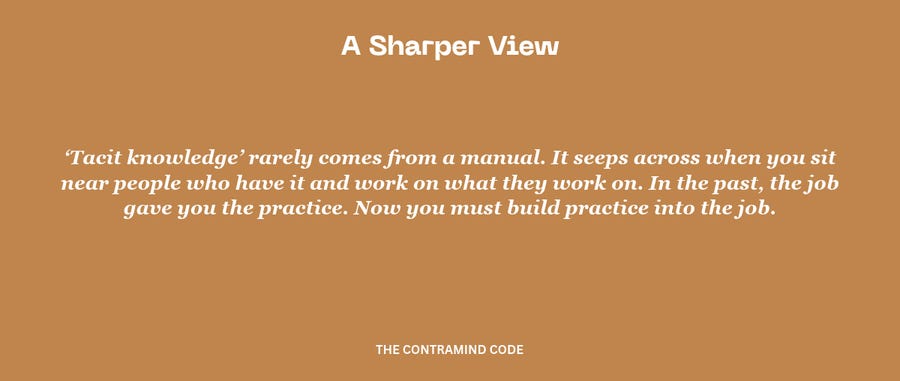
So, how can you keep turning your knowledge into a competitive advantage?
Having the right balance of ‘codified knowledge’ and ‘tacit knowledge’ is important.
Professional work is undergoing a rapid transition. AI is only accelerating it.
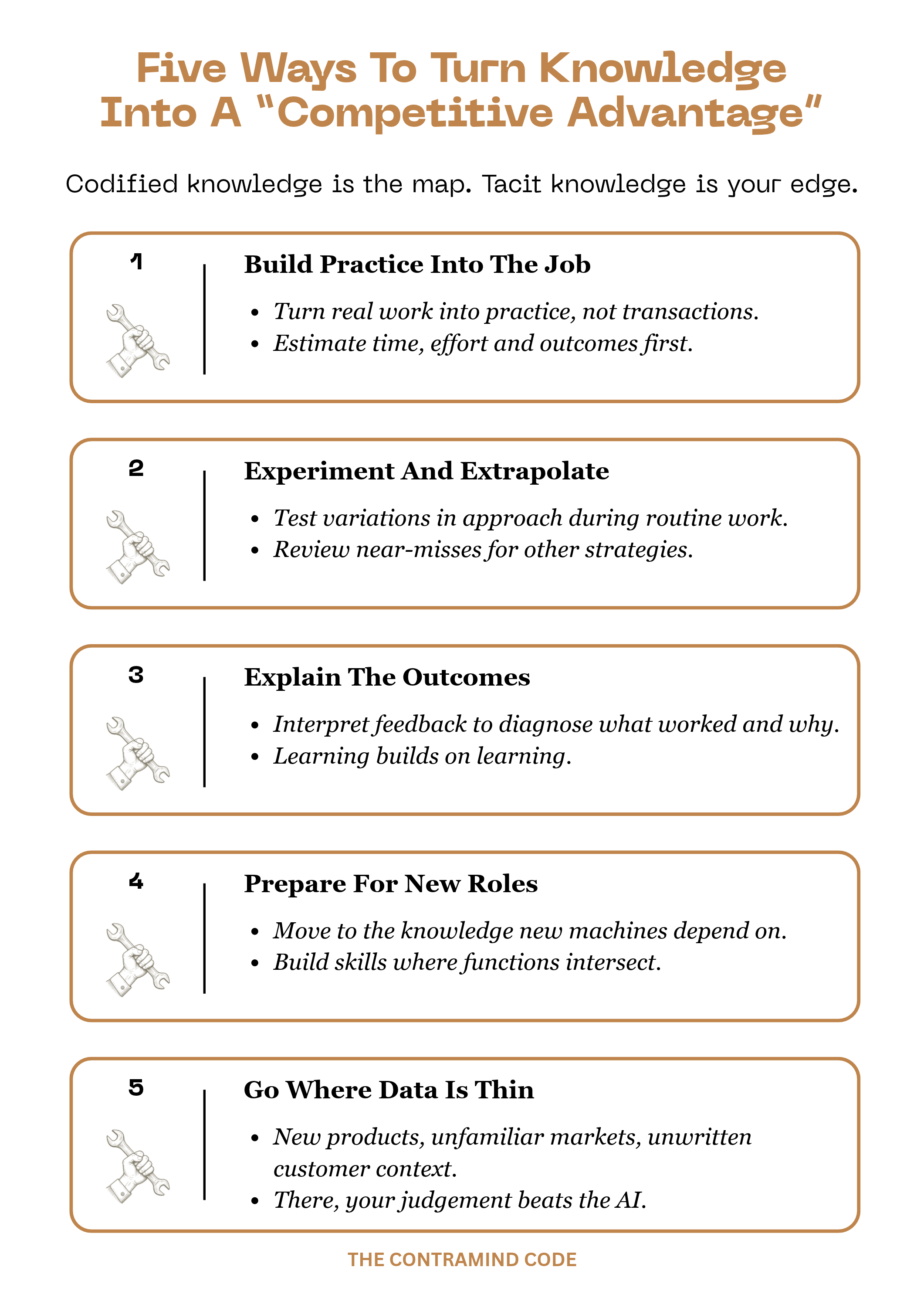
Build practice into the job: In the past, the job gave you the practice. Now you have to build practice into the job. In September '26, I wrote about deliberate practice - the supervised effort that builds expertise early in a career. Most working professionals don't have spare hours for that. Peter Fadde, a professor at Southern Illinois University, and the cognitive psychologist Gary Klein offer another route: turning the work itself into practice. To add to your knowledge repository, you must not just complete tasks transactionally. You must turn your real work into practice. They suggest four ways to do it:
Estimate time, effort, resources and outcomes before acting.
Experiment and test variations in approach or strategy during routine work.
Extrapolate by reviewing incidents or near-misses to imagine alternative strategies and lessons.
Explain the outcomes by interpreting the feedback that can help diagnose performance and guide future choices.
Remember, learning builds on learning, which is why the gap between people widens over time.
Prepare for new jobs or roles that didn’t exist before: According to the World Economic Forum, about 40% of future industrial skills are new or emerging.
Many who successfully managed the industrialisation-era transition were the ones who moved to the ‘knowledge’ the machine depended on and kept their judgement of quality as the standard the machine was held to. For example, in England, the millwrights who specialised in constructing and repairing watermills were among those who moved into engineering. Economic historians Joel Mokyr, Assaf Sarid and Karine van der Beek found that 18th-century English districts with more millwrights had larger textile and iron industries. Their mechanical know-how carried over into the new industries. Similarly, Ole Kirk Kristiansen was a carpenter who had a woodworking shop and then went on to found LEGO. He used the new tools to make something new rather than the old thing faster. Therefore, keep an eye out for new interdisciplinary roles that may emerge and the knowledge required to do them. Developing knowledge and capabilities at the intersection of functions could be a huge opportunity, like a conversation designer, supply chain intelligence analyst, autonomous logistics specialist, quality automation technician, etc. A GM programmer, who was laid off in May '26, told CNBC and captured this idea well: “AI isn't going to do you any good if you don't know the business.” Move from knowing your function to knowing the business. It's the same shift I described as 'whole-loop work' a few weeks ago. That will help you build context and ‘tacit knowledge’. You can make your knowledge a competitive advantage when you apply your 'tacit knowledge' on top of your 'codified knowledge' in new areas.
Go to places where data is thin: AI is expected to learn ‘tacit knowledge’ that often shows up in data. Go to new kinds of products, unfamiliar markets, customers whose context nobody has written down. That's where AI can't yet tell what good looks like, whereas your intuition and judgement can.
So, how do you turn your knowledge into a competitive advantage? Don't compete on 'codified knowledge' alone. AI now gives it to everyone for a few dollars. Use it as your map, and build the 'tacit knowledge' that fills in the terrain. Build practice into your work, stay near people who know more than you, and go where the data is thin. ‘Codified knowledge’ will get you into the game. ‘Tacit knowledge’ is what will keep you ahead.