

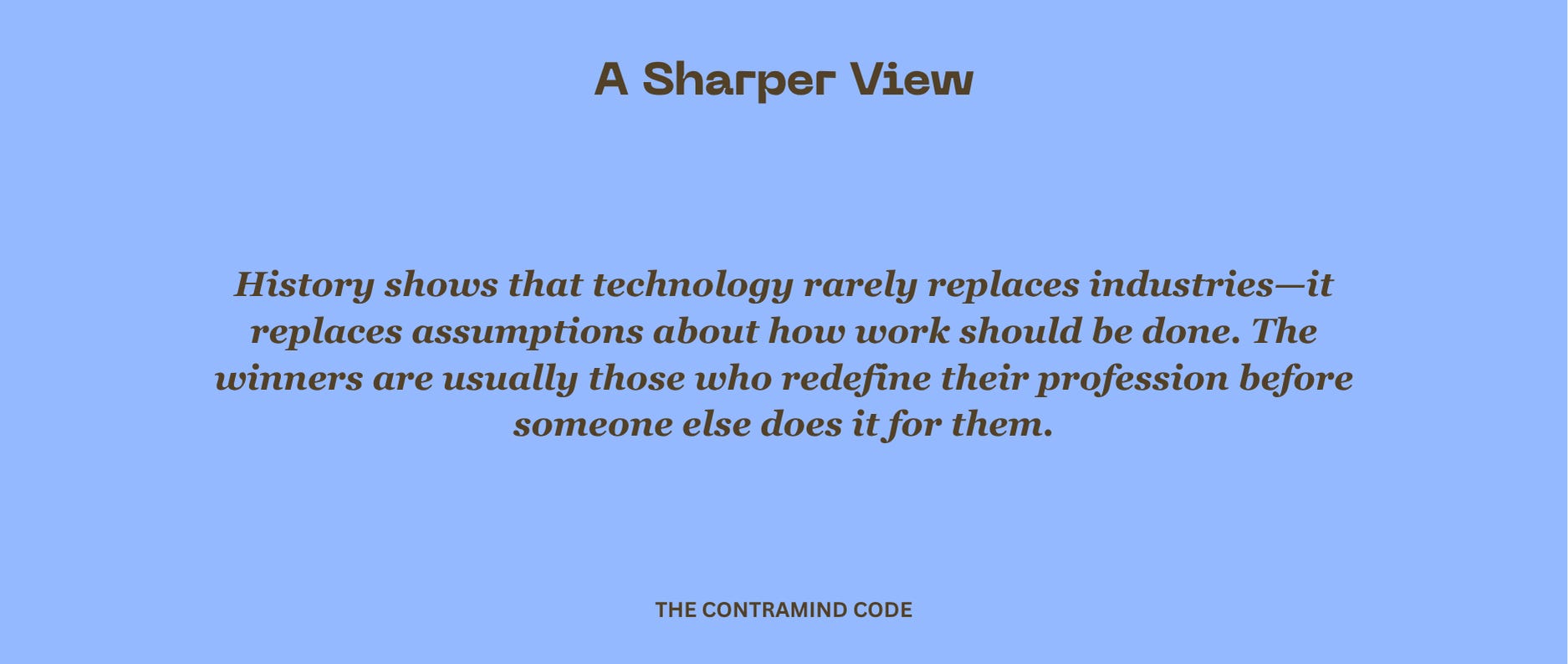
We are all living in interesting times. What we have seen around us over the last three or four years is something many of us may not have seen or experienced in the last few decades. If you were somebody who worked in the last few years of the 20th century, beginning in 1996 and working through the first decade of the 21st century, you would have seen many new industries emerge, existing industries get reshaped, and a whole host of new jobs and professionals emerge. We often forget history and how some of the things we take for granted at work today did not exist a quarter of a century ago.
The retail industry got reshaped with the advent of the internet. While the internet was a general-purpose technology, the innovations built on top of this stack reshaped how business was done. The evolution of e-commerce, search, social media, ride-hailing, and online travel industries emerged from the internet era.
Many existing industries like banking, automotive, airlines, travel, retail, healthcare, medical devices, logistics and communications, to name a few, transformed themselves by embedding this technology in their workflows - be it how payments were made, how new automotive technologies were added to vehicles, how travel bookings were done, how medical diagnostics were done and shared, etc.
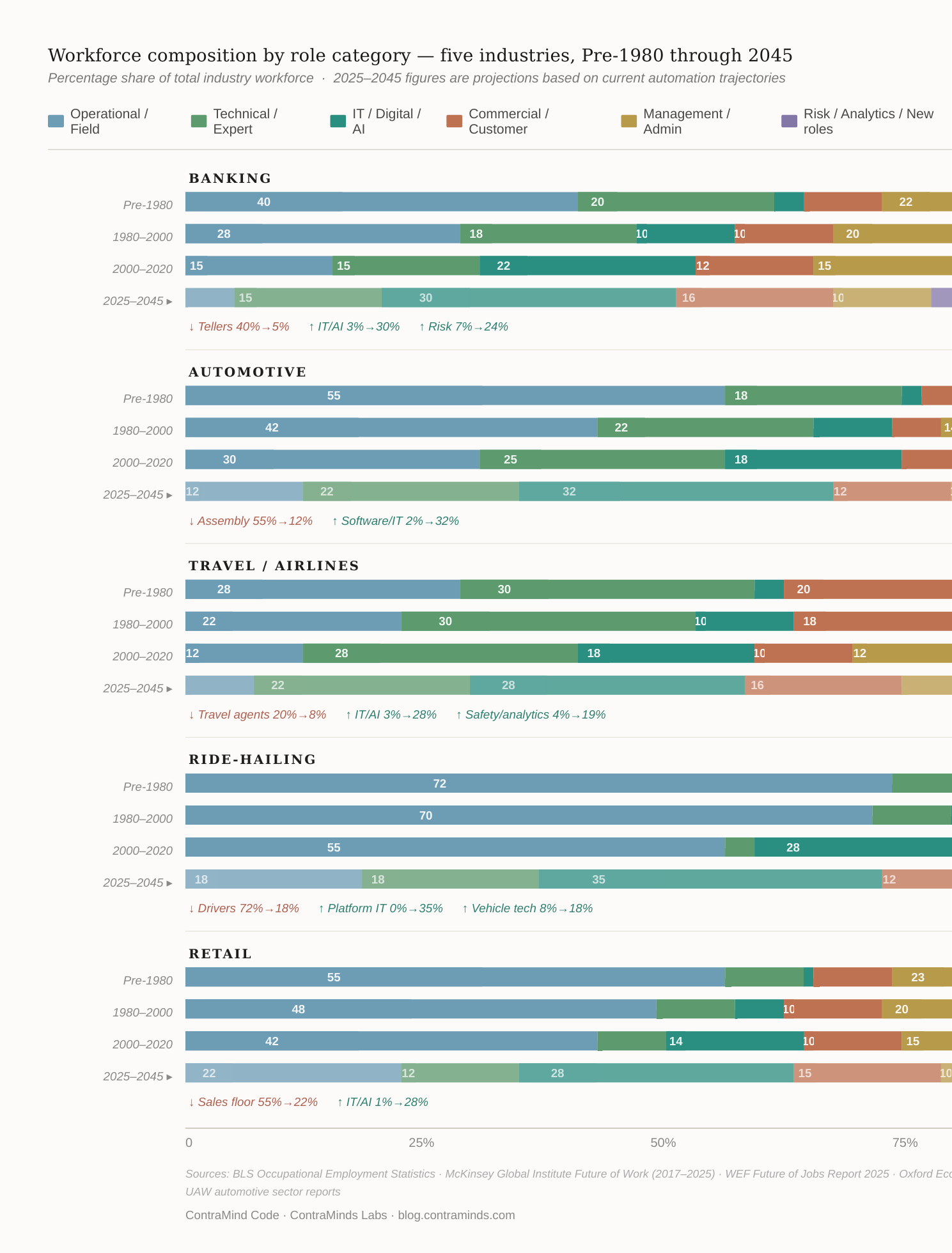
This led to a whole set of new roles and enhanced professional skills that were not available or there a quarter of a century ago. The professionals who were in the midst of this disruptive era, who either started their careers in the early to late 1980s or in the early 1990s, had to adapt to this new normal. Let’s look at industries and how the composition and mix of professionals in the workforce have changed over the years.
So, what do all these changes mean to you?
Welcome to an era where prediction is cheap
A similar disruption is happening with AI. AI is a general-purpose technology and is starting to affect many industries and is creating the need for new professional skills.
We are now entering an era where prediction is cheap. Cheap prediction does three things in tandem:
It commoditises the prediction-heavy roles that currently command premium salaries or take too much time and suck a lot of resources. It’s time-inefficient and resource-inefficient. This problem is bound to break now.
It elevates the complementary judgement roles that surround these cheap predictions. An MIS or sales analyst who sends a report to management will be less valuable, but when they share their insights or perspective, they become powerful. A salesperson who is a great operator on the ground but cares a damn about smart, productivity-linked gains from prediction-led sales productivity algorithms will become less valuable. This complementary skill is becoming important.
It creates entirely new roles to govern the failure modes introduced by cheap prediction. Imagine you are on a credit risk team at a bank, building models to predict credit scores when income and spending data are available with certainty. If incomes become uncertain or volatile due to more independent freelance roles in society and companies begin changing their hiring policies, you need to learn to work and interpret credit scores in a world of uncertainty where there is a lack of regular income data streams.
Just as the internet era did, cheap, AI-driven prediction is bound to create a whole set of new industries, and existing industries have to transform to adopt it into their ways of working.
Let’s look at some of the implications for you to first understand and appreciate this change, start thinking and know what it takes to prepare for it:
Implication #1:
Companies will transform to have smaller headcounts but not reduced capabilities. It is bound to have fewer people doing more consequential or impactful work. The ratio of seniors to juniors is expected to shift dramatically - some of the junior or administrative or operational roles that were valuable for their volume of routine tasks (an MIS analyst, supervisors, programmers, maintenance engineers, project coordinators, etc. ) will collapse. If you are playing a mid- or senior-level role, your expertise and judgment in rare and complex situations become more valuable and will become more fully utilised. However, if you are merely running operations or coordinating resources and projects, whatever your designation or role may be, your role is bound to get disrupted if you don’t upskill yourself to move up the critical thinking value chain.
Implication #2
When you look at history, new roles tend to aggregate into new institutions or industries. The printing press, a general-purpose technology, created publishing houses, libraries, and eventually mass media organisations - companies or institutions that played a role in how they channelled the curation of abundant text and media produced by the printing press. The calculator and computer created investment banks, hedge funds, and actuarial firms, institutions designed to improve quantitative decisions. Look for new industries that could be created by this change. In the past, during the internet era, those who sensed and prepared and got on the bandwagon ahead of others reaped the benefits. It’s imperative you do it now. You need to greatly improve your ‘sense and respond’ capabilities to identify such hidden or emerging opportunities.
Implication # 3
It is important not to get swayed by sensational conversations and hype. Most of the conversation and chatter in the media, and in most articles, seem to ask one question: “What will AI replace?” This is the wrong question to ask and a wrong way to search for answers. Instead, ask yourself this question: “What does this make scarce?” Take, for example, the internet. The internet made information distribution cheap. Before the internet, reaching an audience needed a printing press, a broadcast licence, or a distribution network. These were expensive bottlenecks. The internet shrunk the cost of distribution to near zero. Anyone could publish, reach, or connect with anyone. Therefore, what became scarce with the rapid proliferation of the internet was attention, trust, presence and depth. The companies and professionals who took advantage of these scarcities became valuable. The industries that emerged from this scarcity were programmatic ad tech and marketing technology ($500B+), influencer marketing ($21B), streaming ($80B), Cybersecurity ($500B), Online education ($ 200B), Professional Coaching ($20B), Mindfulness and Meditation ($4B), etc. This led to new roles such as SEO Specialist, Growth Hacker, Social Media Manager, CISO (Chief Information Security Officer), Data Protection Officer, etc. So, start asking this question: “What will AI make scarce?”
Implication #4
What you knew over the years will become less relevant, what you learn that you don’t know will become very relevant. It will become increasingly vital for you to understand how your existing role will evolve and the whole set of new skills you need to equip yourself with. These are subjects or concepts that may not have been taught to you at school or in your past work experience. Because these did not exist when you graduated or completed school or when you were working. Take, for example, a production engineer on the shop floor. They spend almost 60% of their time on tasks that are, at root, prediction problems:
Did this batch meet specification?
Will this machine need maintenance?
What is causing this defect pattern?
What is the optimal production sequence for this week's orders?
Cheap prediction will soon eliminate all of this work done by humans. They need to enhance their skills in redesigning the process layout, introducing new manufacturing technologies, and resolving recurring exceptions that keep reappearing because the prediction system cannot yet handle them.
It is vital for you to start asking questions specific to your role that current prediction systems don’t have the requisite data to predict and how your tacit knowledge will add value to the predictions that these prediction systems will throw up.
Implication #5
It will be important for you to understand which skills will become increasingly premium as prediction becomes cheaper in the next few years. Here are a few that are likely to become important:
Not just data literacy is enough anymore, but data philosophy will become valuable. Data philosophy is the art of understanding the data from different angles and contexts, not just numerical literacy - the underlying meaning behind the data, questioning some of the metrics as to whether they are needed at all as AI generates most of them at quick speed, spotting a data anomaly, etc.
Thinking quality will become premium. If AI can do most routine tasks, compose written documents, write code with prompting, and predict at scale, the real bottleneck shifts from writing or coding to the thinking that precedes them. Your ability to articulate your thinking will become valuable, as AI agents will do the tasks that you define and put down clearly.
Being an orchestrator will be a valuable skill in any role or function in any company. You must develop the ability to direct multiple AI systems effectively toward a complex goal and have a deep understanding of which AI capability to apply to which sub-problem. Developing contextual sensitivity - reading the specific dimensions of a situation will be vital as AI models are trained on historical data. AI agents will be blind to the current situational context. You must envision yourself like how a conductor is to an orchestra - not playing any instrument, but directing the integrated system toward a unified outcome.
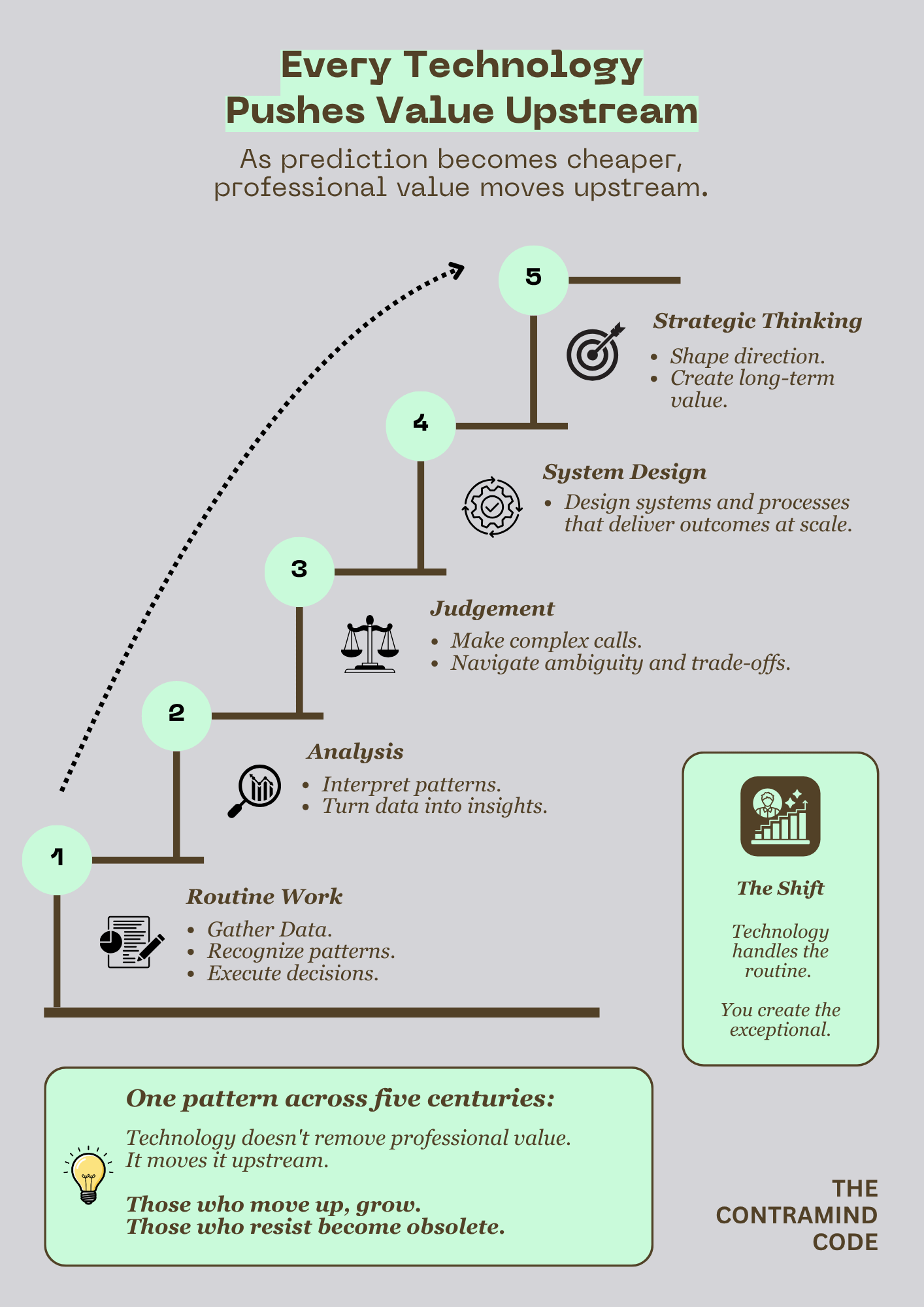
Irrespective of any role you are in today, cheap prediction will collapse three things: routine data gathering, routine pattern recognition, and routine decision execution. One pattern is consistent across five centuries of cognitive technology. Each wave has not reduced professional value. It has only moved professional value upstream, to a higher level or function that the technology could not reach, as yet. Cheap prediction will force you to move your value of work upstream to a higher level. The ones who do will grow, and those who resist will become obsolete.