
When people get a 4.0/4.0 GPA or a relatively high GPA after cracking a tough competitive entrance exam, or after getting a hard-fought admission to a top-tier university or college from among thousands of applicants, the most important assumption they make is that their upward career trajectory is pretty much set for life.
It may be worthwhile to pause and ask yourself: “Like for others, is that enough for me to be successful and will it really help me grow in my job or career?”
Let’s put the tsunami of degrees in context
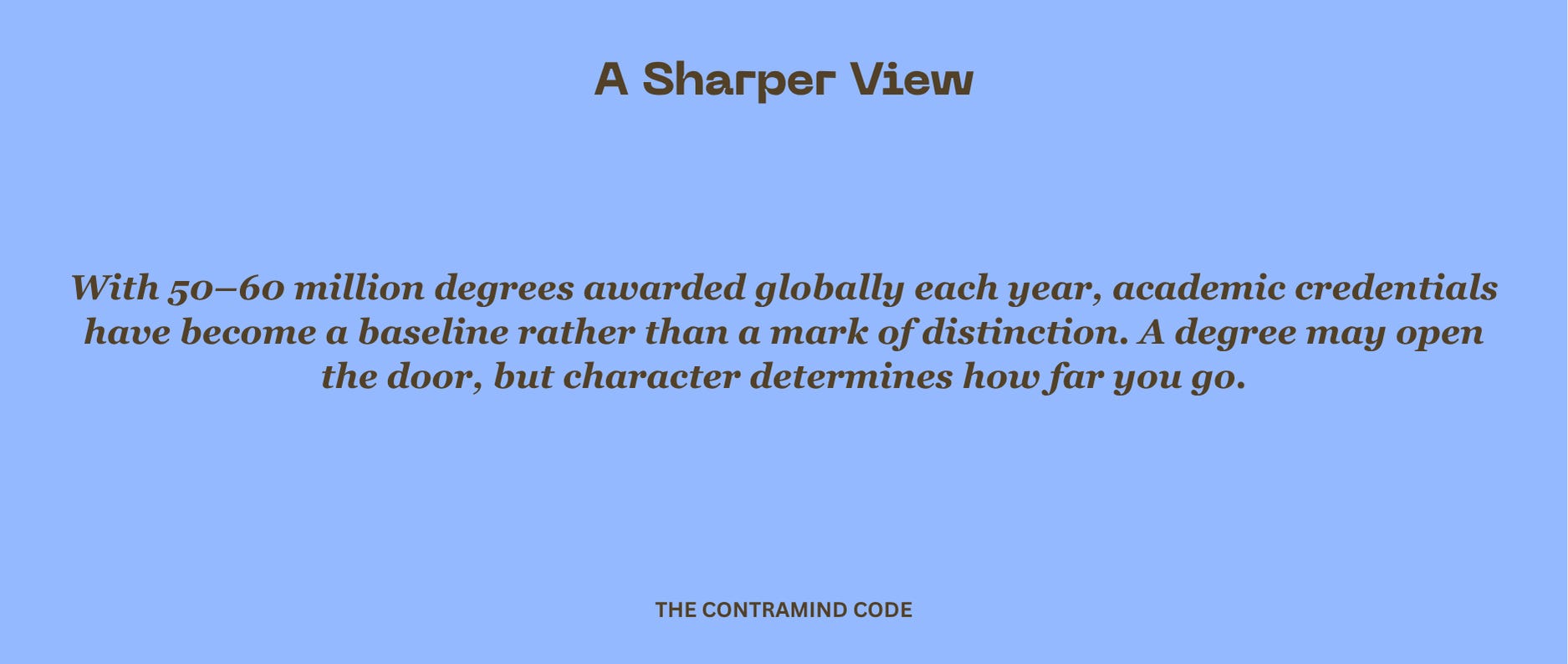
Today, the global annual degree output is approximately 50–60 million!
If you look at this growth over the last 45-year period, it went from approximately 15 million/year to approximately 55 million/year, that’s a growth of roughly 30–35 million/year.
Which countries contribute to this global growth in degrees? And which countries lead the list?
China: Approx. 10–11 million/year (it grew from 1 million in 2000)
India: Approx. 7–8 million/year
US: Approx. 4–5 million/year (all levels)
EU: Approx. 4 million/year
Rest of the world: Approx. 15–20 million/year
You may be surprised to learn that the last 45 years (1980–2026) have produced approximately 80–85% of every degree ever conferred in human history! We live in an era of credential and grade inflation!
Therefore, degrees are no longer scarce assets. There has never been a weaker differentiating signal for degrees than it is right now in human history! Degrees have become baseline qualifications, the minimum for entry, and no longer stand as markers of distinction. It’s a fact that there has been a progressive decline in a degree's role as a differentiating credential, and it carries an increasingly low credential reputation compared to many decades ago.
It’s not that degrees are worthless, but we live in a time when, globally, 50–60 million degrees are issued annually. The genuine differentiator that will sit atop any degree is only character.
So, what’s character?
This is perhaps the most frequently misused word!
Let’s first try to unpack what character is not. Character is not personality. It is not talent. It is not reputation, which is nothing more than what others think of you. It's not just about honesty, trustworthiness, and the like.
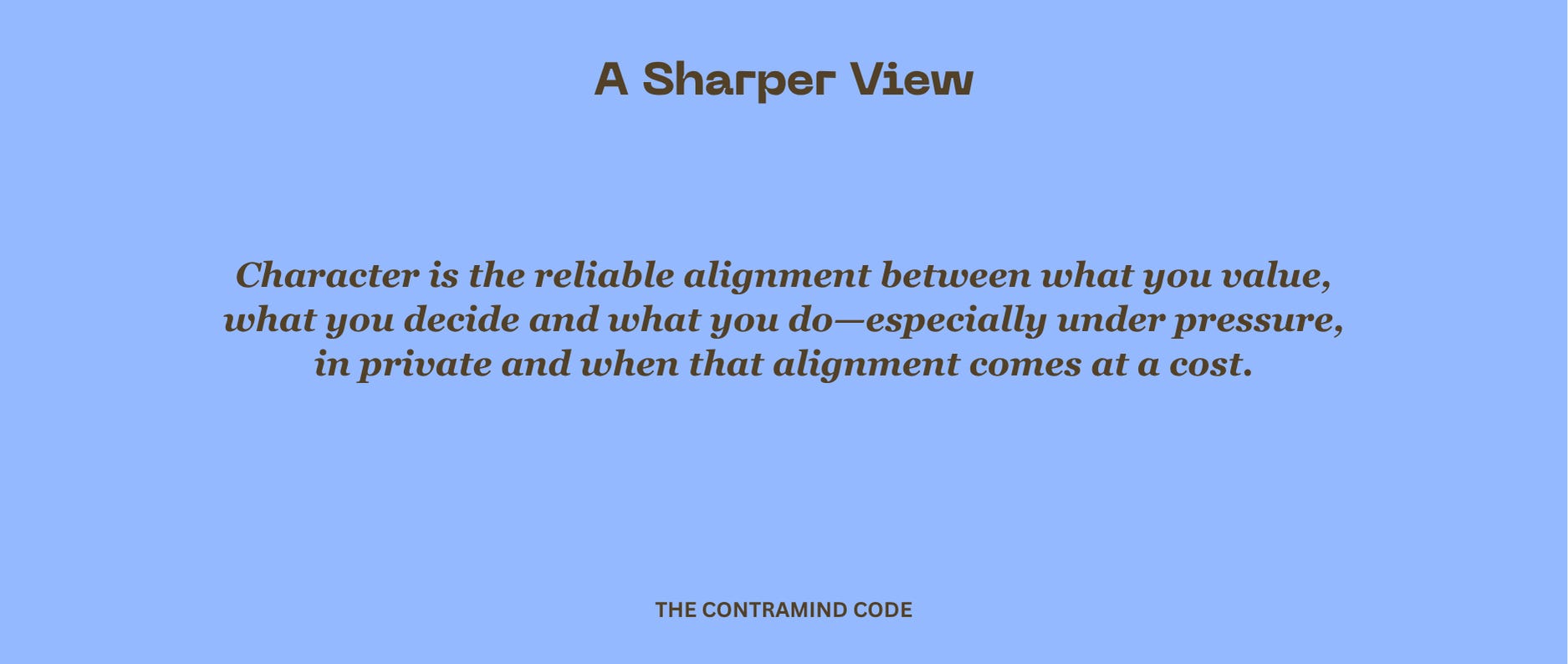
Character is the consistent pattern of how you respond to the world, especially under pressure, in private, and when no one is watching. Character is:
Alignment between your stated values and your demonstrated behaviour
Ability to hold a principled position under pressure
Accurate self-knowledge and willingness to say "I don't know"
Learning orientation irrespective of experience and seniority
Character is the result of habitual action, reinforced until it becomes a disposition or a default habit.
Character, at its core, is the reliable alignment between what you value, what you decide, and what you do — especially when alignment is costly.
How did degree systems replace character?
The modern university degree is no more than 900 years old. The degree system began measuring only information acquisition, technical skill, and one’s ability to perform under exam conditions. However, it did not measure alignment between values and actions under pressure.
It may be very insightful to understand how capable people with expertise were recognised before degrees ever existed!
In fact, research reveals that the degree system slowly displaced character from the centre of professional recognition. By 1900, character education, which had been at the centre of higher education for hundreds of years, had largely disappeared from students' curricula. The universities reorganised themselves around knowledge production rather than character formation.
Credentials can, at best, open doors. However, character determines what you do once you are inside. This is the primary reason you see many people disengaged in the workplace. Or change career paths or occupations when it no longer aligns with what they value and what they want to do.
So, when does character become more important than your degree?
By year five!
A degree gets you an interview when you are 22. But by the time you are 35 or 40, no one asks about it. According to research, a degree shows a low correlation with your performance by the fifth year. Because by that time, your actual track record - your reliability, how you handle failure, whether you make the people around you better gets replaced as the primary signal, as opposed to your degree as a credential.
Just think for a minute:
No one asks for your degree before entrusting you with a company's sensitive strategy!
When you are co-opted into confidential projects or called to lead and diffuse crisis situations, nobody is asking for your degree.
Why?
Because your reputation travels faster than your resume.
Also, your degree does not update itself. However, your character - the discipline to keep learning, taking calculated risks, the ability to take ownership, the honesty to acknowledge what you no longer know, and the courage to adapt keeps getting updated. Because character is the only credential that remains current all through your life and career.
How do you go about building your character?
If research shows that, after a certain number of years at work, character starts to take precedence over your degree, questions that will be on top of your mind are:
“Is character inborn or can it be built?”
“Is it possible to keep improving my character by working on it continuously year after year?”
The answer is a simple yes.
Research shows that character change happens through specific behavioural practices in real conditions with real feedback. The mechanism is termed habituation - ‘the repeated performance of virtuous action until it becomes automatic.’ Don’t confuse this with willpower. Willpower is a finite resource. Through repetition, you transform a character you want to build (which once took a lot of effort for you) into something that will eventually become natural. Remember, any form of growth requires friction, feedback, and sustained engagement with genuine difficulty.
What are the variables that can predict your upward character trajectory?
Learning orientation over performance orientation: Treat challenges as opportunities for development rather than threats to your competence or reputation.
Develop your metacognitive capacity: Metacognitive capacity is the ability to think accurately about your own thinking. Your appraisals and promotions don’t always tell you the truth. It is only a reward for a job you were given. You must develop a genuine sense of being wrong and build systems to recognise it faster. It’s like answering this question - “How do I know when I am wrong about something important?". When you have poor metacognitive capacity, you struggle to find answers to this question, treating it more like a process and outcome, which is not always true.
Improve your relationship with feedback: Again, ‘being open to feedback’ is a frequently used sentence at work. Character gets built beneath this sentence. It’s answering a question like - “Would I be able to tell a time when feedback changed something meaningful in how I work, think, or relate?” It’s the presence of a genuine story and visible evidence of change.
Keep calibrating your self-awareness: There is a very big difference between knowing your weaknesses and having accurate self-awareness. When you describe yourself to others and then compare notes about your description versus what others describe about you, that will show you the gap. This is called the calibration error. It’s about knowing every theory in the world about collaboration versus your ability to actually collaborate in reality. And do the people you work with genuinely believe that you are a collaborator? Knowing and working on that gap is tough but valuable.
Integrate difficulty with your growth: It’s not enough to learn from genuine adversity that you may have faced, but try to intertwine it tightly with your own growth goals by saying, "this experience is part of what made me who I am" without bitterness or false gratitude.
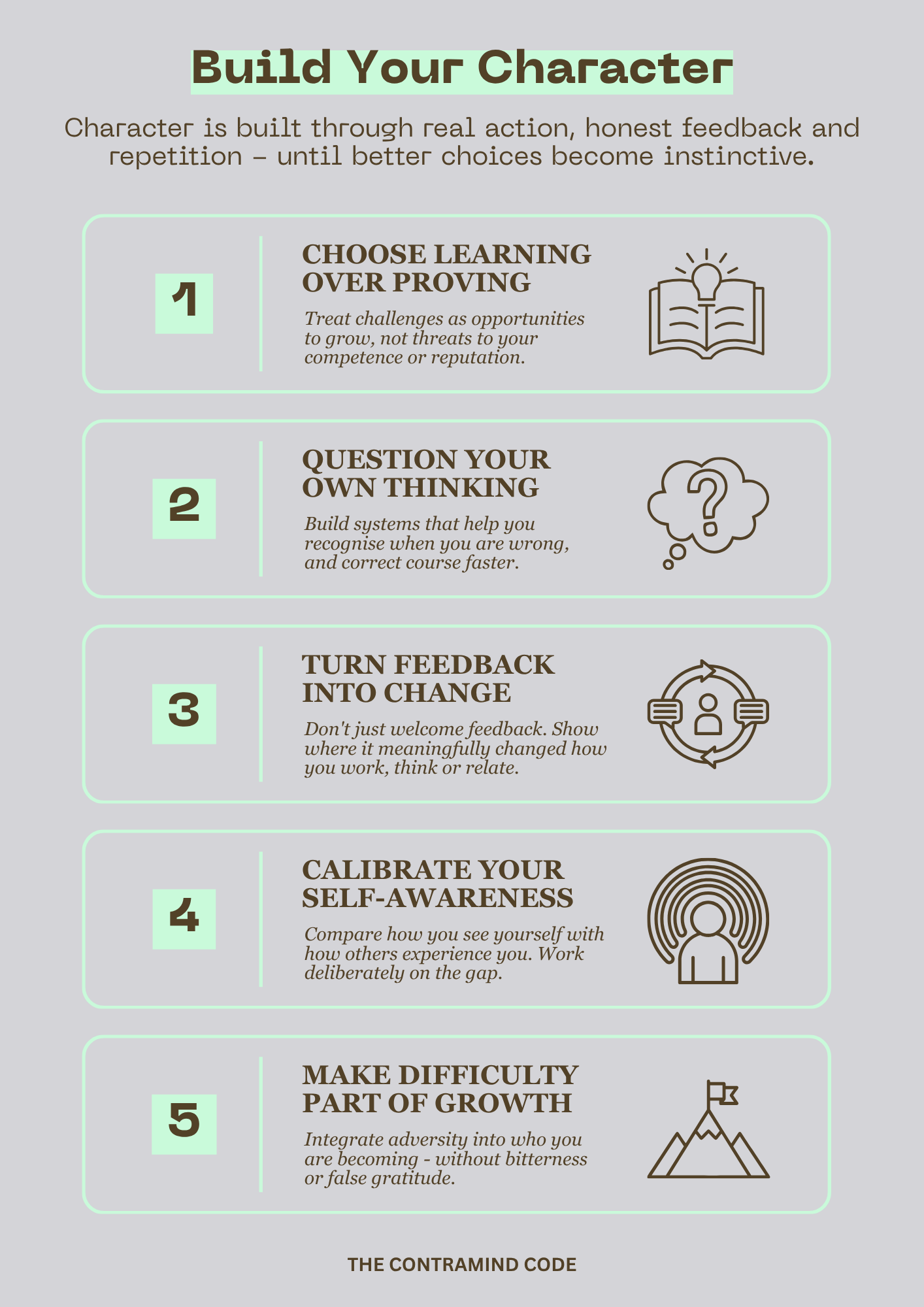
To summarise, character is the accumulated output of thousands of small choices you make consistently over time.
Your degree is a mere entry pass and, in some cases, does not allow you entry, either. However, your character helps you not only get entry but also gain membership in an elite club of achievers.