

A couple of months ago, I wrote about curiosity culture and the importance of being a curious professional. This is becoming increasingly important in the age of AI and the change that is happening all around us today.
One thought that kept coming up was the point that while everybody understands the benefits of being curious, why is it so hard to practice it?
More importantly, do you recognise what it will cost you personally and professionally to practice curiosity?
Not enough is discussed or written about the challenges and implications you would face if you want to stay curious or be a ‘curious professional’.
When you want to be curious or behave like a curious professional in an organisation, here are the challenges:
Curiosity is a weapon that can work in the exact opposite way it was originally intended. When you question a belief, the people involved don't experience intellectual challenge, they experience a personal attack. You will be perceived as aggressive.
Research findings published in an HBR article found that curious employees annoyed managers! Managers saw them as insubordinate or less likeable. If a manager couldn't answer a question, they lost status in public, so they tended to suppress the curious employee who, by nature, kept asking questions.
Curiosity, which is a mechanism for asking inquisitive questions, is something any hierarchical company structure tends to suppress. It creates information asymmetry, which leads to power asymmetry within a company’s hierarchy, as the person closest to a problem knows it best but has the least leverage to ask questions.
Companies often don’t promote the person who asks the best questions, as they're seen as someone with a lot of doubts. They tend to promote the person who shows a ‘sense of certainty’ about what has been assigned to them.
People also face ‘conformity pressure’ and this normally restricts their ability to stay curious.
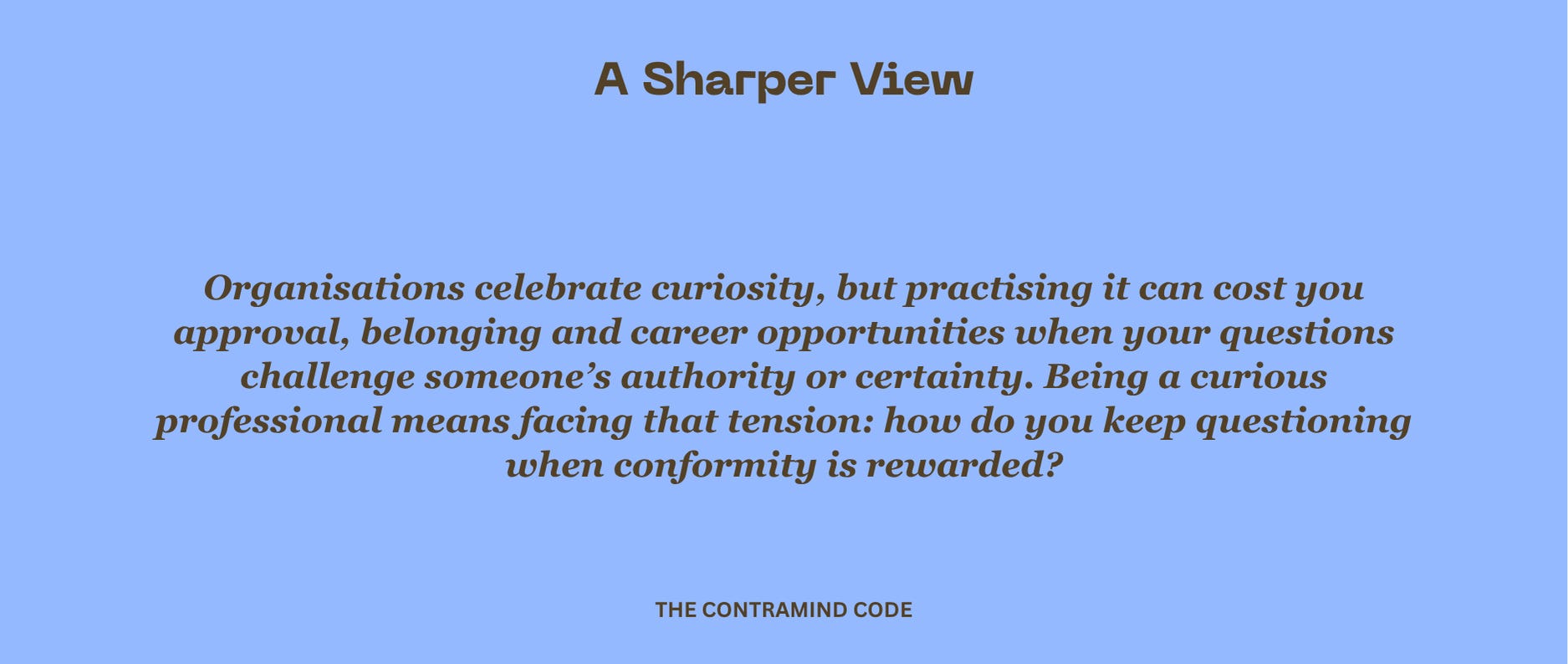
The Curiosity Paradox - A case of misaligned expectations
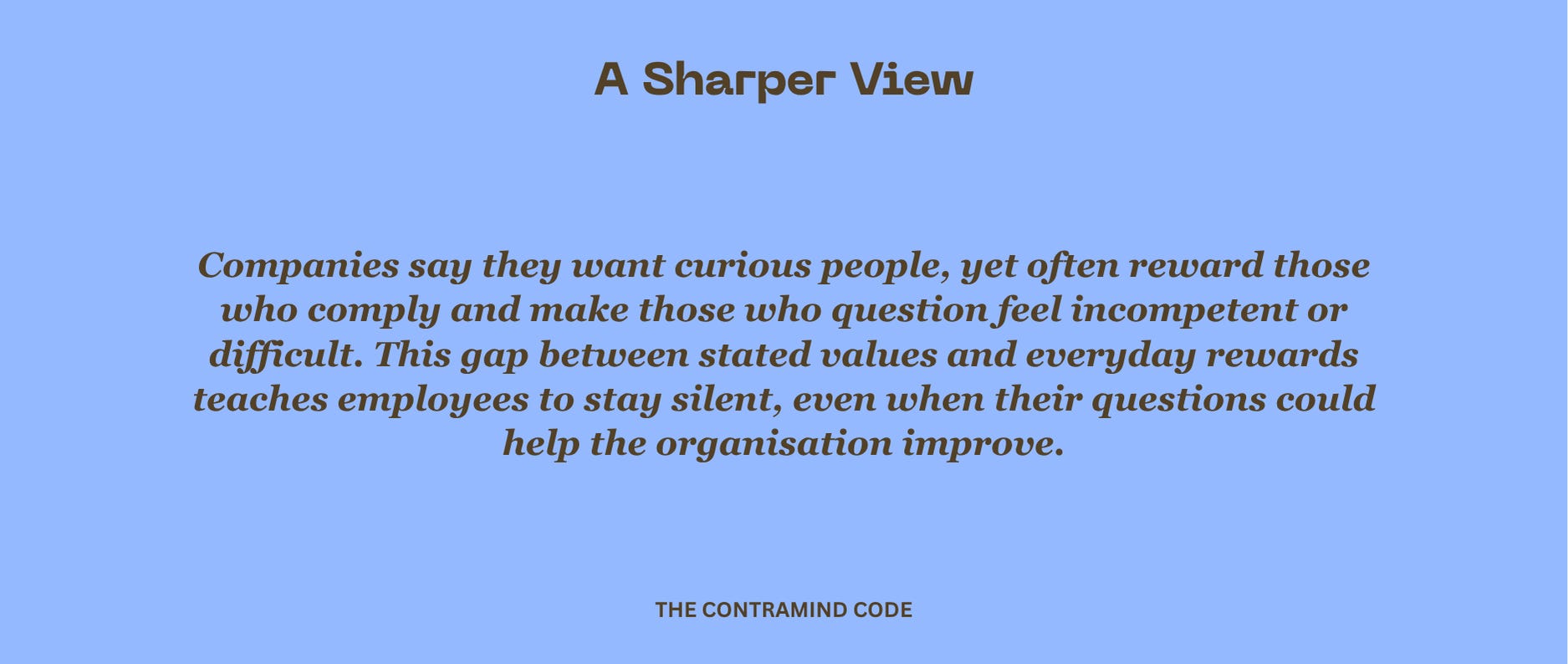
Companies, knowingly or unknowingly, punish curiosity!
Ask any leader if curiosity is important they will vigorously nod in agreement, but they will continue to reward compliance.
Curiosity Paradox #1: Research shows that 95% of workers say they're naturally curious. But only 30% report that their workplace strongly rewards curiosity.
Curiosity Paradox #2: Another study found that 44% of workers say asking too many questions makes them look incompetent.
Curiosity Paradox #3: Nearly half of Gen Z workers (42%) stay silent because they feel they've already asked too many questions.
Here’s what people had to go through for sticking to their curiosity instinct that ran quite contrary to widely held theory or beliefs:
Quality guru Edwards Deming, who believed in total quality management, was once a consultant without believers. American manufacturers rejected his ideas, and he then went to Japan, where Japanese companies adopted his quality-management thinking. He was curious about quality as a system, and he challenged the entire management philosophy of command-and-control manufacturing. Deming was finally brought back to America at the age of 80 to teach Ford what it had refused to learn from him 30 years earlier!
Ray Dalio, an American investor, was fired in 1974 for being publicly right about a market call in a way that embarrassed his superiors. His curiosity about macroeconomic first principles produced conclusions that contradicted institutional consensus.
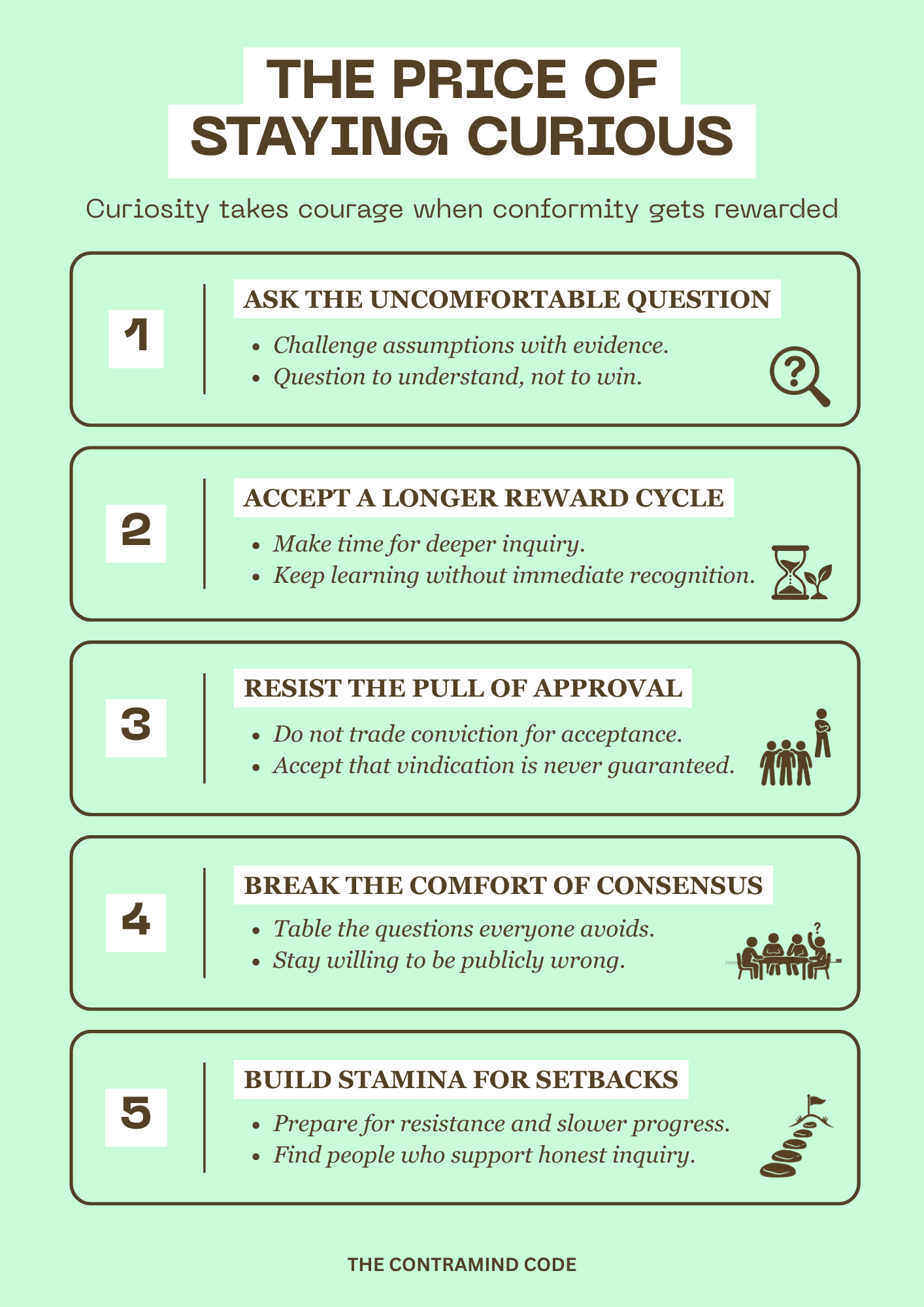
To remain curious, be aware of the downsides of curiosity.
Staying curious certainly requires courage.
It requires ‘intellectual courage’ which includes the willingness to challenge authority based on data and evidence, to be fine with being publicly wrong, to keep sustaining inquisitiveness when the environment around still punishes it, and to have the mental stamina to keep asking open questions longer than any system's patience allows.
Most work environments allow only for ‘pseudo-curiosity’, and this can often mislead you - environments that never challenge anything important, raise questions that make you stay safe, and this gives you a dubious feeling of being curious while producing the same answers as everyone else.
The question is not ‘Is curiosity worth it?’ However, the question is ‘What is the honest price, and are you willing to pay it?’
To stay curious, it pays to appreciate the downsides of curiosity rather than focus on the bright side and its benefits.
Are you ready for a slower rewards timeframe? Curiosity takes time. Deep inquiry is slow. Most organisations reward velocity over depth of thinking and execution, which takes much more time. Because reward systems aren't aligned with this structure, you will be forced to take shortcuts to show quick results and earn rewards. The curious are willing to accept a relatively late reward cycle. Ask yourself, “Am I willing to wait for my rewards far more slowly than others but committed to staying curious, even if there are no immediate rewards?”
Can you resist short-term approval? The ‘conformity pressure’ stress-tests your conviction. Do you sacrifice your ‘deeper gut feeling’ for want of short-term approval in a group when certain plans, topics, or strategies are discussed? You must be willing to be unpopular before being vindicated, and you must also be ready to accept that vindication is not guaranteed.
Are you willing to break the comfort of consensus? Staying curious has a social cost. You are forced to remain in a ‘zone of consensus ’, which is the conformity trap you can get into. Every team or organisation you work for normally runs on an informal agreement that certain questions will not be asked. Ask yourself - “How ready are you to break the unspoken contract?”
Are you ready to overcome setbacks that could pull you down? If you practice curiosity diligently, you may face career setbacks because organisational incentive systems are misaligned, you may risk being excluded from established leadership tracks, or you may be repeatedly passed over in organisations that promote compliance. You need the stomach to handle such setbacks, which may set you back for a couple of years but could eventually help you catch up with others.
To stay curious and experience trust, acceptance, achievement or success, timelines can be brutal. You have to build the muscle to survive in the interim period.