The Old World Is Dying.
This is an article by Jasmine Sun, a Stanford University graduate( graduated a few years back) and an independent writer who writes about AI and Silicon Valley.
In her recent Substack article, she writes that it’s not as scary for the twenty-two-year-olds as it is made out to be! She shares her own experience and perspectives. Some of the thoughts that make this article an interesting read are the ones that can make you think and question commonly held beliefs and views.
Here are some of the questions that she poses, which are quite provocative, and they appeal equally to anybody who is working today:
“Freelancing is as secure as employment”
“Founding a startup is as secure as a big tech job”
“Young people know as much as seasoned professionals”
“Physical labor is valuable; cognitive work is cheap”
“Nothing is sacred; everything is fallible”
She asks three fundamental questions to prepare and succeed in this ever-changing and disruptive world out there:
‘What is your comparative advantage as a human?’
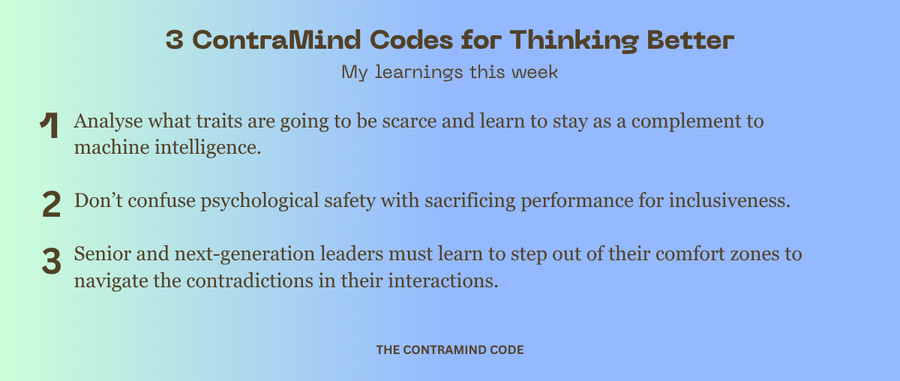
‘What traits will be scarce?’
‘How can you stay a complement to machine intelligence?’
Read the entire article here.
How Boards Have The Best Conversations To Make The Best Decisions.
On the Enter the Boardroom Podcast, Oliver Cummings is in conversation with Prof. Emy C. Edmondson of Harvard Business School about applying the concept of psychological safety to boardrooms.
What was especially valuable in this conversation was the definition of psychological safety, which is often misused in corporate environments. Prof. Emy unpacks the definition very well. And her three questions to assess the quality and depth of boardroom conversations are very intuitive and insightful.
Here is a snapshot of some of the ideas that are discussed in this conversation. Take time to deep dive and listen to this conversation. There are many takeaways to help you apply the concepts as a leader or manager.
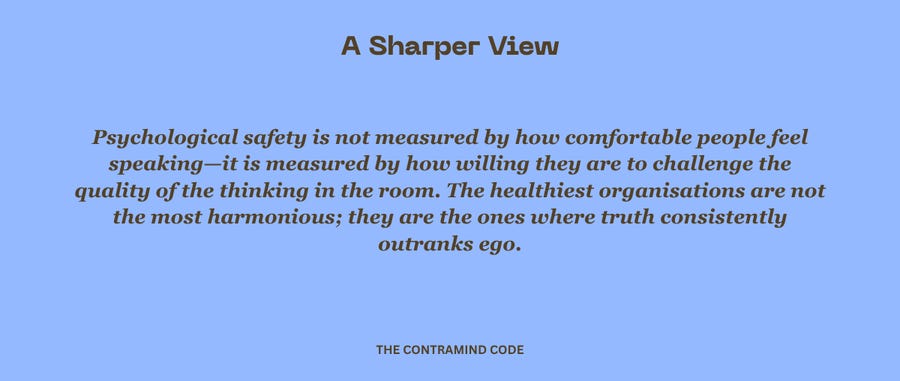
Psychological safety is an environment where people believe it’s safe to speak up honestly with candour. According to Prof. Emy, “It’s a sense of permission for candour.”
She goes on to explain this a lot better and more powerfully: “It is an environment where people are more concerned about the quality of the conversation than about how they look.”
Psychological safety does not mean you are sacrificing “the goal of performance” over “the goal of inclusiveness.”
To effectively measure the scale of where you stand as an organisation, she suggests three questions to score against:
“What’s the quality of our conversations?”
“Are they fully engaged?”
“Do you have a subjective sense that you are getting somewhere? Progressing forward?”
How To Break Bad Management Habits Before They Reach The Next Generation Of Leaders | Elizabeth Lyle.
Elizabeth Lyle is a Managing Director and Partner at BCG, an HBS MBA, and leads BCG's Leadership & Talent Enablement Centre.
In this TED Talk, she talks about how middle managers, or people who are going to be next-generation leaders, need to avoid getting stuck in the old-fashioned or outdated habits of their senior leaders. She reiterates that they cannot wait for things to change till they take the mantle of leadership, as by then some of these bad habits get deeply ingrained in them. And often they settle into ways of working so that they don’t rock the boat, and that leaves them with serious implications in the future.
She proposes a way for middle managers and senior leaders to work together. She makes a very important point that a conscious effort to develop their leadership style or method, which is in tune with the current realities of running an organisation, has to be made in their formative years. The groundwork of how they want to lead needs to be put in place early, and that’s the real challenge for them. It’s imperative that the next generation do this because it may be too late by the time they learn to lead the organisation of tomorrow, and they then could be staring at a situation where they may be without a job.
This can happen only when senior and next-generation leaders step out of their comfort zones and learn to navigate the contradictions in their interactions and approaches to leadership and decision-making. It has to happen in-flight, as they work every day, not in training rooms.
Are You Suffering From Seniority Paradox? Take The Smell Test.
As you become successful and move up the hierarchy, you will begin to realise that fewer and fewer people are willing to tell you uncomfortable truths. It’s akin to you sitting, as you grow in your career, in a soundproof room. What’s more, whatever information trickles to you would be heavily curated by others or people reporting to you to fit into what you may want to hear or believe.
One of the reasons people don’t tell you uncomfortable truths, and why you may sense an eerie silence in your hierarchy chamber, is that it starts with how you behave, process information and operate as a leader. Your past success and the methods you adopted to get there act as major inhibitors. Your behaviour, then, is driven primarily by a need to defend your position because you have already invested too much in proving what you know and protecting your expertise. You want to avoid being seen as someone who doesn't know.
What explains the reasons for such a behaviour pattern of senior leaders?
The Seniority Paradox - The problem of skilled incompetence.
This phenomenon, developed through his famous research by Prof. Chris Argyris, is called ‘skilled incompetence ’- where the more competent a professional becomes at performing within a system, the more competent they simultaneously become at protecting that system—and themselves—from the information that would require it to change. Ironically, the same intellectual capacity that makes a senior leader excellent at executing a known strategy makes them excellent at avoiding the feedback that would tell them the strategy is wrong!
This leads to a predictable behaviour pattern in senior leaders:
They start practising unilateral control. The leader first decides and then seeks inputs to validate, not challenge, what they are doing or planning to do.
Any challenge to the leader’s view is seen as a competitive threat rather than information.
Any bad news is appropriately curated by others before delivery. Very often, views expressed with a certain amount of honesty get labelled as "unhelpful."
Any form of emotion or dissent is treated as irrational.
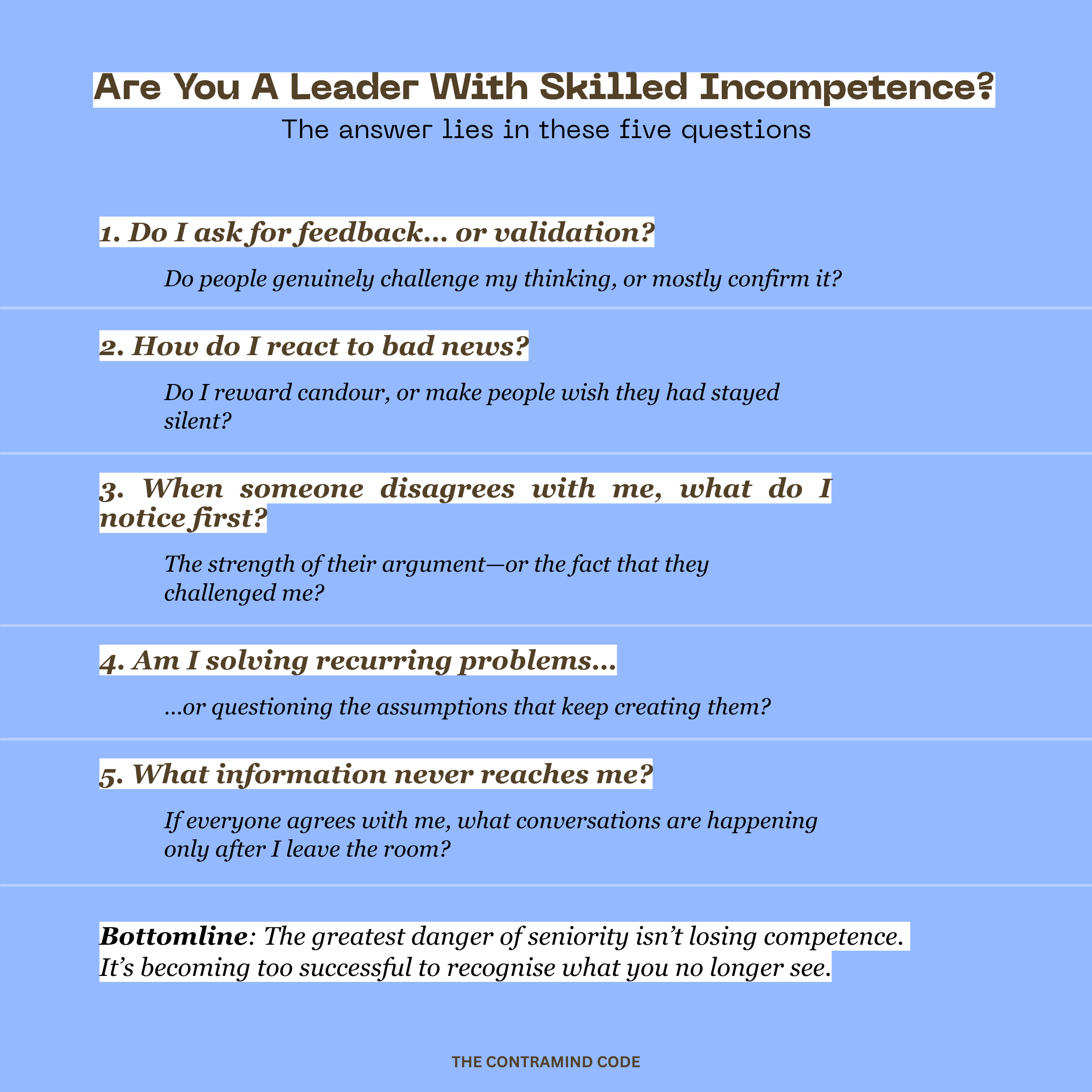
This behavioural pattern creates a default operating system in which every senior professional or leader prioritises control and winning over the truth. This creates an environment, or an ecosystem, in an organisation for filtering information or messages at the top. What also begins to happen is that such senior leaders fall into what’s a ‘single loop trap’, where they begin to fix problems without questioning the assumption that produced them. They then fall into a ‘doom loop’ that leaves them feeling embarrassed and threatened by the prospect of critically examining their own role.
What does this do to young, emerging leaders?
Subordinates learn to pre-filter what they say before they say it. They learn from multiple experiences as to what happens to them when they don’t do it. They learn to edit the information or messages themselves.
They begin to show two modes of behaviour towards their interaction with senior leaders. ‘Defensive Silence’ - They withhold information entirely, and ‘Defensive Voice’ - They say something, but something that’s safe, sanitised, and already known to be acceptable.
They resist taking any intellectual risks. This leads to low engagement, risk aversion, low accountability, low interest in innovation, and self-censoring of new ideas or thoughts.
How do such senior leaders impact the careers of young, emerging leaders?
Career Plateau: When young but highly potential and ambitious leaders work under such senior leaders and hierarchy, they go through years of suppression of their own agency and thoughts on how they would have got things done. This can happen to them across organisations as they move from one to another over their career. Therefore, their plateau isn't caused by their performance but by the absence of opportunities and visibility that a different leader would have created. Such leaders inhibit the display and deployment of their potential in response to problems or opportunities, leading to frustration, burnout, loss of interest, and alienation, resulting in detached interest in work. Their careers plateau far earlier than they should.
Lack of visibility to management: The senior leader, since they exhibit unilateral control behaviour, does not amplify their subordinates’ contribution upward. The subordinate's best work either becomes the leader's demonstration of their own judgment or is suppressed because it would surface a problem the leader doesn't want to surface.
Knowledge hoarding and collaboration breakdown: Young leaders’ behaviour of ‘defensive voice’ and ‘defensive silence’ during their interactions makes them protect the knowledge or information they possess rather than share it. They become fearful that sharing creates exposure and transparency creates a feeling of vulnerability in them. Long after the leader is gone, this becomes career-limiting for young leaders as they unknowingly settle into this de facto behaviour.
Familiar Pattern transfers and compounds: These leaders create a huge downstream impact on such young leaders. Shaped by years of working under senior leaders with the ‘skilled incompetence’ phenomenon, these young leaders get promoted and begin to reproduce the same pattern one level down — often without any conscious intent to do so. They become the next ‘skilled incompetent’ leader, passing the damage to their own team.
If you are a senior leader, what steps do you need to take to break the seniority paradox?
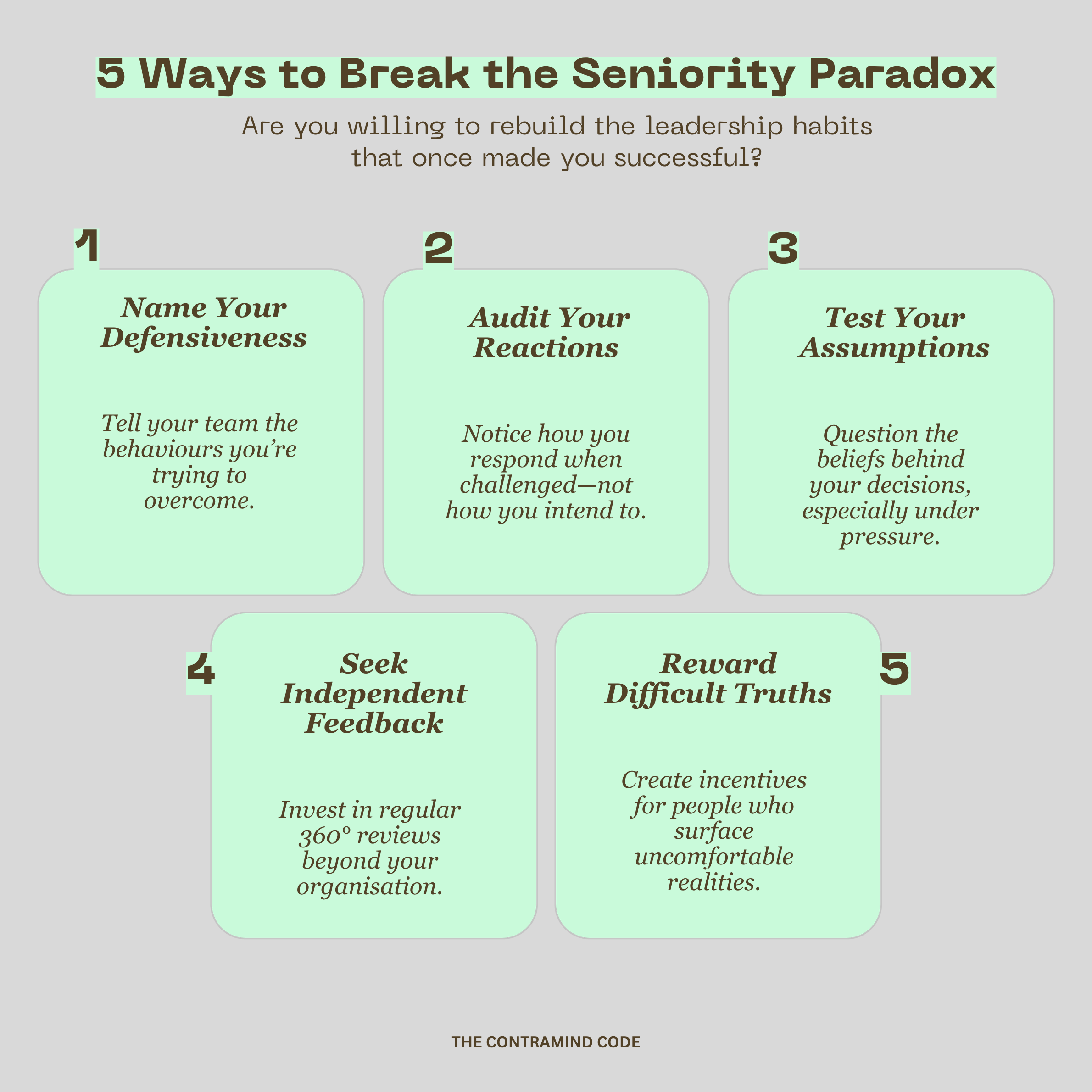
To genuinely change, the important prerequisite is that, as a senior leader, you must develop the ability to hear what you may not want to know. Here are some steps that you can take to work on this problem:
Name your defensive behaviour, in public, to your team.
Audit your reaction pattern — not your intention.
Write down your governing beliefs and test whether you stuck to them when you were under pressure.
Periodically invest in your own 360-degree review( not done by the company you work for), and do it with people you have worked with or reported to across your current and past organisations.
Ask yourself one question in an organisational context: “What are the topics in this organisation that everyone knows about and no one discusses?” and find an appropriate reward system for those who bring such topics consistently.
To break your seniority paradox, it starts with one personal but critical question: “Are you structurally ready for demolition and rebuilding?”